
Introduction: The Moment Performance Marketing Quietly Changed
For a long time, performance marketing felt like something you could almost “predict,” especially for any Digital Marketing Agency in Ahmedabad trying to scale campaigns with consistency. You would run ads, track users through cookies, analyse behaviour across platforms, and gradually improve performance over time. It wasn’t perfect, but it was stable enough to build serious growth strategies around it. If something worked, you could double down on it. If something didn’t, you could tweak targeting, adjust budgets, and usually see results improve.
That version of marketing doesn’t really exist anymore in the same way.
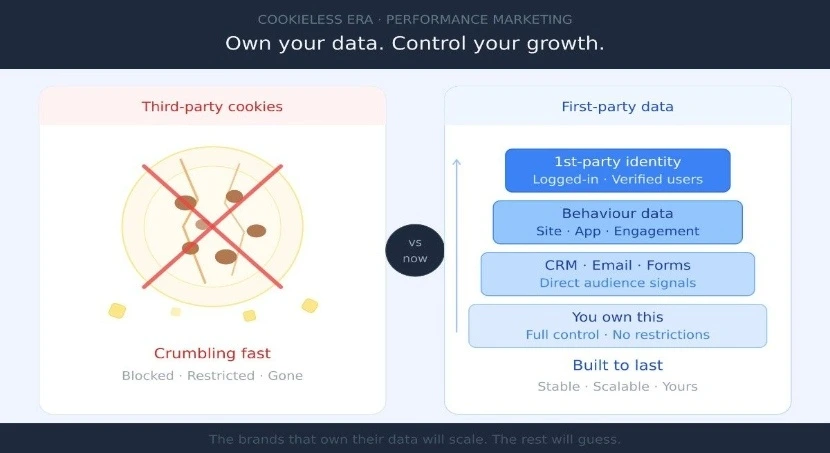
The shift didn’t happen suddenly. There was no single announcement or dramatic change. Instead, it happened quietly over several years. Browser updates started limiting tracking. Privacy laws became stricter. Platforms like Google, Meta, and Apple slowly reduced how much user-level data was accessible.
More about these changes in digital privacy and tracking limitations can be understood in Privacy Sandbox by Google
Individually, each change felt small. But together, they completely changed how digital marketing works.
Today, the impact is visible in almost every campaign that depends on tracking and attribution. Data feels incomplete. Reports don’t always match reality. And performance optimisation often feels like guesswork rather than precision.
For any agency working in a competitive market like Ahmedabad or anywhere else, the environment has fundamentally shifted. The strategies that worked five years ago don’t produce the same consistency anymore. Heavy reliance on third-party tracking, once considered normal, now creates more uncertainty than clarity. For a Best Social Media Marketing Company in Ahmedabad this change has been especially visible in day-to-day campaign performance and reporting accuracy.
And here’s the part most businesses still haven’t fully accepted:
The problem is not just performance. It’s the foundation they are building on.
Most brands are still trying to optimise campaigns using fragmented, partially blocked, or estimated data. When results drop, they react quickly but usually at the surface level. Budgets are changed, ads are rewritten, audiences are tweaked.
But the root issue remains untouched.
They don’t own their data.
And that single factor is now one of the biggest differentiators between brands that scale smoothly and those that constantly struggle with inconsistency.
This is exactly where first-party data stops being a “marketing term” and becomes a structural requirement for growth.
Your identity deserves attention.
Your Branding and Designing solutions should make it stand out.
Explore Our ServicesUnderstanding First-Party Data Without Making It Complicated:
The term first-party data often sounds more technical than it actually is. In reality, the concept is very straightforward.
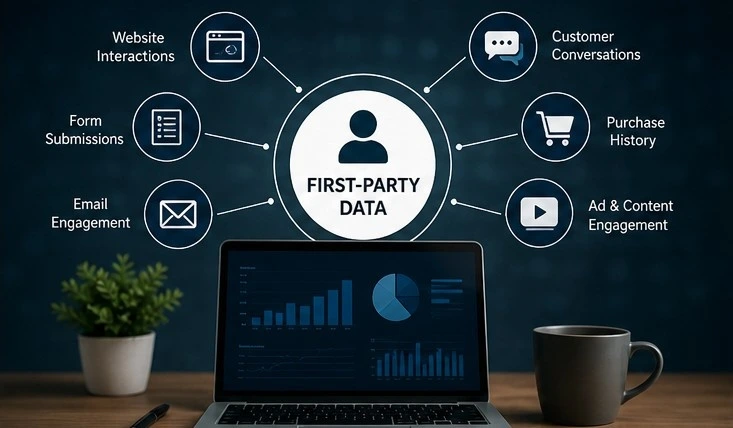
First-party data simply refers to the information you collect directly from your own audience or customers.
There are no middle layers involved. No third-party platforms interpreting behaviour. No assumptions based on external tracking networks.
It comes directly from real interactions with your business.
That could include:
- A user visiting your website
- Someone filling out a contact or enquiry form
- A customer reaching out on WhatsApp or chat
- Email interactions or responses
- Past purchase behaviour or repeat visits
- Engagement with your ads or content
A Branding and Designing Solutions approach typically gathers this data from multiple touchpoints, not just websites. In fact, the most valuable insights often come from combining offline and online interactions together.
But here’s where most businesses misunderstand the process.
They think collecting data is the goal.
It’s not.
Collecting data is just the starting point. The real value comes from what you do with it. How you structure it, connect it, interpret it, and ultimately apply it across marketing decisions.
Without that layer, even large volumes of data don’t create meaningful insights. They just create noise.
That’s why first-party data should not be treated as a “tool” you plug in. It works more like an entire system that needs to be designed properly from the ground up.
Why Third-Party Data Is No Longer Reliable ?

There was a time when third-party data felt like a breakthrough.
It allowed marketers to scale faster, reach new audiences, and understand user behaviour across platforms. It gave the impression that brands could track almost everything a user did online.
But that visibility was always fragile.
The issue with third-party data is that it was never fully accurate. It was built on indirect signals, assumptions, and cross-platform tracking methods that were never completely reliable to begin with.
Over time, that system started breaking down.
Privacy concerns became more important globally, and governments introduced stricter rules around how data can be collected and shared. For example, GDPR regulations overview clearly define limitations on user tracking and data usage across systems, significantly reducing how third-party data can be used in marketing workflows.
At the same time, browsers and platforms started limiting cookies and tracking mechanisms. Apple restricted cross-app tracking. Google began phasing out third-party cookies. Users themselves became more conscious of privacy.
All of this led to one clear outcome marketers started losing visibility, especially in areas like Photography & Videography where understanding real audience engagement and authentic content performance now depends more on first-party data and direct user interactions rather than third-party tracking signals.
The Real Impact on Campaign Performance
The impact of this shift is not theoretical. It shows up directly in campaign results.
Businesses often notice patterns like:
- Cost per lead increasing without any clear reason
- Sudden drops in conversion rates
- Retargeting audiences shrinking unexpectedly
- Difficulty scaling campaigns beyond a certain point
- Performance fluctuations that don’t match changes in strategy
At first, these issues are usually blamed on external factors like competition increasing, ad fatigue, platform algorithm changes, or seasonal variations. While those factors do exist, they are not always the root cause. In many cases, the actual issue is much simpler: the business no longer has reliable data visibility.
A structured approach changes this completely. Instead of reacting to external fluctuations, businesses start building their own behavioural dataset over time through first-party insights. This shift allows them to make decisions based on real user behaviour rather than incomplete or estimated platform signals.
Instead of depending on external signals that may or may not be complete, they build their own behavioural dataset over time, which removes guesswork from performance marketing and brings more stability to scaling efforts. This changes everything. Because when you control your own data, you’re not reacting blindly to platform changes. You’re working with a consistent internal system.
This is especially critical in Mobile Application Development Service where understanding in-app user behaviour, retention patterns, and feature interaction data becomes the foundation for improving performance, engagement, and long-term growth.
.
Building a First-Party Data Strategy (The Right Way)

A strong first-party data strategy is not about buying new software or adding more dashboards.
It is about building a structured system that aligns with how users naturally interact with your business.
1. Data Collection: Focus on Experience, Not Extraction
Most businesses make their first mistake here.
They treat data collection like a technical requirement instead of a user experience problem.
If you ask users for too much information too early, they drop off. If the value exchange is unclear, they don’t engage. If the process feels forced, it creates friction instead of interest.
A company that does this well focuses on timing and relevance.
Instead of asking for everything upfront, they design smaller interaction points where users are naturally willing to share information. In return, users receive something meaningful—better service, useful information, quicker support, or personalised responses.
The goal is not to extract data aggressively. The goal is to make sharing feel logical.
2. Data Organisation: The Step Most Businesses Ignore
Once data starts coming in, the real challenge begins. It needs to be organised in a way that actually makes it usable.
Without structure, data becomes scattered across platforms CRM tools, ad accounts, spreadsheets, website analytics, and email systems. Each system shows a different version of reality.
This fragmentation is where most strategies fail.
Modern systems like Customer Data Platforms (CDPs) help solve this problem by centralising all user interactions into a single profile. These platforms are designed specifically for this purpose, allowing businesses to unify data across channels.
A Performance Marketing Agency uses this unified structure to understand not just individual actions, but complete user journeys over time.
Because isolated data points are useful—but connected data tells the real story.
3. Data Activation: Where Strategy Turns Into Results
This is the stage where data starts influencing performance.
Collecting and organising data is important, but it doesn’t directly improve campaigns. Activation is what bridges that gap.
For example, in Google Ads, first-party data can be used to build custom audiences or improve conversion signals. Google’s automated systems rely heavily on input data quality to optimise bidding and targeting effectively:
So the better your data, the better the algorithm performs.
Agency uses this to improve targeting accuracy and reduce wasted spend.
Similarly, on social platforms, engagement data helps refine creative direction and audience segmentation over time.
Marketing Service provider, for instance, can use first-party insights to understand which type of content drives real interest versus passive engagement.
This is where marketing becomes more precise and less dependent on guesswor
A Practical Example: How Things Change in Real Life ?
Let’s take a simple example.
A service-based business is running ads consistently but struggling with quality leads. Traffic is coming in, but conversions are low. Cost per acquisition keeps increasing.
Initially, they assume the issue is with ad creatives or targeting. They try small changes, but nothing really improves long-term.
Then they shift their approach.
Instead of relying only on platform-level data, they start collecting structured first-party data from every interaction enquiries, returning customers, form submissions, and even direct conversations.
Over time, this data is centralised and analysed properly.
Once patterns become clear, they start adjusting campaigns based on real behaviour instead of assumptions.
How Platforms Are Adapting to This Shift?
Google Ads: Built on Signals
Google Ads today is heavily dependent on data signals. A Google Ads Agency spends less time manually controlling every setting and more time ensuring the system receives high-quality input data.
However, Google still operates within a limitation. it works best when demand already exists.
It captures intent, but it doesn’t always create it.
Meta Ads: Built on Attention
Meta works very differently.
Users are not actively searching for solutions. They are scrolling through content. That means campaigns need to create attention first before generating action.
Agency focuses heavily on creative testing, engagement patterns, and behavioural signals to refine performance.
Why First-Party Data Is a Long-Term Advantage ?
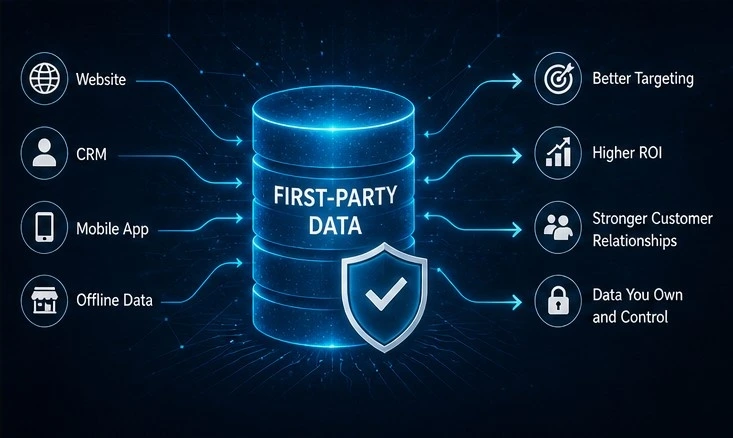
When you own your data, you are not fully dependent on external platforms. You are not constantly reacting to tracking changes or algorithm updates.
This system early gains a structural advantage:
| Area of Advantage | Impact on Performance |
| Faster optimisation cycles | Campaigns adjust quickly based on real data instead of delayed signals |
| More stable performance trends | Results become predictable and less volatile across platforms |
| Better scalability | Campaigns can scale without sudden breakdowns in performance |
| Reduced dependency on third-party systems | Less impact from tracking limitations and platform changes |
This isn’t just about improving ads.
It’s about building a system that keeps working even when the environment keeps changing.
The Shift Has Already Happened. What Every Digital Marketing Agency in Ahmedabad Must Accept ?
Performance marketing is no longer operating in the same environment it once did.
Privacy rules are tighter. Tracking is more limited. Platforms are evolving toward first-party data. User expectations around privacy are also increasing.
This is not a future trend anymore.
It is already the current reality.
Businesses that understand this early and invest in first-party data systems are building long-term stability. Those who don’t will continue dealing with inconsistent performance and unclear insights.
The direction is already decided.
The only question left is how quickly you adapt to it.