Google 2026 Core Update Explained by a Local SEO Company
Late March and early April were rough for a lot of website owners. If your traffic dropped during that window, the Google March 2026 Core Update is most likely the reason. It finished rolling out on 8 April 2026 and the impact was anything but subtle. Some sites jumped up overnight. Others disappeared from the first few pages entirely. And plenty of businesses are still scratching their heads trying to figure out why.
This post is not about guesswork or broad SEO theory. It is about what actually happened, what the data shows, and what you should be doing right now whether you lost ground and want it back, or you gained ground and want to keep it. If you are currently working with or looking for a local SEO company that knows how to navigate these shifts, this is worth reading in full.
What the March 2026 Google Core Update Actually Did?
Google’s official description of the update was vague as usual, something about surfacing more relevant and satisfying content. If you were hoping for specifics, you did not get them. But the ranking data that followed told a much clearer story.
What made this update particularly messy was the timing. A February Discover update had already stirred things up for certain types of content. Then on 24–25 March, a spam update came through and wrapped up in under 20 hours the fastest Google had ever confirmed. Two days later, the core update started rolling. For site owners trying to work out what hit them, having three overlapping updates made it genuinely difficult to point at a single cause.
The Numbers That Tell the Real Story
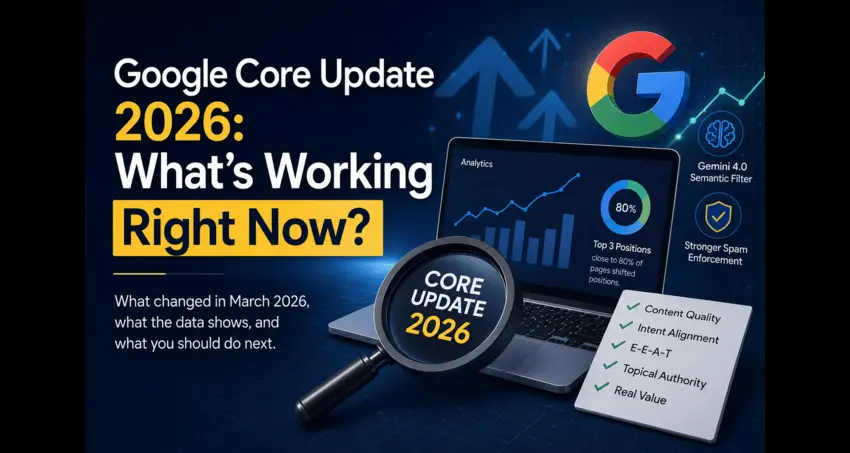
The data that came out after the rollout was hard to ignore. According to SE Ranking, close to 80% of pages are sitting in the top three shifted positions. In the wider top 10, more than 90% of URLs moved. Roughly one in four pages that had been sitting comfortably in the top 10 dropped out of the top 100 altogether. The SEMrush Sensor volatility reading peaked at 9.5 out of 10 one of the highest figures it has ever recorded. Some sites reported losing 20 to 35% of their organic traffic within the first week alone.
This was not Google tweaking a few signals. This was a wide-scale reassessment of content quality happening at the same time as active spam enforcement. If your rankings moved up or down there is almost certainly a clear reason behind it, and it comes down to one of three signals.
Rankings shifted. The right strategy makes sure yours doesn’t.
Digifinity builds SEO strategies for growth-focused businesses across India built for 2026.
Explore Our ServicesThree Core Signals That Drove Winners and Losers
No Google update comes with a public changelog. But through pattern analysis across hundreds of sites and industries, three clear signals emerge from the data. Understanding these signals is the difference between making informed strategic improvements and making reactive changes that compound the damage.
Signal 1: Content That Adds Nothing Gets Dropped
The most consistent finding across post-update analyses is this: content that simply rephrases what other pages already say is no longer sufficient for strong rankings. Google has been moving toward comparative value evaluation, meaning your page is not assessed in isolation, but in direct comparison to competing pages on the same query. If your content adds nothing that the existing top 10 do not already cover, Google’s systems are now better at identifying that and pushing your page down accordingly.
Sites that heavily relied on scaled AI-generated content, specifically content produced without meaningful human editorial oversight reported double-digit drops in organic visibility within the first week. This is particularly relevant for any SEO services provider building content strategies for clients depth, originality, and editorial judgment are now structural ranking requirements, not optional quality improvements.
Signal 2: Parasitic SEO Is Under the Microscope
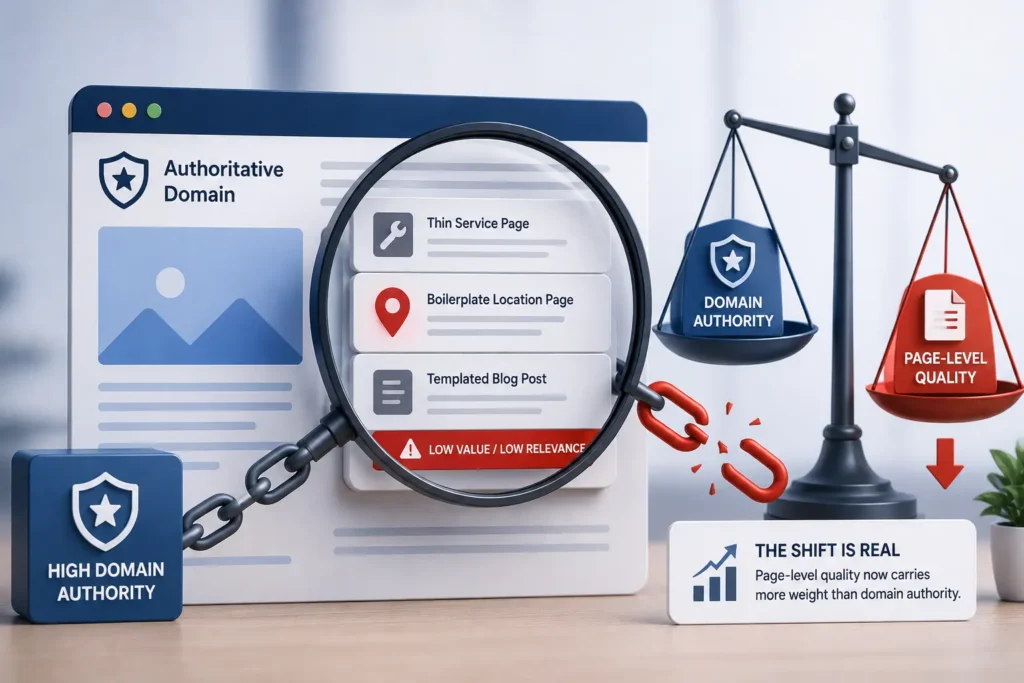
Parasitic SEO describes a tactic where low-quality or tangentially relevant content sections are published on otherwise authoritative domains, benefiting from that domain’s overall trust signal without contributing genuine value. The March 2026 update introduced more aggressive page-level authority evaluation. Thin service pages, boilerplate location pages, and templated blog content that does not demonstrate genuine subject-matter expertise are increasingly exposed even when the root domain has solid authority. The protection that domain authority once offered is shrinking. Page-level quality now carries considerably more weight.
Signal 3: Intent Alignment Now Dictates Position
This one caught a lot of people off guard. Pages with solid backlink profiles, good technical SEO, and decent domain authority still dropped. Meanwhile leaner, more focused pages climbed past them. The reason was not links or technical issues, it was that the content was not actually giving people what they came for.
Google now looks beyond the topic of your page and tries to understand the specific outcome someone is after when they search. If your page makes them scroll past three sections of background context just to find the answer they came for, that is a problem. Padding content with information nobody asked for used to be a safe way to hit word counts. After this update, it is working against you.
A lot of content is written to rank rather than to answer. It hits the right keywords, covers the topic broadly, and ticks the SEO boxes but it makes the reader work to find what they actually need. That approach had a reasonable run, but this update made clear that Google is now measuring whether your page genuinely delivers, not just whether it shows up.
The Gemini 4.0 Semantic Filter: What It Means for Your Content Strategy
This deserves a dedicated section because it represents a genuine departure from how previous core updates worked. Prior to 2026, Google’s assessments of AI-assisted content relied on relatively blunt signals, structural patterns, linguistic markers, and statistical fingerprints. The Gemini 4.0 Semantic Filter operates differently. It evaluates whether content genuinely adds to the semantic understanding of a topic or merely restates it with different phrasing.
The practical implication is significant. If you are using AI tools in your content production, the question is not whether AI was involved, but whether the output demonstrates real knowledge, specific examples, and editorial perspective that a human expert would provide. This is also why investing in website design and development that is structured around genuine content architecture not just aesthetic templates matters more than ever. Sites where AI was used as a drafting tool, with skilled human contributors adding original insight, performed well. Sites where AI was used as a replacement for human expertise did not.
| Content Approach | Update Impact |
| AI drafts + human expertise layered in | Maintained or gained rankings |
| Fully automated, no editorial oversight | Significant visibility drops |
| Rephrased competitor content, no unique angle | Lost top-10 positions |
| Original data + expert commentary + clear intent alignment | Strong gains |
| Parasitic SEO sections on authoritative domains | Page-level drops despite domain strength |
E-E-A-T in 2026 It’s No Longer Just a Guideline:
Most SEOs have heard of E-E-A-T Experience, Expertise, Authoritativeness, and Trustworthiness. For a long time, it felt like something Google mentioned but never really enforced. The March 2026 update changed that. Sites that looked credible on paper but lacked real proof of expertise took visible hits. It is no longer enough to say you know your subject, your content has to show it.
For a deeper understanding of how E-E-A-T works, Moz’s comprehensive E-E-A-T guide is worth reading in full.
Health, finance, legal, and marketing sites with no clear author credentials were among the worst affected. Google is looking for pages written by someone who can genuinely be held accountable for what they publish, not just well-written anonymous content. If your pages do not show who wrote them or why that person is qualified to write it, that is a gap worth fixing now.
This matters even more when someone is searching for a local SEO company or any high-intent service query. These are people ready to make a decision and spend money. Google treats those searches with a higher bar and the pages that rank need to earn that position, not just optimize for it.
What’s Actually Working Right Now?
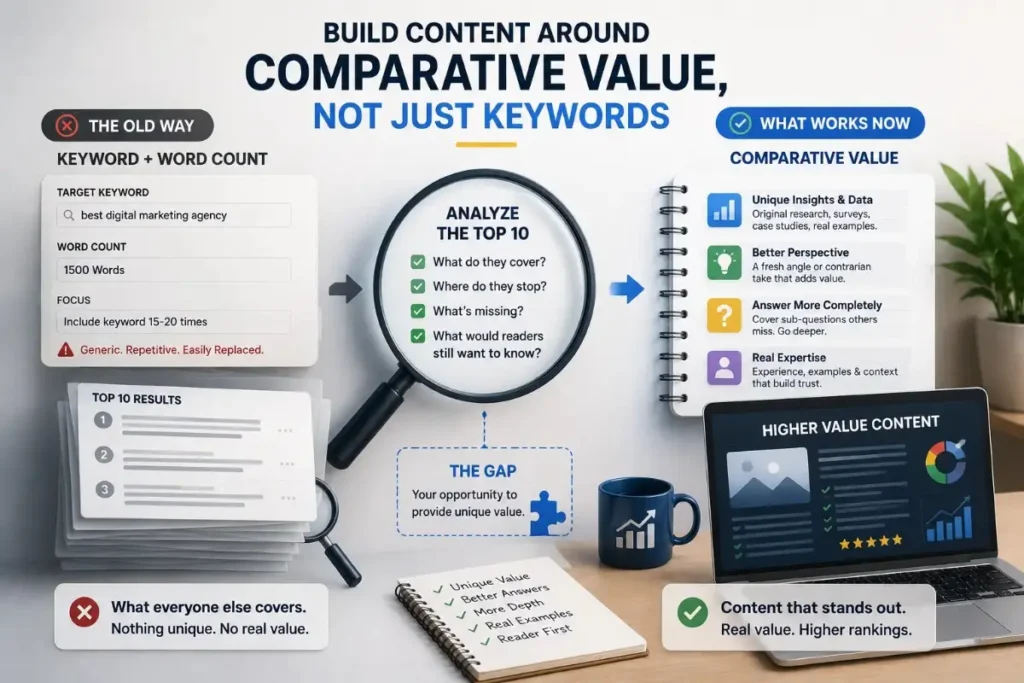
Build Content Around Comparative Value, Not Just Keywords:
Most content briefs still start with a keyword and a word count. That approach is not working the way it used to. The question worth asking before you write anything is not “have I included this keyword enough times?” it is “what does my page offer that none of the current top 10 actually covers?”
That answer could come from your own client data, a perspective that goes against the common advice, a specific sub-question that everyone else glosses over, or simply a more honest and complete explanation of how something actually works. Whatever it is, it needs to come from somewhere real, not from rearranging what is already out there.
Before writing your next piece, spend time with the current top 10 results for that query. Read them properly. Note what each one covers, where each one stops short, and what someone would still not know after reading all of them. That gap is where your content should live. Fill it with something genuinely useful and you give Google a reason to rank you above the pages that are already there.
Fix Your Topical Authority Gaps Before You Chase New Keywords:
Topical authority the degree to which your site is seen as a comprehensive, credible source on a given subject has become a structural ranking factor. Sites with strong topical coverage of their core subject areas showed greater resilience through the update. Sites with scattered content covering many loosely related topics without depth in any of them were significantly more exposed.
Build your content calendar around topical clusters. One pillar page for each core service or subject area, supported by a structured set of satellite content that covers related questions, subtopics, and use cases at genuine depth. This is not new advice but the March 2026 update provided the strongest evidence yet that Google’s systems are actively rewarding sites that have done this work.
Optimise for AI Overviews and Generative Engine Optimisation:
Search in 2026 is no longer purely about ten blue links. Google AI Overviews now appear at the top of a significant percentage of results, particularly for informational and research-intent queries. For businesses running search engine marketing campaigns, being cited in AI Overviews is increasingly where branded discovery begins. Optimising for GEO is no longer a forward-looking aspiration. It is a current competitive requirement.
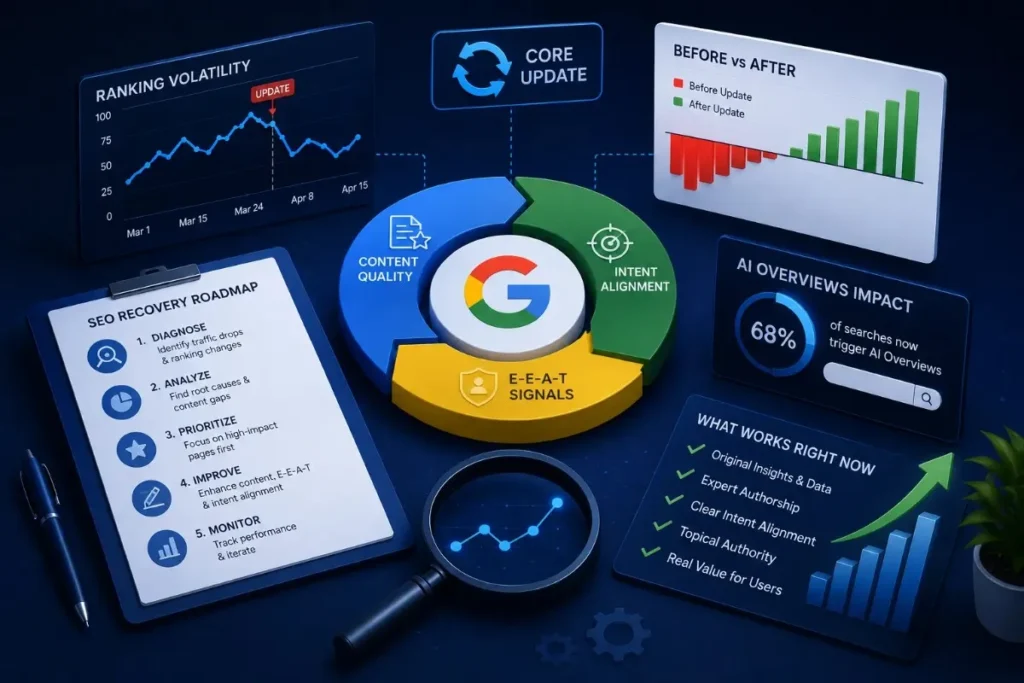
Pages that perform well in AI Overviews tend to do five things consistently: they answer the core question directly in the opening section; they provide specific, verifiable facts; they organise supporting information in a way that is easy to extract; they address likely follow-up questions; and they demonstrate credibility through specific, sourced evidence.
SEO Recovery Roadmap After the Core Update:
Google Search Central explicitly recommends waiting at least one full week after rollout completion before making major changes, rankings continue shifting during rollout, and reactive changes made mid-update often compound the problem rather than resolve it.
| Recovery Phase | Timeline | Action |
| Diagnose | Week 1 post-rollout | Google Search Console audit compares March 27+ vs 4 weeks prior. Isolate drops by page and query type. |
| Identify Root Cause | Week 1–2 | Assess affected pages for intent alignment, content depth, author authority, and comparative value vs. current top 10. |
| Prioritise | Week 2–3 | Address highest-traffic, highest-value affected pages first. Do not attempt site-wide changes simultaneously. |
| Improve | Week 3–8 | Add original data, expert commentary, structured sub-questions. Improve author credibility signals. Align page structure to search intent. |
| Monitor | Ongoing | Track impressions and clicks in Search Console. Core update recovery typically becomes visible only after the next update patience is required. |
For businesses working with a performance marketing strategy alongside SEO, now is a good time to look at whether paid channels can cover the gap while your content improvements take effect. Paid can keep leads coming in during a recovery window but it is a temporary bridge, not a fix. The underlying content issues still need to be dealt with.
How the Right Local SEO Company Makes the Difference
The March 2026 update did not just test websites, it tested the thinking behind them. Sites that had been built on quick wins, templated pages, and keyword stuffing took the biggest hits. Sites where someone had genuinely invested in building real topical depth and consistent content quality came through in much better shape.
If you are currently looking for a local SEO company or thinking about switching partners, the question to ask is not “how fast can you get me ranking?” Anyone can promise speed. The more useful question is “how did your existing clients hold up through this update?” That answer tells you everything about whether their approach actually builds something durable or just something that looks good until the next update arrives.
At Digifinity, we have always believed that SEO done properly should survive algorithm changes, not crumble because of them. That means focusing on content that genuinely demonstrates expertise, tracking what brings in real leads and revenue rather than just chasing positions, and treating every core update as useful feedback about where the bar has moved.
The businesses that come out of this update in the best position will not be the ones that panicked and made reactive changes. They will be the ones that understood what Google was saying and had the right people around them to respond to it properly.