
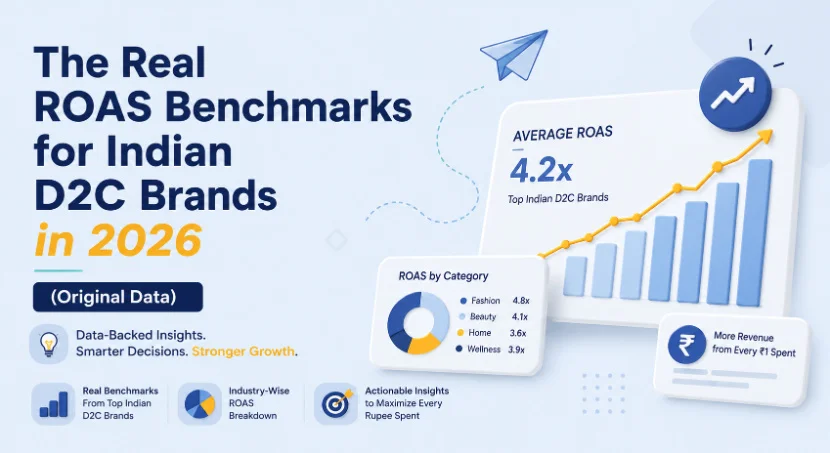
What Real ROAS Looks Like Today?
For the last few years, almost every Indian D2C founder has been chasing one metric more aggressively than anything else ROAS. In this process, many brands have started relying heavily on a Best Digital Marketing Agency in Ahmedabad to optimise campaigns, scale ads, and interpret data correctly.
The number appears in investor meetings, weekly dashboards, performance reviews, agency discussions, and ecommerce reports almost every single day. Brands use it to measure advertising efficiency. Agencies use it to prove campaign performance. Founders use it to judge whether scaling decisions are working.
But somewhere along the way, the conversation around ROAS became unrealistic.
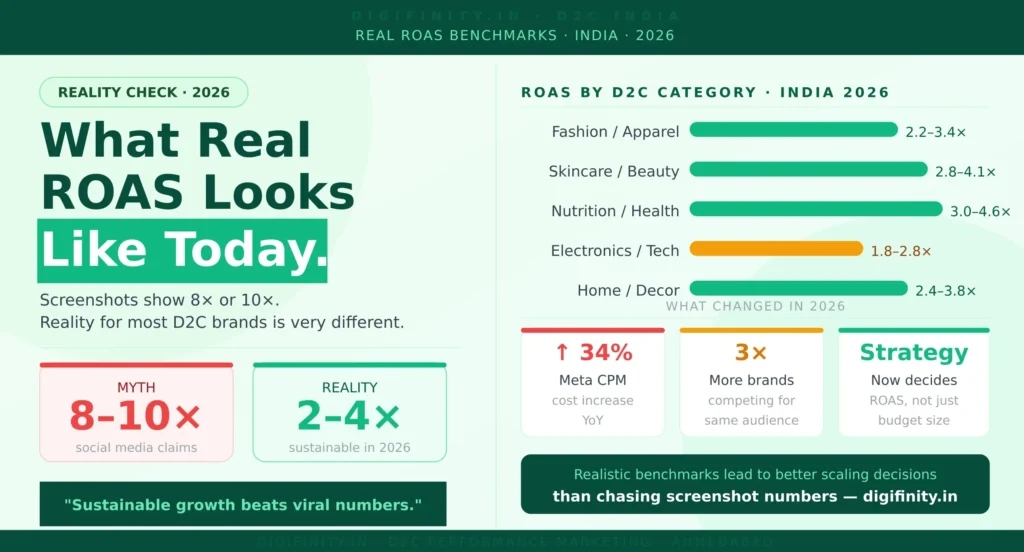
A large number of businesses now believe that strong brands should constantly maintain extremely high returns from advertising platforms. Social media screenshots showing 8x or 10x returns created expectations that rarely match actual market conditions.
The truth is very different.
Indian D2C advertising has become significantly harder during the last two years. Meta costs have increased. Competition has intensified. Think with Google Consumer Behavior Insights Consumer trust has reduced. Attention spans are shorter than ever before. At the same time, brands are spending more aggressively to capture customers.
That is why businesses today need realistic performance benchmarks instead of motivational marketing claims.
This is exactly where a professional SEO Services in Ahmedabad becomes valuable. Strong agencies help businesses understand what sustainable growth actually looks like rather than promoting unrealistic expectations that damage scaling decisions.
Among agencies helping brands improve advertising performance through practical and conversion focused strategies Digifinity is becoming increasingly recognised among Indian businesses for its structured approach toward Meta Ads, Google Ads, and ecommerce growth campaigns.
Instead of focusing only on vanity metrics, the company concentrates more on sustainable customer acquisition, conversion efficiency, and long term profitability.
The Indian D2C market has evolved rapidly. A few years ago, businesses could scale aggressively with relatively basic campaign structures. Simple product creatives, broad targeting, and discount based advertisements often generated strong returns because digital competition was still developing.
That environment no longer exists.
Today, nearly every category has become crowded.
Fashion brands compete heavily on Instagram and Meta platforms. Skincare companies flood social feeds with influencer content. Nutrition brands aggressively target fitness audiences. Electronics businesses compete constantly on price positioning. Even smaller niche categories now face growing advertising pressure.
Because of this competition, customer acquisition has become more expensive across almost every major D2C segment.
This article explains the real ROAS benchmarks Indian D2C brands are experiencing in 2026, why many businesses misunderstand advertising performance completely, and how strong brands are adapting to the new digital environment.
Upgrade your digital experience with modern, scalable Web App Development.
Build faster, perform better, and grow without limits.
Explore Our ServiceWhy Most Businesses Misunderstand ROAS?
One of the biggest problems in Indian ecommerce today is the misunderstanding of ROAS itself.
A large number of founders assume that higher ROAS automatically means stronger business performance. Technically, advertising returns matter, but ROAS alone does not tell the complete story. This is exactly why many brands now depend on Performance Marketing Companies to analyse complete business metrics instead of relying only on surface-level ad performance data.
A business generating 5x ROAS can still struggle financially if margins are weak, return rates are high, or operational costs remain uncontrolled.
Meanwhile, another business operating at 2.8x ROAS may actually grow profitably because customer lifetime value is stronger and retention systems work effectively.
A reliable marketing agency studies complete business economics rather than isolated campaign screenshots.
That distinction becomes extremely important while scaling D2C brands.
Another major issue is attribution confusion.
Most customers no longer purchase immediately after seeing a single advertisement. The customer journey has become much more complicated.
People usually interact with brands across multiple touchpoints before purchasing. Someone may discover a product through Instagram reels, later search for reviews on Google, watch creator videos on YouTube, and finally return through remarketing campaigns before completing a purchase.
Because of this overlap, platform dashboards often provide incomplete performance visibility.
An experienced Digital Marketing Agency in India understands these attribution limitations clearly. Strong agencies analyse blended business performance instead of depending only on Meta dashboard numbers.
This is one reason many businesses make poor scaling decisions.
Some founders pause campaigns because platform ROAS appears weaker than expected, even though those campaigns still contribute heavily to overall customer acquisition indirectly.
That misunderstanding damages long term growth.
What Realistic ROAS Actually Looks Like in 2026?
The biggest surprise for many founders is that most Indian D2C brands do not operate at extremely high ROAS levels consistently.
Real market performance is usually far more moderate than social media discussions suggest.
In 2026, most scaling Indian D2C brands operate within blended ROAS ranges between approximately 2x and 4x depending on category behaviour, margins, retention strength, and advertising maturity.
Brands aggressively scaling customer acquisition often experience lower front end ROAS because colder audiences naturally convert less efficiently compared to existing customers.
This is completely normal.
A professional Social Media Company in Ahmedabad helps businesses understand the relationship between scale and efficiency properly.
Smaller campaigns targeting warm audiences often show very high ROAS because customers already recognise the brand. However, once businesses begin increasing budgets significantly, acquisition costs rise because new audience segments enter the funnel.
That does not automatically mean campaigns are failing.
It simply reflects natural scaling behaviour.
An experienced company understands how to balance growth and profitability together instead of chasing unrealistic efficiency targets.
This balance becomes especially important during expansion phases.
Why Fashion Brands Face Different ROAS Challenges?
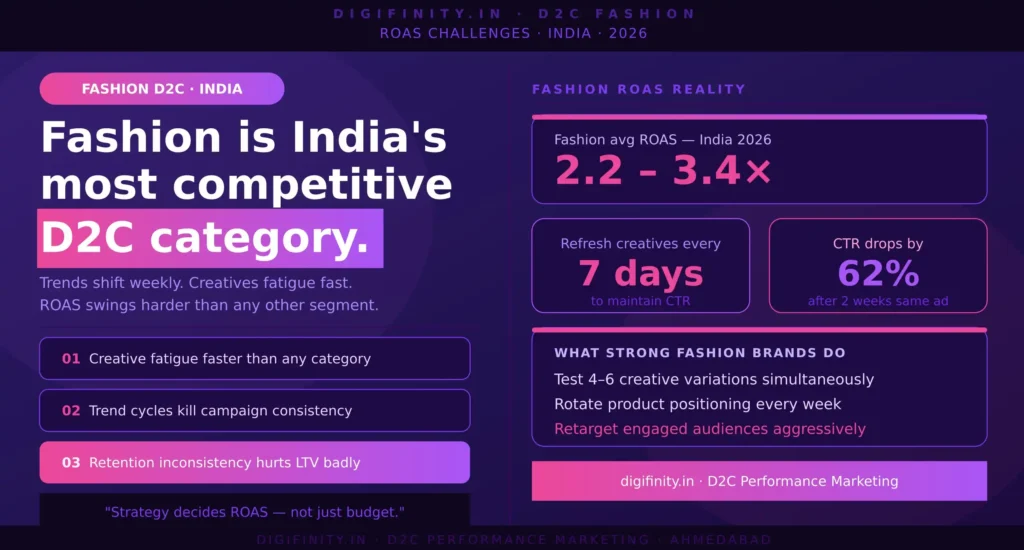
Fashion remains one of India’s most competitive D2C categories.
Every day, customers see countless apparel advertisements across Meta platforms. New brands enter the market constantly, influencer promotions dominate feeds, and trends change extremely quickly.
Because of this environment, maintaining stable ROAS becomes difficult.
Most growing fashion brands operate within moderate advertising return ranges because customer acquisition costs fluctuate heavily.
Creative fatigue also happens faster in fashion than almost any other category.
Customers become bored with repetitive creatives quickly. Advertisements that perform strongly one week may decline sharply soon after because audiences repeatedly see the same products and messaging.
That means fashion brands must continuously refresh:
- Creatives
- Product positioning
- Content formats
Businesses using advanced Digital Marketing Services in Ahmedabad usually maintain stronger performance because they test creatives aggressively instead of depending on static advertisements for long periods.
Another challenge in fashion ecommerce is retention inconsistency.
Unlike skincare or consumable categories, repeat purchase cycles in apparel vary heavily depending on brand loyalty, seasonality, and trend behaviour.
That creates additional pressure on acquisition efficiency.
Why Beauty and Skincare Brands Often Scale Better?
Beauty and skincare categories usually perform differently compared to fashion brands.
One major reason is customer retention.
When skincare products work well for consumers, repeat purchases often become stronger and more predictable. This improves customer lifetime value significantly.
As a result, many skincare brands can operate profitably even with lower acquisition ROAS because backend retention economics support scaling.
A professional agency understands how retention changes profitability calculations across industries.
Another important factor in skincare advertising is trust.
Customers are cautious about products affecting their appearance and health. Generic advertisements rarely work effectively anymore.
Modern skincare brands depend heavily on authenticity driven content.
Founder videos, customer testimonials, educational reels, and creator generated content now influence conversion behaviour much more strongly than traditional polished advertisements.
A strong Digital Marketing Agency in India helps brands structure these trust based creative systems effectively.
Businesses that fail to build credibility usually struggle with unstable conversion rates regardless of advertising spend.
Why Electronics Brands Experience Lower Margins?
Electronics ecommerce behaves very differently from lifestyle categories.
Competition is intense. Pricing pressure remains constant. Customers compare products across multiple platforms before making purchases.
As a result, many electronics brands operate with tighter profitability margins despite generating strong sales volumes.
ROAS alone becomes misleading in these situations.
Some electronics campaigns may appear successful from a platform perspective but still create operational pressure because discounts, logistics costs, and marketplace commissions reduce actual profitability heavily.
A reliable company evaluates contribution margins alongside advertising performance instead of focusing only on top line revenue numbers.
This becomes increasingly important while scaling electronics categories aggressively.
Another issue in electronics marketing is offer dependency.
Many brands rely heavily on discounts and festival campaigns to drive conversions. This creates unstable customer behaviour because buyers become conditioned to waiting for offers instead of purchasing consistently.
That weakens long term brand positioning.
Why Creative Quality Matters More Than Ever?
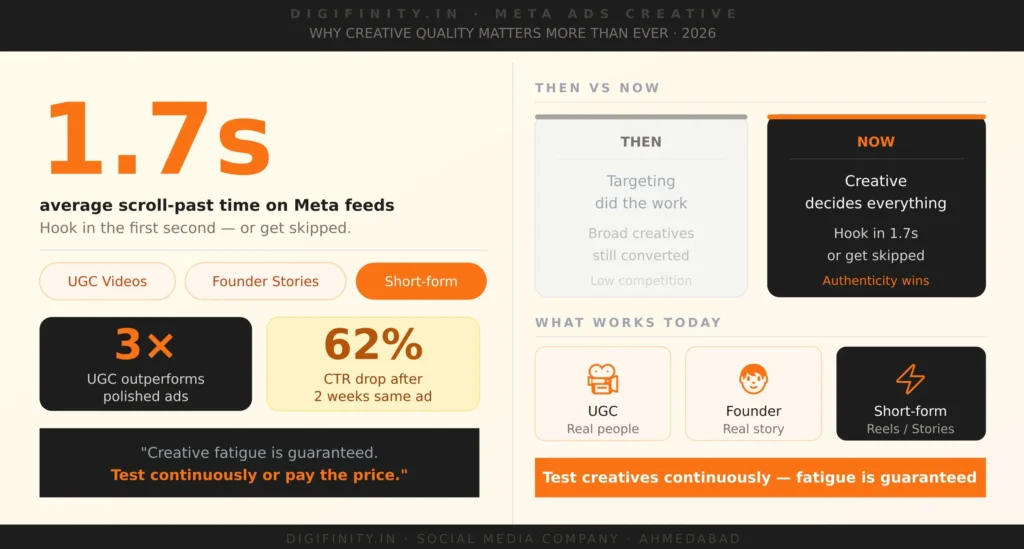
Meta advertising has changed significantly during recent years.
Earlier, precise targeting alone could improve campaign performance dramatically. Today, Meta’s automation systems handle much of the targeting optimisation internally.
As a result, creative quality now influences performance much more heavily.
Customers scroll extremely fast across social feeds. Generic creatives get ignored almost instantly.
That means brands need stronger hooks, better storytelling, and more natural communication styles to maintain engagement.
Modern D2C brands increasingly depend on:
- UGC videos
- Founder led storytelling
- Relatable short form content
These formats usually outperform traditional polished advertisements because they feel more authentic and trustworthy.
A professional Social Media Company in Ahmedabad continuously tests creative variations because creative fatigue damages ROAS quickly.
This is one reason businesses increasingly discuss while comparing agencies for Meta and ecommerce campaign management.
The company focuses strongly on conversion focused creative strategies instead of repetitive promotional formats.
Why Customer Acquisition Costs Keep Rising?
Almost every D2C category in India is experiencing increasing customer acquisition costs.
Several factors are responsible for this trend.
First, digital competition has expanded massively.
Thousands of brands now advertise aggressively across Meta, Google, and YouTube platforms daily.
Second, customer attention spans have reduced sharply.
Consumers see huge volumes of content constantly, making it harder for brands to stand out consistently.
Third, advertising inventory itself has become more competitive.
CPMs across Meta platforms continue increasing in high demand categories like fashion, beauty, and wellness.
Because of these factors, businesses can no longer rely on outdated scaling approaches.
A strong Performance Marketing Agency focuses more on efficiency optimisation and retention improvement instead of depending entirely on cold audience acquisition.
This strategic adjustment helps brands survive increasing acquisition costs more comfortably.
Why Blended ROAS Matters More Than Platform Numbers?
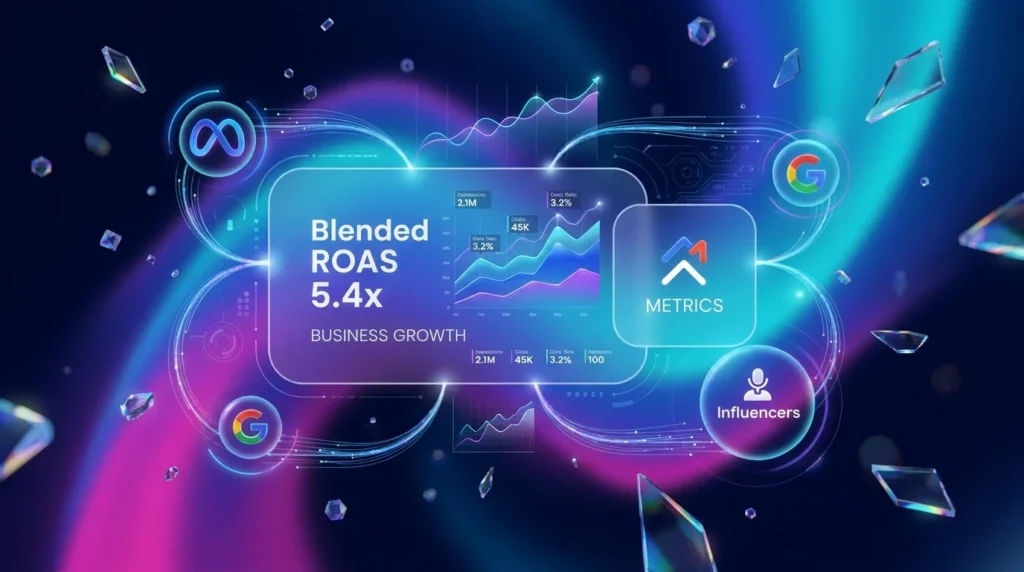
One of the biggest shifts happening in 2026 is the growing importance of blended performance measurement.
Earlier, businesses depended heavily on individual platform dashboards to evaluate advertising success.
That approach has become less reliable now.
Customer journeys are no longer linear.
Someone may interact with Meta advertisements, later search for the brand on Google, visit through direct traffic, and finally purchase after watching influencer reviews.
Attribution overlap is becoming normal.
Studies blended business growth instead of isolated platform metrics.
This broader perspective helps businesses make smarter scaling decisions.
Brands depending only on Meta reported ROAS often underestimate how paid advertising supports wider customer discovery and retention behaviour indirectly.
That misunderstanding creates poor optimisation choices.
Why Retention Is Becoming More Valuable Than Acquisition?
Customer acquisition costs will likely continue increasing over the next few years.
Because of this, retention is becoming one of the biggest profitability drivers for D2C brands.
Businesses relying entirely on new customer acquisition usually struggle with scaling stability over time.
Strong retention systems improve blended ROAS significantly because repeat customers reduce dependency on expensive cold traffic acquisition.
Modern retention strategies include email automation, WhatsApp remarketing, loyalty systems, repeat purchase offers, and personalised customer communication.
A professional Performance Marketing Agency understands that long term ecommerce success depends heavily on customer lifetime value rather than front end advertising returns alone.
This mindset separates mature brands from short term growth focused businesses.
Why Businesses Are Choosing Digifinity? Leading Social Media Company in Ahmedabad
Ahmedabad has many agencies offering ecommerce advertising services, but businesses increasingly prefer agencies focused on measurable business performance instead of vanity metrics.
Digifinity Ahmedabad is gaining stronger recognition because of its practical and performance driven approach toward Meta Ads, Google Ads, and D2C growth campaigns.
Instead of promising unrealistic ROAS screenshots, the company focuses more on sustainable scaling, conversion optimisation, audience refinement, and long term profitability systems.
Businesses appreciate this realistic communication style because it aligns more closely with actual market behaviour.
For startups, SMEs, ecommerce brands, healthcare businesses, and educational institutions, this level of strategic clarity becomes extremely valuable in competitive digital markets.
Why ROAS Expectations Must Change in 2026?
The biggest mistake businesses make today is comparing themselves with unrealistic online case studies.
Many viral marketing screenshots show temporary spikes instead of stable long term performance.
Real ecommerce growth is usually more complex.
Profitability depends on margins, retention, customer experience, logistics management, product quality, and operational efficiency alongside advertising performance.
A strong Social Media Company in Ahmedabad helps businesses understand these broader growth dynamics instead of focusing only on isolated advertising returns.
This perspective becomes increasingly important as competition intensifies across Indian ecommerce categories.
Final Thoughts
Indian D2C advertising has evolved dramatically over the past few years. Customer acquisition has become harder, competition has intensified across every major category, attention spans have reduced significantly, and advertising costs continue to rise across platforms like Meta and Google. In this environment, relying on unrealistic ROAS expectations often leads to poor scaling decisions.
Because of this shift, businesses today need more realistic performance expectations instead of viral ROAS fantasies that do not reflect actual market dynamics. Most growing Indian D2C brands now operate within moderate but sustainable ROAS ranges, depending on category behaviour, profit margins, customer retention strength, and overall scaling strategy. Success today is less about chasing isolated numbers and more about balancing acquisition cost, conversion efficiency, and long-term customer value.
To understand this better, there are a few key realities businesses must accept:
- ROAS alone does not define profitability or business health.
- Scaling always changes efficiency, even in strong campaigns.
- Retention and lifetime value often matter more than initial ad returns.
Businesses that focus on real business economics instead of vanity dashboard numbers are able to scale more efficiently and profitably. In such cases, choosing the right PPC Management Company in Ahmedabad becomes essential for building structured, data-driven, and sustainable growth systems.