
Understanding the Goals of a Website Redesign :
Website redesign is among the key processes a business undergoes in terms of its digital transformation. Any web development company knows that website redesign is not only about the change in design but also about a full website architectural reconstruction including the optimization process and the creation of a new way for users to convert.
When done right, website redesign leads to increased traffic, enhanced user engagement, and increased conversion rates. When done poorly, website redesign will ruin all previous rankings and optimization results and lead to broken URLs.
This is the reason why all professional agencies have their own website redesign checklists. They guarantee flawless work.
A redesign of a web development company’s website does not only include a simple change in appearance but actually impacts such elements as performance, usability, search engine optimization (SEO), and conversion rate. Before the implementation of the redesign, it is important to ensure that the strategic and planning aspects have been properly addressed through setting up some targets for successful achievement of traffic or lead generation or anything else. It is important to re-evaluate the target audience, perform a competitive analysis and to ensure that all the brand message and positioning strategies match the redesign vision. Preparing the right content strategy in advance will contribute to successful communication with visitors on a redesigned website. More details about website performance and optimization can be found on MDN Web Docs – Web Performance.
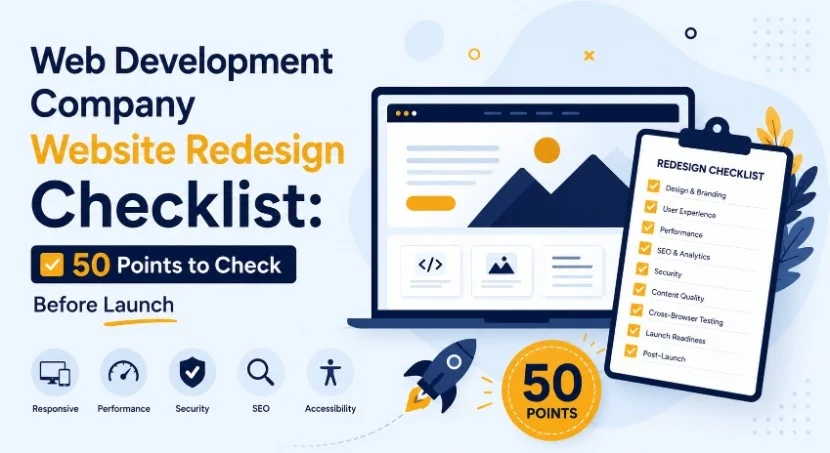
This guide breaks down a complete 50-point framework used by professional agencies to execute redesigns safely and effectively.

Why a Web Development Company Must Treat Website Redesign as a Strategic Migration ?
Most businesses assume redesign is about visuals. In reality, it is a technical migration project wrapped in design changes.
A website redesign affects:
- URL structure and routing
- Internal linking architecture
- SEO indexing and crawlability
- Content hierarchy and relevance
- Performance and Core Web Vitals
- Conversion flow and UX behaviour
- Analytics tracking and data continuity
In the event that even one of these layers falls apart, the whole structure of the website can fall apart.
It has been found by Google Search Central that the failure of proper URL migration and not having redirects are some of the leading reasons why ranking fails in redesigns. 301 redirects will make sure that there is equity transfer and that search engines can follow the flow of pages.
In the case of a web development company in ahmedabad or a competitive region, this is even more important since SEO visibility affects growth and leads.
An effective website redesign checklist will ensure that:
- No SEO authority loss
- Controlled migration process
- Stable search rankings
- Improved UX continuity
- Predictable performance outcomes
UX Strategy: The Foundation of Every Successful Website Redesign :
Before any design or coding begins, UX strategy defines the direction of the entire project. Modern redesigns are not based on opinion—they are based on behavioural data.
UX Strategy: Why The Foundation Of Any Successful Website Re-design Needs To Be This Strategy Since this makes sure that your website design caters to the needs of your customers and is not just about making it visually appealing. In order to come up with a successful UX strategy, the first step to be taken is researching about the users.
It means that information should be collected on what difficulties users encounter using the website and what benefits they can receive while doing this. Without it, the website redesign will fail regardless of how nice it might look..
A professional web development company always starts with understanding how users interact with the current website.
According to the Nielsen Norman Group, users form a first impression of a website in just 0.05 seconds, meaning UX clarity directly influences trust and engagement:
This means users do not “study” websites , they instantly judge them.
UX Foundations Before Redesign :
A strong UX foundation includes:
- Understanding user intent across devices
- Identifying high-performing landing pages
- Studying bounce rate and exit behaviour
- Mapping conversion funnels
- Analysing friction in navigation
- Reviewing mobile vs desktop behaviour differences
Many businesses discover during this phase that most drop-offs occur not because of content,but because of poor structure or slow performance.
The essence of UX strategy is to bring business objectives closer to user interests and achieve a balance between usability and conversion.If done correctly, then this will result in satisfaction on the part of the user along with loyalty and, consequently, high conversion rates. The purpose of website redesign is not merely about changing the appearance of the site but improving usability as well.
At this point, execution is likely to involve structured offerings, such as Web Design & Development , that would make it possible to implement UX strategy decisions practically and effectively.
Complete Website Redesign Checklist (50 Points) :
Below is the full structured checklist used by professional teams during redesign projects.

UX & UI Structure :
A redesign must start with clarity in user experience. If users are confused, nothing else matters.
1 Mobile-first responsive layout implemented
2 Consistent design system across all pages
3 Clear navigation hierarchy and structure
4 CTA placement aligned with user intent
5 Accessibility compliance (WCAG standards)
6 Simplified user journey across pages
7 Above-the-fold clarity within first 3 seconds
8 Visual hierarchy guiding user attention
9 Removal of unnecessary UI distractions
10 Real-user testing before final deployment
UX is not about how a website looks – it is about how easily users can complete actions.
SEO Migration & URL Control :
SEO migration is the most sensitive part of any redesign.
If handled incorrectly, it can destroy rankings.
11 Complete 301 redirect mapping for all URLs
12 Metadata preserved or improved strategically
13 XML sitemap updated and submitted
14 Canonical tags validated across pages
15 Duplicate content resolved
16 Structured data (Schema) implemented
17 Internal linking structure rebuilt
18 Search Console integration completed
19 Crawl errors monitored and fixed
20 Keyword mapping aligned with new structure
A web development company must treat this phase as critical infrastructure, not a secondary task.
Take your marketing to the next level with Digifinity.
Explore our services and see how we help brands achieve measurable growth
Explore Our ServiceTechnical Performance & Core Web Vitals :
The Technical Performance & Core Web Vitals are one of the most important elements for creating a successful website design because of its direct influence on user experience and Google ranking. The Core Web Vitals are performance metrics created by Google that evaluate the load time, interactivity, and stability of pages. Some of the Core Web Vitals include Largest Contentful Paint, First Input Delay, and Cumulative Layout Shift.
Performance is now a ranking factor, not just a technical metric.
21 Optimisation of Core Web Vitals (LCP, INP, CLS)
22 Image optimisation using WebP/AVIF Formats
23 Lazy loading of images and videos
24 JavaScript optimisation and deferral
25 CSS minification and cleanup
26 CDN integration for global speed
27 Server response time optimisation
28 HTTPS security fully implemented
29 Cross-browser testing completed
30 Browser caching enabled
According to studies from Akamai, a difference of one hundred milliseconds in page load time may lower the conversion rate by 7%.
Content Strategy & SEO Architecture :
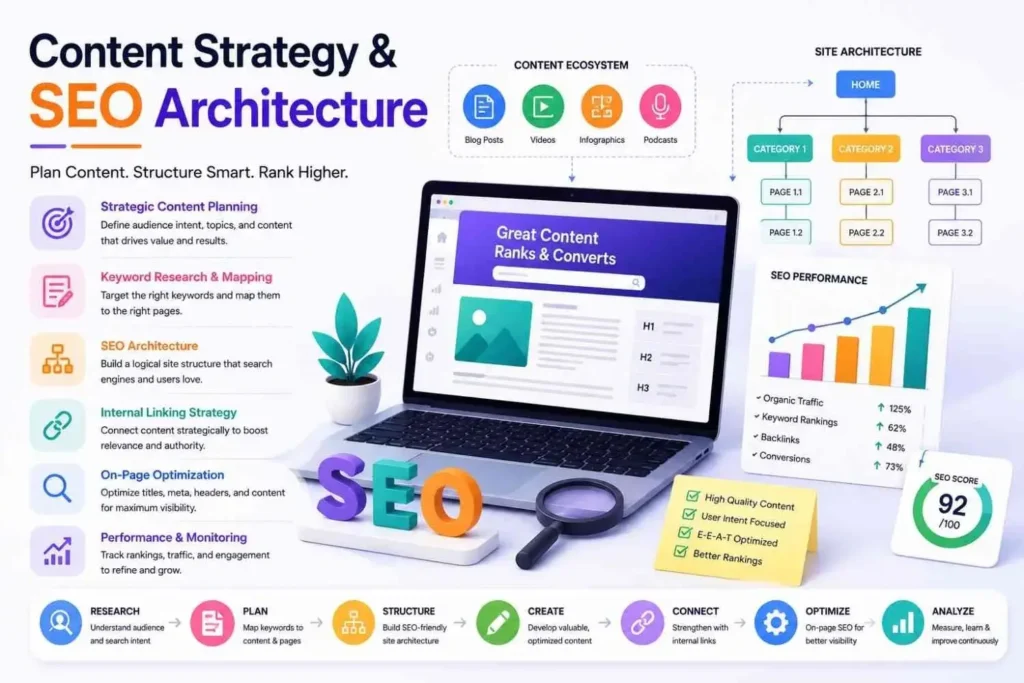
Content determines how Google understands your website.
31 Complete content audit of all pages
32 Removal of outdated or weak content
33 Keyword-to-page mapping strategy
34 Semantic SEO implementation for topical authority
35 Proper heading structure (H1–H3 consistency)
36 Readability improvements for users
37 Internal linking optimisation across pages
With Content Strategy and SEO Architecture, you can be assured that the new design of your website has been well thought out when it comes to providing relevant and user-centered content which is easily searchable by both humans and search engines. This begins with analyzing your current content, getting rid of any irrelevant information, and ensuring that your pages meet your users’ needs and intentions.
Strong internal linking builds authority. For example, linking to a custom software development company helps strengthen topic clusters and improves ranking signals.
Conversion Rate Optimisation :
Conversion Rate Optimization, or commonly known as CRO, is the process whereby one optimizes their website in order to ensure that when people come visiting their site, they will convert. Conversion is where visitors to your website fill forms, buy products, register, or contact you. In terms of a website design or re-design, CRO will help you reduce friction from the user experience so that it’s easy for people to convert.
CRO depends on data and analysis regarding user behavior as well. The use of things such as A/B testing, heatmaps, and other forms of analytics helps determine which elements work well and which do not. With the constant optimization based on information gained from analytics, a redesigned website will perform better.
A redesign must improve business outcomes, not just visuals.
38 CTA optimisation for clarity and performance
39 Funnel simplification from entry to conversion
40 Trust signals added (reviews, testimonials, case studies)
41 Heatmap tracking setup for behaviour analysis
42 A/B testing framework implementation
43 Landing page optimisation for conversions
Many businesses also scale revenue using systems like E-Commerce Companies after redesign completion.
Security & Compliance :
Security builds trust and protects data.
44 SSL certificate installed and validated
45 Secure form handling implemented
46 GDPR/privacy compliance ensured
47 Vulnerability testing completed
Security issues can directly impact trust and SEO performance.
Analytics & Tracking Setup :
The Setup for Analytics and Tracking is part of the key components of website redesign due to the fact that it enables the measurement of the success of the website after launch in terms of how the users engage with the website. The setup will include installing various analytics such as Google Analytics and Google Search Console that measure metrics like visits, interactions, bounce rate, and conversions.
Without measurement, optimisation is impossible.
48 GA4 event tracking configured
49 Google Search Console integration completed
50 Conversion tracking validated
These ensure every redesign outcome is measurable.
The process will also consist of the definition of events, goals, and conversion tracking for activities such as filling forms, clicking links, downloading, and buying. Good analysis will assist companies in making sound business decisions and improving performance problems by continuously optimizing the site. It will not be possible to assess the performance of the redesign without any tracking.
Post-Launch Strategy: Where Most Projects Fail :
Most redesigns fail after launch, not during development.
The first 14–30 days are critical.
A web development company must monitor:
- Indexing status
- Keyword ranking fluctuations
- Crawl errors
- Traffic drops or spikes
- Conversion behaviour changes
This phase determines long-term success.
Post-Launch Strategy is arguably the most essential but frequently ignored stage of website redesign, at which point many initiatives end up failing to show any tangible outcomes. Creating a website is just a start point; it doesn’t mean that all processes related to website development come to an end, which is the exact moment you should start thinking about website performance assessment.
Website performance, user behavior, web analytics, conversion rates, and many other aspects are going to be assessed in order to get an understanding of how well everything was designed.
Furthermore, once the launch is complete, there should be regular SEO analysis, content update, and website monitoring according to the statistical information acquired, because some problems could emerge during use of the website.
This can be achieved through constant audits, A/B testing, and user feedback. A website that does not have a good post-launch strategy will face losses in terms of traffic and ranking, even though it has performed very well initially.
For scaling and post-launch improvements, businesses often use advanced systems like Web App Development Services
Common Website Redesign Mistakes That Destroy SEO :
The Most Common Website Redesign Mistakes That Can Ruin SEO happen if the web designer fails to pay attention to the site architecture for search engines. The biggest problem is changing URL structures but not setting 301 redirects. In this case, the site loses its ranking in SERPs and many of the links become broken. Another critical error is rewriting or removing content without keyword research, which leads to loss of organic traffic to the site.
Even experienced teams make mistakes like:
- Removing indexed pages without redirects
- Changing URL structure without mapping
- Ignoring mobile performance
- Overloading JavaScript frameworks
- Weak internal linking structure
- Poor content migration strategy
A structured checklist prevents these failures.
Business Impact of a Proper Website Redesign :
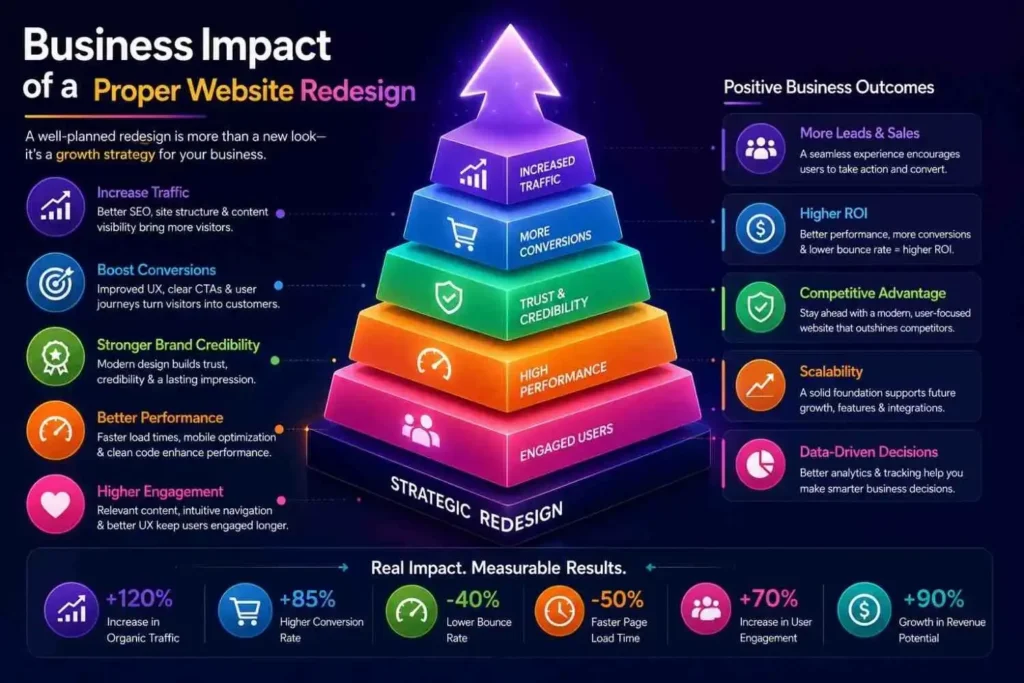
A Good Website Redesign and its Impact on Business is very important as it affects user perception and success rates of the website. A professional redesign of the website provides a comfortable experience for the user. The visitor develops confidence in using the website and makes it easier for him to navigate through it and make some actions. If the website can be easily accessed and used, visitors spend much time there learning about the service and becoming clients later.
A successful redesign improves:
- Organic traffic
- Conversion rates
- User engagement
- Brand trust
- Mobile performance
- Revenue consistency
Nevertheless, according to research by the HTTP Archive Web Almanac, the majority of websites do not meet the standards set by Core Web Vitals and, thus, require more efforts to be put in terms of performance optimisation..
Final Expert Conclusion :
Website redesign is not merely a designing procedure. Rather, it should be perceived as a comprehensive undertaking that incorporates digital engineering, migration of SEO, and meticulous optimization across multiple stages. All these elements must work together in order to create an effective website redesign that will provide a competitive advantage and bring tangible benefits for businesses. Once combined successfully, all mentioned above components allow to turn a simple website redesign into a performance-based transformation that is crucial to enhancing the online presence of an organization.
Properly carried out website redesign allows to enjoy stable rankings, superior user experience, enhanced conversion rate, faster load times, and SEO improvement. Both users and search engines are able to smoothly switch to the updated architecture and avoid any losses or negative outcomes. Overall, successful website redesign is not about proper design at all but rather the discipline of the process that should be applied from the very beginning to the post-launch period.