
The Real ROI of SEO: Ahmedabad’s Best Digital Marketing Agency
Every founder who has ever signed an SEO retainer has asked the same question at some point: is this actually worth it? At Digifinity, the best digital marketing agency in Ahmedabad, we stopped answering that with reassurance a while back and started answering it with numbers instead. Over the past two years, we pulled ranking data, traffic reports, and revenue conversations from more than 50 client engagements across India, spanning SaaS, ecommerce, real estate, and local services. Independent India-specific SEO benchmark research confirms much of what we had already seen first-hand: return timelines here tend to follow the same broad curve seen globally, just against a noticeably lower cost base.
What follows isn’t a sales pitch. It’s what actually happened, month by month, client by client, including the engagements that didn’t go perfectly. We think that honesty is more useful to you than another generic “SEO delivers 500% ROI” claim with no source behind it.
Why “Does SEO Work?” Is the Wrong Question
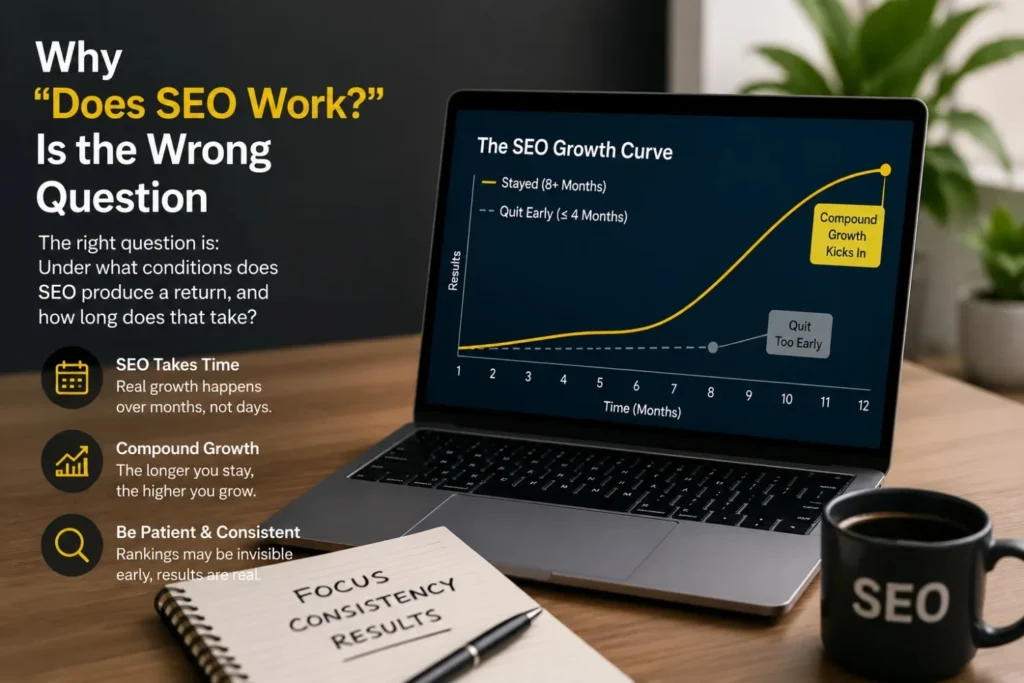
It’s the wrong question because the honest answer is always “it depends,” and that answer helps nobody make a budget decision. The better question is: under what conditions does SEO produce a return, and how long does that take?
We’ve sat across the table from enough Ahmedabad business owners to know the frustration. Someone spent six months and a decent chunk of money on SEO services, saw a handful of new keywords ranking on page two, and walked away convinced the whole channel was a scam. In most of those cases, the strategy wasn’t wrong. The patience ran out one or two months before the compounding actually started, which is arguably the worst time to quit, because that’s usually when the curve starts bending upward.
That’s the pattern our own dataset keeps confirming. SEO doesn’t behave like a paid ad campaign, where spend and results move in a fairly straight line. It behaves more like planting something that needs a season to establish roots before it grows on its own. Clients who stuck with a structured programme for at least eight months saw returns that clients who quit at month four never got close to, even though both groups spent roughly the same total amount by the time they stopped.
There’s a psychological trap hiding in this too. Rankings feel invisible for the first few months, so it’s tempting to judge the whole engagement by how the dashboard looks in week six. But dashboards lag reality. By the time a keyword shows up on page one, Google has usually already been testing that page against searchers for weeks.
What We Measured Across 50+ Engagements?
Before getting to numbers, it’s worth being specific about what we actually tracked, because “ROI” gets thrown around loosely in this industry, often to mean whatever makes the report look good. We didn’t just look at rankings or traffic. We looked at:
- Organic revenue attribution, tracing which leads and sales originated from non-branded organic search, cross-checked against CRM data rather than Google Analytics alone, since GA4 attribution tends to overstate direct traffic and undercount assisted conversions that started with a search.
- Cost per acquired customer through organic channels, compared month-on-month against the same client’s paid acquisition cost, so the comparison was apples-to-apples within one business rather than borrowed from an industry average that may not reflect their category at all.
- Time to breakeven, meaning the point where cumulative organic-attributed revenue exceeded the cumulative retainer spend, not the point where rankings simply improved on a rank tracker.
- Keyword-to-conversion mapping, separating vanity rankings (high volume, low intent) from commercially meaningful ones, because ranking first for a broad term nobody buys through isn’t a result worth reporting to a client.
- Retention of gains after 12 months, checking whether early rankings held, grew, or eroded once active link building slowed down, which tells us a lot about whether the content itself was built to last or just built to rank quickly.
This level of tracking takes more effort than pulling a Search Console screenshot, but it’s the only version of “ROI” that actually means something to a business owner deciding whether to renew a contract.
Ready to Know What Your SEO Spend Should Actually Return?
Digifinity builds SEO strategies backed by real client data, not guesswork, so you know what to expect before you commit.
Explore Our ServiceThe Real Numbers Ahmedabad and Beyond:
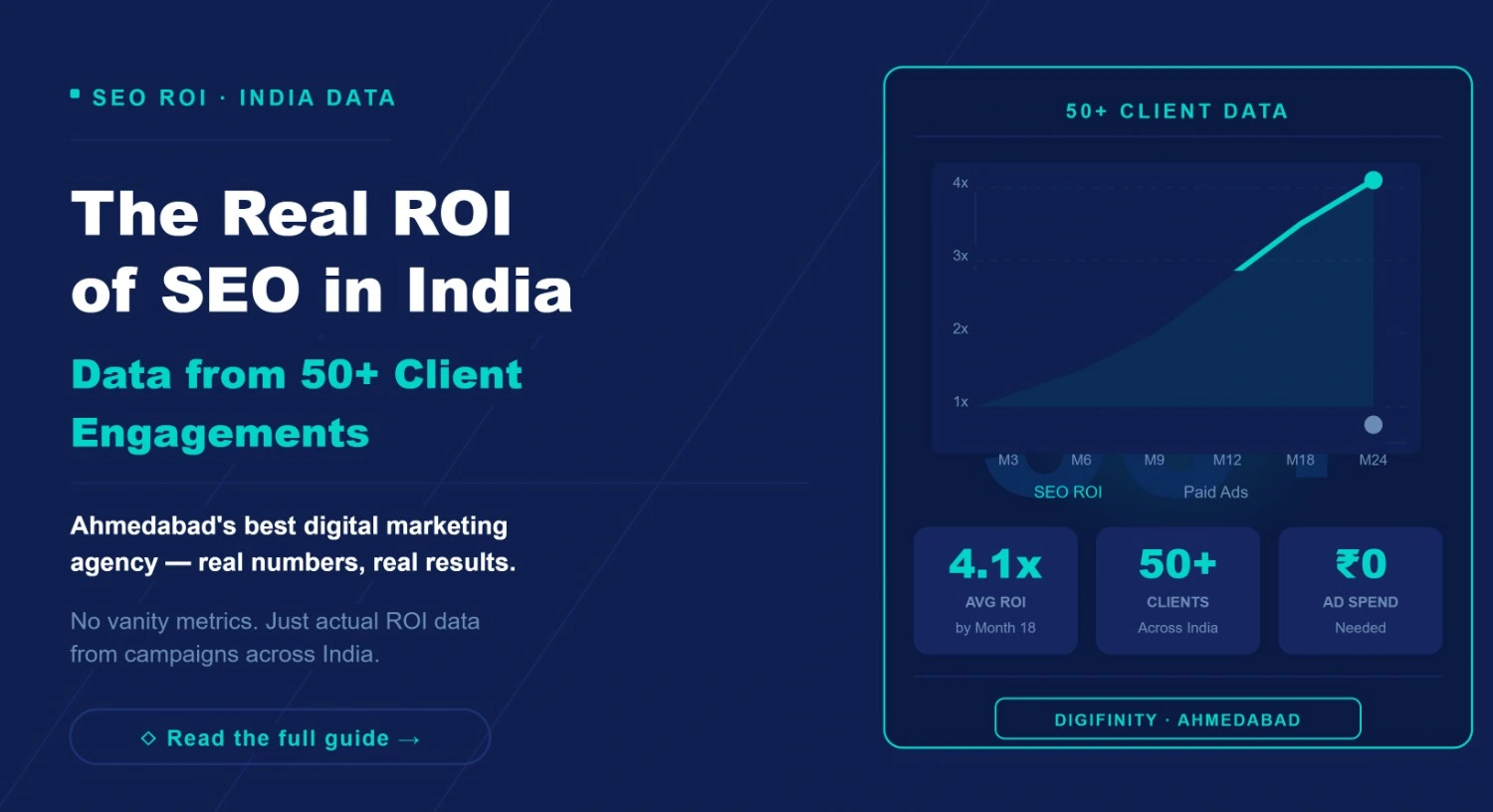
Here’s where it gets concrete. Across our 50+ engagements, the median time to organic breakeven was 8 months, with a range of 5 to 14 months depending on category and starting domain authority. That lines up closely with what broader industry research reports for markets outside India too, which was reassuring in a way. It meant our results weren’t an anomaly of a smaller, less competitive market, and it gave us confidence in setting expectations with new clients rather than guessing.
| Business Category | Avg. Time to Positive ROI | Avg. 12-Month ROI Range | Primary Growth Driver |
| Local services (clinics, legal, home services) | 5–7 months | 300%–650% | Local intent + Google Business Profile |
| Ecommerce (D2C, marketplaces) | 7–10 months | 220%–480% | Category and product page optimisation |
| SaaS and B2B | 8–12 months | 400%–780% | Long-form content and topical authority |
| Real estate and high-ticket services | 6–9 months | 500%–900% | High-intent, low-volume keyword capture |
These aren’t projections pulled from a global report and relabelled for India. They’re what we watched happen inside client accounts we were personally managing, quarter by quarter, with the wins and the slower stretches both included.
A Closer Look at One Engagement Pattern:
One pattern stood out enough that it’s worth walking through without naming the client. A jewellery ecommerce brand came to us roughly a year ago with strong product photography, a functional store, and almost no organic visibility outside branded searches. The first three months went into fixing category structure, cleaning up duplicate product URLs, and building content around search intent rather than product names alone, things like “how to choose a gold chain for daily wear” instead of just listing SKUs.
Nothing dramatic happened for the first ten weeks. Then, between month four and month seven, organic sessions grew month-on-month, and by month eight, organic-attributed revenue had overtaken what the brand was spending on the retainer. By month twelve, organic was contributing a meaningful share of total revenue, at a fraction of the cost per acquisition the brand was seeing through paid social. Nothing about that curve was unusual. It’s close to the median line in the table above. That’s precisely why we’re sharing it: the outlier stories make better anecdotes, but the median story is the one most businesses should actually plan around.
Why Ecommerce ROI Starts With the Store, Not the Keywords?
One thing the dataset made obvious is that SEO rarely delivers its full ROI in isolation. It performs best when the surrounding infrastructure is solid, and nowhere was that clearer than with our ecommerce clients.
For those businesses, the biggest lever wasn’t backlinks. It was fixing category architecture and product page structure through proper ecommerce services before layering keyword strategy on top of a store that wasn’t ready to convert the traffic it would eventually earn. Ranking a broken shopping experience just gets more people to bounce faster, and that bounce behaviour can actually work against future rankings too, since search engines read it as a signal that the page didn’t satisfy the visitor.
What Separates Clients Who See Real ROI From Those Who Don’t?
Not every engagement in our dataset performed equally, and the gap wasn’t random. A handful of factors showed up again and again in the accounts that outperformed:
- They gave the programme a genuine runway. Every client who saw strong 12-month ROI had committed to at least six months before evaluating results seriously, regardless of what early data suggested, and most had agreed to that timeline in writing before the work started.
- They trusted the priority order. Technical fixes and content structure came before link building in every high-performing account, because links pointing at a slow, poorly structured site rarely move the needle in a meaningful way.
- They kept their site technically healthy. Businesses that paired SEO with ongoing platform maintenance, often through the same team handling their broader digital presence, avoided the ranking dips we saw elsewhere from unpatched technical debt piling up quietly in the background.
- They tracked revenue, not rankings. The clients who stopped checking keyword positions daily and started checking monthly organic revenue made calmer, better decisions about where to keep investing and where to pull back.
- They didn’t treat SEO as a switch. Businesses that paused and restarted SEO spend based on short-term cash flow pressure lost more ground than the additional short-term saving was actually worth once we mapped it against the recovery time.
How Technical Infrastructure Sets Your Ranking Ceiling?
Here’s a pattern we’ve seen too many times to call it a coincidence. A client’s inventory system, CRM, or booking flow gets more complex over time, and the site slows down without anyone noticing. Rankings plateau. Content still goes out on schedule. Traffic just… stops moving. Nobody flags it, because on the surface, nothing looks broken.
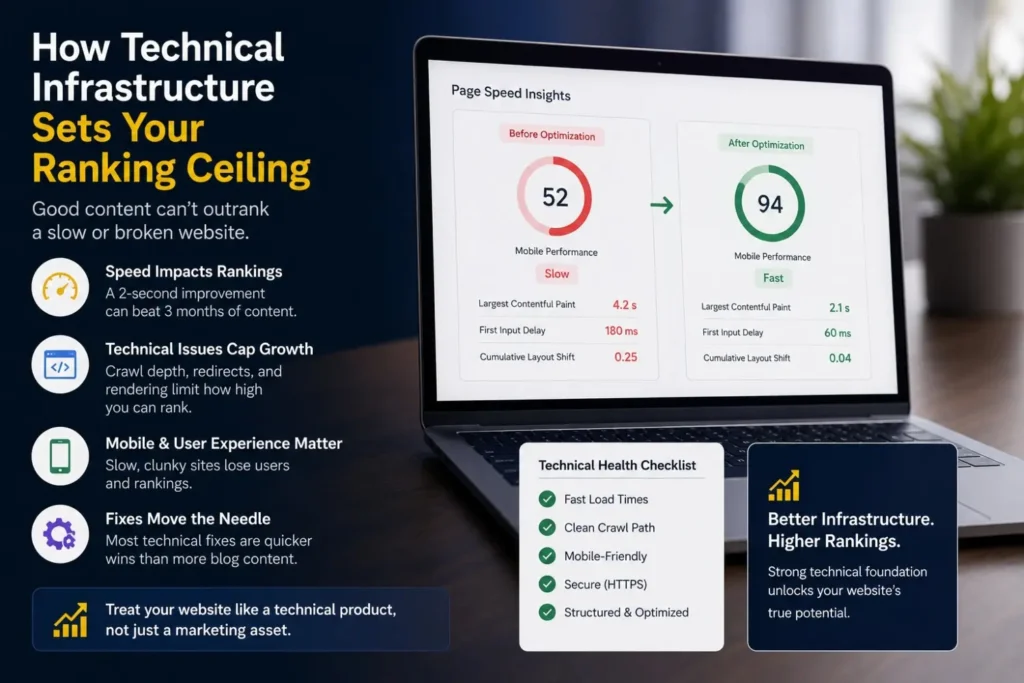
Dig into the actual page speed reports, though, and the story changes fast. We had one account where a two-second cut in load time did more for rankings in a single month than three months of fresh content had managed. That’s not an exaggeration, it’s what the analytics showed. Good content can only carry a page so far. Eventually the technical foundation caps how high it’s allowed to climb, which is exactly why we pull in a custom software development company partner for accounts where page speed or structural issues are quietly capping the ceiling.
Businesses that treat their website purely as a marketing asset, and never as a technical product, tend to hit that wall around month six. That’s usually the point where writing more articles stops helping. Crawl depth, redirect chains, mobile rendering, none of these fixes are as expensive as most owners assume, and honestly, they tend to move the needle faster than another round of blog content would.
A Few Measurement Mistakes We See Often:
Two mistakes come up repeatedly enough that they deserve their own mention, separate from the list above. The first is judging an SEO programme by traffic volume alone. Traffic is easy to celebrate and easy to misread. A spike in sessions from a viral, low-intent keyword can look fantastic on a monthly report while contributing nothing to revenue.
The second is comparing SEO’s month-one performance against paid media’s month-one performance and concluding SEO is underperforming. They aren’t the same kind of investment. Paid media is rented visibility. The moment stops, so does the traffic. SEO is closer to owned infrastructure. It costs more time upfront and less over the long run, and comparing the two on a 30-day window tells you almost nothing useful about either one.
A third mistake, less obvious but just as costly, is reporting on rankings for keywords that were never tied to revenue in the first place. We’ve inherited accounts where the previous agency was proudly reporting a top-three position for a keyword that had never generated a single enquiry. It looked impressive in a slide deck and meant nothing to the business’s bottom line. Every keyword in a serious SEO programme should be traceable back to a commercial reason it was chosen.
Where Paid Search Fits Alongside an Organic Strategy?
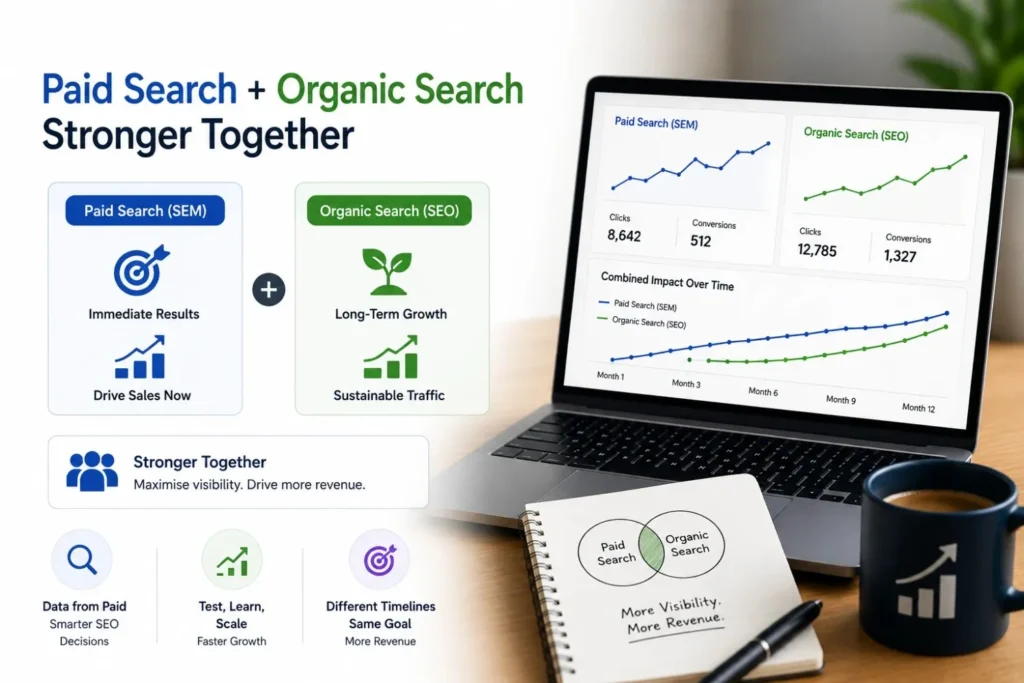
For businesses that needed to move faster than organic timelines allow while SEO built momentum underneath, pairing it with search engine marketing closed the revenue gap without cannibalising long-term organic growth.
The two channels aren’t competing for the same budget line in a well-run account. They’re solving different problems on different timelines, and the businesses that understood that distinction early tended to be more patient with organic in general, precisely because paid was already covering short-term revenue needs. What we noticed across the dataset is that clients who ran both channels together almost never asked us mid-campaign whether SEO was “working,” because the paid side was already proving the offer was converted. That removed a lot of the anxiety that usually drives businesses to pull their SEO budget too early.
There’s a second, less obvious benefit to running both channels together. Paid search data gives you a live feed of which headlines, offers, and landing page angles actually convert, weeks or months before organic content on the same topic would generate enough traffic to tell you anything statistically meaningful. Several clients in our dataset used exactly this approach: test messaging through paid campaigns first, then feed the winning angles into the SEO content calendar once organic pages for those terms were ready to publish.
What the Cost-Per-Lead Data Actually Shows?
Once that patience is in place, the cost picture tends to shift in the client’s favour over time. Paid channels stay roughly flat in cost per lead, sometimes rising as competition for the same keywords increases, while organic cost per lead falls steadily the longer a programme runs, because the traffic keeps arriving without a matching spend increase behind it.
Independent data on channel performance backs up what we saw directly across our own accounts: organic search consistently produces a lower cost per lead than paid channels once it matures, even though paid delivers faster results in the first few months of a campaign. That crossover point is usually where clients stop asking us to justify the SEO line item altogether.
In practical terms, we typically see that crossover somewhere between month six and month nine, depending on how competitive the category is. Before that point, the honest comparison usually favours paid on cost alone. After it, the gap widens every month organic keeps compounding, while paid cost per lead stays essentially static unless the account is actively optimised further.
How Local SEO Changes the Calculation for Ahmedabad Businesses?
Here’s something we tell every Ahmedabad and Gujarat client early on, because it changes how they should plan the first six months. Local searches move faster than national ones. Not a little faster, noticeably faster. Competition for “near me” and city-specific terms is thinner than the broad national keywords everyone assumes SEO is about. A restaurant, a clinic, an interior designer, they’re up against dozens of rivals for those searches, not thousands.
That gap is basically why our local-service clients kept hitting breakeven first in the table above. Someone typing “best interior designer Bodakdev” isn’t browsing, they’re close to picking up the phone. Add a competitive field that’s actually manageable, and consistent, well-structured work starts showing up without needing years of built-up domain authority behind it.
There’s a second thing worth knowing here, and it’s less obvious. Local trust signals compound. Build a solid Google Business Profile, keep citations consistent, and let genuine reviews accumulate, and that foundation keeps working for every service page or location page you add later. A national brand doesn’t get that shortcut. It has to rebuild authority in every new city it enters. An Ahmedabad business that’s already established isn’t starting over each time. It’s just adding to the ground it already holds.