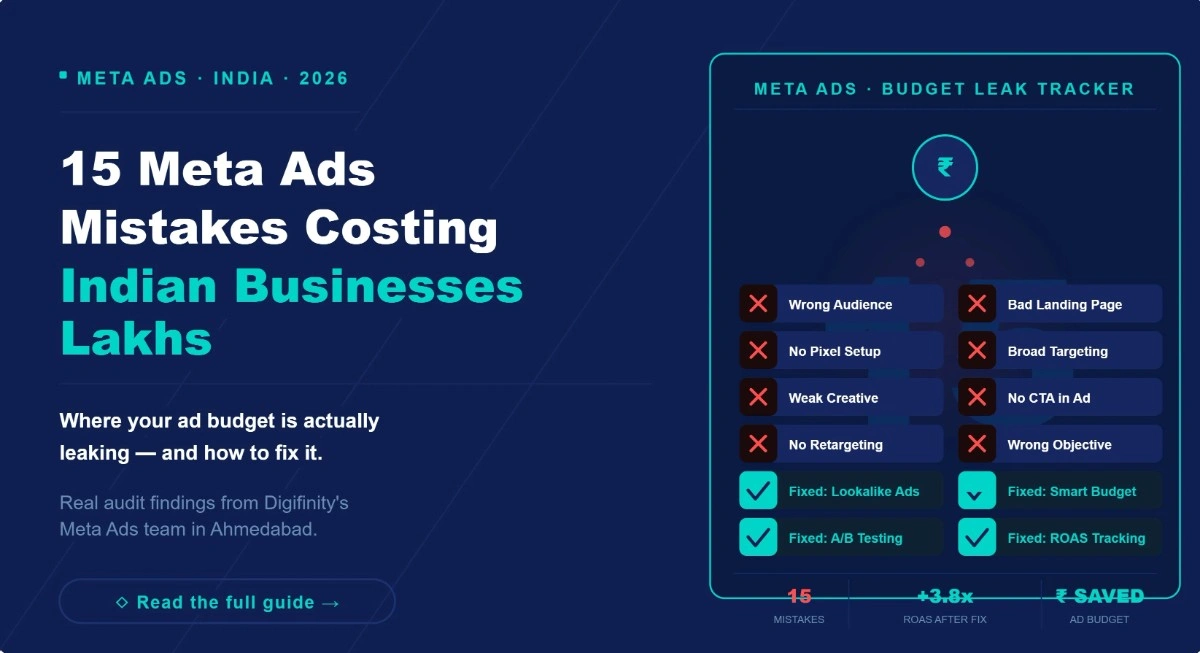
Where your ad budget is actually leaking, and how to fix it?
Running Meta Ads in India in 2026 without a clear strategy is one of the fastest ways to burn through a marketing budget. Somewhere in Ahmedabad right now, a small business owner is staring at their Meta Ads dashboard, watching the spend counter climb while the enquiries stay flat. It’s a familiar scene. The creative looks fine, the offer is decent, and yet the numbers refuse to add up and nine times out of ten, the reason has nothing to do with luck or a “saturated market.”
A digital marketing agency in Ahmedabad, we’ve sat inside enough of these ad accounts to recognise the pattern almost immediately. India’s digital advertising market continues to grow rapidly, which sounds like good news until you realise it also means more brands bidding for the same eyeballs and less room for an account built on guesswork. The platform rarely deserves the blame it gets. What actually costs businesses lakhs every year is far less dramatic: an audience set too wide, a pixel firing on the wrong page, a landing page that loses people before they scroll.
This piece walks through the fifteen Meta Ads mistakes we come across most often while auditing Indian ad accounts, grouped across targeting, creative, budgets and tracking, along with what tends to move the needle fastest once each one gets fixed.
Why Are These Mistakes Getting More Expensive in 2026?
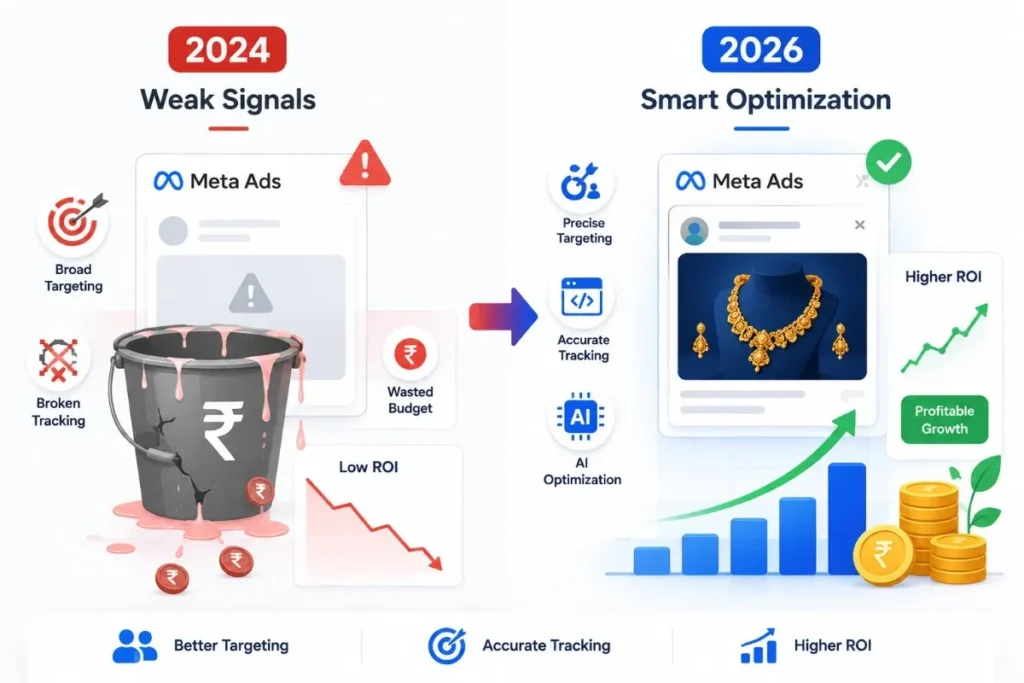
A few years ago, a poorly targeted campaign might have limped along at a mediocre return. Today, with more advertisers bidding for the same audiences and Meta’s algorithm leaning harder on signal quality, sloppy setups get punished faster. Weak targeting or a broken pixel doesn’t just underperform, it actively teaches the algorithm to optimize for the wrong outcome, which compounds the damage with every rupee spent. This is exactly why so many businesses feel like Meta Ads “stopped working” when, in reality, the account was never built to survive a more competitive auction.
Still running Meta Ads on guesswork while your competitors fix theirs?
Every week your account stays unaudited is another week of budget leaking into the wrong audience.
Explore Our ServiceThe 15 Meta Ads Mistakes Draining Ad Budgets Across India:
Targeting and Audience Mistakes:
1. Targeting everyone instead of a defined buyer: Many Indian SMEs still set campaigns to reach “18 to 65, all of India” because a wide net feels safer. It isn’t. Meta’s system needs a tight enough signal to find genuine buyers, and broad, undefined targeting simply hands your budget to whoever clicks, not whoever converts.
2. Ignoring lookalike audiences built from real customers: A brand’s best targeting data is sitting in its own customer list, yet most accounts we audit have never uploaded one. Building a lookalike from actual buyers consistently outperforms interest-based targeting, because it’s modelled on people who already paid, not people who merely fit a demographic guess.
3. Running every city the same way: A creative and offer that works in Mumbai rarely performs identically in Surat or Indore. Cost per click, buying behaviour and even the language that resonates can shift meaningfully city to city, and treating the whole country as one audience wastes the budget that could have been redirected to stronger-performing geographies.
4. Letting audience overlap can cannibalise your own campaigns: When multiple ad sets target overlapping audiences, they end up bidding against each other in the same auction, inflating costs for both. This is one of the quieter budget leaks because nothing looks obviously broken, the numbers just creep upward for no clear reason.
A few signs your targeting has drifted off course:
- Frequency climbing past 3–4 while conversions stay flat or fall
- Cost per click rising steadily with no change in creative or offer
- One ad set consistently starving another of budget in Meta’s delivery insights
- Click-through rate that looks healthy but rarely turns into a genuine enquiry or sale
Creative and Messaging Mistakes:
5. Using the same creative for months: Ad fatigue is real, and Indian audiences scroll through an enormous volume of content daily. A creative that performed brilliantly in month one can quietly decay by month three, with rising costs the only visible symptom until someone checks the frequency metric.
6. Writing an ad copy that talks about the brand, not the buyer: “We are India’s leading manufacturer of…” is a sentence about the business. It should be about the problem the buyer is trying to solve. Copy built around outcomes and objections consistently outperforms copy built around company credentials.
7. Ignoring Reels and short-form video placements: Static image ads still have a place, but short-form video placements now carry a meaningfully lower cost per impression on Meta’s network, and Indian audiences in particular have shifted their attention there. Brands still allocating most of their budget to feed images alone are leaving cheaper reach on the table.
8. Sending traffic to a weak landing page: No amount of clever targeting rescues a slow, cluttered or confusing landing page. This is arguably the single most underestimated mistake on this list: the ad did its job by earning the click, and the page then lost the sale.
Budget, Bidding and Structure Mistakes:
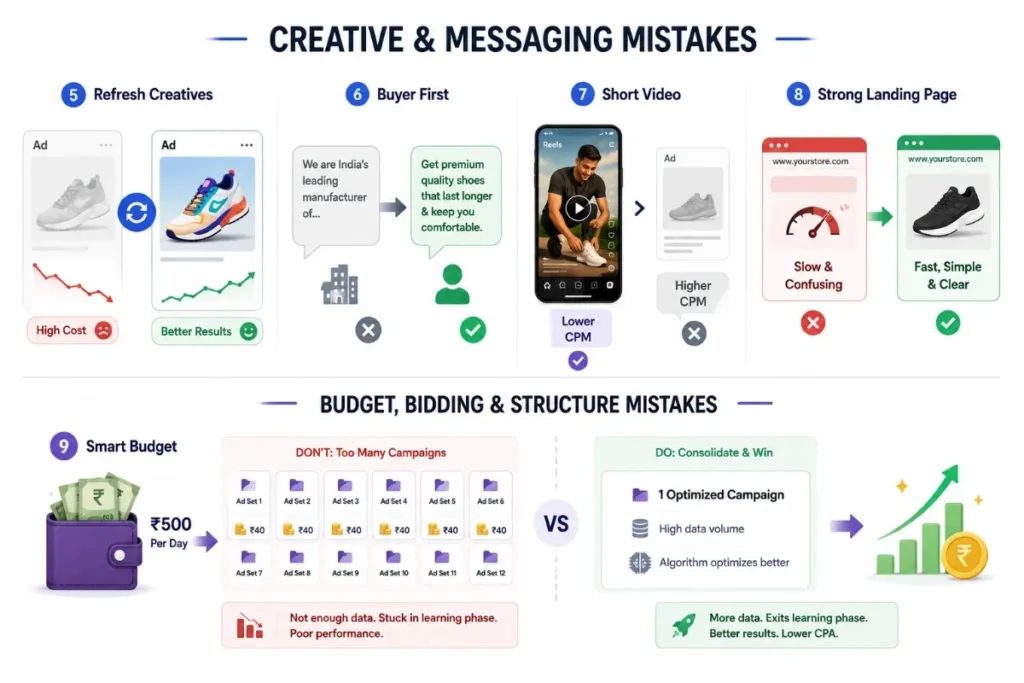
9. Splitting budget across too many campaigns: Meta’s algorithm needs enough conversion volume per ad set to exit the learning phase and optimize properly. Spread ₹500 a day across twelve ad sets and none of them ever gather enough data to perform well consolidation almost always beats fragmentation.
10. Panicking and pausing campaigns too early: Every time an ad set is edited or paused and relaunched, it re-enters the learning phase and temporarily loses efficiency. Judging performance after two days and hitting pause is one of the most common ways businesses sabotage a campaign that simply needs more time to stabilize. Recent Meta Ads benchmark data shows just how much cost metrics like CPM and CPC swing across industries and geographies, which is exactly why judging a fresh campaign against a generic “good CPM” figure instead of your own account’s baseline is one of the fastest ways to panic and pause too early.
11. Fighting the algorithm with manual bids too soon: Manual bidding has its place for experienced media buyers, but for most Indian businesses without deep historical data, it restricts Meta’s delivery system before it has learned enough to bid intelligently on your behalf.
Tracking, Attribution and Optimisation Mistakes:
12. Running ads without a properly configured pixel: This sounds basic, yet it’s one of the most frequent issues found during account audits, pixels installed on the wrong page, firing twice, or missing purchase values entirely. Detailed pixel troubleshooting guidance confirms that a large share of “Meta Ads aren’t working” complaints actually trace back to broken measurement, not poor delivery.
13. Relying on last-click attribution alone: Meta Ads frequently influence a purchase without earning the final click, especially for higher-consideration products. Judging performance purely on last-click numbers understates the channel’s real contribution and often leads to premature budget cuts.
14. Optimising for the wrong conversion event: Optimising for “add to cart” when the actual business goal is “purchase” teaches Meta to find cart-adders, not buyers. These are frequently different audiences, and this single misconfiguration quietly derails an otherwise well-built campaign.
15. Never auditing ad account structure: Accounts built two or three years ago rarely reflect current best practice. Old campaigns left running, outdated pixels, and stale audiences accumulate over time, and without a periodic audit, businesses keep paying for inefficiencies nobody ever goes back to check.
Quick Reference: The Five Costliest Mistakes at a Glance
| Mistake | Real Business Impact | Fastest Fix |
| Broad, undefined targeting | Budget spent on low-intent clicks | Build a lookalike from paying customers |
| Weak or slow landing page | Clicks paid for, sales lost | Redesign for speed and a single clear action |
| Fragmented budgets across ad sets | Campaigns never exit learning phase | Consolidate into fewer, better-funded ad sets |
| Broken or missing pixel | Inaccurate data, poor algorithm decisions | Audit pixel setup and event configuration |
| Optimising for the wrong event | Algorithm finds the wrong audience | Align conversion event with actual business goal |
The Real Cost: What These Mistakes Add Up To
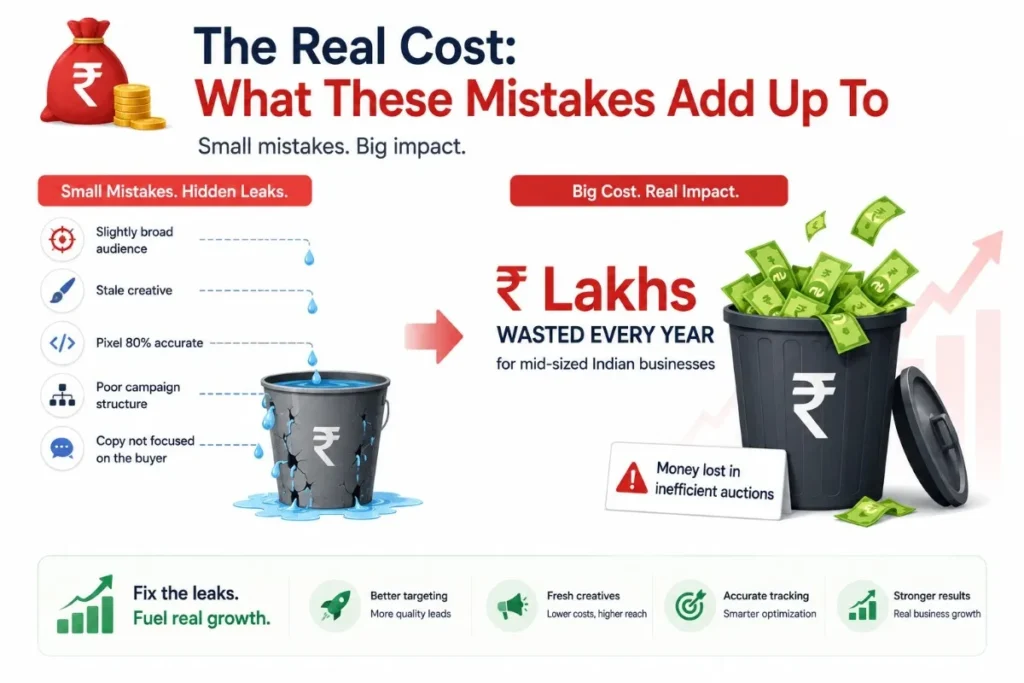
None of these fifteen mistakes looks dramatic in isolation. That’s precisely why they’re so expensive: a slightly broad audience here, a slightly stale creative there, a pixel that’s 80% accurate instead of fully accurate. Individually, each one shaves a few percentage points off performance. Together, across a year of continuous spend, they routinely add up to lakhs in wasted budget for mid-sized Indian businesses, money that could have funded genuine growth instead of quietly disappearing into an inefficient auction.
How Digifinity Fixes These Mistakes:
As a performance marketing agency, our first move with any new Meta Ads account is never to launch new campaigns, it’s to audit the existing one. Most of the fifteen mistakes above surface within the first hour of digging through an account’s structure, pixel events and audience overlap reports.
Our process generally follows the same sequence, regardless of industry:
- Audit: the account structure, pixel health and past 90 days of spend data
- Rebuild: targeting around real customer data rather than broad demographic guesses
- Test: creative and copy variations in small, controlled batches before scaling
- Scale: only the combinations that prove themselves with real conversion data
This order matters. Skipping straight to scaling before the foundation is fixed simply scales the mistakes alongside the spend.
Where SEO Meets Paid Social: A Smarter Growth Stack
Meta Ads rarely perform in isolation from the rest of a business’s search presence. A prospect who clicks an ad, doesn’t convert immediately, and later searches the brand name on Google forms a completely different impression depending on what shows up. If the first organic result is a thin, outdated website with no reviews or credibility signals, the ad has effectively worked against itself; it earned the click, then lost the trust a moment later.
This is where most Meta Ads strategies stop too early. They treat the ad as the entire journey, when for anything beyond an impulse purchase, it’s really just the opening move. Businesses that pair paid social with strong SEO services in Ahmedabad tend to see paid campaigns convert better too, simply because the brand looks established and trustworthy the moment someone checks and that second look happens far more often than most advertisers assume.
Why Continuous Optimisation Matters?
Meta Ads is not a “set it and forget it” channel, and businesses that treat it that way tend to relearn these fifteen mistakes every few months as the algorithm and auction dynamics shift. What worked in January can quietly stop working by April not because the strategy was wrong, but because the auction, the audience, and even Meta’s own ranking signals keep moving underneath it.
Broader industry analysis of common Meta Ads mistakes consistently points to the same pattern: accounts that are reviewed and adjusted weekly outperform those left running untouched, even when the initial setup was solid. A weekly check doesn’t need to mean a full rebuild often it’s as simple as pausing a fatigued creative, tightening an audience that’s drifted, or catching a tracking issue before it skews a month’s worth of decisions.
A Quick Note for App-Based Businesses:
Most of this piece talks about website traffic, but app-based businesses run into the same problems wearing a different costume. Vague targeting still fills your app with people who install it once and never open it again. A broken SDK event is really just a pixel problem in a different wrapper.
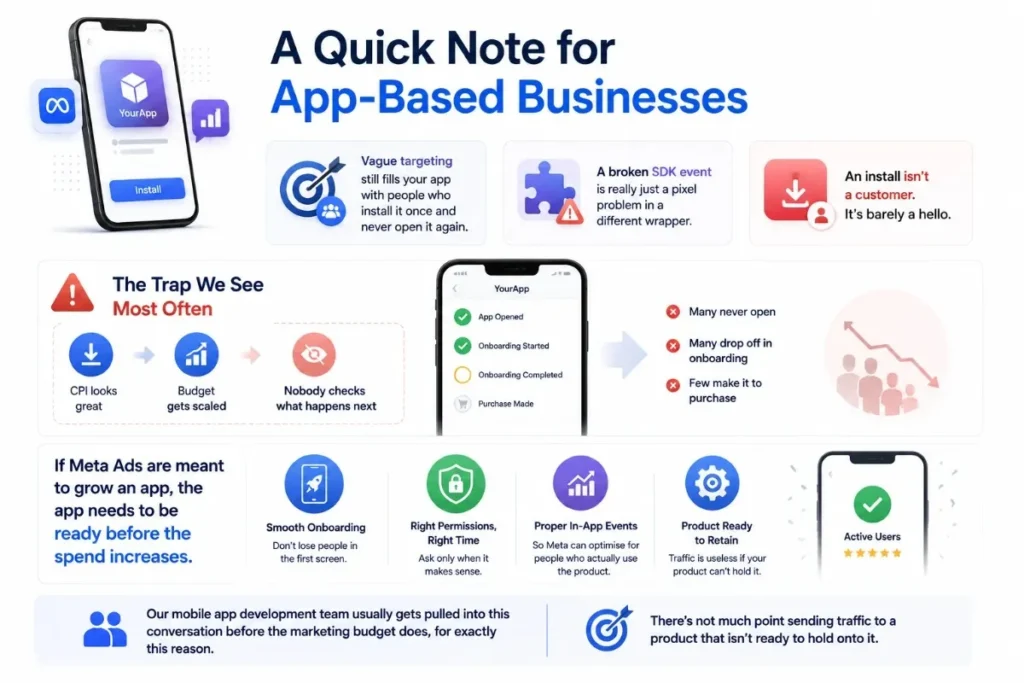
Here’s the trap we see most often: cost-per-install looks great, so the budget gets scaled up. Nobody stops to check whether those installs are actually opening the app, getting through onboarding, or buying anything. An install isn’t a customer. It’s barely a hello.
If Meta Ads are meant to grow an app rather than a website, the app needs to be ready before the spend increases onboarding that doesn’t lose people in the first screen, permissions asked for at the right moment, and in-app events set up properly so Meta can optimise for people who actually use the product. Our mobile app development team usually gets pulled into this conversation before the marketing budget does, for exactly this reason there’s not much point sending traffic to a product that isn’t ready to hold onto it.
Why Choose Digifinity as Your Digital Marketing Agency in Ahmedabad?
There’s no shortage of freelancers and small agencies willing to “run your Meta Ads.” What’s harder to find is a digital marketing agency in Ahmedabad that treats paid social as one part of a connected growth strategy rather than an isolated task. As a digital marketing agency in India working across performance marketing, PPC management and social media, we build campaigns around measurable business outcomes not vanity metrics like reach or impressions.
Whether you need a full audit of an underperforming account or a PPC management company in Ahmedabad to build from scratch, the goal stays the same: fewer wasted rupees, more qualified leads, and a Meta Ads account that gets more efficient over time instead of less.