
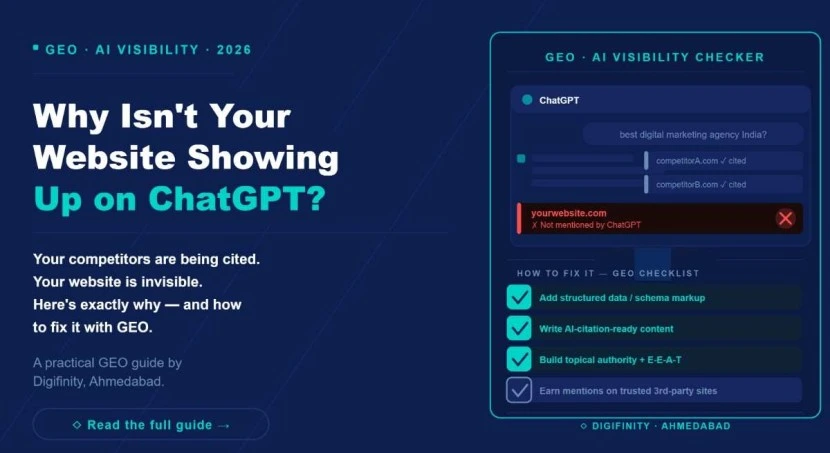
AI Crawlers Are Being Blocked Without Anyone Noticing:
A founder asked us last month why their site ranks on page one of Google for their core keyword, yet ChatGPT has never once mentioned their business when a prospective customer asks for a recommendation. It’s a fair question, and it’s coming up in almost every strategy call we run now. As the best SEO company in India working across both traditional search and AI-driven discovery, this is the exact gap we spend most of our time closing.
For context on how differently these systems actually retrieve and construct answers, Wikipedia is a useful starting point before we get into the mechanics.
The honest answer is that ranking on Google and being cited inside a ChatGPT answer are governed by two overlapping but distinct sets of rules. A page can be technically sound, well-written, and ranking respectably, and still never get pulled into a generative answer. That’s not a bug in your SEO. It’s a gap in how the content was built for retrieval in the first place.
This isn’t a fringe concern anymore, either. We’re seeing the same question from clinics, SaaS founders, ecommerce brands, and B2B service providers alike different industries, same underlying frustration. Their websites do the job on Google. On ChatGPT, Perplexity, or Gemini, they’re invisible, while a competitor with a thinner content library and fewer backlinks gets named confidently, every time. Once you understand what’s actually driving that gap, it stops looking mysterious and starts looking like a fixable technical and structural problem.
What’s Actually Happening When ChatGPT “Doesn’t Show” a Website?
There’s rarely one single reason. Usually it’s a combination of smaller gaps compounding into invisibility.
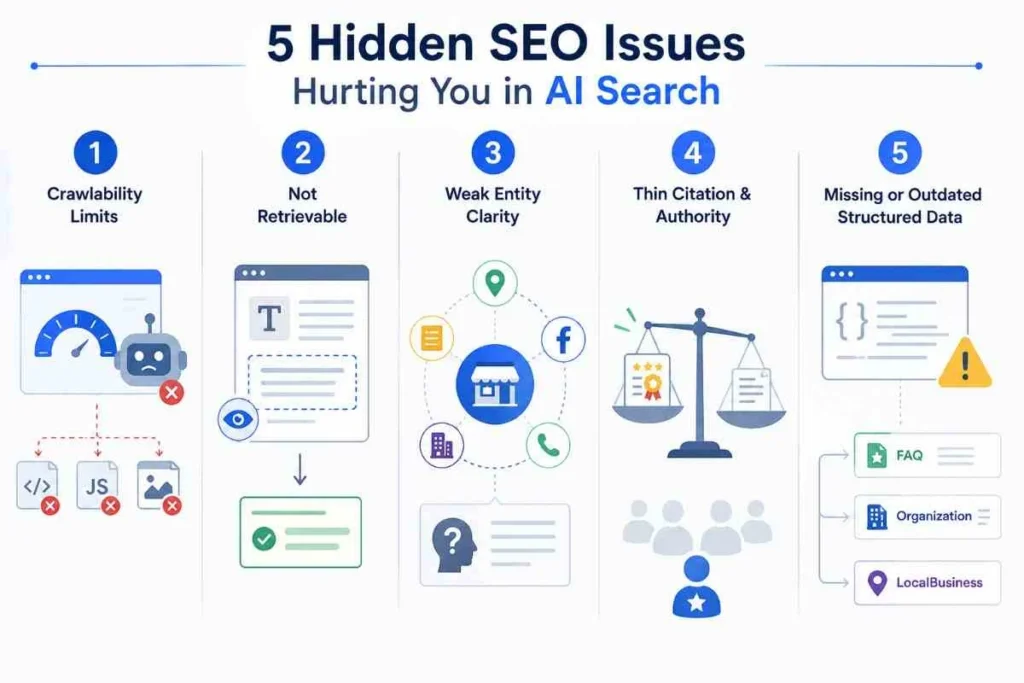
Crawlability isn’t the same problem it used to be:
Most sites we audit are crawlable in the traditional sense Googlebot can reach the pages, index them, and rank them. But AI systems that browse the live web (rather than relying purely on a pre-trained snapshot) often apply stricter thresholds for page speed, render-blocking scripts, and JavaScript-heavy content. If a generative engine’s retrieval layer times out or can’t parse the DOM cleanly, your content simply never enters the pool of candidates it’s choosing from.
Your content might be readable, but is it retrievable?
Readable and retrievable aren’t the same thing. A 1,500-word blog post written in flowing narrative paragraphs might read beautifully to a person, but a model assembling an answer needs discrete, self-contained chunks of information it can lift cleanly. Content that buries the actual answer three paragraphs into a story-led introduction gets skipped in favour of a competitor who states the fact in the first sentence.
Weak entity clarity is the silent killer:
Generative engines lean heavily on how clearly your brand, services, and location are defined as distinct entities across the web, not just on your own site. If your business name, service names, and location appear inconsistently across your site, directories, and social profiles, the model has a harder time confirming who you are and what you actually do with confidence.
Thin citation and authority signals:
If your services page or blog post is one poorly-cited claim among ten pages saying the same generic thing, there’s no reason for an AI system to prefer you. As explained by Search Engine Land, these systems consistently favour sources that demonstrate durable authority and clear attribution over sources that simply repeat commonly known information.
Missing or outdated structured data:
A surprising number of sites we audit either have no schema markup at all or are running FAQ and Organisation schema that hasn’t been touched in years. Structured data is one of the clearest signals you can hand an AI system. It removes the guesswork around what a page is, who published it, and what specific question each section answers. Without it, the model has to infer structure from raw HTML, and inference is inherently less reliable than explicit markup.
Ready to find out where your visibility gaps actually are?
A short audit tells you exactly what’s blocking you from AI answers, no guesswork, no generic checklist.
Explore Our ServiceSEO vs GEO: Why the Old Playbook Isn’t Enough Anymore?
| Factor | Traditional SEO | Generative Engine Optimisation (GEO) |
| Goal | Rank in the ten blue links | Get cited or mentioned inside the generated answer |
| Success metric | Position, click-through rate | Citation frequency, mention share |
| Content format | Long-form, keyword-optimised | Chunked, fact-dense, self-contained passages |
| Trust signal | Backlinks, domain authority | Entity consistency, structured data, cross-platform corroboration |
| Update cycle | Periodic content refreshes | Continuous, since answers regenerate per query |
Neither discipline replaces the other. Strong technical and on-page SEO is still the foundation that makes GEO possible; you can’t get cited in an AI answer if the page underneath it is broken, slow, or invisible to crawlers in the first place.
If you want the term itself unpacked in more depth, Generative Engine Optimization is a useful companion read alongside this piece.
Why Has This Become a Revenue Problem, Not a Vanity Metric?
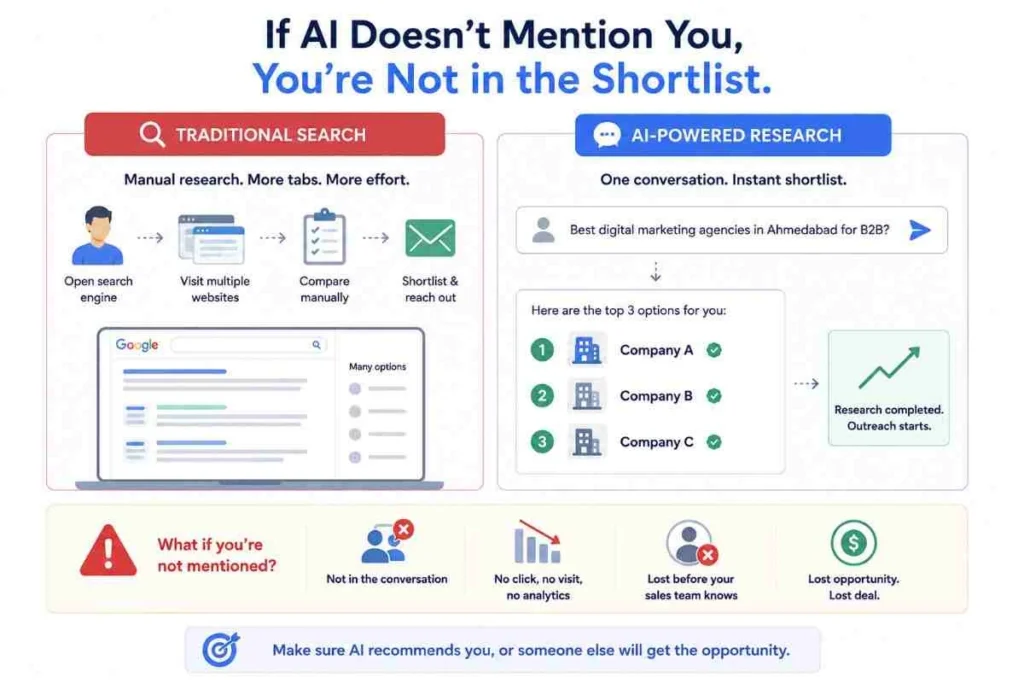
Buyers now research vendors, compare service categories, and shortlist providers inside a chat window before they ever open a search engine tab. When your competitor gets named in that conversation and you don’t, you’ve lost the deal before your sales team even knows the prospect existed. This isn’t a future risk to plan around; eventually it’s already reshaping how shortlists get built across most B2B and considered-purchase categories in India.
Think about how a founder actually researches vendors today. They don’t open ten tabs and compare homepages line by line anymore. They ask an AI assistant to shortlist three options, skim the answer, and start outreach from there. If your business isn’t in that shortlist, you’re not losing a click, you’re losing the entire opportunity to be considered, and you likely won’t even know it happened. There’s no bounce in your analytics for a conversation that never mentioned you.
How We Fix AI Visibility Our GEO-Led SEO Approach?
We don’t treat this as a separate service bolted onto SEO. It’s built as one connected system: fixing the technical and structural layer search engines and AI crawlers both depend on, then layering entity strengthening and answer-ready content structuring on top. Some agencies now market this bundle as ai seo services, though the label matters less than whether the methodology actually holds up against how retrieval systems behave.
This sits on top of the same foundation as our core SEO services. GEO doesn’t work as a bolt-on if the technical SEO underneath it is weak, so we start there rather than skipping straight to schema and content restructuring.
For businesses whose core offering runs through their own web application or platform, this work often overlaps with development-side fixes, particularly where slow rendering or poor page structure is a development issue disguised as a content problem.
What’s Included?
None of this works as a one-off checklist you tick and forget. It has to run as a system that keeps adjusting as the models themselves change. In practice, that looks like:
- Full AI-retrievability audit crawl behaviour, render performance, and structured data gaps
- Entity mapping and consistency correction across your site, directories, and social presence
- Content restructuring into fact-dense, citation-ready passages with clear direct answers
- Schema implementation FAQ, Organisation, Product, and Article markup where relevant
- Ongoing monitoring of mention frequency and citation share across major AI platforms
- Ecommerce and multi-location entity clean-up for businesses with several storefronts or service areas
Each piece feeds the others, which is easy to underestimate. Fix schema without restructuring the content underneath it, and it barely moves anything. Restructure content on a site with messy entity consistency, and you’ve just handed the model conflicting signals to sort through. Order matters here almost as much as the individual fixes do.
The Business Impact of Being Cited by AI Search:
Businesses that get this right see a few things shift, and not always in the order you’d expect. Enquiries start arriving further along in the decision process, because the AI answer already did some of the convincing before the person even landed on the site. Brand recall gets a boost too being named inside a conversational answer just sticks with people more than a blue link ever did. And the advantage compounds. AI systems tend to keep citing sources they’ve already trusted rather than reshuffling the whole list with every query, so getting in early matters more here than it does with Google rankings.
Our Process From Audit to AI Citations:
We start with discovery and an entity audit. Before touching anything, we map your current footprint across search, directories, and AI platforms. You’d be surprised how often a business finds out mid-audit that three different directories list three different addresses.
Next comes the technical and retrievability fixes. This is the unglamorous part: resolving crawl issues, render problems, speed bottlenecks, whatever’s blocking search engines and AI browsing agents from reaching your content cleanly.
Then we move into content restructuring. Priority pages get rewritten into clear, chunked, fact-first formats. Not stripped down, though the depth that builds authority stays, it’s just organised so a model can actually lift the right passage.
Structured data comes after that, not before, because schema markup only helps if it’s describing content that’s already been fixed. This is where FAQ, Organisation, and Article schema get implemented properly, giving machines an explicit signal about what your business does instead of making them guess.
And then it doesn’t stop. We keep monitoring and iterating tracking mention frequency across AI platforms monthly, adjusting as the models themselves change, because they will.
The Frameworks and Technology Behind Our Work:
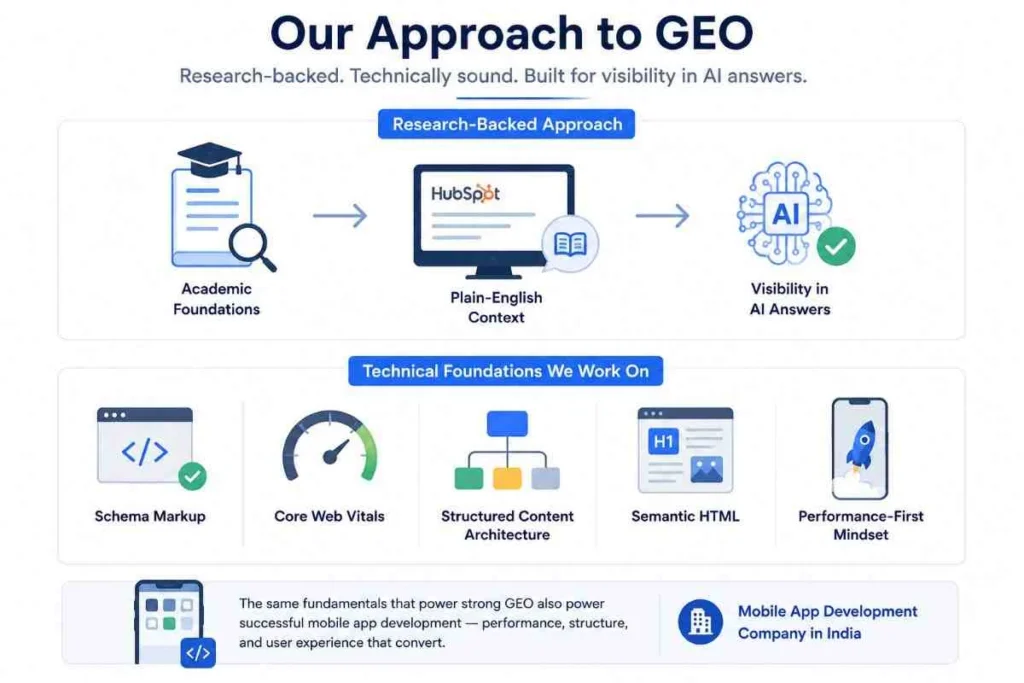
Our approach draws on published research into how these systems actually retrieve and synthesise information, including the original academic work that introduced generative engine optimisation as a discipline. HubSpot is a solid plain-English companion if you want the broader context beyond our own methodology.
On the technical side, we work across schema markup, Core Web Vitals, structured content architecture, and semantic HTML, the same fundamentals that underpin a properly built mobile app development company in India engagement, where performance and structure decide whether a platform actually converts.
Why Digifinity Positioned as the Best SEO Company in India for This?
Most agencies selling GEO right now have simply relabelled their existing SEO service without changing the underlying methodology. We built ours around how retrieval systems actually behave, not around what sounds good in a sales deck. We’re also upfront that this isn’t a fixed-fee, set-and-forget service AI platforms update constantly, and a strategy frozen in place from month one erodes within a quarter.
Coordinating this with paid channels matters too. Whether you’re comparing us as a search engine marketing company or evaluating us purely on organic GEO work, the underlying entity and structural fixes are the same foundation both disciplines pull from. For a deeper look at how GEO principles hold up against real-world implementation trade-offs, Progress’s practical GEO guide is worth a read.