
Why Getting Cited by AI Now Matters More Than Ranking on Google?
Type “best accountant near me” into Google right now and there’s a good chance you won’t see a single website before you see an answer. Google just tells you. That’s the default on a huge share of searches these days, and it’s already reshaping how much traffic ever makes it to a small business’s actual site.
Digifinity works with businesses in Ahmedabad who are watching this play out enquiry numbers holding steady on paid campaigns, organic visits quietly thinning out underneath them. Geo services are the response to that specific problem: getting a business named or quoted inside the answer Google, ChatGPT, or Perplexity generates, rather than hoping someone scrolls past it to a list of links.
Ahrefs ran the numbers across 300,000 keywords and found pages holding the top organic spot lost an average of 34.5% of their clicks whenever an AI Overview sat above them. Rank #1 used to mean close to guaranteed traffic. It doesn’t anymore.
Why Is AI Search Squeezing Small Business Visibility?
For years, the rules of online visibility were fairly stable: publish useful content, earn some backlinks, rank on page one, and the clicks would follow. That formula has cracked. AI Overviews, chatbot answers, and conversational search assistants now sit between a business and its customer, summarising information before anyone reaches a website.
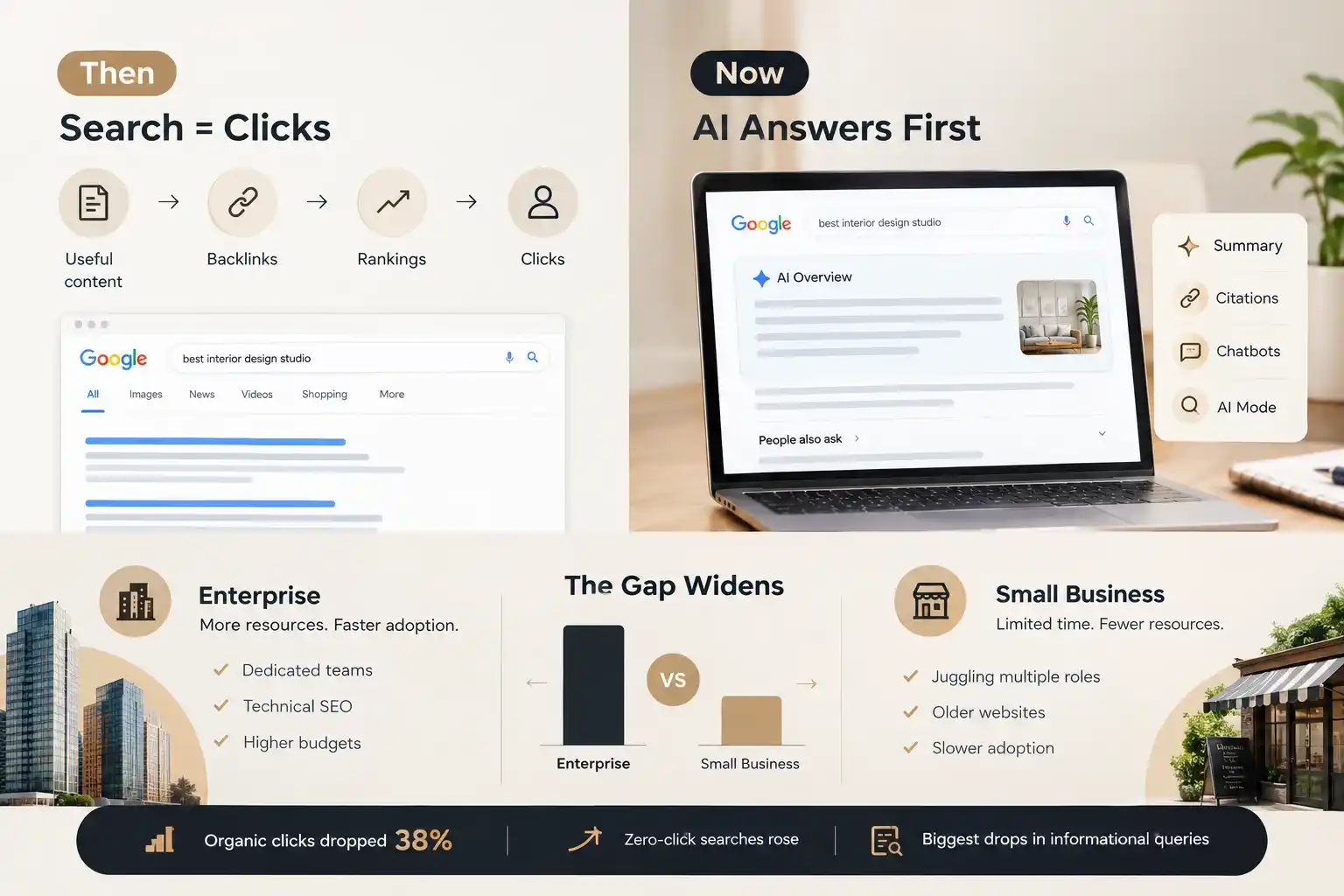
Large companies can absorb this shift. They have content teams, technical SEO specialists, and budgets to experiment with new formats. Small businesses rarely have that luxury. A local accounting firm, a boutique retailer, or a regional service provider is often running marketing alongside a dozen other responsibilities, with no time to decode how generative engines decide what to cite.
There’s also a structural disadvantage at play. Enterprise sites tend to already have the technical foundations, clean schema, established domain authority, dedicated engineering resources that make GEO adoption faster. A small business is often starting from a website that was built years ago, with none of that groundwork in place. Catching up isn’t impossible, but it does mean the gap widens the longer a business waits to address it.
The result is a widening gap. A randomised field study found organic clicks fell by 38% on queries where an AI Overview appeared, with zero-click searches rising sharply in the same conditions and the steepest drops landed on informational queries, exactly the kind small businesses rely on to build early-funnel awareness. Businesses that keep optimising purely for traditional rankings are measuring themselves against a version of search that no longer exists.
What Are GEO Services?
Generative Engine Optimisation, usually shortened to GEO, is the discipline of structuring a website’s content so that AI systems Google’s AI Overviews, ChatGPT, Perplexity, Copilot can understand it, trust it, and quote it directly in their answers. It sits alongside traditional SEO rather than replacing it, but the priorities shift noticeably.
Where conventional SEO optimises for keyword relevance and backlink authority, GEO optimises for extractability and trust signals a language model can verify quickly: clear factual statements, consistent structured data, first-hand expertise, and content that answers a question in the first two sentences rather than the last two paragraphs. Digifinity’s SEO services in Ahmedabad already build much of this foundation. GEO adds the layer on top that determines whether a language model actually references your business when it generates a response.
Salesforce frames this shift plainly: GEO is teaching AI who you are, so that when a customer asks a generative engine a question, a small business has a genuine chance of being the answer rather than being skipped entirely.
For a small business, this distinction matters commercially. Being ranked tenth on a search results page is nearly invisible. Being cited inside an AI Overview, even briefly, puts a brand name in front of a customer who is actively looking for a solution often before that customer has decided which company to contact.
Not Sure Where Your Business Stands in AI Search?
Most businesses have no visibility into whether they’re being cited or bypassed by AI Overviews and chatbot answers right now. Digifinity runs AI visibility audits that show exactly where the gaps are.
Core Components of a GEO Strategy:
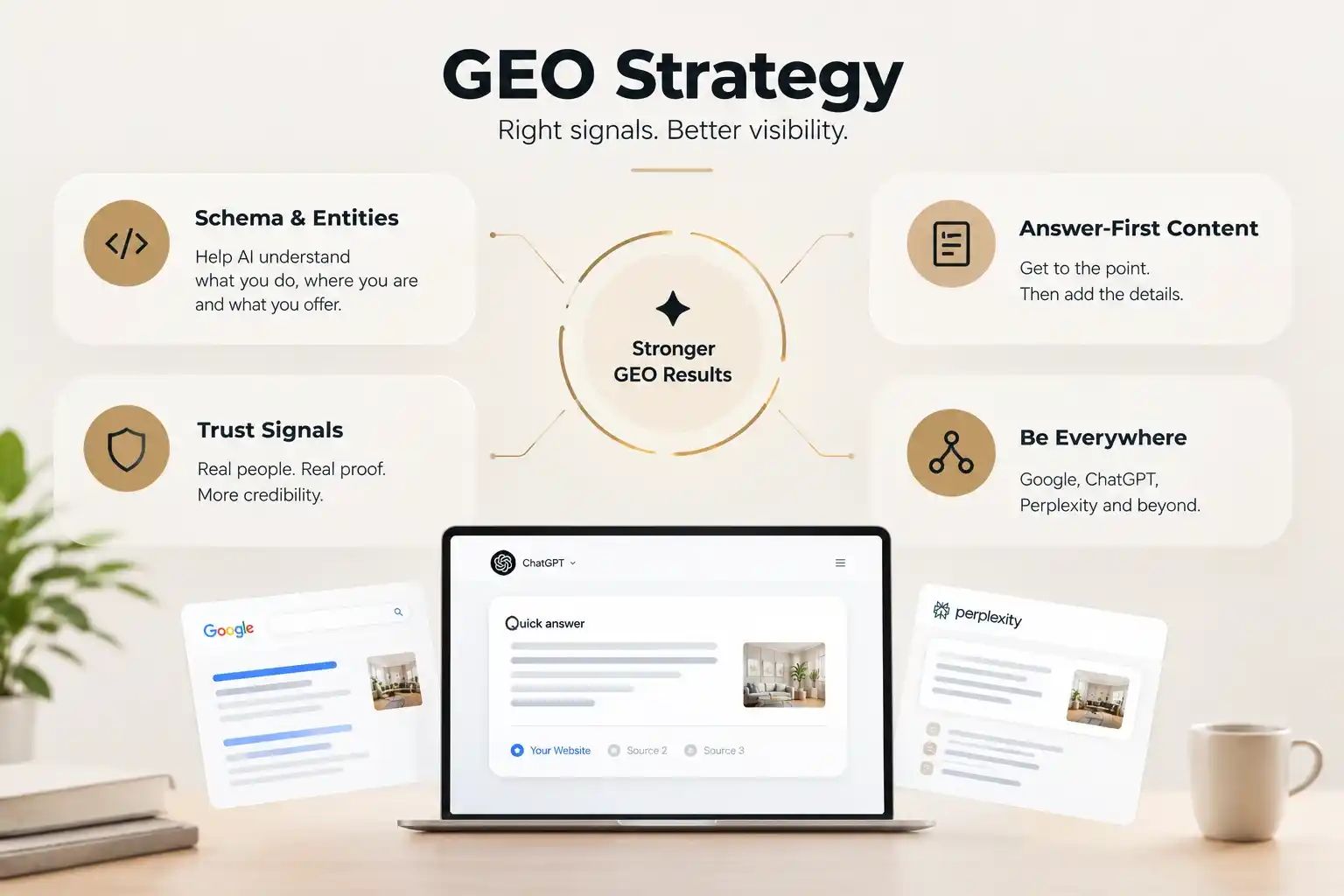
A working GEO strategy isn’t one trick, it’s a handful of things working together. Here’s what tends to actually move the needle:
- Schema markup and entity clarity matter more than most businesses expect. If an AI system can’t work out exactly what you do, where you’re based, and what you’re selling, it tends to skip you in favour of a competitor whose data is unambiguous.
- Content performs better when the answer comes first. Bury the useful sentence three paragraphs down and a model has no clean line to lift open with it, then back it up with detail.
- Trust signals still carry real weight. Author names, genuine case studies, original data, anything that gives a language model a reason to treat a page as more reliable than a generic rewrite of the same topic.
- Presence isn’t limited to Google anymore. ChatGPT and Perplexity are increasingly where people research before they even open a search engine, so visibility needs to extend there too.
Each piece props up the others more than it stands alone. Get the schema right but write vague, generic copy, and a model still passes the page over. Write beautifully and skip the structured data, and that same model struggles to parse what it’s reading with any confidence.
Tools and Technologies Powering GEO:
Executing a GEO strategy well depends on pairing the right tooling with editorial judgement. Structured data validators confirm that schema markup renders correctly before it ever reaches a crawler. AI visibility trackers are a newer category of tool that monitors whether and how often a brand gets cited across different generative engines, filling a gap that traditional rank trackers were never built to cover.
On the content side, natural language processing tools help identify the phrasing patterns that AI Overviews tend to quote, while citation analysis tools reveal which competitor pages are currently winning that visibility and why. None of this technology replaces strong writing or genuine subject expertise; it simply shows where the gaps sit so effort gets spent where it counts.
Business Impact: Why Does This Matters Now?
The commercial case for acting now, rather than waiting, comes down to timing. AI Overviews already appear on a majority of commercial-intent searches, and that share keeps climbing. Search Engine Land reported that click-through rates on AI Overview results are shifting month to month, which means visibility inside those summaries is not a fixed target; it rewards businesses that establish citation early and defend it.
| Traditional SEO Alone | GEO + SEO Combined | |
| Visibility in AI Overviews | Rarely cited | Actively targeted for citation |
| Content format | Keyword-optimised pages | Answer-first, structured, verifiable |
| Competitive position | Competing for page-one rankings only | Competing for both rankings and AI citations |
| Exposure to zero-click search | High risk of being bypassed entirely | Positioned to appear inside the answer itself |
Small businesses that adapt early are not just protecting existing traffic they’re capturing a form of visibility that many competitors haven’t started building yet. Digifinity’s performance marketing companies work often reveals the same pattern: brands that diversify how they get found outperform those relying on a single channel, and GEO is quickly becoming one of those channels a business cannot skip.
There’s a compounding effect worth noting too. Once an AI system starts citing a particular source consistently for a given topic, that pattern tends to persist, because the model has effectively learned to trust it. Businesses that establish citation early aren’t just gaining a temporary edge; they’re building a form of authority that becomes harder for late-arriving competitors to dislodge, much like backlink authority did in traditional SEO.
How Digifinity’s GEO Process Works?
Digifinity approaches GEO as a structured, repeatable process rather than a one-off audit. A typical engagement runs through five stages:
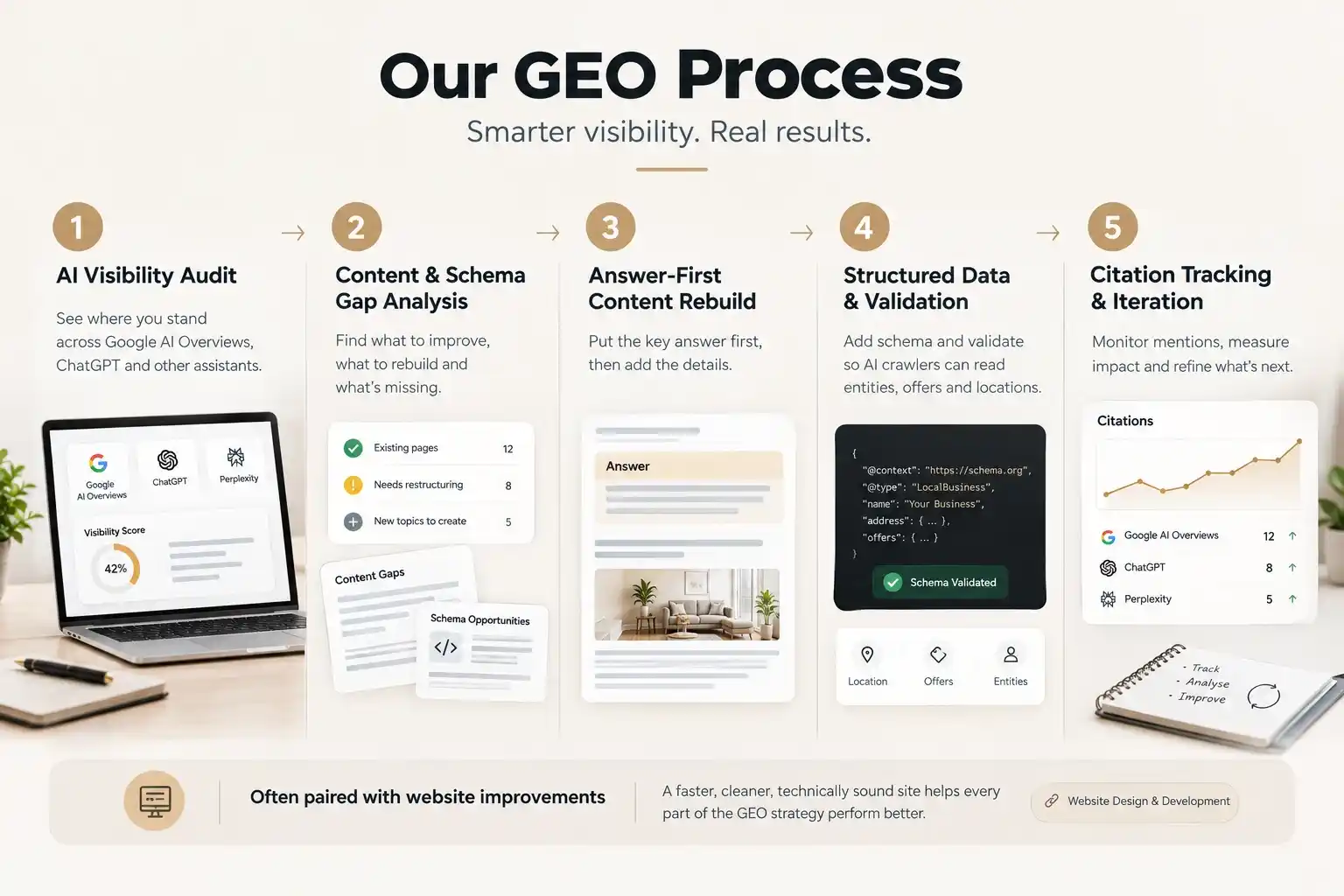
- First comes an AI visibility audit working out where a business currently stands across Google AI Overviews, ChatGPT, and other assistants for the queries that actually matter to it.
- From there, a content and schema gap analysis flags which existing pages can be restructured for citation and which topics need building from scratch.
- Priority pages then get rebuilt answer-first, so the most useful line sits right at the top of a section, with the supporting detail filled in underneath it.
- Structured data goes in alongside that rebuild schema deployed and validated across the site so AI crawlers can read entities, offers, and locations without guessing.
- Once the changes are live, citation tracking runs on an ongoing basis, checking how often and where the business actually gets referenced, and feeding that back into what gets adjusted next.
This process usually runs alongside broader digital presence work. For many clients that includes refreshing the site itself through Digifinity’s website design company team, since a technically clean, fast-loading site makes every other part of the GEO effort work harder.
What GEO Services Typically Cost for a Small Business?
Pricing for GEO work varies with scope, but small businesses generally start with a focused engagement rather than a full-site overhaul. A typical starting point covers an AI visibility audit, schema implementation across core pages, and a rebuild of the five to ten highest-traffic pages enough to establish measurable citation gains without committing to a large retainer immediately.
As results build, most businesses expand into ongoing content production and wider structured data coverage. The investment tends to compare favourably against paid search, since citation inside an AI Overview carries no per-click cost once it’s earned unlike a paid ad position that disappears the moment the budget runs out.
Budget conversations are worth having early rather than after a proposal lands, since scope genuinely varies by industry, current site condition, and how competitive the target queries already are.
Why Do Small Businesses Choose Digifinity for GEO?
Digifinity works from Ahmedabad with a client base that includes small and mid-sized businesses across India, which means the strategies built here account for the budget realities and growth pace that larger agencies often overlook. The team has already run technical SEO audits, structured data corrections, and content rebuilds across its own client portfolio, applying the same discipline it recommends to others.
Clients typically come in through Digifinity’s broader digital marketing work search, social, and web development and add GEO once they see how quickly AI-driven search is reshaping their category. That breadth matters: a business getting cited in an AI Overview still needs a fast, well-built website behind that citation, which is where Digifinity’s ecommerce website design and web development teams come in, ensuring the visitor who does click through finds a site that converts.
There’s also a practical advantage to working with a team that handles GEO alongside the rest of a business’s digital presence rather than as an isolated add-on. Schema changes need to be checked against site performance, content rebuilds need to align with existing brand voice, and citation tracking needs to feed back into whatever channel is actually driving enquiries. Handling all of that under one roof avoids the disconnect that often happens when GEO is bolted on as a separate, unconnected service.