
Why treating B2B search like B2C search costs you qualified pipeline not just traffic.
As a digital marketing agency in Ahmedabad, we see this mistake cost B2B clients a real pipeline all the time treating B2B and B2C SEO as the same discipline.
Digital marketing considers search engine optimization (SEO) to be a “one-size-fits-all” discipline, but that way of thinking is a costly error. While technical fundamentals including site speed and mobile-friendly responsive design are generally true for all forms of SEO, each association’s strategic implementation of B2B SEO compared to B2C SEO is as different as buying something in-store (retail) on impulse vs. executing a multi-year agreement between two enterprise businesses.
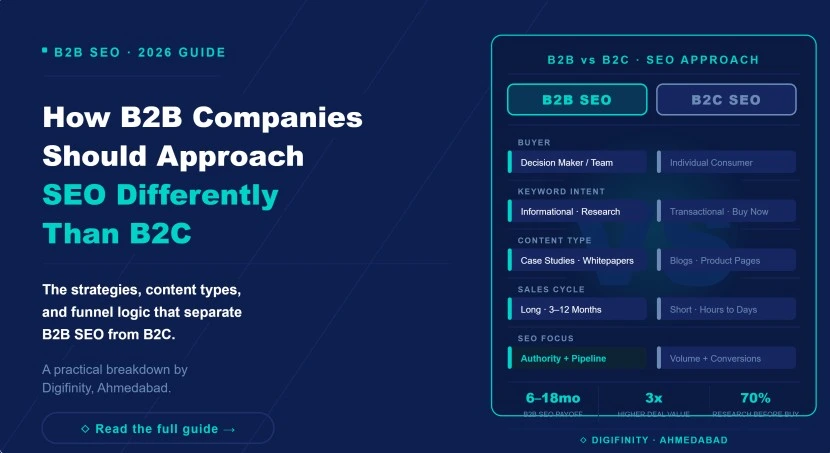
Success as a B2C brand is generally a numbers game. Your target is built around mass volume: millions of impressions, high click-through rates, and immediate “add to cart” actions. Conversely, in the B2B industry, chasing high volume traffic can often create a “volume trap.” If you’re looking to sell a $50k SaaS solution, 1000 casual website visitors have considerably less value than 10 qualified decision-makers representing prospect accounts.
According to Gartner research, B2B buyers spend just 17% of their total purchase process meeting with suppliers. This means the influence of your organic search presence is the primary driver of your success before a sales call is made. If you want to win in this space, your SEO will need to move beyond generic keywords and focus on generating high-value pipeline traffic.
1. Decoding Search Intent: From Emotional Impulse to Rational Risk Mitigation
One of the biggest differences between B2B and B2C SEO is how people are motivated by search intent. When someone does a B2C search, they are searching because they either want something, need something right away, or are looking for entertainment. On the other hand, when someone does a B2B search, they’re searching because they have an obligation to ensure their investment yields a positive return, the solution is effective and efficient and there are low levels of risk.
With B2B, you are not only buying a product; you are also buying the protection of your employment. Furthermore, with B2B, you typically are not targeting one person; you are typically targeting a ‘Buying Committee’. According to the Forrester report, an average enterprise purchase now has 6-10 stakeholders involved!
The Strategic Shift: Your content strategy has to ensure to meet the anxiety levels of the targeted personas. For example, an end-user of an automated payroll reporting solution may type into Google “how to automate payroll reporting” while a CFO may look for ‘ROI of automated payroll systems’. Your B2B content strategy should provide content that supports the entire buying committee with a multi-node intent approach.
Ready to fix the leaks in your B2B pipeline?
As a performance marketing agency, we build systems SEO, paid, and web that turn organic search into qualified pipeline, not just traffic.
Explore Our Service2. Strategic Keyword Research: Why “Zero-Volume” Keywords Win
Marketers often hit a wall when they recognise that keyword search volume can sometimes be viewed in a different light than reality. In the B2B SEO world, the use of low volume or hyper-specific keywords (often called ‘no search’ in standard data processing systems) are frequently shown to produce far superior returns on investment than broad or highly competitive keyword terms.
For example, a query like ‘HIPAA Compliant Cloud Storage For Pediatric Clinic’ may only have 10 searches per month; however, for an organisation that has specialised in this area, being ranked number one on that keyword search will result in a far higher revenue per customer than for a company ranked number one on the keyword ‘Cloud Storage’.
The New Focus: Use “Jobs” to Determine Your Customer’s Long Tail Keywords – Understand the technical, highly jargonised strings that your customers are using in their deep problem-solving stage, and focus on these long-tail keywords. These lower-level, niche-oriented keywords will produce far better conversion rates for your customers when they experience pain at some level in their business operation.
3. Mapping Content to the Long-Term B2B Sales Cycle
In the world of B2C, a period of only a minute to seconds separates a Google search from a purchase, but with B2B companies, the time between those two events ranges from 6 to 18 months. Therefore, content marketing will need to consistently act as a guide along the journey.
With that being said, in order for your performance marketing efforts to sustain themselves over the long term, it is necessary to align your content to the sales funnel:
- Top of Funnel (ToFu): “What is” content and industry trends, such as “The Future of AI in Supply Chains” are used as ways to build brand awareness.
- Middle of Funnel (MoFu): Vendor trust can be developed through the use of comparison guides, technical blueprints and webinars.
- Bottom of Funnel (BoFu): “Alternative to [Competitor]”, pricing breakdown sheets and ROI calculators will help convert your leads into Sales Qualified Leads (SQL).
4. Establishing Authority through E-E-A-T and Thought Leadership
The framework o f Google’s E-E-A-T guidelines (Experience, Expertise, Authority, Trust) serves as the basis for B2B ranking. While a consumer might put $20 on an unproven product, a CTO will not deploy enterprise software based on untested expertise.
When it comes to B2B, authority extends beyond just backlinks; it also encompasses Subject Matter Expertise (SME). Professional buyers can quickly identify generically produced AI-generated content and are therefore giving it lower priority in search results. Therefore, publications should focus on “Information Gain” by creating original research, confidential information or test data, and executive insights.
5. Technical SEO: Optimizing for the MQL Path
Technical SEO in B2C is heavily focused on product schema and mobile checkout user experience but in (B2B), lead capture and attribution are the top priorities for B2B companies. This generally means implementing and configuring technical SEO for the proper capture of (organic) traffic within a (B2B) company leads to higher levels of complexity, often requiring them to configure and create custom integrations with the (CRM) systems they operate.
Three Important Areas to Optimize are:
- Gated vs. Ungated Content: Make sure your high-value assets are easily crawlable to boost their search rankings; however, create a method of capturing those users who want to view your asset but will not be able to (based on your lead generation strategy) until you provide them a downloadable PDF version through lead generation forms.
- CRM Integration: Ensure that your SEO tracking and analytics data are transferred directly into your (CRM); to achieve this level of technical accuracy many companies will collaborate with a leading SEO company or another tech-focused geographic area to ensure there is a clear relationship between (SEO) visibility and lead management.
- Site Structure: Create a logical site structure using silos to logically group similar pages that describe a specific service. This will help both search engine spiders as well as users easily find their way through your solutions offered.
6. Measuring Success: From Rankings to Revenue
The final shift in demonstrating the value of SEO to the senior executive level is through communicating results using B2C and B2B metrics. B2C marketers report on sessions and transactions; however, B2B marketers report on Pipeline Velocity and Customer Acquisition Cost (CAC).
A few basic B2B SEO KPIs to track include:
- Assisted Conversions: how many organic touchpoints occurred before a demo was requested.
- Lead Quality Score: are your organic leads originating from Ideal Customer Profile [ICP] companies.
- Pipeline Value: what’s the total dollar amount of value in potential contract value of the leads generated via organic search.
Conclusion
It takes time to gain enough trust so that people start to use your product or service and recommend you to their friends. B2B SEO is all about building that trust through long-term relationships, rather than quick clicks. By putting your focus on the members of the buying committee, rather than just on the general public, as well as looking at each stage of the long sales cycle, you will be able to turn SEO from just an added expense for your company into an important revenue generator.
One strategy when moving forward is not to try and reach out to the largest audience possible (mass marketing); instead, focus on becoming a trusted authority for the small number of decision makers who have the final say over whether or not to work with you.