
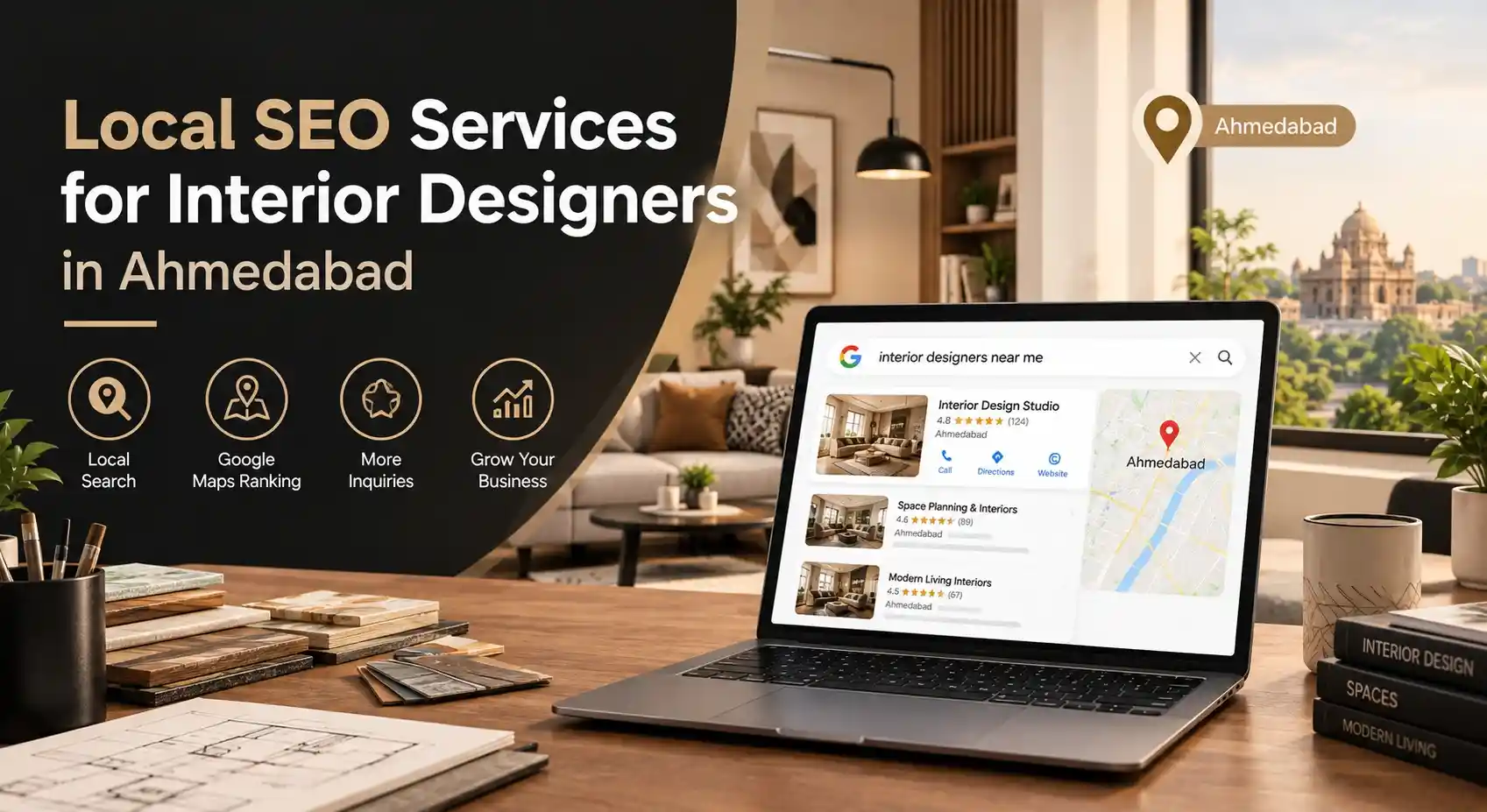
Turning Local Searches Into Design Consultations:
Ahmedabad’s interior design market has quietly turned into a search-first business. Someone renovating a flat in Bopal or fitting out a new office near Prahlad Nagar is typing something close to “interior designer near me” into Google before they call anyone. If a studio isn’t showing up at that moment, a competitor is. That’s the whole case for local SEO services for interior designers visibility at the exact point someone is ready to hire, not visibility for its own sake. Getting there consistently means working within Google’s core search guidelines for how content gets crawled and ranked, rather than treating SEO as an afterthought bolted onto a finished website.
Why do interior designers struggle to rank locally?
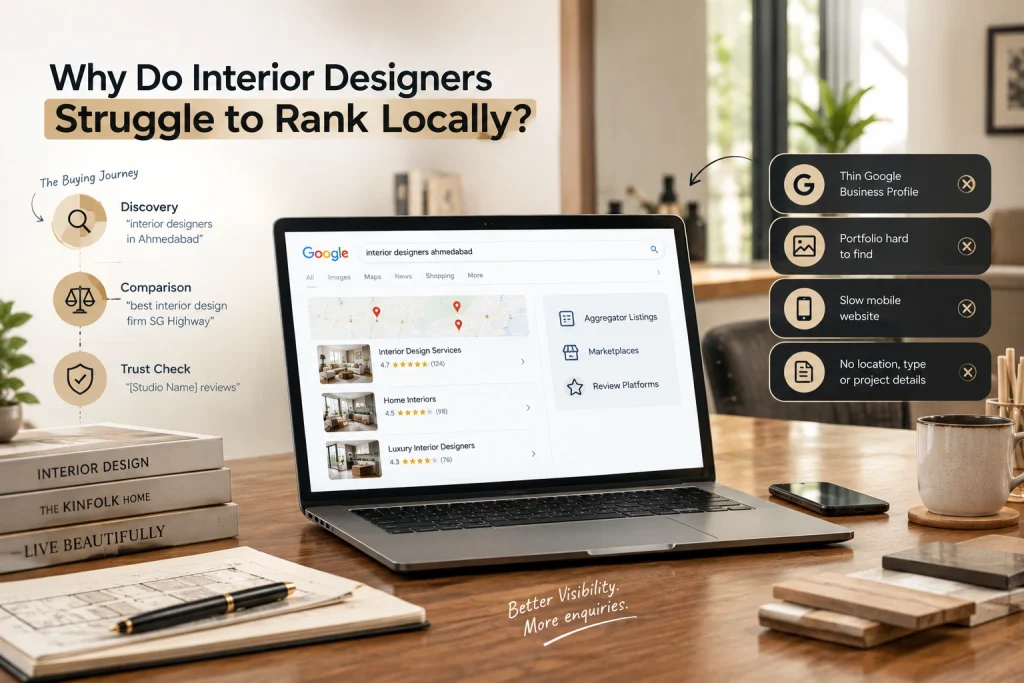
Most interior design studios built their business on referrals and word of mouth, and that instinct doesn’t disappear online it just changes shape. A referral used to mean a phone call from a happy client’s neighbour, prompted by a compliment about a new kitchen or a well-styled living room. Now it means that same neighbour searching the studio’s name, or a related term, and judging the business on what Google shows them in the next ten seconds. A thin Google Business Profile, a portfolio buried three clicks deep, or a website that loads slowly on mobile does the same damage a scruffy office once did: it quietly costs the meeting before the meeting was ever booked. The studio never even learns the enquiry existed, because it never arrived.
A second problem is specific to this industry, and generic SEO advice tends to miss it entirely. Interior design is a visual, trust-heavy purchase with a long consideration window. Nobody hires a designer for a home renovation the way they order a pizza. Search behaviour is layered across that buying journey rather than concentrated in one moment. There is the broad discovery search, something like “interior designers in Ahmedabad,” where a prospect is still building a shortlist. There is the comparison search, “best interior design firm SG Highway,” where they are weighing three or four studios against each other on price, style, and portfolio strength. And there is the trust-check search, the client’s own name typed into Google right before they sign a contract, where a thin or inconsistent online presence can undo months of relationship-building in seconds. A local SEO strategy that only chases the first type of search misses two-thirds of the actual buying journey, and it is usually the two-thirds where deals are won or lost.
Portfolios are the real asset most studios have, and they’re also where the most ground gets lost. A gallery of forty gorgeous project photos with no captions, no location, and no project type attached tells Google almost nothing. It has no way of knowing that renovation was in Bopal, that it was a 3BHK, or that the brief was “warm minimalist.” None of that visual proof ever surfaces for someone typing “modern minimalist interior design Ahmedabad” or “budget home renovation ideas Gujarat” into Google. The work is often the strongest thing a studio has going for it, and search simply can’t see any of it.
Directory sites widen that gap further. Type “interior designers Ahmedabad” into Google right now and the results skew heavily toward aggregator listings, renovation marketplaces, and review platforms rather than actual design studios. Those platforms are built specifically to win this kind of local, service-based query at scale, city after city. A single studio’s website was never built to compete with that structure on its own terms, which is exactly why closing the gap takes more than publishing a handful of extra pages. It takes content organised the way Google actually reads local relevance.
Explore Our Full Range of Digital Marketing Services
From local SEO to branding and web development, see how Digifinity builds connected strategies for growing businesses across Ahmedabad.
Explore Our ServiceWhat local SEO for interior designers actually solves?
Most of the underperformance starts with treating this like generic SEO. A SEO services in Ahmedabad engagement built for an interior designer has to work around portfolio-heavy pages, project-based content, and a sales cycle that runs in weeks rather than minutes. Ranking for “interior design Ahmedabad” on its own is largely a vanity metric; what actually matters is showing up for what someone searches right before they reach out. Sometimes that’s a locality, like “interior designer SG Highway.” Sometimes it’s a style, “modern minimalist interior designer Ahmedabad.” Sometimes it’s a budget question wrapped around a project size, “2BHK interior design cost Ahmedabad.” These sit at different points in someone’s decision-making, which is why a single catch-all services page can’t realistically serve all of them; each one needs a page built for exactly what it’s answering.
In practice, once planning turns into execution, that means:
- Claiming the Google Business Profile properly and keeping it current correct categories, defined service areas, fresh project photography, not a name and phone number left sitting half-filled
- Writing service and portfolio pages the way people actually search, weaving locality and project terms into titles and headers rather than stuffing them in afterwards
- Adding LocalBusiness structured data, giving Google a clear signal to match the studio against “near me” and map-pack searches
- Keeping name, address, and phone details identical across every directory and listing site the studio appears on, since conflicting entries quietly erode trust
- Building content around what people searching for interior designers actually type project type, locality, budget, and style, rather than expecting one page to cover all of it
Building this properly is closer to setting up local infrastructure than writing a handful of blog posts and hoping they perform. It follows the same discipline as our local SEO strategy work with restaurant clients across Ahmedabad: the specific tactics change from one industry to the next, but getting the foundational signals right before layering on content does not.
How keyword research actually works for this industry?
Most keyword research tools aren’t built with interior design in mind, and a generic report tends to surface volume-heavy terms that look impressive but convert poorly. “Interior design” on its own might carry decent national search volume, but it says nothing about budget, project type, or location a studio chasing that term ends up buried in enquiries that go nowhere. Breaking demand into layers that match how someone actually searches works better:
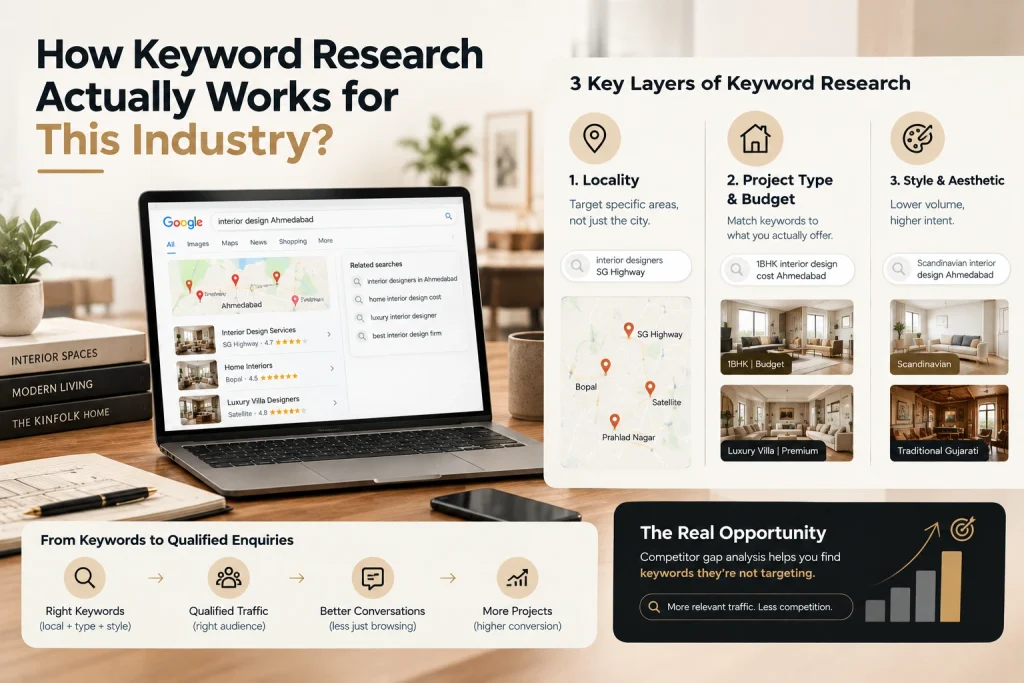
- Locality: is not just “Ahmedabad” as a blanket term, but the specific pockets a studio actually serves, like SG Highway, Bopal, Satellite, or Prahlad Nagar. Ranking city-wide does little if half the resulting enquiries come from areas outside a realistic service radius.
- Project type and budget: “1BHK interior design cost Ahmedabad” and “luxury villa interior design Ahmedabad” pull in two very different audiences. Mapping keywords to what a studio actually offers keeps enquiries qualified rather than just plentiful.
- Style and aesthetic: terms like “Scandinavian interior design Ahmedabad” or “traditional Gujarati home interiors” carry lower volume individually, but attract people who already know what they want, which shortens the sales conversation considerably.
A competitor gap analysis checking which of these a rival studio hasn’t bothered targeting usually turns up more opportunity than fighting over the same handful of high-volume terms everyone else is already chasing.
Benefits and business impact:
The commercial case for local SEO becomes much clearer once you compare what a studio’s search presence typically looks like before this work is done properly against what it looks like once the foundations are in place.
| Area | Without Local SEO | With Local SEO |
| Google Maps visibility | Buried below listing sites and competitors | Appears in the local 3-pack for target searches |
| Portfolio discoverability | Hidden inside the website, no search value | Individual projects indexed and ranking for style and locality terms |
| Trust signals | Inconsistent listings, few or no visible reviews | Verified profile, structured review management, consistent citations |
| Lead quality | Enquiries mixed in with low-intent browsers | Enquiries pre-filtered by locality, style, and budget searches |
| Brand consistency | Search presence disconnected from visual identity | Search presence reinforced by branding and design work |
The last row matters more than it might first appear. Interior design sells on aesthetic judgement, so a search listing that looks polished and a website that reflects the studio’s actual design sensibility do real work in the decision-making process. A client is unlikely to trust their living room to a designer whose own online presence looks neglected, regardless of how strong the portfolio photography is once you finally find it buried in the site.
Paid advertising can generate enquiries quickly, but the moment the budget stops, so does the visibility that came with it. Local SEO behaves differently. A well-optimised Google Business Profile and a properly structured set of service pages keep generating enquiries months after the initial work was completed, because the underlying signals do not disappear the way ad spend does the day a campaign is paused. For a business with project cycles as long as interior design’s, that compounding effect matters more than it does in faster-moving categories where the purchase decision happens in minutes rather than weeks.
Ranking well locally also changes the quality of enquiries a studio receives, not just the quantity. A prospect who finds a studio through a locality and style-specific search has already self-selected on budget range and aesthetic preference before they ever pick up the phone, which means initial consultations spend less time on qualification and more time on the actual project. That shift alone tends to shorten the sales cycle, even before accounting for the additional visibility.
How does the engagement actually run?
The order matters here more than people expect. Skip the audit and you’re guessing at what’s actually broken instead of fixing it, so that’s where we start checking the existing Google Business Profile, the website, and whatever local citations already exist, noting where categories are missing or details don’t match up across platforms.
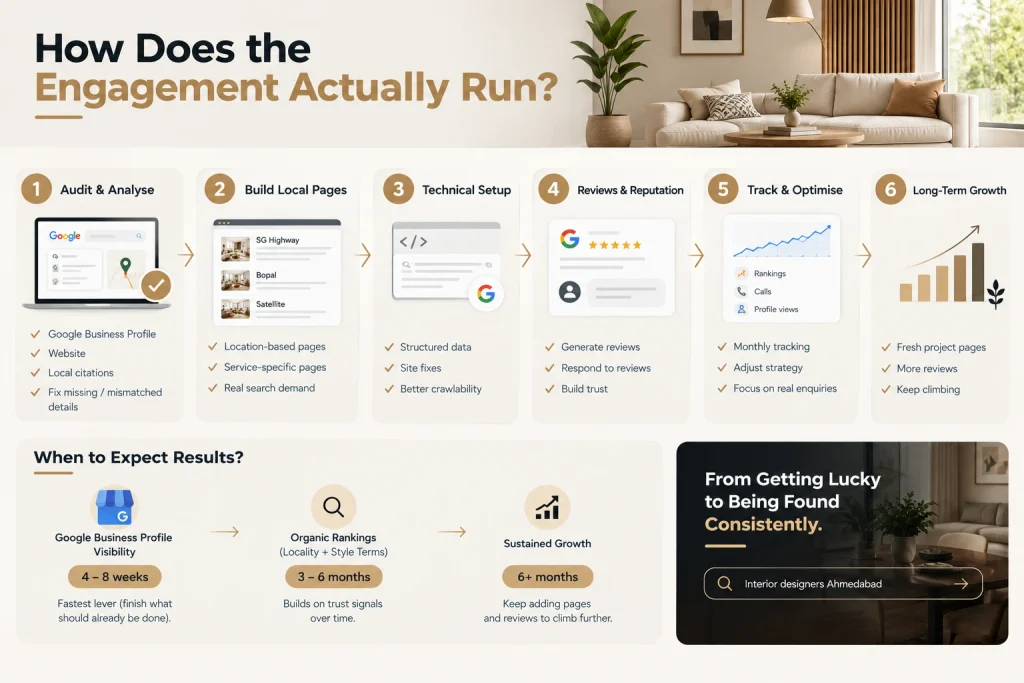
Once that picture is clear, the work shifts to building landing pages around the localities and services that real search demand is pointing to, not the ones that simply sound reasonable in a planning meeting. Technical groundwork follows: structured data and site fixes that let Google read the business correctly instead of piecing it together on guesswork. Reviews get their own process too generated and responded to on purpose, rather than left to whichever client happens to remember afterwards.
From there it’s ongoing. Rankings, calls, and profile views get tracked every month, and the plan shifts toward whatever’s genuinely bringing in enquiries rather than whatever looked promising when the strategy was first written.
None of this looks particularly exciting in isolation. What it adds up to is the gap between a studio that occasionally gets found by luck and one that shows up reliably for the searches that matter, month after month.
The first signs of movement usually show up in Google Business Profile visibility, somewhere in the first four to eight weeks that’s the fastest lever, largely because it’s a matter of finishing work that should already have been done. Organic rankings for the harder locality and style terms take longer, typically three to six months, since they build on trust signals that accumulate over time rather than switch on overnight. Studios that treat this as a single project tend to plateau once those early gains land. The ones who keep adding fresh project pages and collecting reviews keep climbing well past that point.
Common mistakes that hold interior design studios back locally:
The same handful of mistakes turn up almost every time we audit a new studio, and most are straightforward to fix once someone actually goes looking. Duplicate Google Business Profile listings top the list: a studio changes offices, or someone on the team creates a second listing years back without realising one already exists, and Google ends up splitting reviews and ranking signals across two competing profiles instead of consolidating them into one. Neither version performs as well as a single, properly claimed profile would on its own.
Stock photography is another quiet cost. A studio that fills its Google Business Profile and website with generic interior stock images, rather than photographs of its own completed projects, sends a weak trust signal to both Google and prospective clients. It also wastes the studio’s strongest actual asset, since finished project photography is exactly the kind of content that ranks well and converts browsers into enquiries.
Ignoring reviews entirely is a third recurring issue, and it tends to compound over time. A studio with twelve reviews and no replies looks less active than a competitor with eight reviews and thoughtful responses to each one, because Google and prospects both read reply activity as a signal of an engaged, currently operating business. Left unaddressed for long enough, a stagnant review profile starts to actively work against a studio rather than simply doing nothing for it.
Finally, treating the website as a portfolio only, with no locality or service-specific landing pages at all, is perhaps the most expensive mistake because it’s the hardest to notice from the inside. The site looks complete to the studio that built it. To Google, it looks like a single page competing for dozens of different search intents at once, which is a fight it almost never wins against competitors who have split that content out properly.
Why choose Digifinity?
Most agencies treat local SEO as a generic package with the same tactics with a different city name swapped in, regardless of what the business actually sells or who it is trying to reach. We build it around how interior designers are genuinely searched for and chosen, which means the keyword strategy, the website design and development work, and the local citation strategy are aligned from day one rather than fixed separately later once problems surface in the data.
There’s a forward-looking piece to this too. AI-driven search tools are increasingly summarising and recommending local businesses directly within the answer itself, so answer engine optimisation is starting to sit alongside traditional ranking rather than waiting as a separate project for later. Clear content structure and consistent local signals help on both fronts a studio set up this way tends to show up in conventional results and in the AI-generated summaries now appearing above them.
That matters more for interior designers than it does for most local service categories, since the purchase decision leans so heavily on trust and visual proof before a single conversation even happens. Getting the foundational structure right now means a studio isn’t rebuilding this work from scratch in eighteen months when the search landscape shifts again it’s already built for where things are going.