
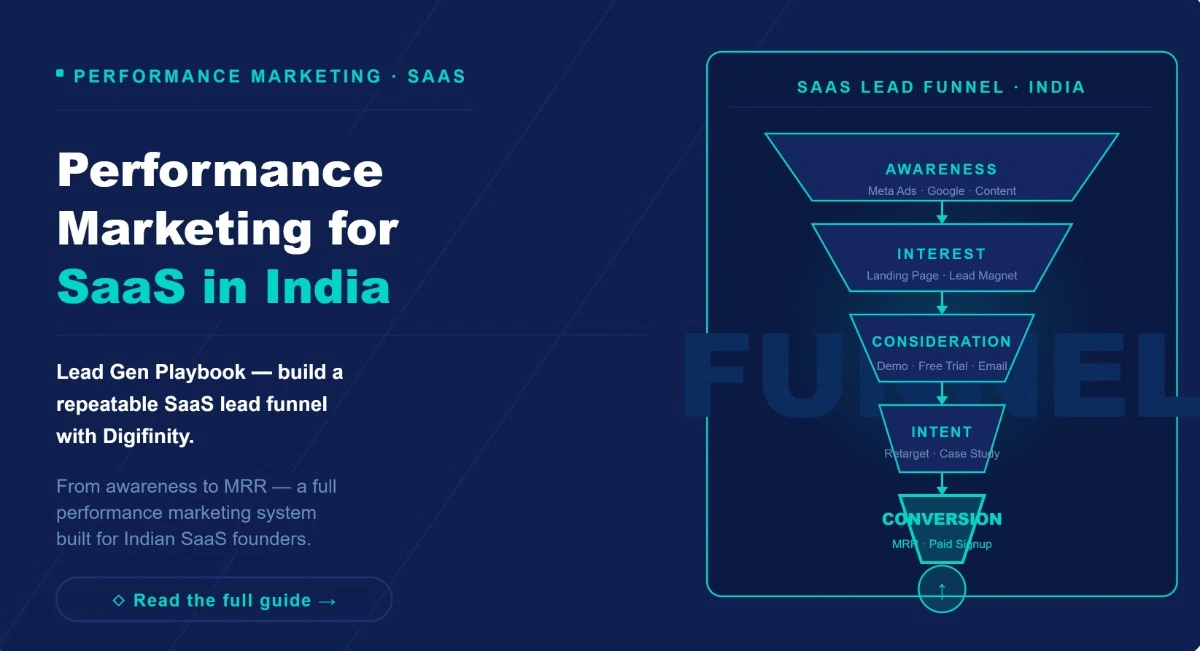
Build a Repeatable SaaS Lead Funnel with Digifinity:
SaaS founders in India rarely struggle to get traffic. Getting people to the website was never the hard part. The hard part is what happens after: turning that traffic into trial sign-ups, demo bookings, and eventually paying customers. That’s usually where the budget quietly disappears. Searching for a Digital Marketing Agency in Ahmedabad that actually understands the SaaS sales cycle, instead of treating it like any other lead gen job? This playbook covers the channels, funnel structure, and budget logic that work for Indian SaaS companies today.
One thing worth flagging before getting into the playbook itself. SaaS buying has changed quite a bit lately. McKinsey’s research on B2B growth economics found buyers now expect a smoother, more self-directed path to purchase than they did even a couple of years ago. Funnels built around the old, sales-led assumption tend to leave money on the table now.
Why Is SaaS Lead Generation Different From Standard Lead Gen?
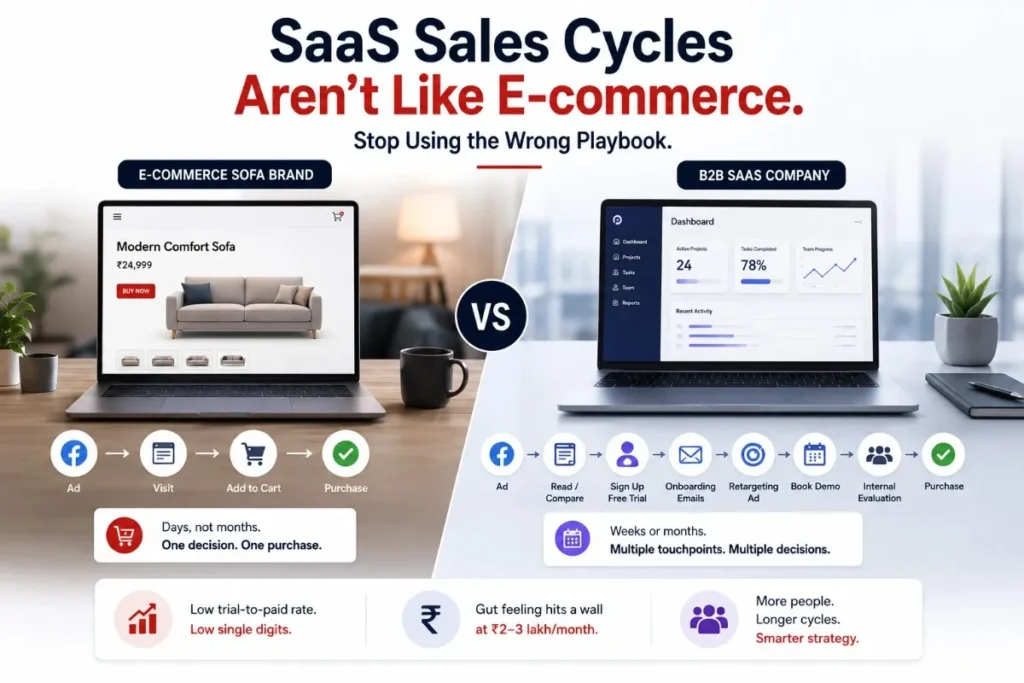
Picture a furniture brand selling sofas online next to a SaaS company selling project management software. On paper they look similar. Both just want visitors to convert. In reality, the sales cycles barely resemble each other at all.
SaaS buyers take their time. They compare more options. Sometimes a second or third decision-maker gets pulled in before anything’s approved. A Facebook ad almost never closes a SaaS deal by itself. What usually happens instead looks something like this: someone reads a comparison article, signs up for a free trial, ignores a couple of onboarding emails, gets pulled back by a retargeting ad, then books a demo call weeks later. Sometimes over a month later.
Bolting an e-commerce playbook onto a SaaS account tends to backfire for exactly this reason. Cost-per-click might look fine on paper. Cost-per-qualified-lead tells a very different story once trial-to-paid conversion rates enter the picture, and for most B2B SaaS products those rates sit in the low single digits.
Founders running growth on gut feeling alone tend to hit a wall around ₹2-3 lakh a month in ad spend. Past that, more money without proper attribution just adds noise.
HubSpot’s marketing research backs this up. Their data shows B2B buying committees now involve more people and longer research windows than they did just a few years back.
The Core Channels That Actually Move the Needle:
Every founder asks the same question at some point: where should the first rupee of the budget actually go? Not every channel earns an equal share, and honestly, most SaaS teams in India spread themselves too thin trying to be everywhere at once.
Google Ads paired with SEO tends to win the intent battle. People typing in a search bar already know they’ve got a problem and are comparing tools to fix it. That intent comes at a price though; keyword costs in competitive SaaS categories climb fast.
LinkedIn works differently. It’s slower, pricier per click, and nobody would call it cheap. But when you need to reach a specific VP of Operations at a 200-person company rather than “anyone who might be interested,” nothing else really competes. Mid-market and enterprise SaaS sellers lean on it for exactly this reason.
Then there’s organic content comparison pages, “alternatives to [competitor]” posts, integration guides. These outperform generic blog traffic by a wide margin, mostly because whoever’s reading them has already done half their research and just needs a reason to pick you.
Retargeting gets ignored more than it should. Something like 95% of visitors leave without converting on their first visit, and most SaaS teams barely bother chasing them back through Meta or Google Display.
And referral loops free tools, calculators, a genuinely useful freemium tier spread on their own without eating into ad spend at all, though they take longer to build momentum.
A dedicated performance marketing agency usually runs several of these at once rather than testing one, waiting, then moving to the next. SaaS attribution windows run long enough that a single buyer might touch three or four of these channels before ever converting.
Ready to Build a Lead Gen System That Actually Scales?
Stop losing SaaS leads to a funnel that wasn’t built for how your buyers actually research and decide.
Explore Our ServiceStructuring a SaaS Lead Gen Funnel That Doesn’t Leak:
Most SaaS funnels leak at the same three points. Fuzzy top-of-funnel messaging. A trial sign-up flow with too much friction. Weak nurture sequences once someone’s actually signed up. Fixing the leaks matters more than pouring in more top-of-funnel budget.
A workable structure looks something like this:
- Top of funnel: SEO content and paid search aimed at problem-aware and solution-aware keywords. Not just branded terms.
- Middle of funnel: Comparison pages, case studies, retargeting ads that build trust with people who haven’t converted yet.
- Bottom of funnel: Low-friction trial or demo booking flows, ideally under three form fields, paired with an email sequence nudging toward activation.
- Post-conversion: Onboarding emails and in-app prompts pushing trial users toward whichever feature correlates most with paid conversion.
Skip any of these stages and growth doesn’t just slow down. Customer acquisition cost quietly inflates because the budget keeps flowing into a funnel that can’t hold onto what it’s generating.
Worth remembering too that the trial sign-up flow isn’t purely a marketing problem. It’s usually the SaaS product’s own web app doing the heavy lifting at that exact moment, so a rocky or slow-loading sign-up screen can undo weeks of good campaign work. Founders who spot this late often end up looping in a web app development team just to fix the one screen that was quietly costing them leads all along.
Budget Allocation: Where SaaS Companies Get It Wrong?
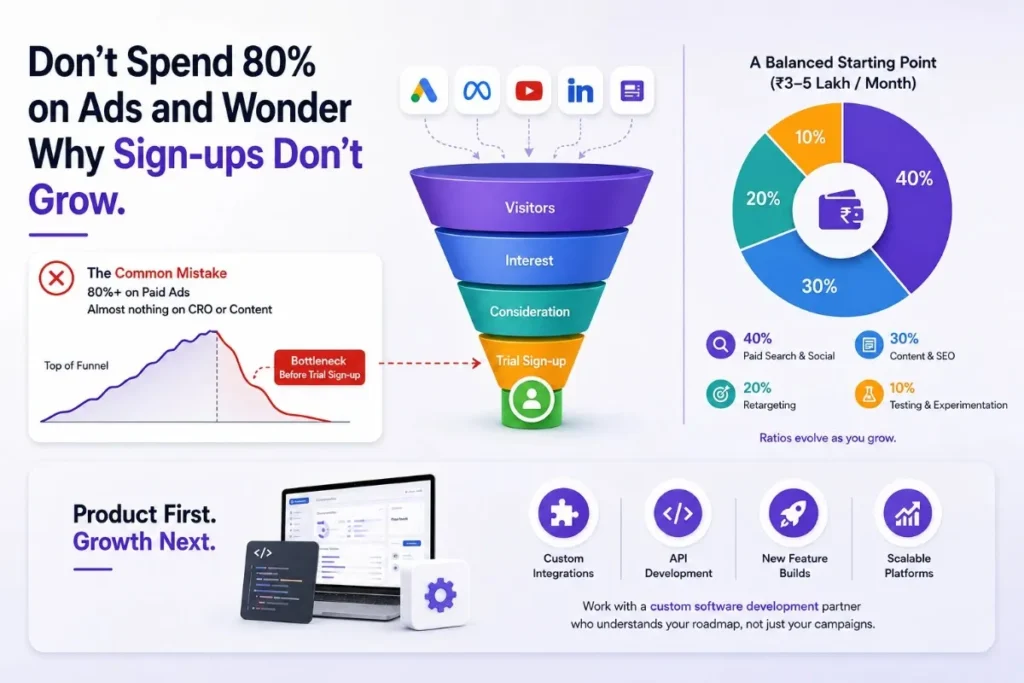
Here’s a mistake we see constantly among early-stage SaaS founders in India. They dump 80% of the budget into paid acquisition and almost nothing into conversion rate optimization or content. The result: a top-of-funnel that keeps growing while a bottleneck sits right before the trial sign-up.
A more balanced starting point for a company spending around ₹3-5 lakh a month might look like this 40% on paid search and social, 30% on content and SEO, 20% on retargeting, 10% held back for testing. These ratios shift over time. Mature SaaS brands with strong organic traffic often flip this entirely, pushing more toward retention than pure acquisition.
Custom-built platforms and internal tools matter more here than most marketers assume. If the product needs ongoing development, new integrations, API work, or feature builds already promised in campaigns, it helps to have a custom software development partner who actually understands the roadmap. Not just the campaign calendar.
SEO’s Role in a Performance-First SaaS Strategy:
Performance marketing gets the spotlight. Results show up fast and they’re easy to track. SEO gets underfunded because the payoff takes months. But for SaaS specifically, organic search often becomes the highest-margin channel within 12-18 months. Cost per lead drops close to zero once content starts ranking.
Keyword strategy for SaaS SEO looks different from most other industries too. Instead of chasing high-volume, generic terms, the content that actually converts usually targets:
- Comparison and “vs” keywords buyers weighing your product against a competitor right now
- “Best [category] software for [use case]” queries narrow intent, but it converts well
- Integration-based searches people checking whether your tool plays nicely with something they already use
- Problem-based queries searchers who haven’t picked a solution category yet, useful for building awareness early
Getting this content mapped out properly is where a team offering dedicated SEO Services in Ahmedabad tends to earn its keep. Someone who thinks in terms of keyword intent against the funnel stage rather than chasing volume for its own sake.
Performance Marketing vs Traditional Marketing for SaaS:
| Factor | Performance Marketing | Traditional Marketing |
| Measurability | Every rupee traceable to a lead or conversion | Difficult to attribute directly to revenue |
| Speed to results | Days to weeks | Months, sometimes longer |
| Best suited for | Trial sign-ups, demo bookings, retargeting | Brand awareness, long-term trust building |
| Budget flexibility | Can be paused, scaled, or shifted daily | Locked in for campaign duration |
| SaaS fit | Strong matches how SaaS buyers research and compare | Weaker fit unless combined with digital channels |
Neither works particularly well alone for SaaS. Brand awareness from content and PR gives performance campaigns something worth retargeting against. Performance data reveals which messaging is actually landing, and that feeds straight back into better organic content.
Common Mistakes SaaS Companies Make With Paid Campaigns:
A handful of patterns keep showing up when we audit underperforming SaaS ad accounts. Often the same ones we spot when a founder brings us in as their digital marketing agency in Ahmedabad after a previous campaign fell flat.
- Stale ad creative: Running the same ad for months without testing anything new. SaaS audiences fatigue faster than people expect, especially on LinkedIn where impression volume is thinner to begin with.
- Optimising for the wrong signal: Chasing clicks or raw sign-ups instead of qualified leads floods the pipeline with people who were never going to convert.
- Weak landing page relevance: Sending paid traffic to a generic homepage instead of a page matching the exact ad promise kills conversion rates quietly, without anyone noticing why numbers dropped.
- Broken mobile experience: A growing share of SaaS research happens on a phone even when the purchase decision gets made on a laptop later. If a sign-up or demo form breaks on mobile, leads are gone before they reach the stages worth optimising.
Teams building companion apps or mobile-first onboarding often lean on a mobile app development company in India to keep that last point from becoming a problem.
Localising Messaging for Indian B2B Buyers:
A fair number of SaaS campaigns underperform in India, not because the product is wrong, but because the messaging was written for a US or European buyer and never really adapted. Pricing psychology, objection handling, how you even talk about free trials. All of it shifts with the audience.
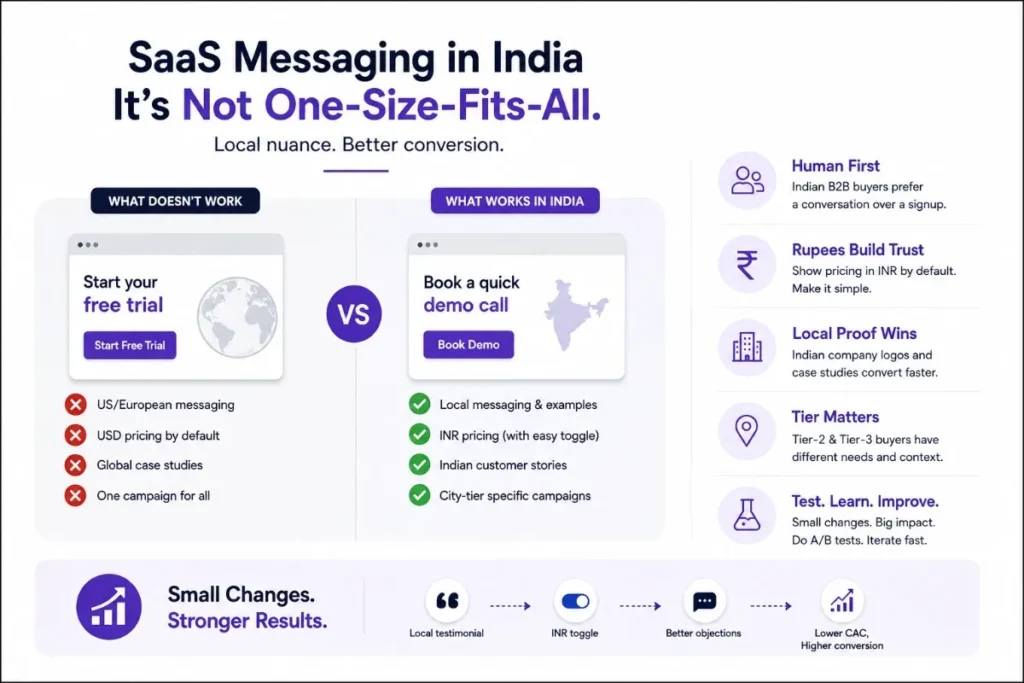
Indian B2B buyers, particularly at mid-market companies, tend to be more price-sensitive upfront and often want a human conversation before committing to anything, even something free. Landing pages leading purely with “start your free trial” sometimes convert worse locally than ones offering a short demo call instead. A call just feels like a lower-risk first step. Testing both paths, rather than assuming one global template fits everywhere, usually settles this fast.
Currency display matters more than people give it credit for. Showing pricing in USD by default, even with a small INR note underneath, can quietly hurt conversion among buyers who’d rather just see a rupee figure without doing the maths themselves. Case studies featuring recognisable Indian company names tend to build trust faster too, even when the international logos are technically more impressive on paper.
Regional differences run deeper than language alone. A SaaS company selling into tier-2 and tier-3 Indian cities faces a different competitive landscape and a different level of buyer sophistication than one selling purely into Bengaluru or Mumbai enterprise accounts. Segmenting messaging by city tier, instead of running one national campaign for everyone, tends to bring acquisition costs down. The ad copy and landing page actually speak to where the buyer’s coming from.
None of this needs a full campaign rebuild, by the way. Small changes can shift things within a few weeks of testing, swapping a US-centric testimonial for a local one, adding an INR toggle, that sort of thing.
Tracking the Right KPIs:
Impressions and click-through rate look good in a report. They rarely say much about whether the business is actually growing. For SaaS lead gen, the numbers worth watching are cost per qualified lead (not just cost per lead), trial-to-paid conversion rate, time to activation, and customer acquisition cost against lifetime value.
| KPI | What It Measures | Why It Matters More Than Raw Lead Volume |
| Cost per qualified lead | Spend divided by leads that meet ICP criteria | Filters out cheap, unqualified leads that never convert |
| Trial-to-paid conversion rate | % of trial users who become paying customers | Reveals whether onboarding, not acquisition, is the real bottleneck |
| Time to activation | Days between sign-up and first meaningful product use | Slower activation almost always predicts higher churn |
| CAC-to-LTV ratio | Acquisition cost relative to customer lifetime value | Shows whether growth is actually profitable, not just fast |
| Channel-level payback period | Months to recover acquisition cost per channel | Flags which channels to scale and which to pause |
Google’s own marketing analytics and measurement resources have some useful frameworks here, tying ad spend back to pipeline value instead of surface-level engagement. Most SaaS marketing teams need to make that shift sooner rather than later.
Checking these numbers monthly, instead of waiting until quarter-end, makes it far easier to catch a leaking funnel stage before it eats through a serious chunk of budget.
Building a Repeatable Playbook, Not a One-Off Campaign:
SaaS companies that scale predictably treat performance marketing as a system, not a string of one-off campaigns. Write down what messaging works for which segment. Build landing page templates that can be adapted fast for new campaigns. Set up dashboards that make weekly optimisation an easy call rather than a monthly scramble.
Whether that’s run in-house or handed to a digital marketing agency in Ahmedabad, the discipline matters more than who’s actually executing it. Being honest about channel fatigue matters too. What worked for lead gen eighteen months ago on Google Ads might cost three times as much now for the same result. Competition in the SaaS category has picked up a lot. Quarterly channel reviews, not just campaign-level check-ins, keep a strategy from calcifying around channels that used to work rather than ones still pulling their weight.
Research from Gartner’s marketing technology coverage keeps landing on the same point. SaaS companies that pull marketing, sales, and product data into one view of the customer journey tend to outperform the ones running these functions in silos.