
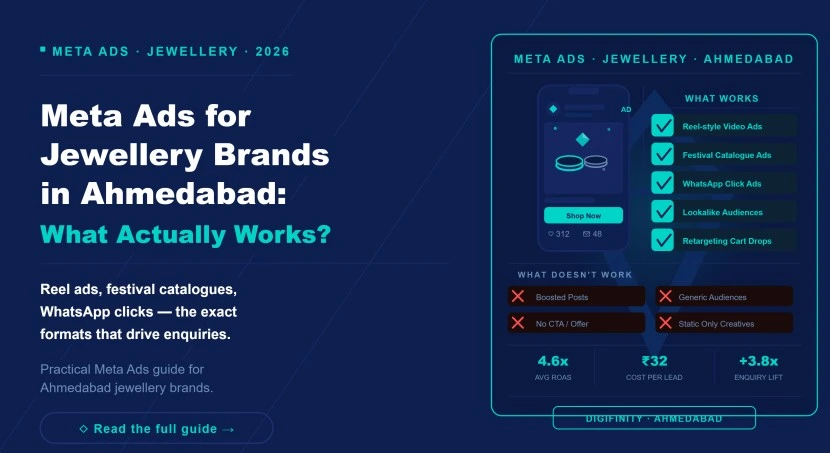
Meta Ads for Jewellery Brands in Ahmedabad: The Funnel Most Agencies Get Wrong
Run Meta Ads for jewellery brands in Ahmedabad the way most brands do, and you’re boosting a product photo, throwing some budget at it, hoping the enquiries roll in. Then three weeks later they’re staring at rising cost per lead and a comment section full of “interested” that never turns into a sale. Jewellery just doesn’t behave like an impulse category. It’s emotional, it’s high-trust, it’s tied to an occasion, and the ads that work for it look nothing like what works for a food delivery app or a clothing flash sale.
That gap matters even more in a market like Ahmedabad, where jewellery buying sits so close to weddings, festivals and family occasions. Not casual browsing. According to Meta’s own guidance for retailers, campaigns built around one single conversion event tend to underperform against jewellery’s naturally longer decision window. Which is basically why so many brands get decent reach and flat sales at the same time.
Why Jewellery Sells Differently on Meta?
Nobody sees a gold necklace ad and buys in the same session, not the way they might with a t-shirt or a phone case. There’s a checklist running quietly in the background. Is this design right for my daughter’s engagement? Does the karat actually match what’s promised? Is this seller trustworthy enough for a purchase this size? Meta Ads for jewellery aren’t closing a sale in one click. They’re stacking up enough trust and desire, over several touches, that the eventual visit to your website (or your store) feels like the obvious next step rather than a risk.
That’s also why brands treating Meta Ads as a pure traffic tool tend to burn through budget fast. The platform rewards accounts that understand its own logic. Warm, engaged audiences convert far cheaper than cold, first-touch traffic ever will. Skip the warming stage and you’re paying premium prices for someone who was never buying on the first look anyway.
Trust signals do a lot of quiet work here too. Certification marks, return policy, customer photos, even the comments under an ad, all of it feeds that background checklist a buyer’s running. A brand with real social proof, actual reviews, customers tagging themselves in photos, genuine replies instead of silence, earns a shorter decision window than one that just looks polished. Small thing to plan for at campaign setup. Shows up in conversion numbers once there’s enough data to compare.
The Ahmedabad Jewellery Market: What Makes It Unique?
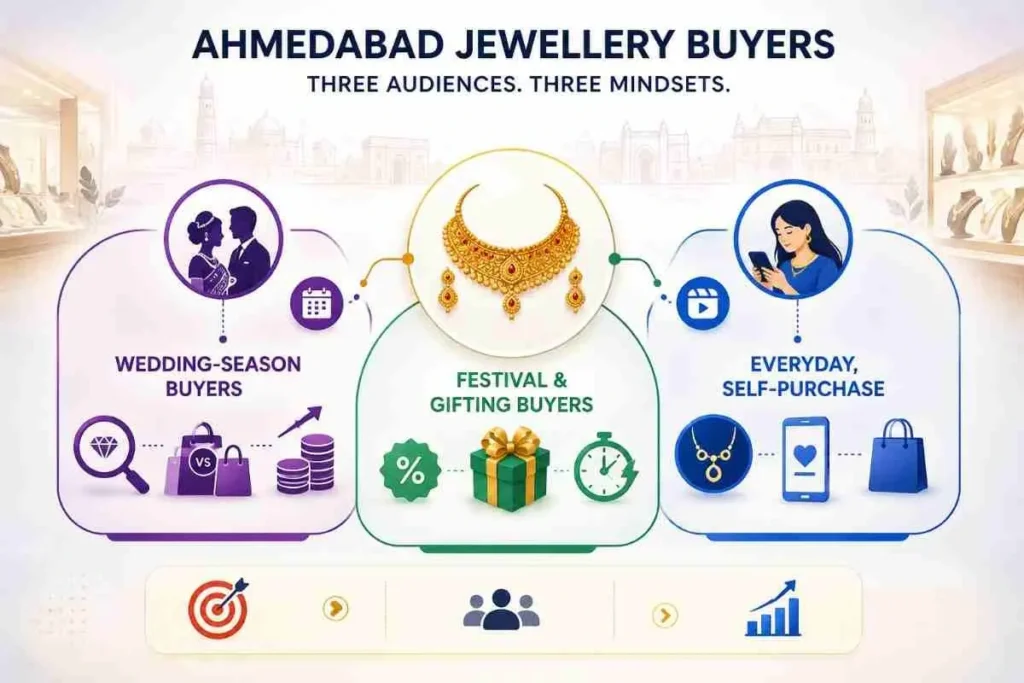
Ahmedabad’s jewellery buyers aren’t one audience. They split into a few pretty distinct behavioural groups, and treating them as one crowd is probably the single biggest way the budget quietly leaks out of a campaign.
Take wedding-season buyers first. High intent, high budget, but they’re comparing you against three or four other stores before committing, sometimes for weeks. Festival and gifting buyers behave differently again, smaller basket size, more price-sensitive, and they respond well when there’s genuine urgency or a limited-time angle. Then there’s the everyday, self-purchase crowd. Younger, usually scrolling Reels before they ever hit the Facebook feed, and drawn to lighter, wearable pieces rather than heavy traditional sets.
Put the same ad set, same creative and same offer in front of all three, and the overall numbers can still look fine. That’s the trap. Decent blended metrics can be hiding genuinely poor performance inside each individual segment.
Worth keeping the scale in mind too, since it changes how competitive the auction gets. India’s jewellery market is one of the largest in the world by consumer demand. Statista’s market data points to steady year-on-year growth in organised retail jewellery spend, and that includes the online and social-commerce slice brands are increasingly fighting over. More buyers is good news, obviously, but it also means more brands chasing the same audience, particularly around Diwali, Dhanteras and wedding season, when Meta’s ad auction gets noticeably more expensive.
Not sure where your Meta Ads budget is actually leaking?
A quick account review usually shows exactly where cost-per-result is climbing, and why.
Explore Our ServiceBuilding a Meta Ads Funnel for Jewellery:
Top of Funnel: Reach and Visual Storytelling
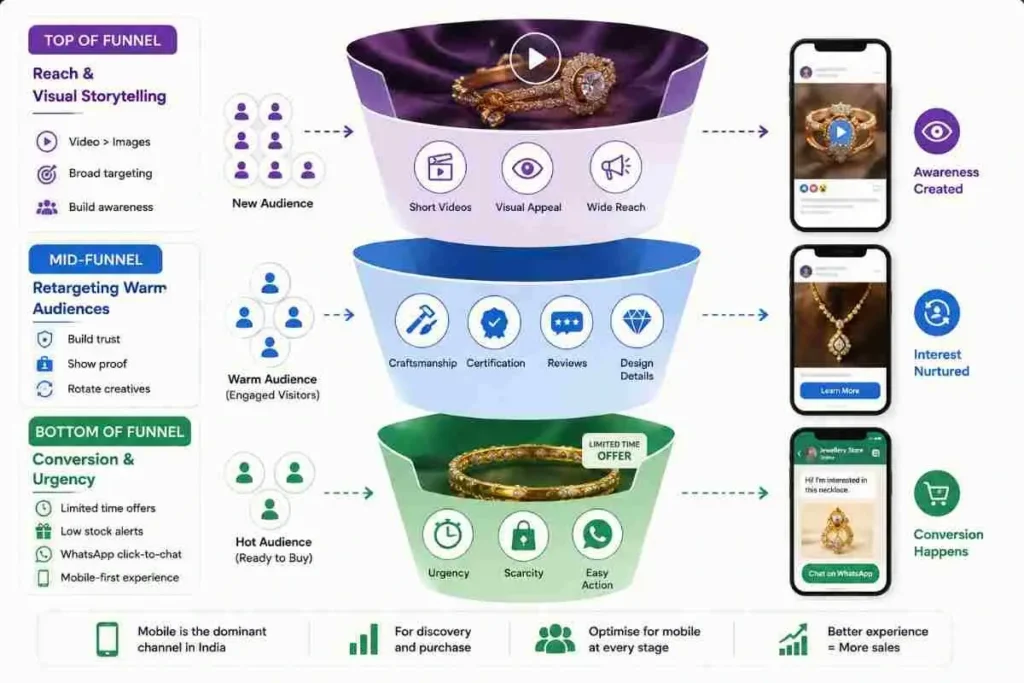
Nobody’s buying at this stage, and that’s fine. The job here is simpler: get your designs in front of people who’ve never heard of your brand, and give them a reason to stop scrolling for two seconds. Video wins over static images almost every time. A ring catching light. A necklace being fastened. A close-up on craftsmanship that a photo just can’t capture. Broad interest targeting and lookalikes suit this stage well, since you’re casting wide rather than chasing a conversion straight away.
Mid-Funnel: Retargeting Warm Audiences
Most of the real persuasion happens right here, which makes it strange how often jewellery brands skip or underfund this stage entirely. Anyone who watched more than half a video, visited a product page, or engaged with a post belongs in a retargeting audience, and the message they see needs to shift. Trust, craftsmanship, certification, reviews, not just the product photo again.
Frequency matters more than budget size once you’re at this point. Show the same retargeting ad too often and the audience’s patience runs out within days. Better to rotate two or three creative variants, each nudging a different objection, price, authenticity, whether the design actually suits them, so attention holds longer than it would with one static ad running unchanged for weeks.
Bottom of Funnel: Conversion and Urgency
By now the buyer’s seen your brand a few times. They’re close. Limited-time offers, “only a few pieces left in this design,” or a direct WhatsApp click-to-chat option, any of these can tip a warm lead into an actual sale. Higher-value pieces especially tend to need a real conversation before someone commits, so building that option straight into the ad usually beats forcing people through an impersonal checkout.
There’s a mobile angle worth flagging here too. IAMAI’s research on India’s internet usage keeps showing mobile as the dominant channel for both discovery and the purchase decision itself, not just browsing. Which means a bottom-funnel ad sending traffic to a desktop-optimised checkout, or a WhatsApp link that doesn’t open cleanly on a phone, is losing sales at the exact moment a buyer was ready to convert. Quietly, and completely avoidably.
Creative That Converts for Jewellery Ads:
Photography quality genuinely makes or breaks jewellery ad performance in a way it doesn’t for most other categories. Buyers are judging craftsmanship with their eyes, so a flat, poorly lit product shot reads as a lower-quality product even when the piece itself is fine.
A few things tend to work consistently well. Video over static images, especially close-up detail shots and footage of someone actually wearing the piece. Real customers rather than studio-only shots, since natural settings read as more honest. Carousel ads for full collections, letting people browse several designs inside one ad rather than clicking through separately. And ad copy that leans into the occasion, “for the bride who wants something different,” rather than a flat product description that could belong to any brand.
Video length matters more than most brands assume, too. The first three seconds decide whether anyone stops scrolling at all, so opening on the finished piece, light catching a stone, a chain settling on skin, beats a logo intro or a slow brand build-up almost every time. Fifteen to thirty seconds is usually the sweet spot for top-of-funnel content. Push longer than that and attention starts dropping off, unless the video is genuinely story-driven, a behind-the-scenes look at how a piece gets made tends to work, but that format suits retargeting audiences who already trust you a bit more than it suits cold traffic.
Budgeting and Bidding for Jewellery Campaigns in Ahmedabad:
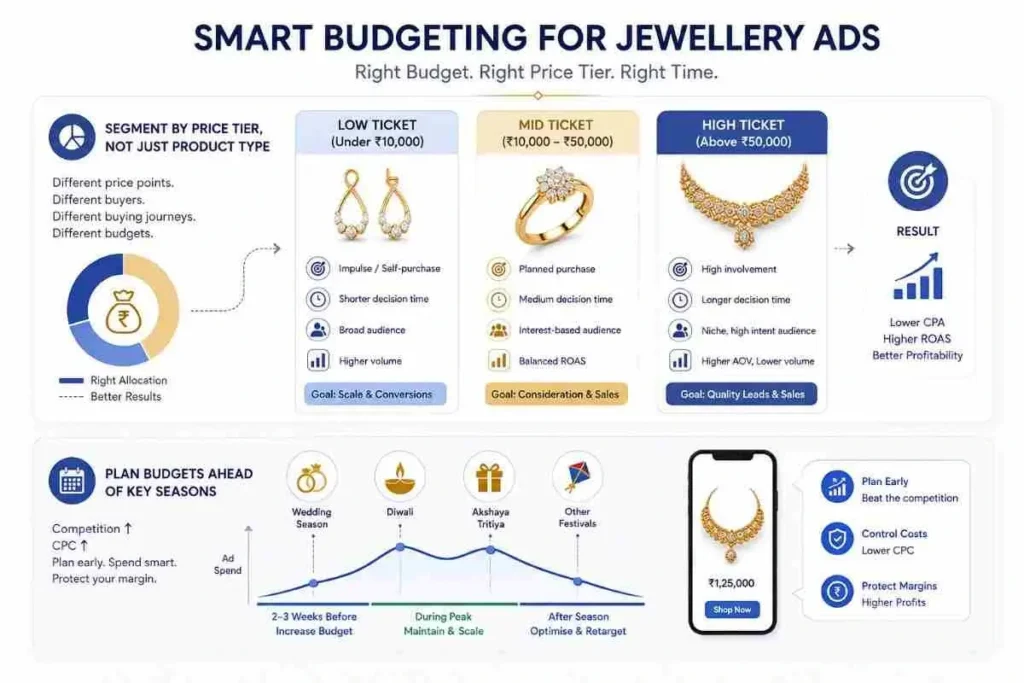
Jewellery covers a wider price range than almost any other ecommerce category, so flat budget allocation across products is a mistake. A ₹5,000 pair of earrings and a ₹2 lakh necklace shouldn’t be fighting for the same ad budget under the same campaign objective. The buying signals, the decision time, the whole audience is different. Segmenting campaigns by price tier, not just product type, tends to produce far more predictable cost-per-acquisition numbers.
Seasonal budget shifts matter more here than in most categories too. Wedding season and major festivals push cost-per-click up sharply as every jewellery brand in the region competes for the same audience at once. Planning budget increases ahead of those windows, rather than reacting after costs have already climbed, protects margin. Our Performance Marketing Companies approach to jewellery accounts typically front-loads spend two to three weeks before major occasions for exactly this reason.
Common Mistakes Jewellery Brands Make With Meta Ads:
Running only cold-audience campaigns and never building a retargeting layer Using identical creative and messaging across wedding, festival and everyday buyer segments Sending traffic to a slow or poorly built website, undoing everything the ad just achieved Ignoring WhatsApp and Messenger as a real conversion path for high-value pieces Measuring success by reach or engagement instead of actual enquiries and sales
That third one deserves its own mention. No amount of ad spend fixes a website that takes six seconds to load a product photo. Sometimes it’s a design problem. Just as often it’s the underlying platform struggling under traffic spikes during sale periods, and that’s really a job for custom software development, not another round of design tweaks. If the site can’t keep pace with the ads pointing at it, the budget’s essentially funding an expensive bounce rate.
How SEO and Meta Ads Work Together for Jewellery Brands?
Paid and organic aren’t rivals. They compound each other. A buyer who sees your Meta Ad but doesn’t convert straight away will often go and search your brand name, or the product type, on Google before deciding anything. If your organic presence is thin, or worse, absent, at that point, you’ve lost a warm lead you already paid to generate. Building real search visibility alongside paid campaigns, through SEO Services in Ahmedabad, closes that gap and protects the return on ad spend you’ve already put in.
For jewellery brands selling online rather than purely in-store, this pairing matters even more, since the ecommerce experience itself becomes part of the funnel, not just a landing point for ads.