
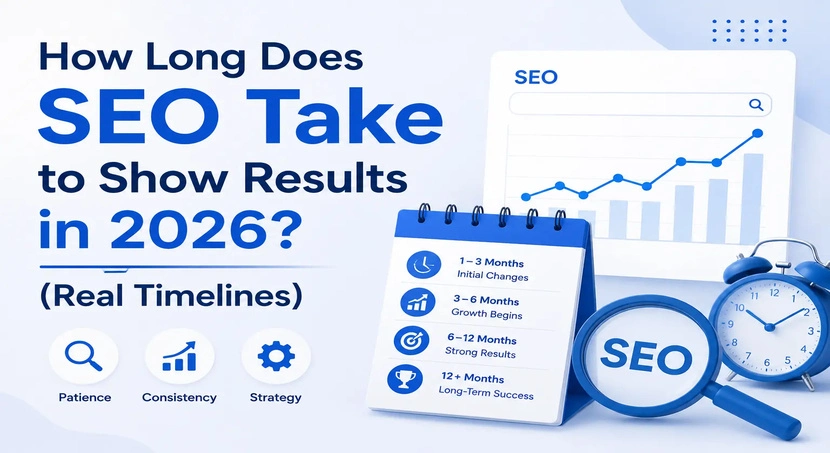
Real SEO Timelines in 2026: What to Expect From Your SEO Agency Month by Month
If you’ve ever hired a digital marketing agency and spent the next few months staring at a rankings dashboard willing something to move, you’re not unusual. Every founder, marketing lead, and business director asks the same question eventually: when does this actually start working? The honest answer is that SEO doesn’t run on a fixed clock but it does follow a consistent and learnable pattern. Understanding that pattern is what separates businesses that build durable organic growth from those that walk away from the highest-ROI acquisition channel in digital marketing just as it’s gaining momentum.
This guide sets out real SEO timelines for 2026, what shapes them, what to expect at each stage, and what a credible, well-run campaign actually looks like month by month. No guesswork, no vague promises. In fact according to BrightEdge, organic search drives over 53% of all website traffic making it the single largest digital channel for most businesses.
The Honest Answer Most SEO Agencies Won’t Give You:
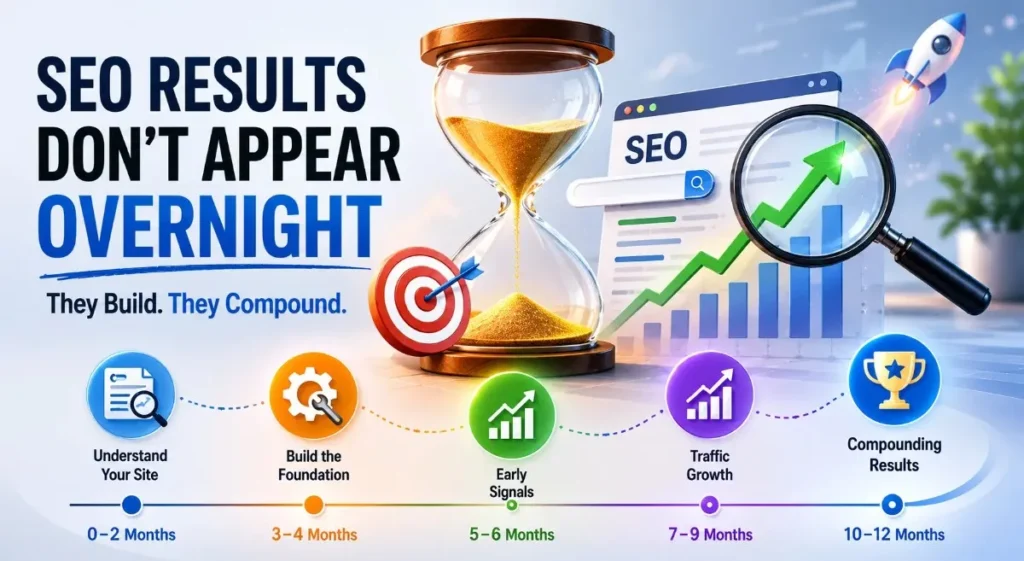
The industry standard response is “three to six months.” It isn’t entirely wrong but it leaves out everything that actually matters. SEO results don’t appear suddenly. They build incrementally, then compound, and the pace at which that happens is shaped entirely by factors unique to your domain, your competitive market, and the quality of what happens in the first few weeks of any engagement.
A credible approach to SEO services in Ahmedabad starts with your real data domain health, current rankings, competitor positioning, technical issues not a packaged timeline built to win a proposal. The gap between seeing meaningful results in four months versus fourteen almost always comes down to the same three things: insufficient technical preparation, a content strategy that lacks depth, or keyword targets that don’t reflect the domain’s current authority level.
What large-scale campaign data consistently shows is this: the majority of newly optimised pages take between three and twelve months to reach their ranking potential. Google has publicly acknowledged that new content can take several months to be fully evaluated within its ranking systems. That isn’t a limitation to work around, it’s the design of a system built to reward sustained quality over short-term activity.
Why Do SEO Timelines Vary So Dramatically Between Businesses?
There is no universal SEO schedule. The timeline of any given business experience is shaped by its starting point, the competitive intensity of its market, and the rigour of what gets executed in the opening months. Four variables consistently carry more weight than everything else combined.
- Domain Authority and Website Age
A domain with years of indexed content, an established backlink profile, and long-running user engagement signals responds to optimization considerably faster than a site that launched six months ago. Google’s trust in a domain accumulates over time. A newer site competing in a dense vertical might need 12 to 18 months to rank for commercially meaningful terms, while a well-aged domain in the same space, optimised correctly, might reach those positions in four to six. This isn’t an arbitrary penalty; it reflects Google’s design preference for sustained, demonstrable quality over manufactured short-term signals.
- Industry Competition Level
Ranking for “accounting software for SMEs” is a fundamentally different challenge from ranking for “chartered accountant in Rajkot.” The more saturated the keyword environment, the longer it takes to displace entrenched competitors with years of authority behind them. Verticals like legal services, financial products, SaaS, and ecommerce require substantially more authoritative content, technical precision, and link equity to crack the first page. Any reliable timeline estimate has to begin with a genuine competitor analysis not a keyword volume report.
- Content Quality and Topical Depth
Google’s Helpful Content system consistently rewards sites that demonstrate genuine expertise across a topic rather than pages that simply mention keywords at the right frequency. A site with fifty thin, disconnected pages will lose to a site with fifteen deeply considered, internally linked ones. Content strategy built on search volume alone produces slow, demoralising results. Topical authority building a structured library of interconnected, expert-level content that covers a subject comprehensively is now one of the most reliable ways to accelerate ranking momentum.
- Technical SEO Foundations
Crawl efficiency, Core Web Vitals, structured data implementation, and mobile experience are the infrastructure that every ranking sits on. When these are broken or neglected, strong content still struggles to surface. Most businesses carry more technical debt than they realise: duplicate metadata, slow load times, fractured internal linking, redirect chains, and crawl errors all create friction that quietly suppresses Google’s ability to assess and rank the site accurately. Addressing this early is often what shifts a nine-month result into a four-month one.
Not all SEO agencies are equal. Make sure you’re choosing the right one.
Digifinity delivers result-driven SEO strategies for growth-focused businesses across Ahmedabad and India built for 2026.
Explore Our ServiceA Realistic SEO Timeline: Month by Month
Rather than a vague range, here is what a properly executed SEO campaign actually looks like across the first twelve months drawn from consistent patterns observed across new, mid-authority, and established domains.
| Phase | What Happens | Visible Results | ROI Stage |
| Months 1–2Audit & Foundation | Technical audit, keyword mapping, on-page optimisation, fixing crawl issues | Minimal – foundation being built | Building |
| Months 3–4Early Signals | Google recrawls pages, indexation improves, Search Console impressions rise | Early rankings on long-tail & low-competition terms | Early |
| Months 5–6Traffic Growth | Organic traffic grows, positions 6–15 for target terms, featured snippets emerge | Qualified traffic, reportable growth | Growing |
| Months 7–9Momentum | Pages move into top 5, new content ranks faster, link equity flows | Consistent leads, lower cost-per-acquisition | Positive ROI |
| Months 10–12Compounding | Authority compounds, SEO outperforms paid on CPA, content library accelerates | Strong revenue-level organic results | High ROI |
- Months 1–2: Audit, Strategy and Foundation
This phase is entirely diagnostic and structural. A thorough technical audit surfaces everything currently suppressing performance. Keyword research is conducted at the topical level not just a list of terms, but a full map of intent clusters, content gaps, and competitor positioning. On-page optimization begins on the highest-priority pages, and critical technical issues are resolved in order of impact.
Visible ranking movement during this phase is minimal and should be expected. The work done here is the foundation on which everything else is built. Skipping or compressing this phase to show early results is the single most common reason SEO campaigns plateau or fail to compound past month six.
- Months 3–4: Early Signals and Crawl Improvements
By this stage, Google has begun recrawling and re-evaluating optimised pages. Improvements in crawl coverage, indexation rates, and early ranking movement on lower-competition terms are typical. Search Console impressions begin climbing even before click-through rates shift in a meaningful way. For businesses running paid search alongside SEO, this is a productive moment to cross-reference intent data. A well-structured performance marketing agency will often surface which terms are converting through paid channels, directly informing which organic targets deserve priority.
This is also the phase where patience is most tested and most necessary. Making reactive changes based on six weeks of early data is where many campaigns lose structure and momentum. Consistency here is genuinely protective.
- Months 5–6: Measurable Traffic Growth Begins
Organic traffic real, qualified visitors with genuine search intent begins growing in ways that can be reported with confidence. Pages start appearing in positions 6 to 15 for target terms. Featured snippet opportunities begin to surface. Internal link equity, built methodically over the previous months, starts flowing through the site architecture and lifting related pages with it.
For online retailers, category and product pages optimised in the first two months typically begin generating conversion-relevant traffic in this window. Businesses managing a structured approach to e-commerce growth solutions will begin aligning organic traffic patterns with the buying journey at this stage ensuring visitors arriving through search are landing in experiences built to convert, not just to inform.
- Months 7–12: Compounding Results and Real ROI
The compounding nature of well-managed SEO becomes tangible here. Pages that are ranked in positions 8 to 12 begin moving into the top five. New content, informed by actual performance data from earlier phases, starts ranking faster because the domain’s overall authority has grown. Link acquisition, conducted properly throughout the campaign, amplifies the strongest pages. For most businesses, month nine to twelve is the window where cost-per-acquisition from organic search becomes demonstrably more efficient than paid channels not marginally, but significantly.
This is not a ceiling. It is a foundation. A well-managed SEO campaign continues compounding into year two and beyond, with the ROI curve steepening rather than flattening as the content and authority base grows.
Local SEO vs Ecommerce SEO: Do the Timelines Actually Differ?
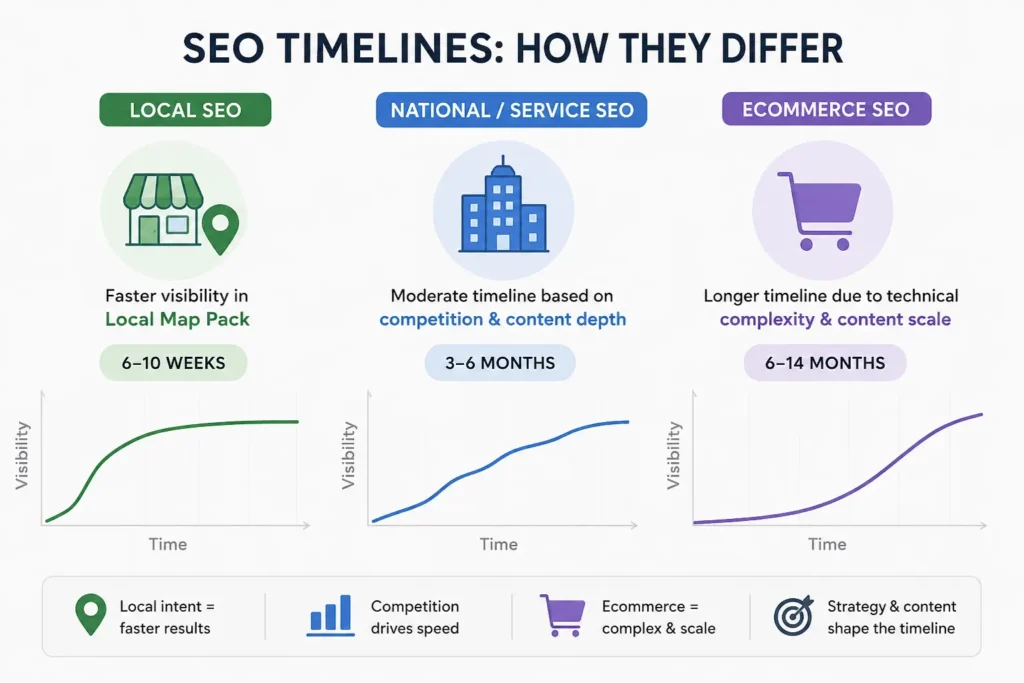
Yes, in ways that matter practically. Local SEO, particularly for Google Business Profile optimization and map pack visibility, tends to produce visible movement faster than national or ecommerce campaigns. A well-optimised local service business in a moderately competitive city can often see map pack movement within six to ten weeks. The competitive pool is smaller and the geographic boundaries of the intent signal work in the optimiser’s favour.
Ecommerce SEO operates at a different level of complexity entirely. Large product catalogues introduce real technical challenges, crawl budget management, canonicalisation across filtered and faceted URLs, thin content on product pages, and duplicate signals from variant pages. The content requirements for category pages are considerably more demanding than equivalent service pages. A realistic timeline for an ecommerce site targeting competitive product categories is six to fourteen months before organic search becomes a dependable revenue channel. Prioritising high-intent category pages with stronger existing authority can compress this window but it cannot eliminate the ranking timeline that Google’s systems require.
National service businesses agencies, SaaS products, professional consultancies sit between the two extremes, with timelines shaped primarily by the competitive density of the target keyword set and the systematicness of the content architecture being built.
How AI Is Changing SEO Execution Speed in 2026?
Artificial intelligence hasn’t changed what Google rewards. It has changed how fast the foundational work can be done. AI-assisted SEO tooling now enables faster content gap analysis, more precise keyword clustering, automated technical auditing across large sites, and real-time monitoring of ranking fluctuations across thousands of terms simultaneously. Tasks that previously consumed three weeks of analyst time topical mapping, internal link auditing, schema implementation at scale now take days when the tooling and expertise are properly combined.
The practical impact on campaign timelines is real. A capable SEO team using AI tooling effectively can compress the technical foundation phase from eight weeks to three or four without sacrificing quality. For reference on how Google evaluates the output of this work, the Google Search Quality Evaluator Guidelines remain the most authoritative public document available on what the search engine actually rewards, worth reading carefully if you’re serious about understanding ranking behaviour in 2026.
That said, AI does not resolve the fundamental ranking constraint: Google still needs time to crawl, assess, and rank content through its systems. No tooling eliminates that evaluation window. The agencies delivering the best results in 2026 are those using AI to accelerate execution while preserving the human editorial judgment and strategic thinking that Google’s quality systems are explicitly designed to identify and reward.
Red Flags: When SEO Is Taking Longer Than It Should?
Slow SEO is not always the result of competitive difficulty. Much of it is poor or misdirected execution and being able to distinguish between the two is important when evaluating an ongoing engagement.
If a campaign is six months in and there is no movement in crawl coverage, no meaningful shift in Search Console impressions, and no ranking progress on any category of target terms, something structural is wrong. The most common causes are inconsistent or low-quality content publication, technical issues that were identified but left unresolved, a link acquisition approach that is either absent or dependent on low-authority sources, or keyword targets that were set without honest reference to the domain’s current authority level.
Businesses that complement their organic investment with structured search engine marketing campaigns during the early SEO build phase often gain a meaningful data advantage. Paid search reveals which terms actually convert in your market before organic rankings confirm that insight can substantially refocus SEO priorities and prevent months of effort directed at the wrong keyword set.
For a reliable, updated view of how Google’s algorithm has evolved and what each major update rewards or panalises, Moz‘s Algorithm Update History is one of the most consistently maintained references available.
How Digifinity Approaches SEO Differently?
At Digifinity, SEO is treated as a business system not a standalone channel managed separately from everything else the business is doing. Every engagement begins with a forensic audit of the current position: technical health, content relevance and depth, backlink profile, and competitor positioning. Recommendations only follow once that diagnostic picture is clear.
The team integrates AI-assisted execution with experienced human judgment across technical SEO, content strategy, and structured link acquisition. Where relevant, SEO is integrated with complementary disciplines from the outset a technically sound website design and development foundation often removes half the technical debt that slows campaigns throughout their lifecycle, making the SEO work more effective and the results more durable.
Reporting is built around business outcomes, qualified traffic growth, ranking movement on commercially relevant terms, and lead or revenue attribution rather than the vanity metrics that often mask the absence of real progress. Every report explains what changed, why it changed, and what it means for the next phase.
For independent context on what strong SEO performance looks like across industries and keyword types, Ahrefs’ SEO Statistics provides one of the most comprehensive data-backed benchmarks currently available.
What Google Is Actually Evaluating When It Ranks Your Site?
Google doesn’t rank websites. It ranks trust. That distinction sounds small but it changes how you should think about every decision in an SEO campaign.
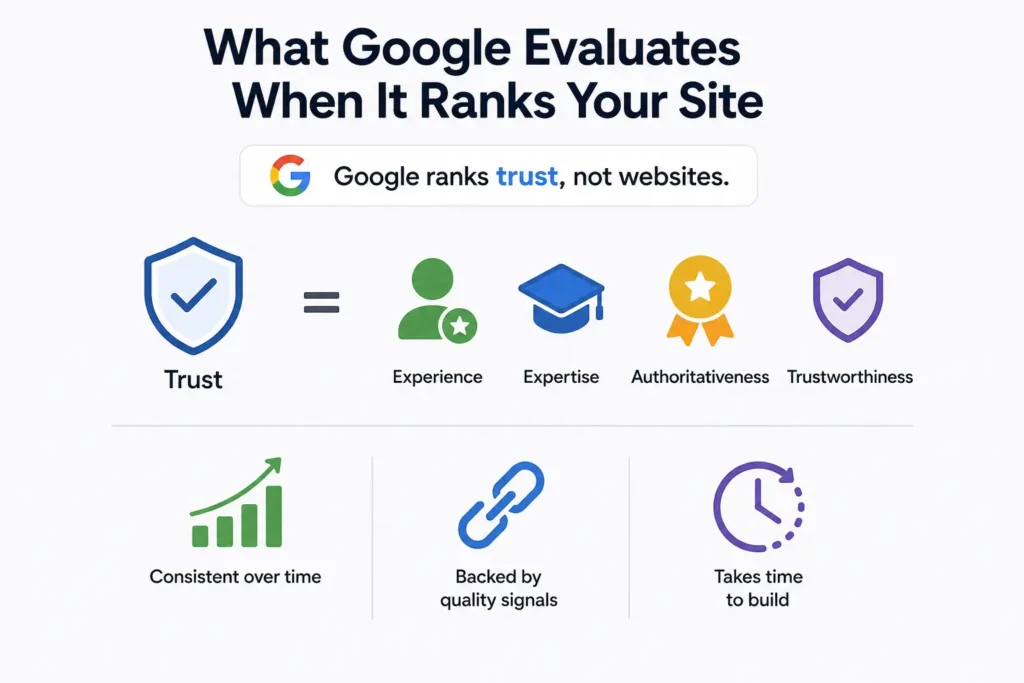
The E-E-A-T framework: Experience, Expertise, Authoritativeness, Trustworthiness is Google’s publicly stated quality lens. But most people treat it as a documentation exercise. Add author bios, cite some sources, tick the box. That’s not what it is. E-E-A-T is the accumulation of real signals across a site over time:
- Who wrote the content and what they demonstrably know
- Which sites link to them and in what context
- How consistently the site publishes over months and years
- Whether the claims it makes can be independently verified
Google’s quality evaluators are trained to spot the difference between expertise performed and expertise demonstrated and so, increasingly, are its automated systems.
Think of it this way: two competing sites, same keyword targets, similar backlinks, both technically clean. One ranks on page one, the other sits on page three and can’t figure out why. Nine times out of ten, the gap isn’t technical. It’s credibility. The signals that create that gap are:
- Clear authorship from someone who demonstrably knows the subject
- Consistent publishing history over a sustained period
- References and links from other respected, relevant sources
These aren’t soft signals. They’re what separates similar sites in competitive searches and unlike a meta tag fix, they take time to build. Which is why starting early matters far more than most businesses realise. If you want to go deeper on how Google’s quality evaluators are actually trained to assess this, Search Engine Journal’s breakdown of E-E-A-T is worth an hour of your time before you write another content brief.