
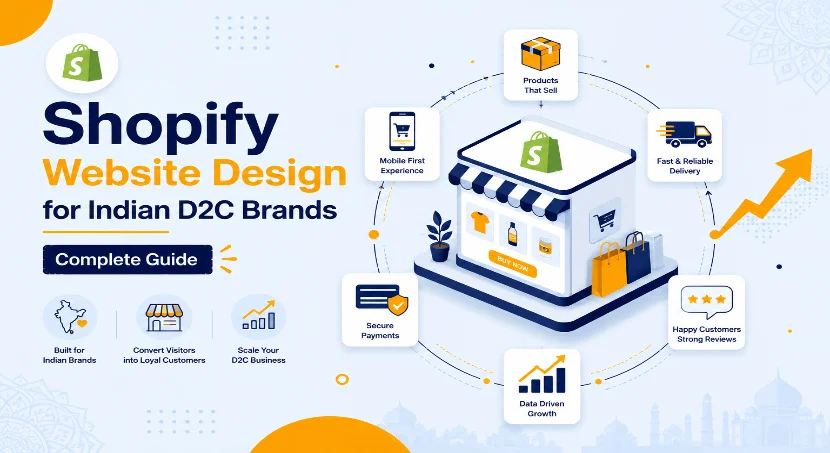
Why a Web Development Company Is Essential for Shopify Growth ?
India’s digital commerce scene is changing big time. It began with the rise of convenient online shopping and has turned into a strong push for direct-to-consumer sales. Now, brands aren’t hanging around marketplace giants like Amazon or Flipkart anymore. They’re creating their own spaces with a web development company. This lets them handle their own branding, make customers happy, and boost profits in the long run.
The heart of this change is the website.
For today’s D2C companies, a Shopify store isn’t just about listing products; it’s their main way to make money, tell their brand’s story, and get new customers. While Shopify gives the basic setup, what really drives success is how well you execute things.
Google has pushed this shift by focusing on mobile-first indexing. They now mainly use the mobile version of sites for both indexing and ranking purposes. This means having a mobile-friendly site is not optional , it’s essential if you want to show up well in search results.
This is where choosing the right partner becomes a strategic business decision rather than a technical one.
A well-built Shopify website determines whether a visitor becomes a customer , or leaves forever.
The Rise of Shopify in India’s D2C Ecosystem :
India’s D2C market is one of the fastest growing in the world. Thanks to more phones, easier payments, and better delivery, people trust buying straight from brands way more now.
As per the India Brand Equity Foundation, the eCommerce industry in India is set for rapid growth.
These D2C brands are expected to shape the future of retail. Shopify is central to this revolution as it makes everything simple by taking care of the technicalities, while the brand gets busy expanding itself.
Key reasons behind Shopify’s dominance include:
- Quick deployment and scalability
- Secure cloud infrastructure
- Extensive third-party app ecosystem
- Built-in mobile responsiveness
- Strong checkout and payment integrations
Many brands get this wrong: Shopify doesn’t promise success. It’s all about execution.
This is why working with a specialised Web Development Company In Ahmedabad has become a common strategy for scaling D2C brands looking for both affordability and expertise.
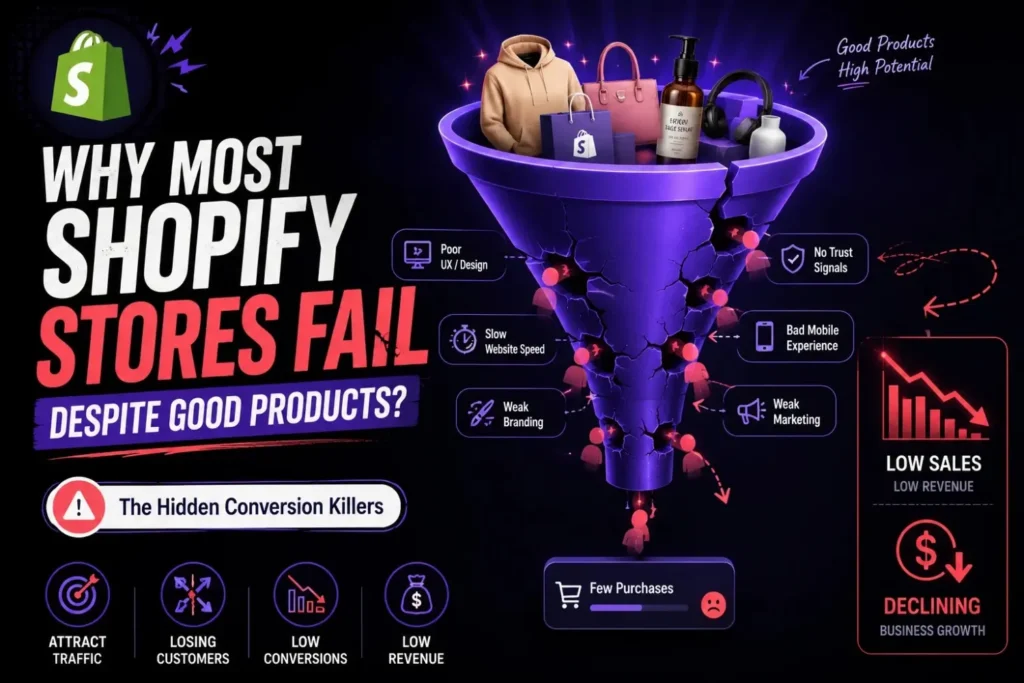
Why Most Shopify Stores Fail Despite Good Products ?
A surprising truth in eCommerce is that most failures are not product-related , they are experience-related.
Even with great products, brands stumble because their sites can’t navigate users through the purchase process smoothly. So, while the offerings are strong, the websites let customers down, failing to guide them to check out easily.
A successful Shopify store is built on psychology, not just design.
Website visitors generally adopt a consistent behavior pattern while browsing a particular website. Firstly, the user enters the website and creates an instant impression about the website. After this, he or she starts analyzing the website to see whether it offers anything of value to him or her or not. In case it offers any useful information, then the user begins checking the credibility of the website by searching for credibility factors like professional appearance, informative data, or security features.
If your store stumbles at any point, conversions will plummet right away.
Many Shopify stores fail even though they have great products because they make mistakes while carrying out each step of the buyer’s journey. Many companies often underestimate the importance of good user experience, fast websites, mobile-friendliness, and easy-to-navigate sites. This results in tons of visitors bouncing before buying anything. Also, vague messaging and not showing enough trust (like security badges or customer reviews) really ruffles potential buyers. Not to mention, depending too much on paid ads instead of SEO makes growing the business super hard. Plus, not planning for analytics and keeping track of customer data from the start can prevent shops from scaling properly, leaving them as quick flash-in-the-pan ventures rather than steady businesses.
A strong Website Development cost in India approach understands this behaviour and focuses on designing stores that guide users intuitively instead of overwhelming them.
Your success deserves the right marketing partner.
Explore our services and see how Digifinity transforms ideas into measurable growth.
Explore Our ServiceMobile-First Commerce Has Become the Standard :
The time when mobile commerce was only a passing fancy is gone and has been replaced by the reality of mobile commerce being the norm. It is where people go first when they decide to shop online. Hence, organizations must adapt to the mobile experience to stay relevant.
It is a norm in mobile-first commerce since most Indians conduct transactions on their mobile phones rather than through the use of desktop computers. Users want sites that load fast and can be easily navigated using their tiny screens, with easy checkout procedures as well. If a website cannot support the use of mobiles, then there is a high possibility of extremely high bounce rates and frustrated customers. Brands have now begun focusing on designing websites that adopt responsive designs, are touch-friendly, and load faster.
Over 70% of eCommerce visits in India come from mobiles now. So, when making a Shopify store, it must be designed for mobile first, not fixed later on.
A mobile-first Shopify experience focuses on:
- Fast loading product pages
- Simplified navigation structures
- Minimal design friction
- Easy checkout flows
- Optimised visual hierarchy
Mobile performance really matters. If it’s poor, SEO rankings drop, and so do conversion rates, hurting a site big time.
Building Shopify Stores That Convert Visitors into Customers :
Creating a Shopify store isn’t just about making it look pretty. It’s more about functionality too, you see. So, while aesthetics matter, they aren’t the whole point. It is about influencing decisions.
Everything on a page needs to make things clear and easy, reducing confusion and making stuff straightforward. So each part should help people understand better, not get in their way.
The Psychology Behind High-Converting Stores
A high-performing Shopify store follows three core principles:
- Clarity: Users understand what is being sold instantly
- Trust: Users feel confident in the brand
- Momentum: Users are guided toward action without distraction
Without these three elements, even high-traffic stores fail to convert.
Homepage Strategy: Your Digital First Impression
Your homepage is not just a landing page, it is your pitch.
Within seconds, it must communicate:
- What the brand offers
- Why it is different
- Why users should trust it
High-performing Shopify homepages typically include:
- Strong hero messaging
- Product highlights
- Customer reviews
- Brand storytelling elements
- Clear calls-to-action
A poorly structured homepage confuses users and increases bounce rates dramatically.
Product Pages: The True Conversion Engine
If the homepage brings users in, the product page closes the sale.
This is where purchase decisions happen.
Product pages are supposed to give buyers all the necessary information and assurance to buy a product. This can be achieved through the provision of high-resolution images and videos from several angles to help customers know what the product looks like, detailed product description with emphasis on benefits rather than features, product price and deals available, shipping details, returns policy, and customer testimonials and reviews among other aspects.
By this point, lots of brands invest in structured Web Design and Development. They focus on making product pages conversion-friendly, not just pretty to look at.
This makes sure that UX, branding, and conversion strategy all work together instead of staying separate.

Trust: The Most Underrated Conversion Factor
Trust plays a huge role in eCommerce sales.
A customer may love a product but still bail if they don’t trust the site. After all, people won’t pull out their credit card for something that feels risky. Plus, if a site seems shady, shoppers usually just move on.
Research from the Nielsen Norman Group highlights that users form credibility judgments within seconds of interacting with a website:
Every design decision affects how trustworthy we perceive something to be, so they really matter.
Key trust-building elements include:
- Authentic customer reviews
- Verified ratings
- Secure checkout indicators
- Transparent shipping policies
- Real user-generated content
Brands that prioritise trust consistently outperform competitors with similar products.
Understanding Website Development Cost in India :
Cost often comes up when people talk about Shopify development.
However, prices can vary a lot based on how complex things get and what business goals you have.
Shopify Development Pricing Overview
| Type of Store | Estimated Cost |
| Basic Shopify Setup | ₹30,000 – ₹80,000 |
| Growth-Oriented Store | ₹80,000 – ₹3,00,000 |
| Custom Shopify Development | ₹3,00,000 – ₹10,00,000 |
| Enterprise Shopify Plus | ₹10,00,000+ |
But focusing solely on price can be misleading.
Rather than concentrating only on price and aesthetics, organizations should take into account other attributes that lead to sustained success. They include conversion efficiency to optimize sales, scalability to help in future expansion, speed to offer the best possible user experience, a proper SEO structure to improve search engine visibility, and good integration that allows easy connection with external tools and applications.
A low-cost store that does not convert becomes significantly more expensive over time.
Why E-Commerce Growth Systems Are Essential ?
Starting up a Shopify store is only the first step; true success depends on constantly making it better and better.
This is where structured E-Commerce Companies become essential.
These systems focus on:
- Conversion rate optimisation (CRO)
- Customer journey mapping
- Retention strategies
- Performance analytics
- Revenue scaling frameworks
McKinsey & Company found that businesses focusing on personalized customer experiences beat their rivals in revenue growth. Consistently, these firms come out ahead, so it pays to prioritize what customers want individually.
This shows that optimization isn’t just beneficial; it’s necessary.
Choosing the Right Web Development Company :
Not all development partners deliver the same value.
A good Shopify methodology is the integration of both technological and strategic skills. These would include strong development skills on Shopify, the ability to do UX/UI design and thus create an easy journey for the customers, the application of conversion rate optimization (CRO) in order to achieve maximum sales, the knowledge of SEO architecture, and strong business growth strategies.
Without this combination, Shopify stores may look great but totally bomb online.
Sure, they might seem nice, but they don’t convert visitors into buyers, so.
That crucial balance is key for any store to succeed.
Picking the right web development partner is super crucial because it really affects how well your business does online.It’s not just about design and coding; you also need a team that understands your business goals, knows your audience, and fits your long-term plans. They should build speedy, responsive sites to convert visitors into customers, and keep everything secure and scalable for growth.
Picking the right provider is key. You want someone great at integrating SEO, making sure users have a smooth experience, and giving ongoing support after launch. They’re more than just a service provider; they become a long-term digital partner. This partner helps turn your site into a steady revenue generator.
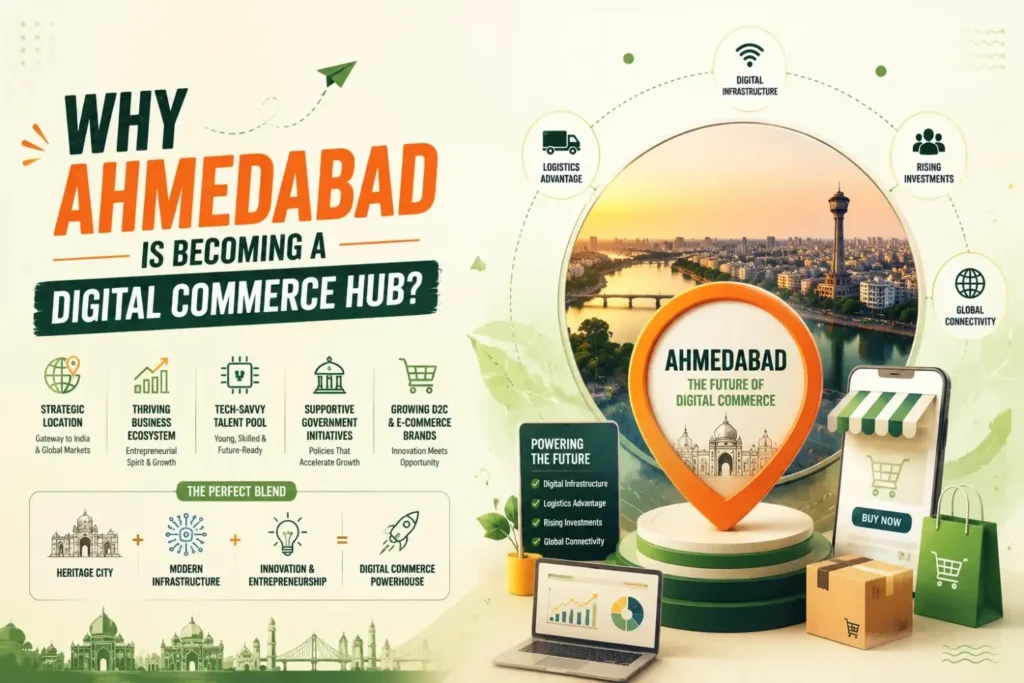
Why Ahmedabad Is Becoming a Digital Commerce Hub ?
Ahmedabad has grown super fast as a hub for digital services and eCommerce in India. So, it’s now seen as one of the leaders in these areas.
A Web Design Company In Ahmedabad often provides a strong balance of affordability, expertise, and scalability.
Key advantages include:
- Cost-efficient development services
- Strong technical talent pool
- Experience in D2C projects
- Full-stack service capabilities
This makes Ahmedabad a top pick for startups and growing brands in India, boosting business growth there.
Future of Shopify and D2C Commerce :
Shopify and direct-to-consumer sales are headed towards super personalized, AI-driven, experience-focused systems. Beyond just quality, brands now compete on the whole customer journey – from finding the product to after-sales fun stuff. Shopify will keep getting upgraded with automations and AI, helping businesses amp up sales instantly. So, expect more smart, seamless shopping experiences everywhere.
The future of eCommerce is moving towards smarts, automation, and personalization. It’s heading toward smarter systems that know what you like, but also using more robot processes. Plus, it wants to make each shopping trip feel personal.
AI in Commerce
AI is changing the way businesses work through smarter product suggestions, improved pricing models, better customer support through automated solutions, and predictive analytics which assist the organization in understanding customers’ behavior and predicting future trends and thus taking informed decisions.
Headless Commerce
Headless architectures allow firms to develop better, faster, and scalable digital solutions. With the decoupling of the front-end and back-end of the solution, it will lead to improvements in the performance of websites, provide designers with room to customize the interface, and allow for content distribution across many channels, including websites, mobile apps, and intelligent devices.
Conversational Commerce
The integration of AI in virtual assistants is changing the whole process of interaction between the user and the virtual experience. The users are switching from conventional methods like navigation or search engine to the use of AI technology in product discovery, querying, getting personal recommendation and transaction.
Industry research from Baymard Institute highlights that reducing friction directly improves conversion rates.
This reinforces the importance of continuous UX optimisation.
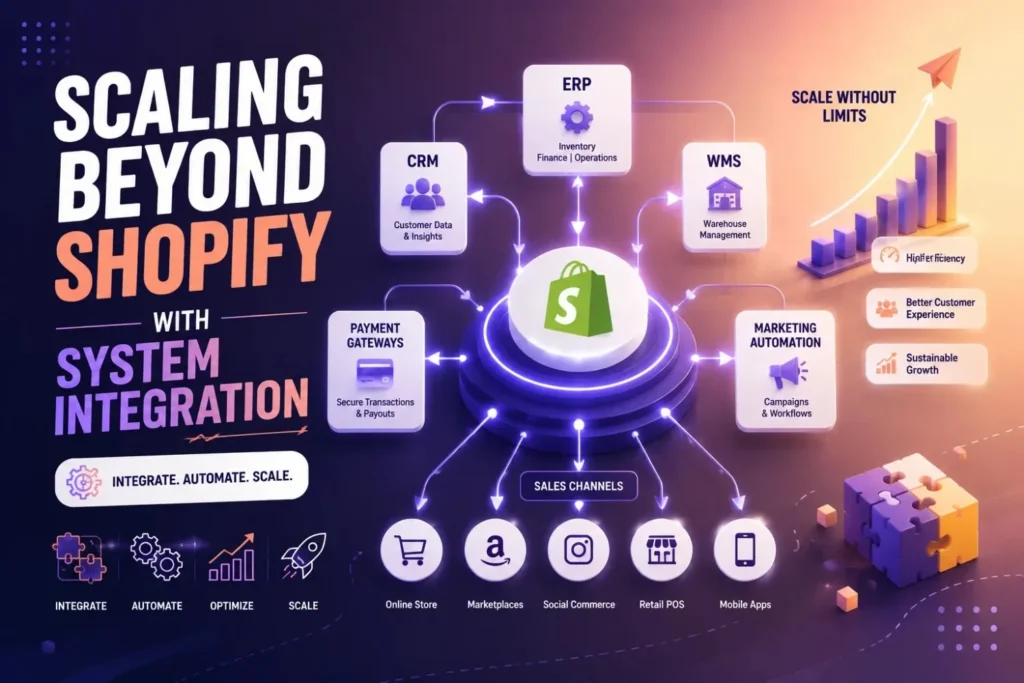
Scaling Beyond Shopify with System Integration :
To grow past Shopify, businesses need to go from just having a standalone store to a full digital ecosystem. When operations expand, depending solely on basic store features limits how well you run things and your ability to see the big picture. That’s where system integration comes in – it links your store to crucial stuff like CRMs, ERPs, payment gateways, inventory managers, and marketing automations, so everything works smoother.
When brands expand, Shopify remains just one piece of a bigger puzzle. So, they often incorporate other tools into their setup.
This is where Custom Software Development Company plays a crucial role.
These services help integrate:
- ERP systems
- CRM platforms
- Inventory management systems
- Automation workflows
This transforms Shopify from a storefront into a full business operating system.
Final Thoughts :
Good Shopify website design plays a major role in the success of D2C brands of India. Not only does it have to be aesthetically pleasing, but it also must be functional. Website speed, ease of use and making sure that you get the sale – these all play an important part.
As the Indian D2C ecosystem matures, businesses that allocate resources towards designing their Shopify stores strategically, scale-wise, and for conversions would be able to gain customer trust, drive sales, and achieve sustained growth.