

The Shopify site for a D2C company is not just an online catalog but your salesman, product showcase, trust builder and transaction generator that works round the clock.
This is important.
An attractively presented Shopify site is doomed to failure if the customers are unable to comprehend the product within no time, browse through the catalog effortlessly, develop trust in the brand, figure out delivery charges, or go through checkout hassle-free. On the other hand, a well-designed Shopify site can make the same traffic convert.
This is when it comes to selecting the best website design company.
When it comes to designing a Shopify website for D2C brands in Surat, a designer should not merely focus on aspects like colors, font, and layout design. There is more to the job that needs to be considered.
For a D2C business, the practical takeaway is straightforward: design the store for customers first, then make sure search engines can understand and discover it. Google’s guidance on creating helpful content similarly emphasises satisfying the user’s needs rather than producing content primarily for search engines.

Why D2C Brands Need More Than a Good-Looking Shopify Store ?
Direct-to-consumer brands face other business pressures than traditional businesses do.
The discovery of the product can be made by the consumer through Instagram, YouTube, Influencers, Google search, an ad or through recommendations from friends. They are then taken directly to a product or a collection page, bypassing the home page.
That means every important page needs to perform a specific commercial job.
A product page may require explaining how the product works, establishing the unique features of the product, dealing with any possible objections, showing good quality by providing web development services, indicating the price and the mode of delivery, and making the next step clear.
The homepage, however, has a completely different function. This is because the homepage must set up positioning, steer the user towards appropriate product categories, and explain why the company is noteworthy.
That’s why it is important for a professional Shopify website designer to start from customer journeys rather than building a homepage only.
Imagine a skincare company based in Surat that sells three lines of products.
One bad way of doing this is putting a banner on the homepage saying:
“Premium Skincare for Modern You”
It sounds nice but provides little value to the visitor.
A better option is telling the visitor everything right away:
“Science-driven skincare for sensitive Indian skin – dermatologist-tested formulations made for daily use”
The second message gives a reason for the visitor to proceed.
It’s all about strategy, not decoration.
Thus, an experienced team takes into account every major screen and asks one question:
What does the customer need to know and do next?
What a Shopify Website Designer Actually Does for a D2C Brand ?
There have been many changes in the job description of the Shopify web designer.
This process is no longer restricted to the creation of visual mockups. A good web design company should know the impact of designs on usability, search engine optimization, and business performance.
Brand-first Shopify design
A D2C website must reflect the brand and not just look like a typical Shopify site.
These include elements such as typography, color palette, photographic direction, product display, iconography, packaging tone, button design, marketing and editorial tone.
It is not important that the website looks very costly.
It is important that it is recognizable and credible as the brand.
For instance, an upscale home decor brand would need ample whitespace, editorial photography, and minimalist typography. A performance nutrition brand would need a strong product hierarchy, comparison charts, ingredient list and proof points.
The Shopify theme should not dictate the branding but should complement it.
Conversion-focused ecommerce UX
Secondly, there is need to create a journey that diminishes uncertainty. Questions from visitors include whether the product suits them, the reason for choosing that brand, what makes it different from other similar products, cost of delivery, delivery time, ability to return the goods in case of a problem, satisfaction of past buyers, and security of payments.
An effective Shopify website does that before the visitor even asks those questions.
It is at this point that ecommerce website design gets intertwined with conversion rate optimization.
Technical Shopify development
Design can never exist separately from technology.
The design process may include customizing the Shopify theme, creating the product and collection structure, using third-party apps, integrating payments, integrating shipping, managing inventory, using customer review tools, marketing via email, analyzing data, tracking conversions, and custom functionalities.
The idea is to develop a system that will remain manageable as the business grows.
SEO-ready website architecture
SEO must not be included after creating the site.
The Shopify store should be created with search visibility in mind.
It is important that all pages – products, collection pages, and all other related content – serve specific purposes. Search engines need to know what all pages represent, the relationships between products and collections, and navigation paths for users on your website.
Structured data will assist in communicating ecommerce-specific data such as products, reviews, organizations, and other similar entities to the search engine.
This means that both your designer and developer need to collaborate with your SEO team in such a way that web development services in Ahmedabad are integrated from day one.
From strategy to execution, we’ve got you covered.
Explore our complete suite of marketing services today.
Explore Our ServiceWhy Shopify Is a Strong Choice for D2C Brands ?
Shopify, in particular, is especially useful for D2C brands in that it provides an ecommerce infrastructure without necessitating the construction of a full commerce platform by the brand.
Nevertheless, the platform alone does not ensure success.
Two different brands can use Shopify and achieve two very different commercial outcomes.
It all depends on:
Strategy → UX → Design → Technology → Traffic → Measurement → Optimization
This Shopify resource explains how DTC brands are approaching acquisition, customer retention, first-party data, omnichannel commerce, social commerce and AI. It supports the point that a modern D2C platform needs to do more than simply display products.
The Shopify store, in effect, must be viewed as a growth engine.
With an emerging D2C brand, Shopify will allow for a fairly uncomplicated product offering. But as the brand grows, the store can become increasingly complicated in terms of product offerings, marketing, customer segments, integrations, etc.
The key issue here is not,
“Will Shopify be able to build my store?”
They will.
The more pertinent question is,
“How should I build my Shopify store to reflect the way my customers really purchase?”
There is where the need for Shopify professional knowledge and responsive web design arises.
9 Elements a High-Performing Shopify D2C Website Needs :
1. A clear value proposition
Three basic questions that need immediate answers on your website include:
What do you sell? To whom? And why do they care?
If the answer lies beneath a carousel, an animated or big banner, you are forcing your visitors to do a lot of work.
The website must make your value proposition visible without needing to scroll too much.
Example:
Poor:
“Explore a better way of living.”
Better:
“Performance footwear that offers light weight for daily commuting needs of Indians.”
2. Mobile-first responsive web design
When it comes to D2C brands, mobile experience must not be viewed as a miniature version of desktop experience.
It must be created as an independent entity based on the mobile user behavior.
All actions from navigation to filters, from product images to sticky add to cart buttons, from variants to checkout interactions must be considered for mobile experience.
According to Baymard’s 2026 research on mobile e-commerce, 75% of mobile ecommerce websites in its benchmarking were marked as “Mediocre” from UX perspective even though they were some of the largest ecommerce brands.
Website development services become a business necessity rather than just an ideal solution for technical purposes.
For a D2C website designed on Shopify, testing for mobile navigation, readability, loading of images, selection of product variants, sticky buy buttons, search capability, filterability, filling of forms, and check out process would be necessary.
A website which seems good on a 27 inch monitor but is frustrating on mobile phone is not a successful D2C website.
3. High-converting product pages
The purchase decision often takes place at the product page level.
A well-designed product page would include:
Product → Benefit → Evidence → Details → Reducing Risks → Call to Action
It will include great product photos, effective product names, product prices and discounts, product benefits, key product specifications, product variations, product reviews, FAQ, shipping details, return policy details, product usage, related products, and call to actions.
Order matters.
A visitor must not have to scroll through five paragraphs of the company history to find out how the product works.
4. Smart collection and navigation architecture
With a growing number of products in the D2C catalog, inadequate navigation may become a hidden barrier to conversions. Here is where a performance marketing agency can step in and solve the problems related to conversions.
For example, a fashion company that begins with 20 items and grows to 300.
A simple navigation may not do.
The website may require:
Shop → Women → Dresses → Occasion → Workwear → New Arrivals
instead of making clients go through 300 products.
Search and filters should match customer thinking.
For example, if customers look for products based on skin concern, product type, size, color, material, price, or intended usage, the website should make these pathways easier.
5. Trust and social proof
The first-timer is not the same as the repeat customer when it comes to confidence.
Trust indicators make up for that.
Good trust indicators are things like genuine reviews, pictures taken by customers, testimonies, ratings, media citations, certification where applicable, secure payment details, easy returns, shipping information, contact information, and About-the-brand information.
Do not fake trust.
Testimonials that are faked, overstated claims, and vague badges may produce the opposite result.
6. Friction-free cart and checkout
Adding an item into the cart does not mean the transaction is completed. A web development agency can assist in improving the checkout process and eliminating possible obstacles which would hinder clients from completing the transaction.
Baymard’s latest research places the average ecommerce cart abandonment rate at approximately 70%, while its checkout research shows that many ecommerce sites still have substantial usability problems. Its 2025 benchmark found that 64% of desktop ecommerce sites and 63% of mobile sites had “Mediocre” or worse checkout UX performance.
However, not all abandoned carts can be salvaged, since someone who is only price-checking or window shopping will leave despite the quality of your checkout process.
Unnecessary friction, on the other hand, is an entirely different case.
A Shopify brand should reduce unnecessary friction, such as unexpected fees, complicated shipping information, too many form fields, mandatory account creation, ineffective error messages, difficult payment instructions, challenging mobile input options, and confusion regarding returns.
According to Baymard, checkout complexity is one of the causes of abandonment. The takeaway here is that it is important to have a simple purchase process without eliminating necessary information.

Shopify Website Design for Surat-Based D2C Brands :
Surat boasts a good entrepreneurial and manufacturing environment with industries operating in the textile, fashion, jewelry, food, beauty, lifestyle, and many other consumer segments.
For domestic D2C businesses, there is a good chance here.
The website can be the means to connect the business capability of the locality with the potential customers at the national/international level through professional website development services.
For example, a fashion brand from Surat could possibly have good manufacturing links and competitive pricing. This information will not be known by customers outside the state of Gujarat.
The website must articulate the commercial value proposition.
Local knowledge becomes essential here.
Shopify website designers working with brands based out of Surat must be aware of both the value proposition of the brand and its growth ambitions.
The website can therefore combine:
- Local brand credibility.
- National shipping information.
- Strong product storytelling.
- Search-friendly category pages.
- Mobile-first design.
- Social proof.
- Conversion-focused merchandising.
The objective is not simply to create a “Surat Shopify website”.
It is to build a D2C commerce platform capable of growing beyond Surat.
How to Choose the Right Shopify Website Designer in Surat ?
The selection of the appropriate provider must not be dependent solely on aesthetic considerations.
Pose your questions to prospective providers.
Do they understand D2C?
It is quite likely that a designer who has mainly created corporate websites does not have knowledge about product merchandising, product variants, shopping cart actions, online sales conversion, and effective use of SEO services.
Ask to see actual ecommerce work.
Can they explain their design decisions?
A good agency will always be able to provide an explanation for why a certain section is there.
Example:
“Reviews are put right under the product benefits since that’s where users would look for confirmation.”
It’s better than:
“We’ve put the reviews here because it’s just balanced.”
Do they consider SEO from the beginning?
There must be an association between design, content, and search architecture on your Shopify website.
Question everything about collections, product URLs, metadata, internal links, image optimization, structured data, indexation, canonicals, Search Console, and Merchant Center.
Do they understand conversion tracking?
If the agency fails to give an explanation of how it can measure the effectiveness of the site on the business performance, beware.
Website projects must have measurable outcomes.
Shopify Website Design Process for a D2C Brand :
A professional Shopify project should follow a structured process.
Stage 1: Discovery
Start with the business rather than the theme.
Products, customers, competitors, prices, ecommerce website design, brand position, acquisition sources, analytics and conversion figures should be reviewed.
Stage 2: Strategy
Define your target customers, product hierarchy, value proposition, navigational structure, content needs, conversion path, and SEO potential.
This forms the basis of the design.
Stage 3: UX architecture
Structure first, then add visual embellishments.
Mapping:
Homepage → Collection → Product → Cart → Checkout
Followed by additional journey mapping such as:
Blog → Product → Collection → Purchase
and
Google Search → Product/Collection → Trust Content → Purchase
Stage 4: UI design
Next, create the visual system.
This should reflect the brand while being usable.
Stage 5: Shopify development
UX and UI that have been approved become the actual Shopify website.
At this phase, theme development and app integration take place.
Stage 6: SEO implementation
Review of the technical and content factors occurs prior to the release date.
This includes factors like metadata, headings, internal linking, image optimization, structured data, XML sitemap, canonicals, redirects and indexation.
Stage 7: Quality assurance
Test on mobiles, tablets, and desktop computers, all major browsers, product types, cart, checkout process, forms, search engine, web design company filter, payments, and shipping methods.
Stage 8: Launch and optimisation
The launch of the website is not the end of the project.
It is the start of the optimisation process.
Check the data, detect the friction, and perform the improvements.

Common Shopify Website Mistakes That Cost D2C Brands Sales :
Many D2C websites don’t fail due to a big technical glitch.
They generate losses because of minor glitches accumulated together.
Designing for the brand instead of the customer :
The company can adore its visual identity, while the clients have difficulty comprehending the proposition.
It is important to get the message across first.
Using too many Shopify apps :
Applications can enhance capabilities, but too many third-party scripts can cause complications and poor performance.
All applications must be validated before release.
Question:
Does this application make enough money to validate the technology used in it?
Treating product descriptions as an afterthought :
Copy for the product should address customer concerns instead of just listing manufacturer specifications.
Hiding delivery and returns information :
When people are uncertain, they become hesitant.
Make the delivery schedule, shipping cost, and returns policy easily available.
Ignoring mobile users :
The usability on mobile devices is of high importance in case of direct-to-consumer companies as social and paid promotions, as well as search engine marketing, often drive visitors straight to the mobile landing page.
Making every page look identical :
Consistency is important, but each page is unique.
Homepages should not act as if they were product pages.
Collection pages should not act as if they were blog posts.
Product pages should not act as if they were about us pages.
Focusing only on launch :
It is possible for a site to have an impressive technical performance right from its creation yet still lack commercial success.
Performance needs to be continuously evaluated.
Shopify Website Designer vs General Web Development Agency :
Not every web development agency approaches ecommerce in the same way.
| Area | General Web Development Agency | Shopify D2C Specialist |
| Website design | Often broad | Ecommerce-focused |
| Shopify expertise | May vary | Core capability |
| Product UX | General | Conversion-focused |
| Checkout optimisation | May be limited | Central consideration |
| Ecommerce SEO | Variable | Built into architecture |
| Product merchandising | Often secondary | Core priority |
| D2C customer journey | May be generic | Brand and funnel focused |
| CRO | Often post-launch | Integrated from planning |
| Mobile ecommerce | Responsive | Mobile-first commerce |
| Growth optimisation | Project-based | Continuous |
This does not mean every specialist is automatically better.
The important factor is relevant experience.
A good web development agency would know how to showcase their success with the Shopify platform through solving business problems and not merely with nice screenshots.
How to Measure Whether Your Shopify Website Is Actually Working ?
Website success should be measured through business outcomes.
Consider using a performance framework like this:
| Stage | Metric | What it tells you |
| Acquisition | Organic traffic | Search visibility |
| Acquisition | Paid landing-page traffic | Advertising effectiveness |
| Engagement | Product-view rate | Product discovery |
| Consideration | Add-to-cart rate | Product interest |
| Checkout | Checkout initiation | Purchase intent |
| Conversion | Purchase conversion rate | Commercial effectiveness |
| Revenue | Average order value | Basket performance |
| Retention | Repeat purchase rate | Customer value |
| Experience | Mobile conversion rate | Mobile UX quality |
Don’t optimize one metric independently.
For instance, it doesn’t make sense to improve traffic by 50%, but have your conversion rate plummet.
Nor does it help to raise conversion rate but lower average order value at the same time.
Here’s a good business formula:
Revenue = Qualified Traffic × Conversion Rate × Average Order Value
This provides your web marketing strategy with a business basis that enables e-commerce firms to generate traffic, close sales, and grow their business.
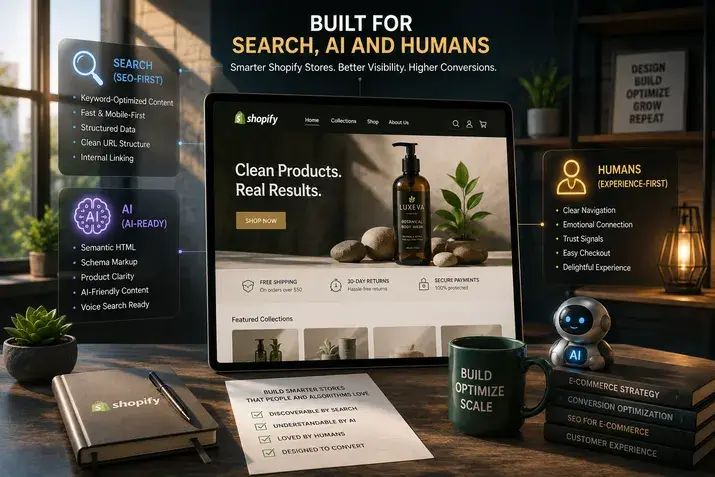
Building a Shopify Store for Search, AI and Humans :
AI-powered search experiences have resulted in great confusion regarding SEO.
The basics, however, remain quite unchanged.
This Semrush guide explains how ecommerce websites can improve visibility across AI search and traditional search by focusing on crawlability, site authority, structured product data, product feeds and clear product information. It is highly relevant to the section because it connects ecommerce SEO with AI-driven product discovery
SEO principles that underpin classic searches are similarly helpful for making content readable in novel AI-driven searches. What should matter is quality, accessibility, and organization of content rather than trying to game AI algorithms.
This means that your D2C Shopify store should definitely not be loaded with gimmicky “AI SEO” practices.
Instead, make the content readable.
For product pages, clearly communicate:
- What the product is.
- Who it is for.
- What problem it solves.
- How it works.
- What it costs.
- What customers think.
- How it is delivered.
- How it can be returned.
- What makes it different.
This is also helpful for generative searches since good structure makes it easy for a system to understand and summarize information about website development services.
For more general topics, address legitimate customer inquiries.
The skincare company could produce:
“How to Create a Skincare Regimen for Sensitive Skin”
The fashion company could produce:
“How to Select Suitable Fabric for Summer Wear”
The nutrition company could produce:
“How to Interpret Protein Supplement Labels”
The idea isn’t to create hundreds of superficial blog posts.
The idea is to become an expert on the topics that matter most to the business.
A Mini Example: Redesigning a D2C Fashion Store
Consider a Surat-based clothing brand that gets 40,000 visits to their website per month.
This brand has good Instagram engagement, good product photographs, and competitive prices.
However, it suffers from poor mobile conversions on their website.
For redesign, the brand shouldn’t start out by saying:
“Let’s just change the colors.”
They should first understand the customer journey.
Say the data looks like this:
40,000 visits → 14,000 views → 2,000 adds to cart → 1,100 checkouts → 500 purchases
The problem is not the traffic.
The biggest opportunity is likely between add to cart and purchase.
The redesign team can study factors like visibility of shipping costs, shipping estimates, guest checkout, payment failures, form length, mobile entry behavior, and return policy visibility.
If the website design company successfully increases checkout completion with an effective redesign, then the brand can earn extra money without investing anything in acquiring customers.
Conversion-oriented design on Shopify is the key strength.
You don’t always need more visitors; sometimes, you need to lose fewer of the visitors that you already have.
Why SEO, Web Design and Development Should Work Together ?
One such mistake made by many agencies is the over-separation of their departments.
The designer designs the visual interface.
The developer implements it.
The SEO department tweaks it.
The content department supplies the copy at a later stage.
It creates unnecessary complications.
An alternative to that is a more collaborative process.
The team must know what SEO needs.
The developer must know about performance.
The SEO department must know about UX.
The content department must know about conversions.
For instance, changing the URL structure of collections after implementation can lead to indexing problems.
Similarly, making changes to the product template design after writing the content can create layout issues.
Implementing lots of applications after development can negatively impact performance.
These are not separate complications.
They are interlinked decisions.
The Role of Content in Shopify D2C Growth :
A Shopify store should not depend entirely on paid advertising.
While paid traffic will boost growth, web development services will enable you to create a technical base that allows organic search to be a compounding source of visitors.
The content ecosystem may include some commercial content, which includes product pages, collection pages, and category pages.
Educational content may include buying guides, product comparison guides, how-to content, and expert opinions.
Trust content may include an about page, customer stories, reviews, FAQ, and shipping and return policies.
These pages may be mutually reinforcing through internal linking.
A buying guide page can be linked from relevant collection pages.
A collection page may be linked to relevant products.
A product page may be linked to relevant guides.
It creates a natural topical hierarchy for both customers and search engines.
From the perspective of a brand making investments in their website, it has much more value than just publishing a huge amount of unrelated pages.
The Technical Foundation Matters More as the Brand Scales :
For a small D2C company, manual processes are occasionally workable.
For an expanding brand, they are not.
As products, numbers, and integrations grow, responsive web design and technical decisions become increasingly crucial.
A Shopify project should consider:
- Theme maintainability.
- App dependency.
- Product taxonomy.
- Variant structure.
- URL consistency.
- Redirect management.
- Analytics.
- Tracking reliability.
- Performance.
- SEO migration requirements.
The idea is to develop a store which would be able to change without being entirely redesigned each time when a new product range or marketing channel appears.
And it is at this point where professional development services could play a significant role.
The aim is to design a flexible store as the company develops.
What Makes a Shopify Website Investment Worthwhile ?
Cheap website is usually not a cheap solution.
Let’s assume one website costs $2,000 and another one $6,000.
But if the first one gives worse conversion rate, bad user experience, and lots of technical work to be done, all the saved money may be spent on fixing issues.
Instead of:
“How much does the website cost?”
ask:
“What results should be achieved by the website?”
Effective investment strategy:
Website investment → Improved UX → More conversions → More sales → Increased customer lifetime value
Even a slight improvement matters for a D2C brand.
For instance, let’s imagine that the company gets 20,000 visitors per month, and converts only 1%, which means 200 orders.
When 1.5% conversion rate is achieved, 300 orders are made.
This is 50% more orders without any extra traffic.
Although the financial cost is determined by other factors like average purchase value, margins, and repurchase rate, this shows how important web development services and website optimization really are.
Final Thoughts :
A successful D2C Shopify website is not built by selecting an aesthetically pleasing theme and filling it with products.
It is built by integrating brand strategy, consumer psychology, ecommerce user experience, responsive web design, technical development, SEO, analytics and conversion optimization into one unified whole.
For D2C businesses in Surat, the significance is especially pronounced. The right Shopify website will turn a local business into a brand that can sell to consumers anywhere in India and even internationally.
The right Shopify website designer, therefore, must look further than mere aesthetics.
They must ask:
Are consumers able to grasp the brand identity quickly?
Are they able to find the right product without hassle?
Do they feel assured by the brand?
Can they buy conveniently using their phone?
Can search engines interpret the catalog?
Is the brand able to track success?
Will the site grow with the brand?
The result is very different from merely asking whether the website “looks good.”
In such a case, a professional website design agency needs to develop the Shopify store based on the buyer’s journey and the business goals. Once all the above-mentioned elements are taken into consideration and worked together, the website becomes much more than just an online shop; it becomes an asset that helps to grow.
For an emerging brand, this is the benchmark to strive for.