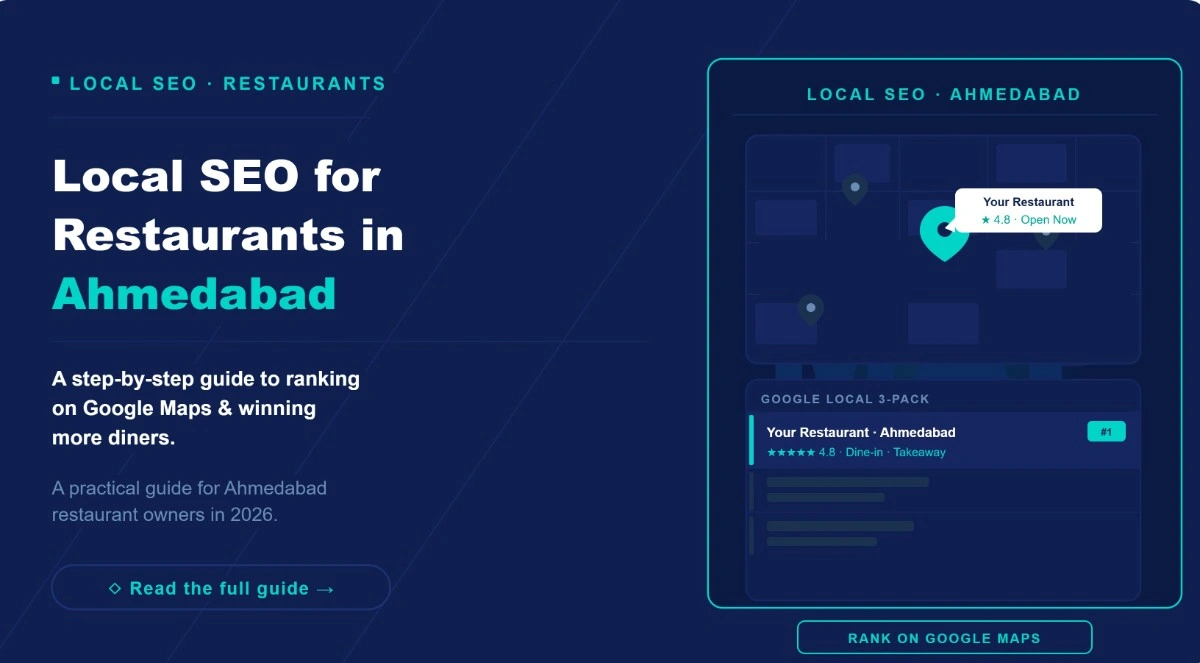
A practical guide to ranking on Google Maps and winning more diners:
Open Google Maps right now and search “restaurant near me” from anywhere in Ahmedabad. The three names that show up in that little map pack aren’t there by luck. They’re there because someone did the unglamorous work of setting up proper local seo services and stuck with it long enough for Google to notice. If your restaurant isn’t one of those three names, you’re losing footfall to competitors who simply understood this earlier and according to Google’s own research on local search behaviour, a large share of “near me” searches lead to a visit within a day.
This guide walks through exactly what it takes to fix that, step by step, without the vague promises most agencies hand out.
Nothing here is complicated in theory. Google Business Profile, on-page fixes, citations, reviews, content, and a bit of local link building that’s the whole game. What trips most restaurant owners up isn’t understanding these pieces, it’s finding the time to do all of them consistently while actually running a kitchen. So think of this less as a one-off checklist and more as a working reference you can come back to as each piece falls into place.
Why Local SEO Actually Matters for Ahmedabad’s Restaurant Scene?
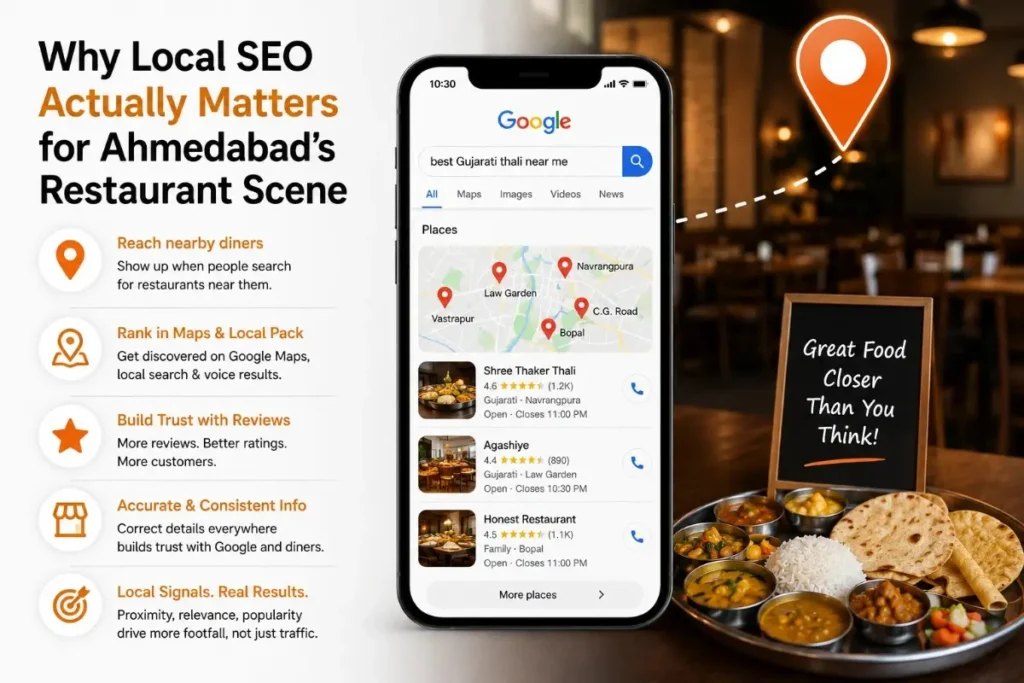
Ahmedabad’s food market is dense. Law Garden, C.G. Road, Navrangpura, Vastrapur, Bopal every one of these pockets has three or four restaurants competing for the same lunch crowd. National SEO doesn’t help here. Nobody in Mumbai is going to book a table at your Satellite outlet. What matters is whether you show up when someone standing two streets away searches “best Gujarati thali near me” or “family restaurant Bopal is open now.”
That’s a different discipline from standard SEO. It leans on proximity signals, review velocity, category accuracy, and consistent business information across the web, rather than just keyword-optimised blog posts. Get it right and you show up on Maps, in the local pack, and in voice search results all without paying per click.
Step 1: Get Your Google Business Profile Right First
Everything else you do sits on top of this. A restaurant with a messy or half-filled Google Business Profile will struggle to rank no matter how good the website is. Google’s own guidance on Business Profile setup is worth a read once, even if you hand the ongoing management to someone else.
- Claim and verify the listing this typically takes 15-20 minutes, though postal verification can add a few days if Google requires it.
- Set the primary category precisely. “Restaurant” is too broad; “Gujarati Restaurant” or “North Indian Restaurant” gives Google far clearer intent-matching signals.
- Add photos weekly. Listings updated with fresh images at least once a week tend to hold visibility better than ones left static for months.
- Fill in every attribute seating capacity, outdoor seating, parking, Wi-Fi, dietary options because these fields directly influence which searches you surface for.
Restaurants that treat their Business Profile as a living page, not a one-time setup, consistently outperform ones that fill it in once and forget it. And while you’re at it, it’s worth being honest about photo quality. Dim phone snaps of the dining area rarely help, and restaurants that invest in proper photography and videography tend to see noticeably better click-through from the Maps listing to actual visits.
Ready to Turn Google Search Into Your Best Waiter?
Digifinity works with restaurants across Ahmedabad to build local search visibility that brings real diners, not just profile views. Whether you need Google Business Profile management, on-page SEO, or a full local SEO strategy, we’ll build a plan around your outlets and your neighbourhood.
Explore Our ServiceStep 2: On-Page Local SEO for Your Restaurant Website
Your website still matters, even in a Maps-driven category. Google cross-checks your site against your Business Profile to confirm you’re a real, active business.
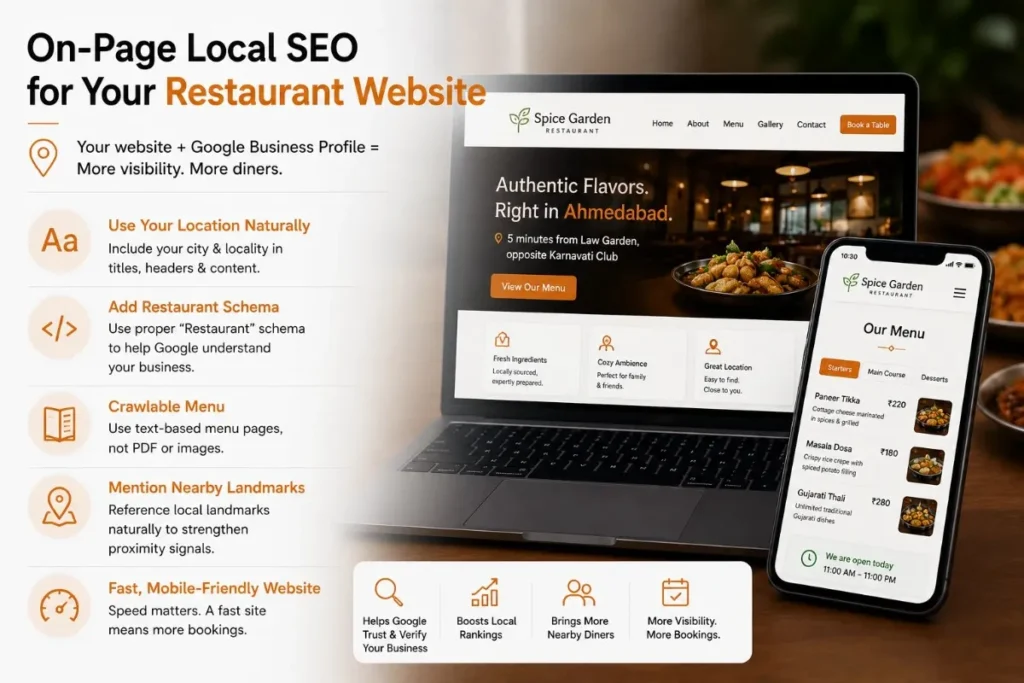
The essentials here: your city and locality named naturally in page titles and headers, a proper schema markup for “Restaurant” (not generic “LocalBusiness”), and a menu page that’s actual crawlable text not a PDF or an image, which Google can’t read well. If your current site was built without these basics in mind, it’s worth having it audited through a proper local seo services engagement rather than patching it piecemeal.
There’s a smaller detail most restaurant sites get wrong too: mentioning nearby landmarks naturally in your area or “About” page. “Five minutes from Law Garden” or “opposite Karnavati Club” isn’t just helpful for customers, it reinforces the proximity signals Google is already pulling from your Business Profile. Small thing, but it adds up.
Site speed matters more here than most restaurant owners assume a slow-loading menu page on mobile data is a lost booking, not just a ranking penalty. Most people checking a restaurant on their phone before stepping out aren’t going to wait ten seconds for a hero image to load; they’ll just tap back and pick the next result on the map.
Step 3: Citations, NAP Consistency, and Online Ordering Integration
NAP stands for Name, Address, Phone number, and it needs to match, exactly, everywhere your restaurant is listed Zomato, Swiggy, Justdial, Google, Facebook, your own website footer. Even a small inconsistency, like “Rd” in one place and “Road” in another, quietly weakens the trust signal Google builds around your business.
Beyond citations, most Ahmedabad restaurants today run some form of online ordering or table booking, whether through Swiggy, Zomato, or their own system. When that ordering flow lives on a shaky, poorly integrated backend, it doesn’t just frustrate customers, it drags down site performance metrics that feed into your local rankings too. Restaurants scaling this properly usually work with a custom software development partner rather than bolting on a third-party widget that slows the page down.
None of this needs to be complicated on day one. Even a simple, well-built booking form that doesn’t crash during peak dinner rush solves most of the frustration customers actually run into.
For restaurants outgrowing basic plugins and wanting a proper reservation or loyalty system built around how their business actually runs, that usually means commissioning dedicated web app development rather than stacking more third-party tools on top of each other.
Step 4: Reviews and Reputation Management
Review count and review recency carry real weight in local ranking algorithms arguably more than most restaurant owners realise. A restaurant with 40 reviews from the last three months will often outrank one with 300 reviews that stopped coming in a year ago.
Ask happy customers directly, right at the table or via a simple WhatsApp follow-up. Respond to every review, good and bad, within 48 hours where possible. Google factors owner responsiveness into how it evaluates a listing’s activity level, and BrightLocal’s annual consumer review survey has repeatedly found that response patterns influence whether diners trust a listing enough to book, not just the star rating itself.
Step 5: Local Content and Keyword Targeting
This is where small business seo services thinking becomes essential, because restaurant content shouldn’t read like generic corporate copy. Write blog posts and landing pages around what people in Ahmedabad actually search: “best rooftop restaurant Ahmedabad for anniversary,” “pure veg restaurant near Sabarmati Riverfront,” “budget thali places Maninagar.” These long-tail, hyper-local phrases convert far better than chasing “restaurant Ahmedabad” alone, which is dominated by aggregator sites you’ll never outrank directly. Neil Patel’s writing on long-tail keyword strategy makes a similar point for local businesses generally the further you narrow the intent, the easier the win.
Seasonal and event-driven content works particularly well here too Navratri special menus, monsoon thali offers, New Year bookings because it captures search spikes that generic evergreen pages miss entirely.
Step 6: Local Link Building and Digital PR
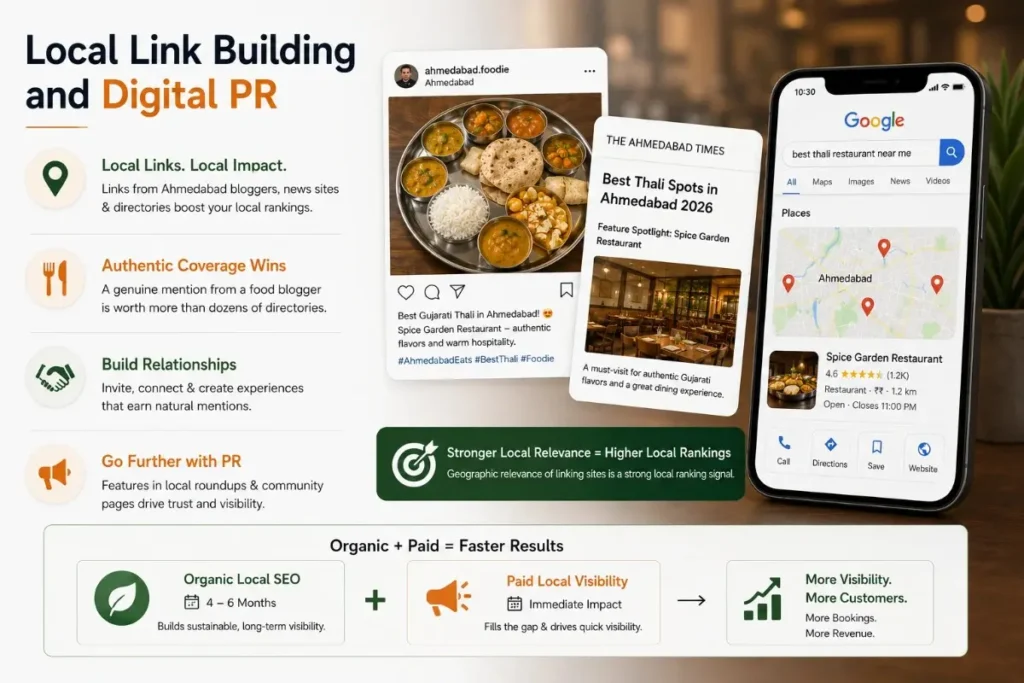
Links from Ahmedabad-based food bloggers, local news sites, and community directories carry more local ranking weight than a generic national backlink ever will. A feature on an Ahmedabad food Instagram page or a mention in a “Best Thali Spots in Ahmedabad 2026” roundup does more for local visibility than most people expect. Search Engine Land’s coverage of local ranking factors consistently points to geographic relevance of linking sites as one of the stronger signals in this category.
The trick is not chasing links for their own sake. A single genuine mention from a food blogger who actually ate at your restaurant and photographed the thali is worth more than ten paid directory submissions nobody clicks through. Reach out personally, invite them for a tasting, and let the coverage happen naturally.
Pairing this organic push with paid local visibility, run properly through a performance marketing approach, tends to compress the timeline considerably. Organic local SEO alone can take four to six months to show clear movement, while paid fills that gap.
DIY Local SEO vs Hiring an Agency:
| Factor | DIY Approach | Professional Agency |
| Time investment | 5-8 hours weekly, ongoing | Handled end-to-end, owner reviews reports monthly |
| Citation consistency | Manual, error-prone across 15+ platforms | Managed and monitored systematically |
| Review response strategy | Often reactive or inconsistent | Structured, timely, tone-consistent |
| Typical time to see ranking movement | Unpredictable, often 6-9 months | Usually 3-4 months with focused execution |
| Technical fixes (schema, speed, mobile) | Frequently skipped or done incorrectly | Built in as standard |
Neither path is wrong. A single-location restaurant with a hands-on owner can absolutely do this alone. A multi-outlet brand competing across several Ahmedabad neighbourhoods usually can’t spare the bandwidth, and that’s where a dedicated agency earns its cost back quickly through covers, not clicks. Most owners who go searching for the best digital marketing agency in Ahmedabad at this stage are really just looking for someone who’ll treat their restaurant’s growth like it matters, not another line item.
Common Mistakes Ahmedabad Restaurants Make:
A few patterns show up again and again. Restaurants list themselves under the wrong primary category to “cast a wider net,” which actually dilutes relevance instead of expanding it. Others run separate, uncoordinated Google Business Profiles for delivery-only and dine-in versions of the same outlet, splitting their review count and confusing Google’s understanding of the business. And plenty simply stop updating their profile the moment it starts ranking, not realising that stagnant listings lose ground to competitors who keep posting.
There’s one more mistake worth calling out on its own: restaurants that pour money into GBP optimisation and reviews while running a website that hasn’t been touched since 2019. If the menu page still loads slowly or the site isn’t mobile-friendly, all that local ranking effort just brings frustrated visitors to a page that turns them away. Sometimes fixing that web development agency relationship matters as much as the SEO work itself.
Why Do Restaurants Work With Digifinity on Local SEO?
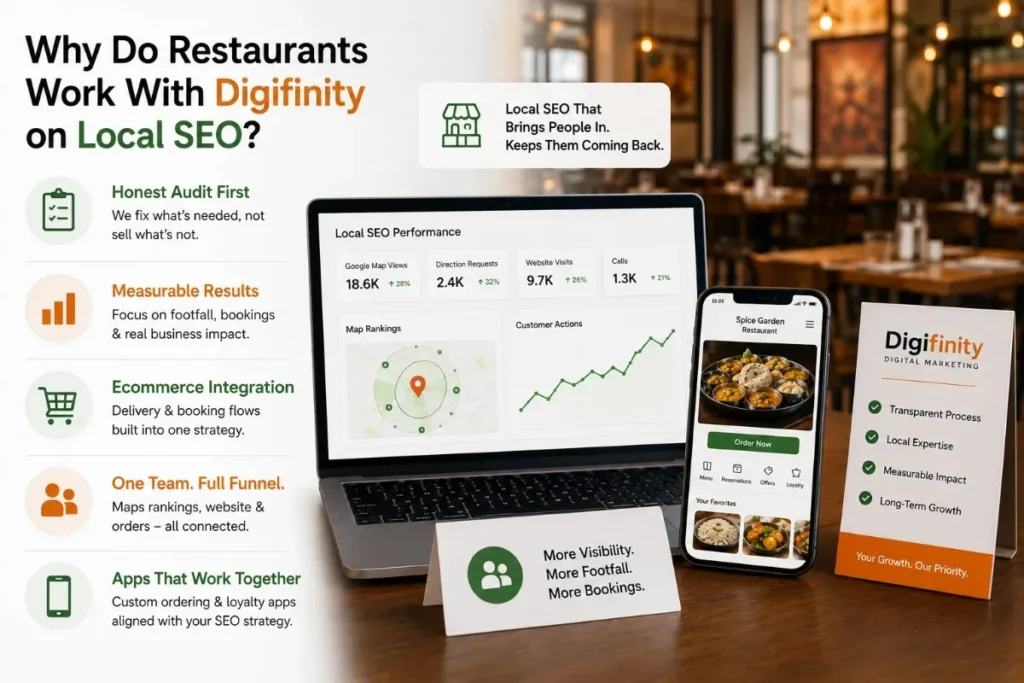
We’re not the biggest name in the city, and we don’t try to be. What Digifinity offers restaurant clients is a structured, transparent process as one of the more grounded options among the best digital marketing agency in Ahmedabad searches turn up, our approach focuses on measurable footfall and booking impact rather than vanity ranking screenshots.
That process usually starts with an honest audit, not a sales pitch. We’d rather tell a restaurant owner their Business Profile just needs three fixes and a review push than sell a twelve-month retainer they don’t need yet. The bigger engagements come later, once the basics are actually working.
For restaurants that also run online ordering, we handle that through our broader ecommerce services work, folding delivery and booking flows into the same strategy instead of treating them as separate projects.
None of this happens in silos internally either; the same team tracking your Maps rankings is the one looking at your ordering funnel, so a drop in one usually gets caught before it shows up in the other.
And for brands wanting their own ordering or loyalty app rather than relying entirely on aggregators, our mobile app development team builds that alongside the SEO strategy, so the two aren’t working against each other.