Why Website Speed Matters More Than Ever in 2026 ?
Website speed has ceased to be a technical luxury. It has now become an essential business need. Slow websites irritate visitors, increase bounce rates, and decrease conversions. On the other hand, fast websites enhance engagement, build trust, and drive growth.
Google still gives user experience priority in its ranking algorithm. This means that website performance affects search engine result visibility. Companies which spend money on optimizing their site for performance tend to get more leads and keep customers loyal.
Based on Google Search Central documentation for Page Experience, pages that have a good user experience are more likely to meet today’s search needs.
Because of this, any Web Development Company In Ahmedabad must make sure to keep the speed of the website at its highest from the beginning of development itself.
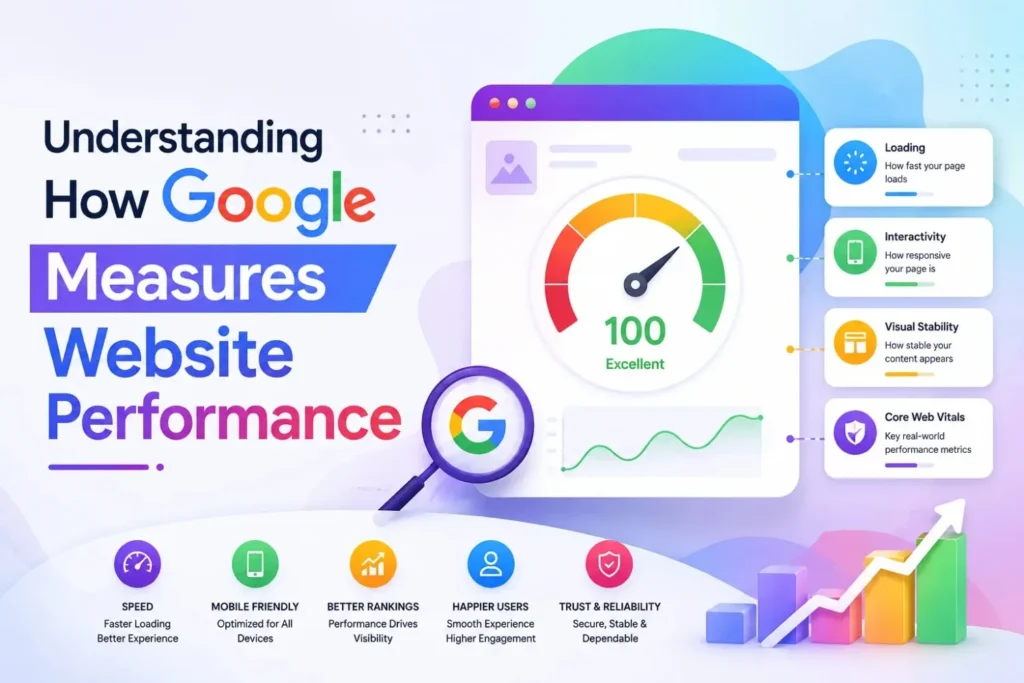
Understanding How Google Measures Website Performance :
The Google PageSpeed Insights tool analyzes web pages based on data obtained from actual users as well as lab testing. This tool gives you a performance rating according to a number of technical parameters.
Key areas assessed include:
| Performance Metric | Recommended Target |
| Largest Contentful Paint (LCP) | Under 2.5 Seconds |
| Interaction to Next Paint (INP) | Under 200ms |
| Cumulative Layout Shift (CLS) | Under 0.1 |
| First Contentful Paint | Under 1.8 Seconds |
This is what helps to detect problems affecting the speed and usability of websites.
Speed is not the only factor that Google considers when ranking sites; it also gives high importance to the performance of sites on mobile devices because many people use their phones for surfing the web. Google employs a technique known as mobile-first indexing to determine the performance of a site, looking at factors like responsive design and speed.
Bounce rate and user engagement can also give indications about the usefulness of the content to the visitors.
Moreover, Google takes into account page experience signals such as HTTPS security, safe browsing, and no presence of annoying pop-ups.
Web Development Company normally starts their optimization process with an analysis of these performance indicators before making any changes to technology.
Core Web Vitals: The Foundation of Website Performance
The Core Web Vitals have emerged as critical performance metrics.
The performance indicators include loading speed, responsiveness, and visual stability. All these indicators give a true picture of the quality of user experience.
Largest Contentful Paint (LCP)
The LCP metric shows how soon the largest element becomes visible on a webpage.
Factors affecting LCP include:
- Large images
- Slow hosting
- Render-blocking resources
Interaction to Next Paint (INP)
This measure INP tests the speed at which the website reacts to user’s actions.
Larger files of JavaScript tend to cause lags that may impact responsiveness adversely.
Cumulative Layout Shift (CLS)
CLS assesses any unexpected motion that occurs to page elements while the page is being loaded.
Poor CLS performance results in a frustrating user experience.
The importance of Core Web Vitals extends beyond being merely user-friendly; the reason is that Google takes into account these performance measures while ranking webpages. It means that sites which perform highly when tested for Core Web Vitals are bound to enjoy better rankings, receive more traffic, and experience lower bounce rates.
In such conditions, the optimization of Core Web Vitals has become an essential aspect of contemporary web development and SEO.
Core Web Vitals optimization must become a priority for companies that plan on spending their time and money on web design and development.
As per Chrome Developers Core Web Vitals Guide, websites that perform well on Core Web Vitals generally offer better user experience and higher engagement levels.
Unlock new opportunities with marketing campaigns that inspire action and deliver results.
From strategy to execution, we help your brand stand out in a competitive market.
Explore Our ServicePractical Techniques to Improve PageSpeed Insights Scores :
A good PageSpeed score necessitates an organized approach to optimization.
Optimise Images
Images are often the largest files on a website.
Best practices include:
- Converting images to WebP format
- Compressing files before upload
- Using responsive image sizing
- Implementing lazy loading
This results in the pages becoming lighter in weight and load faster.
Remove Unnecessary Code
Unused CSS and JavaScript can be major reasons for slow loading websites.
Businesses should:
- Minify code files
- Remove unused resources
- Defer non-critical scripts
- Implement code splitting
As a result, browsers can render content much faster.
Improve Hosting Performance
Hosting quality directly impacts website speed.
Recommended options include:
- Cloud hosting
- Managed hosting solutions
- Dedicated server resources
- High-performance infrastructure
Research and analysis conducted by DebugBear prove that there is a very tight connection between server response time, performance of websites, and customer satisfaction.
According to performance insights provided by DebugBear, quick server response times along with efficient page loading make an integral part of enhancing user experience, engagement, and website performance. Analyzing important metrics including Time to First Byte (TTFB), Largest Contentful Paint (LCP), and Core Web Vitals may help find out where problems occur and improve the score on PageSpeed Insights.
Many organizations collaborate with a specialized Web Design Company in Ahmedabad for the purpose of ensuring that their hosting and development choices help them achieve performance objectives.
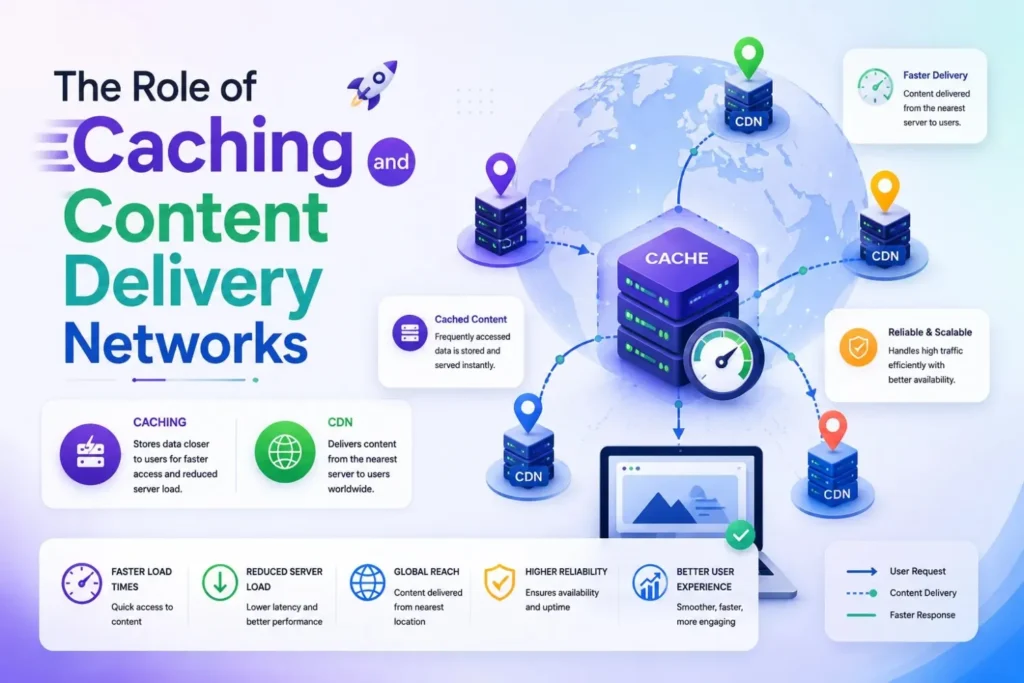
The Role of Caching and Content Delivery Networks :
Caching is a technology that stores often-referenced data to decrease the number of server calls and speed up the loading process.
Businesses should implement:
- Browser caching
- Server-side caching
- Object caching
- Edge caching
Moreover, the Content Delivery Network (CDN) serves to distribute website files on multiple servers around the globe.
This allows visitors to receive content from the nearest location.
Nowadays, web applications must be able to provide quick loading and immediate response times to their users. There is always the possibility that too much data or traffic, and distance between users and servers might slow down loading and response times of websites and web applications. Caching and CDNs play an important role in making web applications fast and smooth.
What is Caching?
The act of storing the data that is frequently required in a temporary place known as cache is caching. This saves the system the trouble of always looking for the data from its original place, which is a slower process.
For companies which spend money on seo services, increases in website speed can help improve both the efficiency of crawling and user engagement.
According to the CDNS explained by Cloudflare Learning Center, the use of CDN can greatly lower latency and increase the speed of loading content globally.
Website Development Cost in India and Performance Considerations :
The main consideration of most businesses when choosing websites is always cost. Nevertheless, it is imperative to consider future profitability too.
However, the costliest ones will be custom web applications and enterprise-grade software that will typically start costing you from ₹1,00,000 or even more. Such products will include sophisticated elements like users’ dashboards, API integration, live data processing, and high-end security. The costs will increase further if your business needs specific UI/UX designs as well as scalable solutions.
Performance is an important aspect of the internet today. Google assesses the websites according to metrics such as Core Web Vitals. These measure factors such as loading performance, interaction, and visual consistency. Thus, while development cost is important for firms, performance optimization is also equally critical. A little extra spending on quality development will pay off greatly for businesses in the future.
The average Website Development Cost in India depends on project complexity, design requirements, and functionality.
| Website Type | Estimated Cost |
| Basic Business Website | ₹15,000 – ₹50,000 |
| Professional Corporate Website | ₹50,000 – ₹1,50,000 |
| Custom Business Website | ₹1,50,000+ |
| E-commerce Website | ₹75,000 – ₹5,00,000+ |
When comparing providers, companies need to look at their level of expertise, performance ability, and value instead of just the price.
The costs of initial investment might be different, but better quality construction will help to decrease maintenance costs later.
Optimal image usage, efficient code, quality hosting providers, and caching techniques form some of the important elements for improved performance. Low performance may cause slow loading web pages, unhappy visitors, and reduced conversions.
Being able to understand the total cost enables organizations to make decisions for sustainable growth.
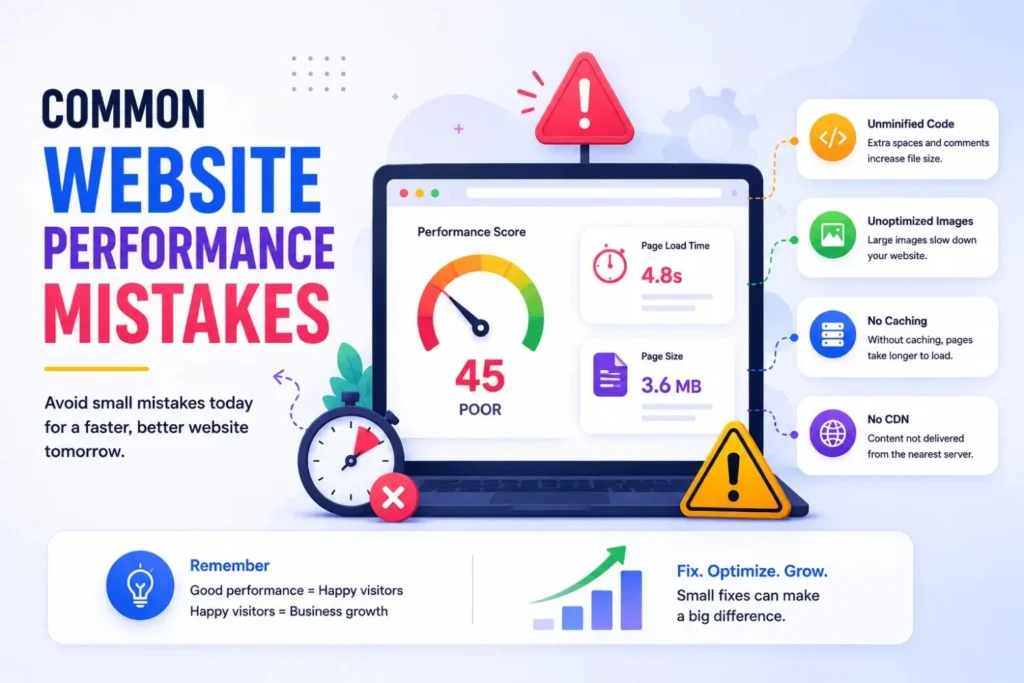
Common Website Performance Mistakes :
Many websites fail performance audits because of avoidable mistakes.
Common issues include:
- Oversized image files
- Cheap shared hosting
- Excessive plugins
- Unoptimised themes
- Multiple third-party scripts
- Poor coding practices
These elements cause performance problems for both the user and the search engine.
The companies using a performance marketing agency may find out that optimizing their landing page speed could improve their advertising results.
Moreover, website optimisation increases the efficiency of campaigns through various marketing channels.
Real Business Example of Performance Optimisation :
A rapidly expanding service industry had issues with engagement because of the poor performance of their website.
After conducting a complete audit, the following improvements were implemented:
- Image optimisation
- Hosting upgrades
- CDN integration
- JavaScript reduction
- Advanced caching
The results were substantial.
| Metric | Before | After |
| PageSpeed Score | 56 | 99 |
| LCP | 5.1s | 1.8s |
| Bounce Rate | 62% | 37% |
| Organic Traffic | Baseline | 0.43 |
| Lead Generation | Baseline | 0.32 |
Such innovations show how the process of optimization is crucial for the success of the enterprise.
For instance, one way that large e-commerce websites have managed to improve their checkout procedure is through decreasing the number of steps needed to make an online purchase. In addition, they have worked towards reducing server response time, which has greatly helped increase conversion rates since fewer customers will be frustrated by poor site performance and navigate away from the website.
Many businesses work with a reputable Website Design Company In Ahmedabad in order to accomplish the same results while also ensuring good visuals.
As per AWS case studies, many companies have managed to deliver good performance through the application of optimisation tools via the cloud, including auto-scaling, load balancing, caching, and distributed computing methods. Through these techniques, it becomes easier for businesses to deal with high traffic volume without compromising on speed and reliability.
For instance, businesses that utilize the services of AWS can scale up their resources automatically during the high-demand times, which include special occasions for online sales. This helps in ensuring that websites and applications do not crash or become unresponsive due to heavy traffic.
Why Speed Optimisation Delivers Long-Term Value ?
The effectiveness of websites impacts all areas of digital marketing.
| Benefit Area | Impact of Faster Websites |
| User Experience | Smooth navigation, quicker loading, and better usability |
| Search Visibility | Higher rankings in search engines like Google |
| Conversion Rates | Increased sales, sign-ups, and inquiries |
| Lead Quality | More engaged and relevant potential customers |
| Customer Retention | Improved trust leading to repeat visits and loyalty |
The advantages of speed optimization have a long-term nature because it has a direct impact on both the user experience and the company’s performance. The loading speed is an important factor that can create a good first impression and make users spend more time on the site, visiting different pages and interacting with the content. Users feel comfortable navigating through the site, which creates a sense of trust towards it and makes people use it in the future again.
When businesses evaluate Website Development Charges, performance optimization must be treated as an investment rather than another cost factor.
The optimized website still delivers value many years after going live.
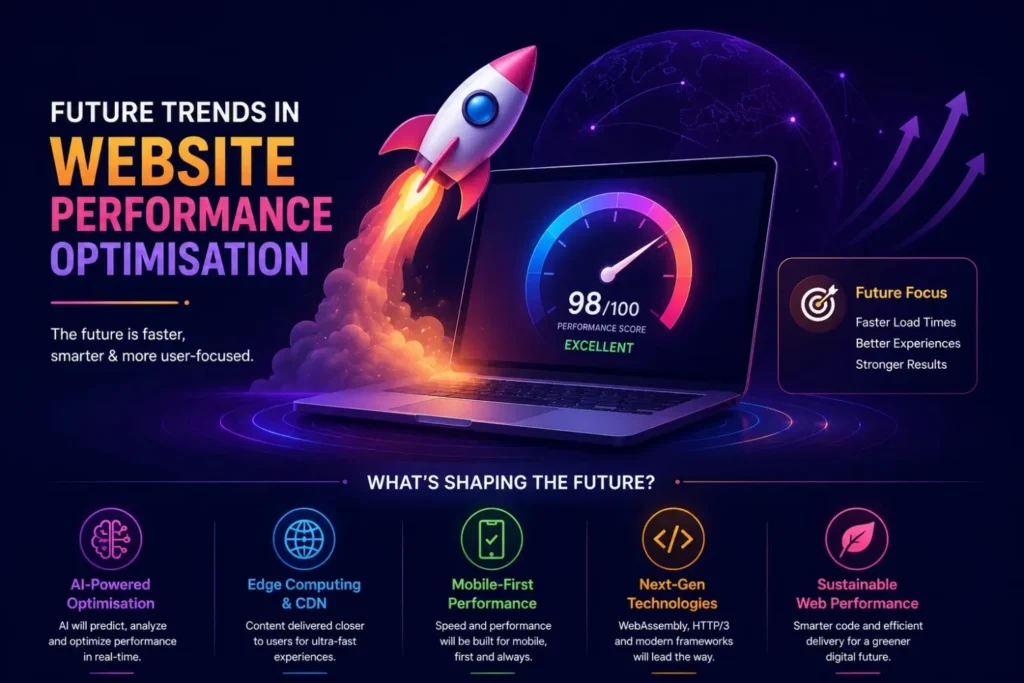
Future Trends in Website Performance Optimisation :
Website performance continues to evolve.
Emerging technologies include:
- HTTP/3
- Edge computing
- AI-driven optimisation
- Server-side rendering
- Advanced caching systems
Companies which embrace these technologies first generally achieve an edge over their competitors.
Other important trends include edge computing and content delivery networks (CDNs). By analyzing data closer to end users, websites will be able to minimize lag and improve their loading time. This trend will benefit organizations by providing better user experiences even in locations where internet connection is poor.
AI and automation have started to gain significance even in performance optimization as well. AI-based technology is capable of compressing images, optimizing codes, predicting user behavior, and modifying the content delivery process. It helps to save manual work while increasing efficiency.
The use of contemporary web technologies like SSR, SSG, and lightweight JavaScript frameworks is expected to keep increasing in the future.
For companies that have decided to pursue Search Engine Marketing, these changes will not only improve their campaigns but also increase the level of satisfaction of users.
Conclusion :
Performance has been identified as a critical differentiator in the year 2026. Those companies that focus on performance have better rankings and engagement.
By choosing to work with an experienced company in Ahmedabad, your website will be created in such a way that its efficiency and scalability are considered from the very beginning. Be it cost considerations, website redesigns, or a website launch – the performance should never be overlooked.
In collaboration with an experienced Web Development Company in Ahmedabad, all aspects of the optimization of performance are ensured to be done successfully. Speed must not be considered as something that has to be done only once but as something that changes with changing behavior of users and technology.
When you make an investment in your website, you need to know that the optimization process at the stage of development saves on expenditures and ensures good profits. An optimized website saves you money both on maintenance and advertising, and helps you to avoid losses due to bad performance.
In relation to Website development costs, it should be noted that they represent an investment into future success and not merely an expenditure.