
Impact of Apple iOS 14 Privacy Update on Meta Ads and Digital Advertising Attribution:
Being in the Social Media Company in Ahmedabad we’ve seen the digital ad world change a lot lately. Yet, nothing compares to how Apple’s iOS 14 Privacy Update has shaken up ad measurement and digital advertising attribution across the world. Apple’s changes around user privacy fundamentally altered how platforms like Meta collect and use conversion data for advertising campaigns.
This update really shook things up for businesses big into Meta Ads. It totally altered how user behavior is tracked and measured across websites and apps. Prior to iOS 14, ads on Facebook made it easier for marketers to follow a user’s journey. From clicking an ad to making a purchase, companies could link these actions to their campaigns pretty accurately, though that’s all changed now.
Today, that process is considerably more complicated.
Indian businesses counting on Facebook and Instagram ads for leads, sales, appointments, and inquiries need to grasp iOS 14 Attribution. This knowledge is key to keeping campaigns strong and safeguarding their advertising ROI. No matter if you’re an ecommerce brand, healthcare provider, school, real estate firm, or local service biz, every ad decision relies on that attribution data.
A professional Digital Marketing Agency in India knows that for ads to succeed, you need more than just great creativity and good targeting. Proper measurement is key too. Without it, businesses can’t tell what campaigns make money or which audience converts best. They also don’t know which creatives work or what customer journeys end in sales. So, it gets super hard to allocate budgets right.
Apple introduced the App Tracking Transparency framework, which is pretty cool. It requires apps to ask for user permission before tracking activity across other sites and apps. Now, people have way more control over their data collection and sharing online. So, it’s all about giving users those privacy options.
This shift is a double-edged sword for businesses running Meta ads. Successful adapters keep getting good results, but those stuck with old tracking ways? They suffer from less accurate reports and optimization gets harder too.
Stop forcing your business into generic websites.
Our Website Development Services create custom solutions that fit your goals perfectly.
Explore Our ServiceWhy iOS 14 Attribution Matters for Indian Businesses?
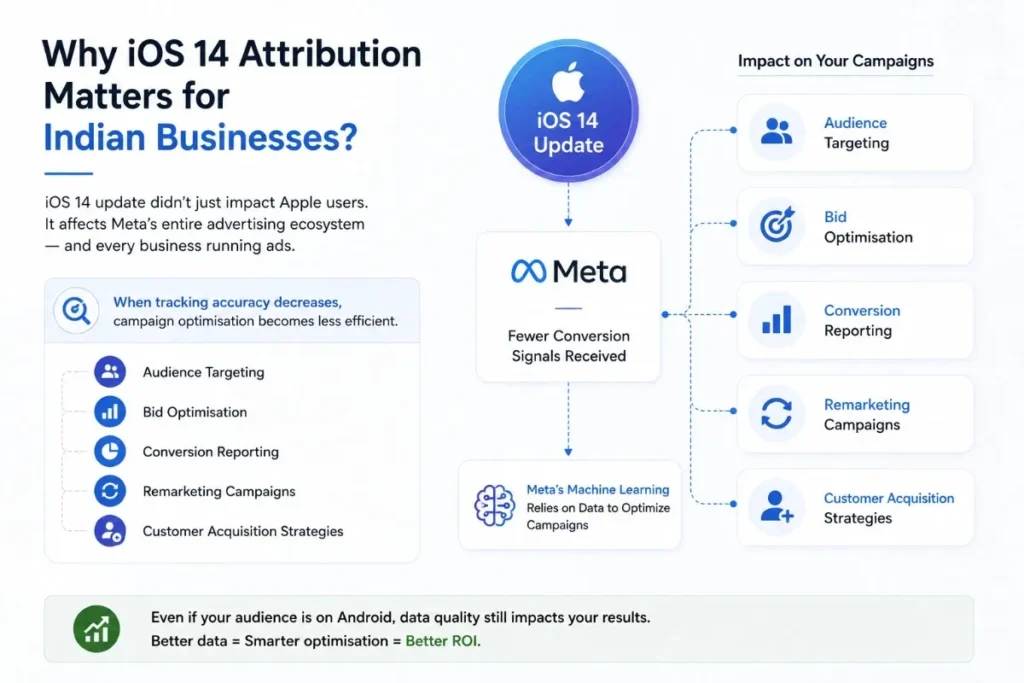
Many advertisers, including businesses seeking SEO Services in Ahmedabad initially believed the iOS 14 update would only affect companies targeting Apple users. That assumption proved incorrect because attribution data influences Meta’s entire advertising ecosystem.
When tracking accuracy decreases, campaign optimization becomes less efficient because Meta receives fewer conversion signals. This affects:
- Audience targeting
- Bid optimisation
- Conversion reporting
- Remarketing campaigns
- Customer acquisition strategies
Even businesses aimed at Android folks might get hit indirectly since Meta’s machine learning depends on conversion data to amp up campaign success, so data quality is key here.
The Shift Towards Privacy-First Advertising:
The advertising world is heading into a privacy-first era. People care more about data collection, cross-platform tracking, and how their info is shared online. To address these concerns, governments and tech firms are creating tougher rules and policies to protect privacy.
Apple placed itself as a privacy-focused tech company with App Tracking Transparency. This led to way less available user-level tracking data. For advertisers, it meant getting used to a new deal; traditional attribution models now act differently. They don’t work like before, so changes were necessary.
Why Meta Advertisers Were Affected More Than Most Platforms?
Meta’s ads relied big time on tracking users’ behavior. They became super effective by analyzing browsing, buying, app use, site visits, and full customer journey letting them target ads really well.
This data helped Meta deliver highly personalised advertising experiences. When iOS users began opting out of tracking, Meta lost access to a significant portion of that behavioural data.
Businesses working with an experienced Performance Marketing Agency generally adapted faster because agencies implemented alternative tracking systems and optimisation frameworks to maintain campaign performance.
Understanding iOS 14 Attribution:
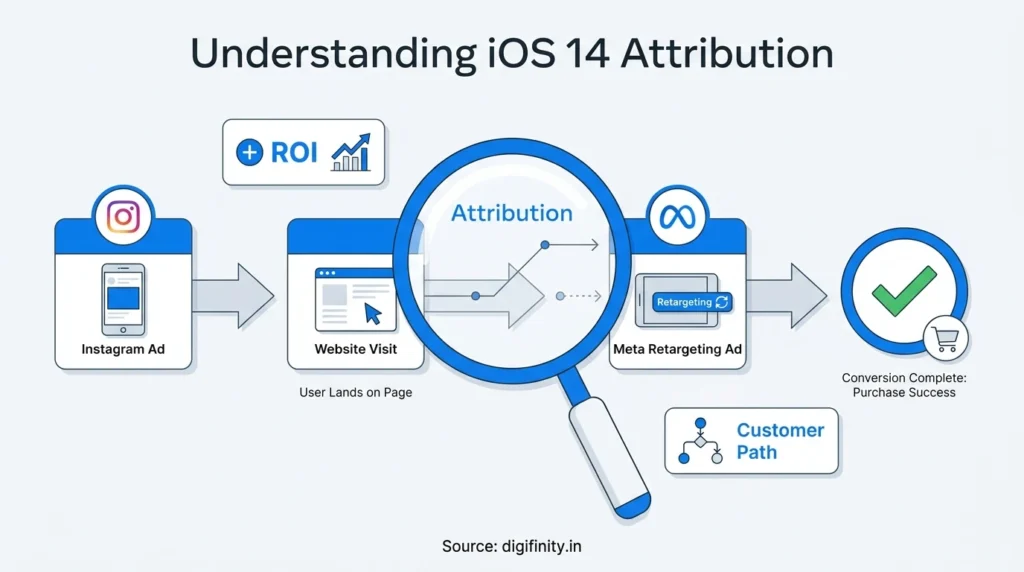
To talk about fixes, we first need to know what attribution means.
Attribution is giving credit to a specific part of marketing for a conversion. For instance, a customer could find out about a brand on Instagram, check out the site, leave without buying, come back from Facebook ads, and make the purchase then. So, attribution figures out which touchpoint gets the credit for the sale.
Correct attribution lets companies know how well their marketing works, shows customer paths, and gauges ad return on investment and profits. Otherwise, improving strategies is just guesswork.
One of the most detailed breakdowns of how iOS 14 changed Meta advertising comes from Jon Loomer’s Facebook Ads impact On iOS 14 Guide where he explains how attribution windows, conversion tracking, and optimization signals were significantly affected after Apple’s privacy updates.
What Changed with Apple’s App Tracking Transparency (ATT) ?
Apple launched App Tracking Transparency to let users have more say in how apps follow their actions online.
Apple’s App Tracking Transparency feature is pretty straightforward yet powerful. Apps have to ask users if it’s okay to track their behavior across other sites and apps.
Users get a popup asking if they want to allow tracking. Since many say no, this limits user-level data, making conversion tracking tougher and shrinking reporting accuracy.
You can understand this impact in detail through industry analysis of Apple’s App Tracking Transparency (ATT) which explains how iOS privacy changes have significantly affected ad tracking, attribution accuracy, and performance marketing across platforms like Meta and Google Ads.
This impacts advertisers worldwide, including those in India, big time.
Apple’s Privacy Strategy:
For any Digital Marketing Agency in India understanding Apple’s privacy framework has become essential for managing successful digital advertising campaigns. Apple positions privacy as a core product feature. Its privacy initiatives include:
- App Tracking Transparency
- Privacy Nutrition Labels
- Mail Privacy Protection
- Safari Tracking Prevention
These features give users greater control over personal information. From a consumer perspective, this provides stronger privacy protection and transparency. From an advertiser’s perspective, it reduces visibility into customer behaviour and attribution data.
Meta’s Advertising Ecosystem:
Meta’s advertising success historically relied on detailed behavioural signals. The more data Meta receives, the better its algorithms can identify ideal customers, optimise campaigns, predict conversions, and improve ad delivery.
When data gets scarce, optimization gets tough too. That’s why lots of businesses saw major changes in their campaign reports after iOS 14 rolled out.
Major Changes Introduced by iOS 14:
iOS 14 Attribution goes way beyond just a privacy update. It brings major changes to how Meta tracks and shares conversion data too. So the effects on data collection and reporting are huge.
The biggest shift for Performance Marketing Companies was the cutback in user-level tracking. Pre-iOS 14, Meta tracked customers extensively across apps and sites. With the update though, users could avoid tracking, making conversion visibility harder, audience creation less precise, and slowing down retargeting and campaign learning.
Meta changed its attribution windows too. Before iOS 14, ads used 28-day, 7-day click, and 1-day view attributions. Post-update, Meta limited these options, making it look like ad performances dropped. In reality, business results stayed the same, so the numbers appeared worse just because of changed reporting, not actual decline.
Meta came out with Aggregated Event Measurement (AEM), helping advertisers keep track of key conversion events while following Apple’s privacy rules. With AEM, advertisers need to prioritize stuff like purchases, checkouts, and adding items to carts. So, it makes sense to focus on what really matters.
Also, Meta added domain verification requirements. Now, advertisers must prove they own their sites to manage conversion events and boost tracking accuracy, so things run smoother.
How iOS 14 Attribution Impacts Meta Ads Reporting ?
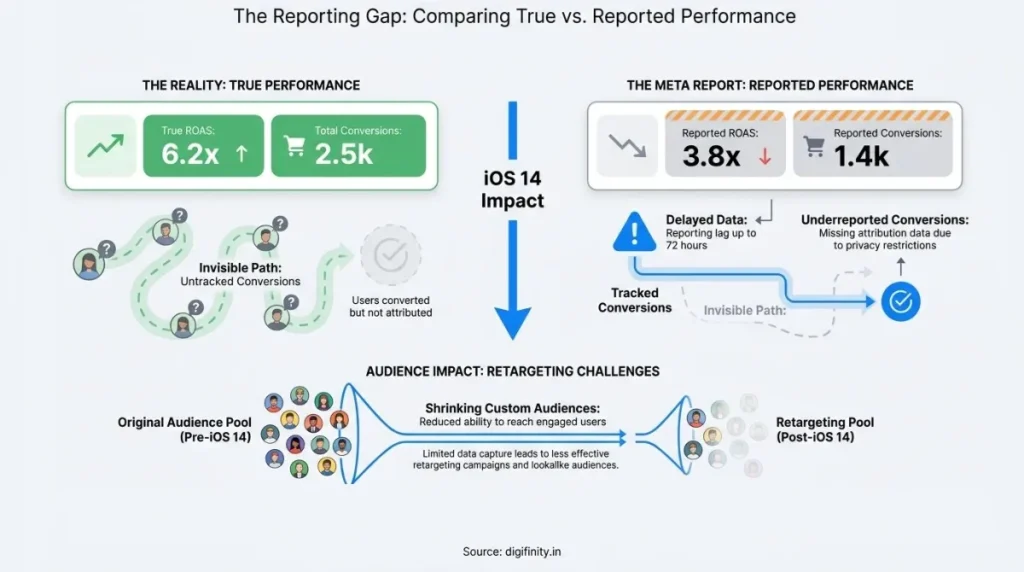
After iOS 14, advertisers still worry most about reporting accuracy. Businesses measure campaign success through metrics like leads, purchases, and revenue. With attribution visibility dropping, though, these metrics get less reliable. This makes things harder for Performance Marketing Agencies when it comes to measuring and optimizing campaigns.
Admitters saw that their reports were lagging first. Conversion data didn’t pop up right away anymore. Processing took longer, updates came late, and performance seemed off. This made quick fixes tough for companies needing to optimize fast.
Underreported conversions are also a big issue. Sometimes, you click a Meta Ad, check out a site, and come back later on a different device to make the purchase. But because of privacy rules, Meta might not always track that conversion correctly. Thus, reported ROAS looks lower, CPA seems higher, and the campaign ends up looking weaker than it truly is.
Building an audience got harder after iOS 14 too. The custom groups, like site visitors and people who added things to carts, shrunk. This makes retargeting less effective, harms lookalike group quality, and makes scaling campaigns tougher.
Meta once dominated with its retargeting ads. But since iOS 14, tracking users got harder, shrinking those audience pools. As a result, businesses had to ditch old ways and find new methods for both customer acquisition and retention.
Impact on Different Industries in India:
The impact of iOS 14 Attribution varies a lot across different industries. Some were hit hard, others weren’t.
Ecommerce businesses were hit the hardest because they rely so much on retargeting and long customer journeys. Many brands saw less cart abandonment tracking, smaller remarketing groups, and lower sales reports. Still, companies using Conversion API regained much of their lost ground; this tactic is often suggested by digital marketing pros, like those from the Best Digital Marketing Agency in Ahmedabad.
Real estate companies usually have longer buying cycles. Buyers tend to research projects, compare developers, and visit properties several times before they make an inquiry. Because of this, attribution visibility is reduced, making it harder to know which campaigns actually influence leads and final sales.
Healthcare providers usually faced some attribution challenges. People typically research doctors, clinics, and treatments extensively before acting. Tracking visibility dropped for healthcare ads, but those advertisers kept getting good results since trust and search intent still drove conversions.
Schools depend a lot on getting leads through campaigns. Students see lots of ads before contacting them. This makes it harder to track who’s a good lead, figure out which ads work, and see what paths lead to sign-ups.
Local service businesses got hit less hard since much of their interaction is via direct calls, WhatsApp, and contact forms. Yet, knowing where leads come from is still key for setting budgets and improving campaigns.
How Meta Responded to the iOS 14 Update ?
Meta rapidly released various fixes to aid advertisers through privacy changes, keeping campaigns effective. This shift demanded strategic tweaks from all Digital Marketing Agencies in India, so everyone had to adapt quickly.
The big development was Conversion API (CAPI). It sends data straight from servers to Meta, not relying on browsers like before. This boost in tracking reliability also reduces data loss and makes conversions clearer, while enhancing attribution accuracy too.
Meta expanded its Aggregated Event Measurement (AEM) for privacy-compliant attribution too. This lets advertisers focus on key conversion events while keeping their optimization abilities intact.
Also, Meta’s leaning hard into machine learning and conversion modeling. They analyse campaign signals, past perf, and stats to guess conversions they can’t observe directly. This isn’t exactly like traditional tracking but it gives advertisers key insights into how their campaigns are doing.
Conversion API vs Meta Pixel :
Admitters often wonder if the Meta Pixel is enough for them since iOS 14. The deal? It’s mostly not these days.
| Feature | Meta Pixel | Conversion API |
| Browser-Based Tracking | Yes | No |
| Server-Side Tracking | No | Yes |
| iOS 14 Resilience | Moderate | Strong |
| Data Reliability | Medium | High |
| Tracking Accuracy | Reduced | Improved |
| Privacy Compliance | Good | Better |
Most advanced advertisers now use both systems together. This hybrid approach creates stronger tracking infrastructure and provides better optimisation opportunities.
Practical Strategies to Improve Attribution Accuracy:
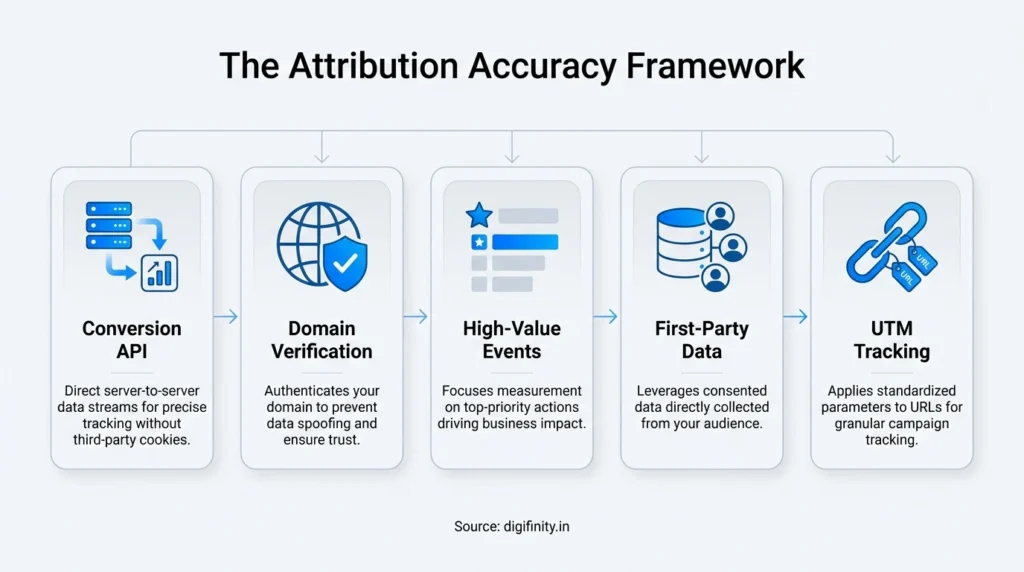
Businesses that continue generating strong Meta Ads performance generally follow a structured attribution strategy, a best practice commonly implemented through Digital Marketing Services in Ahmedabad :
- Implement Conversion API
- Verify Your Domain
- Prioritise High-Value Events
- Improve First-Party Data Collection
- Use UTM Tracking
Using these strategies lets businesses regain visibility, boost report quality, and make smarter optimization choices, so they can perform better.
The Future of Meta Advertising in a Privacy-First World:
Privacy rules are tightening, and people are getting savvier about ads. Thus, the way digital ads work keeps changing.
Unlimited third-party tracking days are numbered. Companies will need to find new ways to show ads that fit these stricter rules and more cautious users. So, expect big shifts in how advertisers operate moving forward.
Businesses sticking with old traditional attribution models are gonna struggle more and more. To succeed, ads folk need to build measurement systems using first-party data, server-side tracking, CRM tools, conversion modeling, and multi-touch attribution instead.
The goal isn’t about perfect tracking anymore. We just want to make smarter business decisions with the data we’ve still got.
First-Party Data as a Competitive Advantage:
The iOS 14 update shows how crucial first-party data is now. This kind of info comes straight from customers via stuff like website forms, sign-ups, emails, and loyalty clubs. So companies are relying more on direct customer interactions for their data.
Unlike third-party tracking, first-party data remains under the control of the business. Companies that actively collect and organise customer information can improve audience targeting, create stronger remarketing campaigns, increase customer retention, and improve attribution accuracy, making first-party data a key focus area for any PPC Management Company in Ahmedabad.
For example, an ecommerce company with a well-maintained customer database can upload customer lists into Meta and create highly effective custom audiences, even when browser-based tracking becomes less reliable.
AI-Powered Conversion Modelling:
AI is now a key part of how we measure ad success. With direct tracking getting more restricted, Meta depends more on machine learning to guess how people convert. So, they use these tools to fill the gap.
These systems look at past performance, user interactions, and campaign clues to predict unseen conversions using stats. Modeling can’t totally take the place of direct tracking, but it helps advertisers by offering useful insights. Plus, it aids better decision-making.
Server-Side Tracking Growth:
Server-side tracking is really popular now among advertisers who want more precise results. It’s different from browser-based tracking because it sends data straight from business servers to ad platforms, not through browsers.
This method makes data more reliable, boosts privacy compliance, cuts signal loss, and improves conversion visibility. Plus, Meta’s Conversion API is still one of the most commonly used server-side tracking solutions around today.
Businesses that put money into server-side infrastructure frequently get way more attribution visibility compared to those depending solely on browser-based tracking methods.
Common Mistakes Businesses Make After iOS 14:
In Ahmedabad, A Performance Marketing Agency often sees local businesses make avoidable blunders hurting campaign performance, even with access to new tracking tools.
Counting on just Meta Pixel is a big no-no. Though it’s still helpful, it isn’t enough alone now. Companies that use only Pixel data might miss parts of customer journeys, conversions, and accurate reports. So, don’t ignore other tools to keep your analytics top-notch.
Delaying or ignoring Conversion API implementation is another common error. While many think setup is complex, most modern sites and e-commerce platforms actually support pretty easy integrations. Not having it set up means less visibility on conversions and poorer optimization performance, so it’s best to tackle this early.
Many advertisers only look at Meta Ads Manager reports, missing the bigger picture. They need to use more than just that; modern analysis should also factor in CRM data, other analytics platforms, offline conversions, revenue tracking, and the value of customers over time.
Assuming lower conversions mean a weak campaign performance is likely the biggest mistake. Often, strong business results go along with less visible attribution. When looking at campaign success, use bigger picture stats too—revenue growth, lead quality, sales volume, customer acquisition costs, and total ROI.
How a Social Media Company in Ahmedabad Can Help ?
With attribution getting more complex, businesses frequently need specialized help to keep their ads efficient.
Performance Marketing Companies can help organizations deal with privacy-driven ad changes while still getting solid business results. They use stuff like Meta Pixel, Conversion API, and UTM tracking. Plus, they do domain verification, event prioritisation, and integrate CRMs. So, businesses get the tools they need in a changing digital world.
Since iOS 14, campaign optimization strategies have changed a lot. Advertisers now focus more on broad audience targeting, testing ad creatives, making landing pages conversion-friendly, collecting first-party data, and using full-funnel marketing strategies.
Understanding how to set up campaigns that stay effective with limited attribution data is key.
Performance Reporting in the New Attribution Era
Today, reporting needs more than just checking Meta numbers. Top firms blend Meta Ads data with Google Analytics, CRM systems, sales reports, and revenue attributions for a fuller grasp of their marketing performance.
Companies using this combined approach make smarter ad choices since they see the whole customer journey clearer.
Conversion-Focused Campaign Management
Advertising works best when it boosts the bottom line. A top Digital Marketing Agency in Ahmedabad goes for sales growth and lead quality, not just fancy metrics like clicks and impressions. They also make sure customer acquisition is efficient and scalable in the long run.
This focus makes even more sense with all the new privacy rules changing digital ads.
Why Is iOS 14 Attribution Still a Competitive Opportunity ?
Many businesses see iOS 14’s Attribution feature as a limit, while forward-thinking advertisers see it as a chance.
Those who adjust quickly get a leg up because their rivals usually misread performance data. As a result, building out your tracking system becomes a real selling point. With better attribution, companies make wiser choices, and first-party data grows way more valuable.
Firms investing in privacy-compliant measuring systems now will fare better with platform changes and stricter rules down the line. Instead of fighting privacy trends, smart ads sync their plans with these shifts.
Doing this builds stronger, more enduring growth over time.
Conclusion
iOS 14 Attribution totally changed how Meta advertising operates. For Indian businesses, this has a big effect on more than just reports and attribution windows. It also impacts how campaigns are optimized, audiences are targeted, conversions are measured, and budgets are allocated.
The update didn’t remove advertising opportunities; it just shifted the rules.
Now, companies savvy with modern attribution methods can do well with Meta Ads. They focus on things like Conversion API, first-party data collection, and server-side tracking. Plus, they use attribution models and integrated reporting.
A Best Digital Marketing Agency in Ahmedabad can aid businesses in navigating changes, improving measurement accuracy, and keeping strong ad performance despite strict privacy rules. So, they get the help they need to succeed.
Businesses will dominate digital ads by blending data smarts, privacy rules adherence, and strategic performance marketing. So, data knowledge, following privacy laws, and smart ad strategies are key for success in the future.