What the Best Digital Marketing Agency Approach Gets Right?
Most businesses in India start keyword research the wrong way round. They open a tool, type in a broad term, sort by volume, and pick whatever sits at the top. It feels productive, but it rarely brings in the right traffic. Real keyword research is what separates a genuinely useful strategy from the kind offered by the best digital marketing agency in name only; it has to start with how your actual customers search, not with a spreadsheet full of numbers. Neil Patel’s own breakdown of the keyword research process makes a similar point: volume without intent is a vanity metric, not a strategy.
India adds a layer most global guides skip entirely. Search behaviour here is a mix of English, Hindi, Hinglish, and regional phrasing, sometimes within the same query. Someone searching for a chartered accountant in Pune might type “CA near me,” “best CA Pune,” or “chartered accountant fees Pune” three different intents wearing the same job title. Getting this wrong means writing content that ranks for nothing anyone actually searches.
There’s also a scale problem unique to India that’s easy to underestimate. A single product category can have a dozen valid ways to search for it depending on the city, the customer’s age group, and even whether they’re typing in English or transliterated Hindi on a mobile keyboard. A business selling water purifiers might see traffic potential in “RO water purifier price,” “best water filter for home,” and “ghar ke liye best water purifier” three phrases of the same need. Treating them as one keyword instead of three distinct opportunities is where a lot of otherwise solid content strategies quietly lose traffic.
Start With Buyer Intent, Not Search Volume:
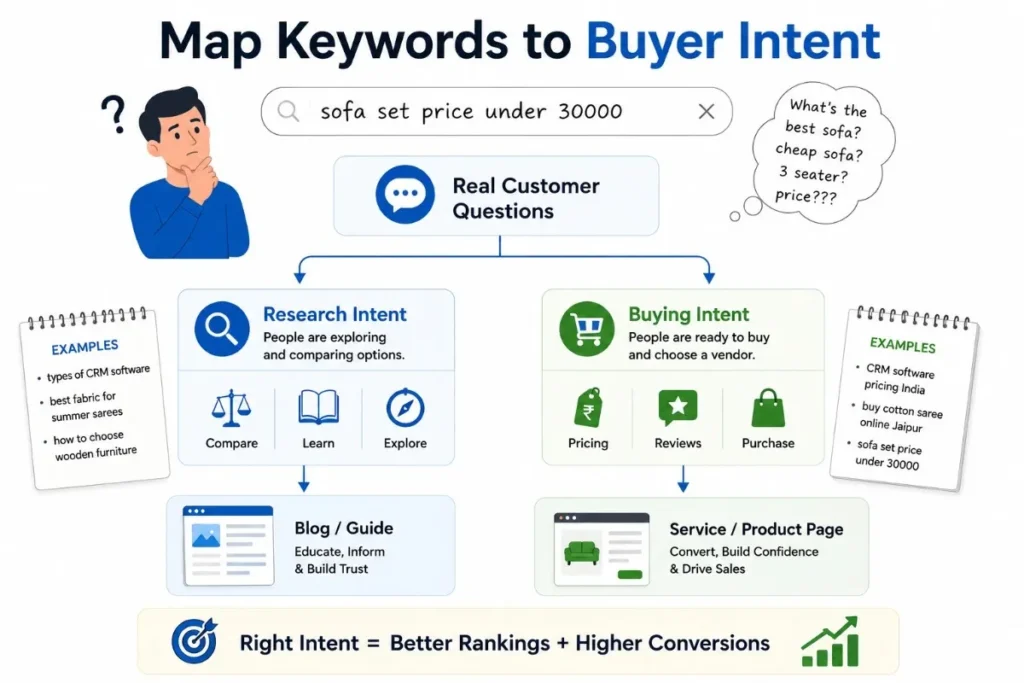
Before opening any tool, write down the actual questions your customers ask before they buy. Not the polished, SEO-friendly version, the messy, real one. A furniture brand’s customer might type “sofa set price under 30000” rather than “buy sofa online.” That distinction changes what content you build and what page it should live on.
This is the step most businesses rush through, and it’s usually where a structured SEO services approach earns its keep. Someone has to sit down and separate genuine buying intent from casual browsing before a single tool gets opened.
Once you have a rough list of real phrases, group them by where the customer is in their decision:
- Early-stage searches: people are still comparing options, usually within the first week or two of research. Think “types of CRM software” or “best fabric for summer sarees.”
- Ready-to-buy searches: people who’ve already decided and are choosing a vendor, often within days of converting. Think “CRM software pricing India” or “buy cotton saree online Jaipur.”
Mixing these two groups into one content plan is a common mistake. Early-stage searchers need education; ready-to-buy searchers need pricing, comparisons, and trust signals.
It helps to think of this as mapping keywords to actual pages rather than just a content calendar. An early-stage keyword usually belongs on a blog post or guide, somewhere you can afford to explain, compare, and build trust without asking for the sale immediately. A ready-to-buy keyword belongs on a service page, product page, or landing page built specifically to convert, with pricing, testimonials, and a clear next step visible without much scrolling. Businesses that put both intents on the same page usually the homepage tend to see decent traffic but weak conversion, because the page is trying to serve two very different visitor mindsets at once.
Not Sure Which Keywords Are Worth Chasing?
Digifinity helps D2C brands across Ahmedabad and India find the right keywords and turn them into rankings. No guesswork, just a plan built for your goals.
Explore Our ServiceCheck Keyword Difficulty Before You Commit:
Volume just tells you how many people are searching. It says nothing about whether you’ll ever see page one for it. That’s what difficulty scores are for, and Ahrefs’ guidance on reading keyword difficulty is worth a read if this is new territory, a term with decent volume but a score propped up by established .com and .in giants isn’t worth burning your first few months on.
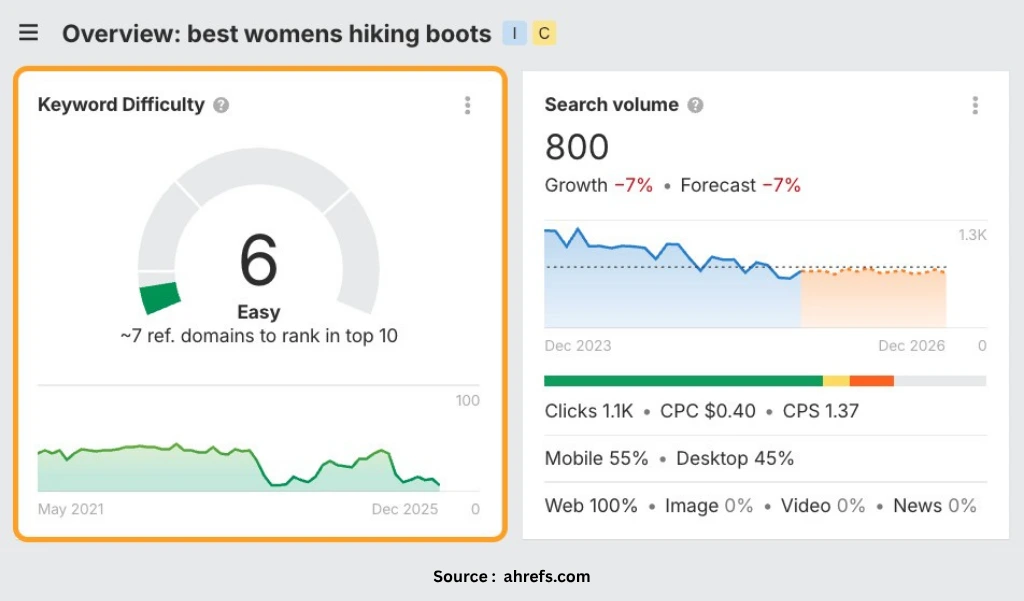
For most small and mid-sized Indian businesses, the better move is going after moderate volume, low-to-medium difficulty first, then building up topical authority before touching the expensive stuff. It’s slower, sure. But it’s also the difference between actually ranking by month three and never ranking at all.
Take “digital marketing agency” as an example of massive volume in India, but the top spots belong to agencies sitting on years of backlinks and domain authority most newer sites simply haven’t built yet. Even something as competitive as the best digital marketing agency won’t budge overnight no matter how well-written the content is. Narrow it down to something like “digital marketing agency for D2C brands in Ahmedabad” instead, and suddenly you’ve got far less volume but a genuine shot at ranking within a few months, since there’s less established competition fighting you for it. Build a cluster of these smaller, winnable terms first that’s usually what earns you the authority to eventually go after the bigger ones.
Localise the Way Indians Actually Search:
A generic “digital marketing agency” keyword strategy ignores how location-specific Indian search behaviour really is. People add city names, landmarks, and even neighbourhood references into searches far more than users in the US or UK typically do. “Best gym near Vastrapur,” “packers and movers Bopal,” “dentist SG Highway” the location isn’t an afterthought, it’s core to the query.
This becomes even more pronounced outside the metros. Tier 2 and tier 3 cities in India often show search patterns that don’t map neatly onto what works in Mumbai, Delhi, or Bengaluru. A business expanding into Surat or Indore can’t simply copy the keyword strategy that worked in a metro market and swap the city name, local competition, price sensitivity, and even the platforms people search on can differ meaningfully. Building separate, smaller keyword clusters for each city you serve, rather than one blanket list with the city name inserted, tends to perform far better over time.
If you’re running an ecommerce store, this shows up differently: buyers still search by product plus trust signals like “COD available” or “return policy,” which matters if you’re working with an ecommerce service provider to structure product pages around these patterns rather than generic category names.
Here’s a quick look at the different types of keywords in SEO and how they typically play out in practice:
| Keyword Type | Example | Best Suited For |
| Short-tail | “digital marketing agency” | Homepage, top-of-funnel awareness |
| Long-tail | “affordable digital marketing agency for startups” | Service pages, blog content |
| Local intent | “digital marketing agency in Ahmedabad” | Location pages, Google Business Profile |
Tools Worth Using for the Indian Market:
Ahrefs and Semrush are fine for volume and difficulty numbers, but honestly, they undersell how Indians actually search, especially anything in a regional language. We’ve had better luck pairing Google Keyword Planner with Trends set specifically to India, since it tends to surface patterns the bigger international tools just don’t pick up.
There’s a handful of scrappier sources most people skip, too. Scroll to the bottom of a Google results page and the “People Also Ask” and “Related Searches” sections often show exactly how someone phrased a query, not the tidied-up version a tool spits out. Even better, go back through old customer WhatsApp messages, support tickets, or comments on your own social posts. Real people type things too specific or too colloquial for any keyword tool to register as “volume,” and that’s usually where the good stuff hides.
Worth a mention here too: once your keyword list is sorted, check whether the pages you’re sending that traffic to actually look consistent. Ranking well but looking inconsistent brand to brand kills trust fast, and that’s often when someone finally calls in a branding agency in Ahmedabad usually a few months after the SEO work has already started working, not before.
Prioritise, Track, and Revisit:
Keyword research isn’t a one-time task you file away after the first content calendar is built. Search behaviour shifts, especially with how quickly AI Overviews and voice search are changing query patterns in India. A realistic cadence looks something like this:
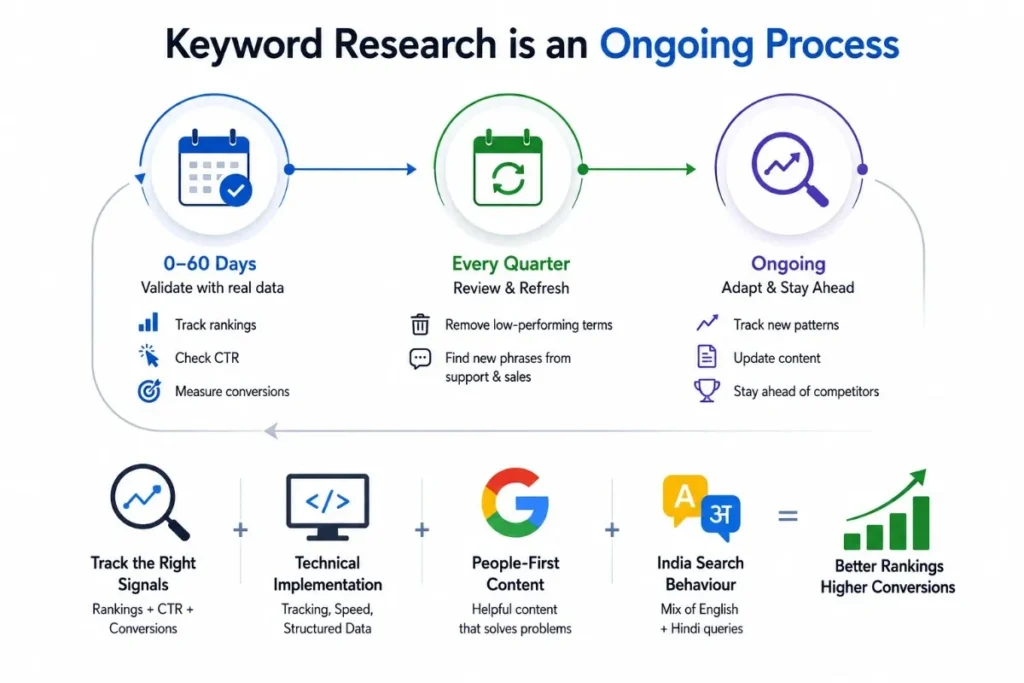
- In the first 30 to 60 days, focus on validating your initial keyword list against actual ranking movement and click-through data, not assumptions.
- Every quarter after that, revisit your keyword map, retire terms that aren’t converting, and fold in new phrases that come up in customer support conversations or sales calls.
This kind of tracking only works if you’re looking at the right signals. Rankings alone can be misleading; a keyword sitting at position four might still be sending almost no traffic if the search volume was never there to begin with, while a term ranking at position eight could be quietly driving solid conversions because the intent behind it was strong. Pairing rank tracking with actual click-through and conversion data, rather than treating position as the only measure of success, tends to give a far more honest picture of what’s working.
If your business runs on a custom-built platform, this tracking work often needs proper technical implementation, event tracking, structured data, page speed which is exactly where a web app development services team earns its place in the process, well beyond just building the site.
Google’s own guidance on creating helpful, people-first content is a useful sanity check here too. If a keyword doesn’t map to a genuine content idea that helps someone, it’s probably not worth chasing regardless of what the volume looks like.
This is also where a lot of keyword strategies quietly go stale. It’s easy to build a list once, publish content against it, and assume the job is done, but search behaviour rarely stays still for long. A term that drove solid traffic last year can lose relevance within months if buyer language shifts, a competitor outranks you, or Google’s own results start favouring a different content format entirely for that query.
It’s also worth paying attention to how Indian consumer behaviour itself is shifting. Google’s research on India search behaviour has shown that Indian users routinely blend English and Hindi within the same query, which is exactly why a keyword strategy built purely on tidy, single-language queries tends to underperform over time.
Bringing It Together:
Keyword research for Indian businesses isn’t about finding the highest-volume term and hoping for the best. It’s about understanding the actual language your customers use, respecting how localised Indian search behaviour really is, and revisiting your list often enough that it stays useful. Get the intent right first the rankings tend to follow.
None of this needs to happen perfectly on the first attempt. Most businesses refine their keyword strategy over several cycles, dropping terms that never converted and doubling down on the ones that quietly brought in the right kind of enquiry. Whether you’re working with a branding agency in Ahmedabad on visual identity or handling content in-house, the businesses that treat this as an ongoing habit, the kind you’d expect from the best digital marketing agency, not a one-time exercise before a website launch, are usually the ones still ranking comfortably a year or two later.