
Hiring an SEO Company in Ahmedabad? Here is What Actually Matters in 2026
Let me be direct with you. If you have already spoken to three or four SEO agencies in Ahmedabad, you have probably heard the same things from all of them: guaranteed rankings, proven process, dedicated account manager, and transparent reporting. It all sounds reasonable until six months pass and the only thing that has visibly changed is your bank balance.
Choosing the right Ahmedabad SEO company is not complicated once you know what to look for. But most business owners go into the process with the wrong questions. They ask about packages and pricing before they have established whether the agency actually understands their market, their competitors, or their customer. This guide is written to fix that.

So this guide covers three things: what separates genuinely effective SEO from expensive busywork, the questions worth asking any agency before you hand over a rupee, and what different budget levels actually look like in practice here in Ahmedabad. Read it once and you will never sit through a bad agency pitch without knowing exactly what is going on.
Why do most SEO campaigns here fail before they start?
Nobody agrees what success looks like:
This is the most common and most avoidable problem. An agency starts work, publishes content, builds some links, and sends a monthly report. Traffic ticks up slightly. A handful of keywords move from position 14 to position 9. The client is unsatisfied but cannot articulate why, and the agency points to the report as evidence of progress.
Nobody defined what success actually meant at the start. Not in business terms enquiries, leads, revenue just in vague SEO terms that the agency controls the narrative around. If you do not nail this in the first conversation, you are setting yourself up for twelve months of disappointment followed by an awkward offboarding call.
The fix is simple. Before any work begins, agree on three to five commercial metrics that the SEO work is supposed to move. Organic enquiry volume. Qualified organic sessions not total sessions. Conversion rate from organic traffic. Revenue with organic as first or last touch. These are harder for an agency to fudge than keyword position charts, which is exactly why many of them avoid the conversation.
Activity reports dressed up as results:
You will recognise this one. The monthly report arrives as a PDF or a Google Data Studio link. It shows a traffic graph going up and to the right, a table of keyword rankings, and a list of deliverables completed: eight blog posts published, forty-two backlinks built, meta titles updated across twelve pages. It looks impressive. It tells you almost nothing useful.
What is the traffic actually worth? Are those visitors converting? Are the keywords moving commercially relevant terms or informational long-tails that will never produce an enquiry? Are the backlinks from real websites that Google respects, or from a link farm that costs ₹500 per placement? These are the questions the report should answer. If yours does not, that is the problem.
Not all SEO agencies are equal. Make sure you’re choosing the right one.
Digifinity delivers result-driven SEO strategies for growth-focused businesses across Ahmedabad and India built for 2026.
Explore Our ServiceWhat a serious Ahmedabad SEO company actually does differently?
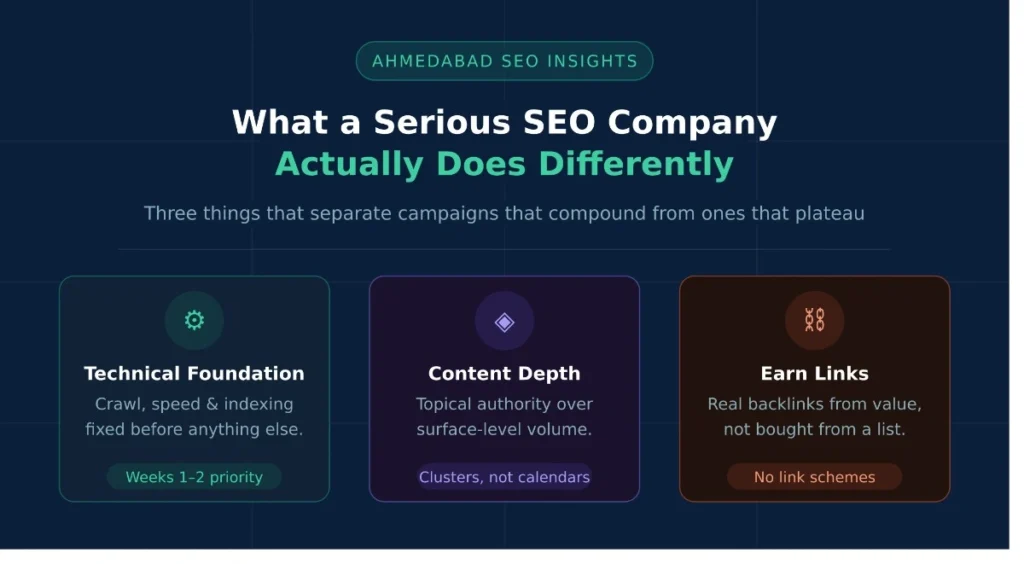
They start with the technical foundation, not the content calendar
A lot of agencies jump straight to content because it is visible, deliverable, and easy to report on. Content is also completely useless if Google cannot crawl and index your site properly. Slow pages, broken internal links, duplicate content from URL parameters, pages blocked in robots.txt by accident, hreflang errors on multilingual sites these are the things that quietly kill campaigns before the first blog post goes live.
Our SEO services in Ahmedabad spend the first two to three weeks of every engagement on the technical layer. We use Screaming Frog to crawl the site, cross-reference with Google Search Console data, run log file analysis where server access is available, and produce a prioritised issue list before recommending any content or link work. It is not glamorous but it is what separates campaigns that compound from ones that plateau.
They understand content depth, not just content volume
Publishing more content is not the same as publishing better content. Google’s systems have become quite good at identifying sites that have genuine expertise on a topic versus sites that are producing surface-level articles at scale. The term used in the industry is topical authority and building it requires a deliberate architecture, not a blog content calendar driven by keyword search volume alone.
A good content strategy is not a content calendar. It is one solid page on a topic, backed by five or six detailed pieces that answer the questions surrounding it, all linked together properly. Takes longer to build. Costs more upfront. But it is the kind of thing that actually ranks and keeps ranking rather than spiking once and quietly disappearing.
They earn links rather than buy them
Link building is the part of SEO where the most money gets wasted and the most damage gets done. If an agency is offering you fifty backlinks per month as part of a package, the only question worth asking is where those links are coming from. Paid guest posts on irrelevant websites, directory submissions, and private blog network links are not assets. They are liabilities that can result in a manual penalty or a significant organic traffic drop the next time Google updates its spam detection systems.
Google’s own spam policies make clear that link schemes and manipulative link-building practices can result in penalties. Real link building takes time. You create something genuinely useful, a data piece, an original take, a resource your industry actually needs and then you put it in front of the right people. Sometimes a journalist picks it up. Sometimes an editor links to it in a roundup. Sometimes nothing happens and you try a different angle. The hit rate is lower than buying links from a spreadsheet. The links you do earn, though, are the ones Google has been rewarding for fifteen years and will keep rewarding.
Local SEO vs. national SEO a question worth answering early:
Most businesses in Ahmedabad need both, but in different proportions and at different stages. Getting this wrong at the start costs time and budget that cannot be recovered.
| Local SEO | National SEO | |
| Best For | Service businesses (legal, medical, finance) | Products, SaaS, pan-India services |
| Competition | Lower, more achievable | Higher, needs domain authority |
| Speed to Results | Faster | Slower |
| When to Start | Immediately | After local foundation is built |
When local SEO should be your first priority?
If you run a service business legal, medical, financial, construction, interior design, events where the customer’s location matters to them, local SEO should be the first thing you optimize. A prospect in Prahlad Nagar searching for a chartered accountant is not going to hire someone based in Delhi. The search intent is inherently local, which means the competition is local, and the path to ranking is more achievable than going after national terms with your current domain authority.
Our Search Engine Optimisation service covers the full local stack Google Business Profile optimisation, local citation consistency across directories, review acquisition strategy, and localised landing pages for specific areas of Ahmedabad where your customers are concentrated. Done properly, this can move the needle on enquiries faster than almost any other channel.
When to push nationally?
If you have a product, a SaaS platform, or a service that can genuinely be delivered anywhere in India, national SEO is worth building towards but timing matters. Trying to rank for broad national terms with a domain that has not yet demonstrated authority in its local market is an inefficient use of budget. Build the local foundation, earn some authority and backlinks in your niche, and then expand the keyword strategy outward. The compounding effect is real and measurable.
AI SEO in 2026: what is genuinely useful and what is noise?
Every agency pitching you right now will mention AI. Some of them are using it intelligently. A lot of them have just rebranded their existing process with some new language and a ChatGPT subscription.
Where does AI actually move the needle?
AI tools are genuinely useful in a few specific areas and those areas matter. Keyword clustering used to mean a strategist spending two days sorting a spreadsheet by hand. Now it takes an hour and the output is more accurate. Same with technical auditing across large sites, finding content gaps in a competitive landscape, and modelling which pages have realistic ranking potential. Not glamorous work. But getting it right faster means the strategy built on top of it is better from day one.
Our SEO services build these tools into the research and analysis phase of every campaign, which means the strategy work we present to clients is based on a more complete data picture than most agencies can produce manually.
Where the human layer is still non-negotiable?
Strategy, editorial judgement, and link acquisition cannot be automated. An AI tool can tell you which topics have search volume and which competitors are ranking for them. It cannot tell you which angle on a piece of content will resonate with your specific audience, which publication is worth pursuing for a backlink, or how to position your brand’s expertise in a way that builds genuine trust with readers. Those decisions still require people who actually understand your business and your market.
Ecommerce SEO: where most Gujarat businesses are leaving money on the table?
The growth of D2C ecommerce across Gujarat has been significant over the past four years. Textile manufacturers, pharmaceutical companies, food brands, and industrial equipment suppliers are all building direct online channels. And almost all of them have the same SEO problems.
Product pages that Google cannot differentiate:
Walk through your product pages honestly for a minute. If the descriptions read like they came straight off a manufacturer’s spec sheet or worse, if you have hundreds of pages that are basically the same template with a different product name dropped in Google is not going to rank them. Why would it? There is nothing there it has not already seen on fifty other sites. Unique descriptions, proper schema markup so your price and reviews show up in search results, a clear page structure that is the starting point, not the finish line.
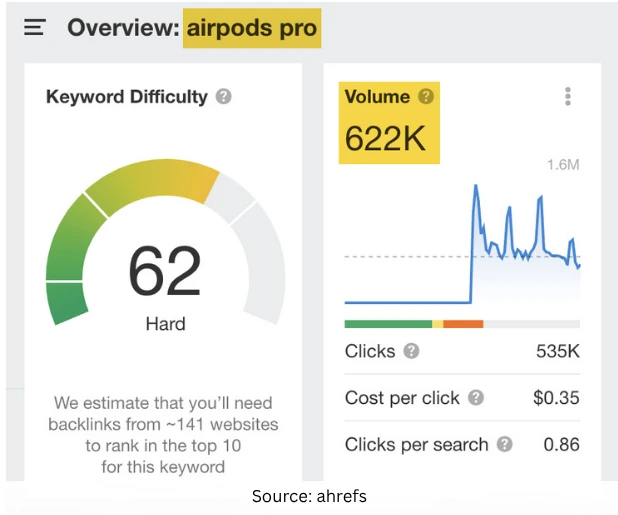
Our E-Commerce Solutions start at the catalogue level identifying which products and categories have realistic ranking potential, which ones are cannibalising each other, and where the structural changes will produce the highest return.
Category pages that are doing nothing:
Category pages are typically the highest-traffic pages on an ecommerce site, and they are almost always the most neglected. A category page with a heading, a filter bar, and a grid of products is not an SEO asset. Add a genuine introductory section that addresses what the customer is looking for, optimize the heading structure, manage your faceted navigation properly so you are not creating thousands of duplicate URLs, and build internal links from relevant blog content and suddenly those pages become serious organic traffic drivers.
According to Ahrefs’ research on ecommerce SEO, category pages consistently outperform product pages for organic traffic potential when properly optimised, making them one of the highest-ROI investments for online stores.
Seven questions to ask any SEO agency in Ahmedabad before you hire them:
These are not trick questions. They are the things any experienced agency should be able to answer clearly without hesitation. If you get evasive or generic answers, take that seriously.
- Show me a client in my industry or a similar one. What did their organic traffic and enquiry numbers look like when you started versus now?
- Walk me through your technical audit process. What tools do you use and what do you actually look for?
- Where are your backlinks coming from? Can you show me three recent examples of editorial links you have earned for clients?
- What does success look like at the end of month three, month six, and month twelve? Give me specific numbers, not ranges.
- Who will actually be doing the work on my account, not the person in this meeting, the person who will be opening my Google Search Console every Monday?
- When Google released its last major core update, what happened to your clients’ rankings and how did you respond?
- If we are not hitting the milestones we agreed at the six-month mark, what happens? Is there a process, a clause, anything concrete?
A good agency will engage with all of these directly. They may push back on some of them, which is fine, and often a good sign. What you do not want is deflection, buzzwords in place of specifics, or the sense that nobody has ever asked these questions before.
How is our SEO process structured?
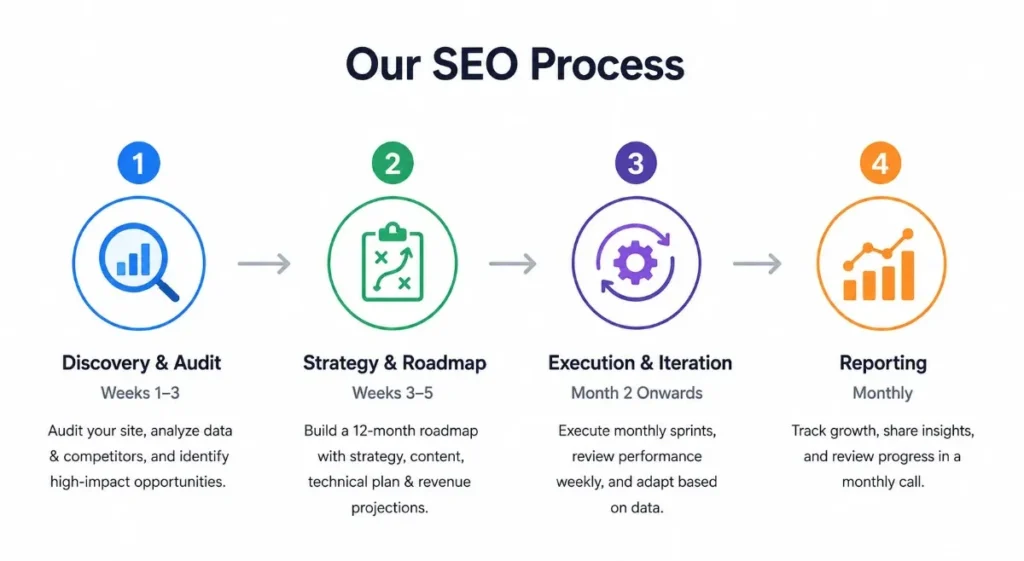
Discovery and audit weeks one to three:
We crawl the full site, pull twelve months of Search Console and Analytics data, run a competitive gap analysis across your top five organic competitors, and build an issues list prioritised by revenue impact. Everything we recommend from this point forward comes from what we find in this phase not from a template.
Strategy and roadmap weeks three to five:
The roadmap covers the full twelve months with quarterly milestones. It includes a keyword architecture mapped to your buyer journey, a content plan built around topical authority clusters, a technical remediation schedule, and a link acquisition approach suited to your category and domain authority stage. It is presented as a business document with revenue projections attached, not a list of deliverables.
Execution and iteration month two onwards:
We work in monthly sprints. Each sprint has a defined set of technical tasks, content pieces, and outreach targets. We review performance weekly internally and adjust sprint priorities based on what the data is showing. If something is working faster than expected, we put more resources behind it. If something is not moving, we diagnose why before pushing more content at it.
Reporting monthly, in person or on a call:
The report covers organic revenue, qualified session volume, conversion rate from organic, and keyword movement on the commercial-intent terms in your roadmap. We present this in a 45-minute call every month. There is no automated report sent to your inbox without a conversation because a number without context is just noise.
Why do clients stay with us?
Retention in SEO agencies is low. Client churn is high. The main reason is not that results are bad, it is that the client never feels like the agency actually understands their business. They feel like an account number, not a commercial partner.
We work with a deliberately limited number of clients so that the senior people on our team are genuinely across every account. There is no junior handoff after the proposal is signed. The strategist who presents the roadmap is the same person who reviews the content and approves the technical changes. That is not scalable and we know it. It is also the only way we know how to produce the kind of work that compounds.
We also tell clients things they do not always want to hear. If a keyword target is unrealistic on the current budget, we say so. If the website needs a structural rebuild before SEO can move the needle, we say that too even if it means delaying the start of the engagement. If a full site overhaul is needed, our Website Design and Development team works alongside the SEO process so nothing is built in isolation. Clients stay because they trust us, and they trust us because we have never once told them what they wanted to hear just to keep the retainer going.
What SEO actually costs in Ahmedabad right now?
Pricing in this market ranges from ₹8,000 per month at the bottom to well above ₹1,50,000 for large enterprise engagements. Here is what those price points actually look like in practice.
Below ₹20,000 per month, you are almost certainly getting templated deliverables: a few blog posts, some directory submissions, a keyword report, and a rankings spreadsheet at the end of the month. It is not necessarily useless but it is also not strategic SEO. It will not move competitive keywords and it will not compound.
Between ₹30,000 and ₹80,000 is where real work becomes possible but only if the agency is allocating that budget to senior time, proper content, and legitimate links rather than padding a deliverable list with low-value tasks. This is also the range where asking the seven questions above becomes most important, because the variance in quality between agencies at this price point is enormous.
Above ₹80,000, you are into territory where you should expect a full-time strategist equivalent, significant content production, proactive PR-driven link acquisition, and commercial reporting tied to real revenue metrics. If you are paying at this level and not getting those things, you have the wrong agency.