
The Local SEO Company Advantage: Combining SEO, AEO, and GEO Under One Strategy
Three years ago, the average business owner had one question about search: “Why isn’t my website ranking?” In 2026, that question has multiplied. Now it’s: “Why doesn’t my business show up when someone asks ChatGPT?” Or: “Why is my competitor appearing in Google’s AI Overview and I’m not?” The rules of search have been quietly rewritten and working with a reliable local SEO company is no longer just about getting onto page one. It’s about being visible across an entirely new landscape of search.
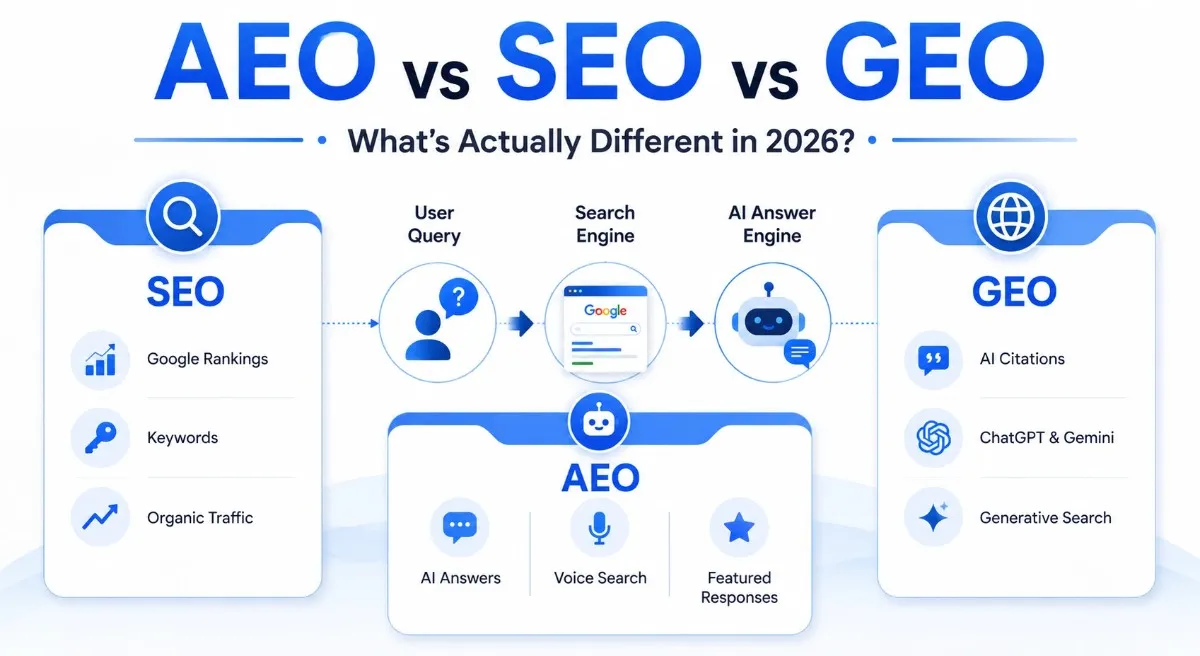
SEO, AEO, and GEO are the three disciplines that cover this new landscape. They’re not different names for the same thing; each one targets a different search surface, a different user behaviour, and a different stage of the buying process.According to Google’s How Search Works, search systems evaluate hundreds of signals simultaneously meaning the rules businesses ranked under just two years ago have already shifted significantly.
This guide explains what each one actually means, where they overlap, and how a joined-up strategy across all three is what separates businesses that grow through search from those that stagnate.
Search Has Changed And Most Businesses Haven’t Noticed
Here’s something worth sitting with: a user can now search for your type of service, get a full answer from Google’s AI, and never visit a single website. No click. No visit. No chance for you to make an impression unless your content was the source Google pulled from.
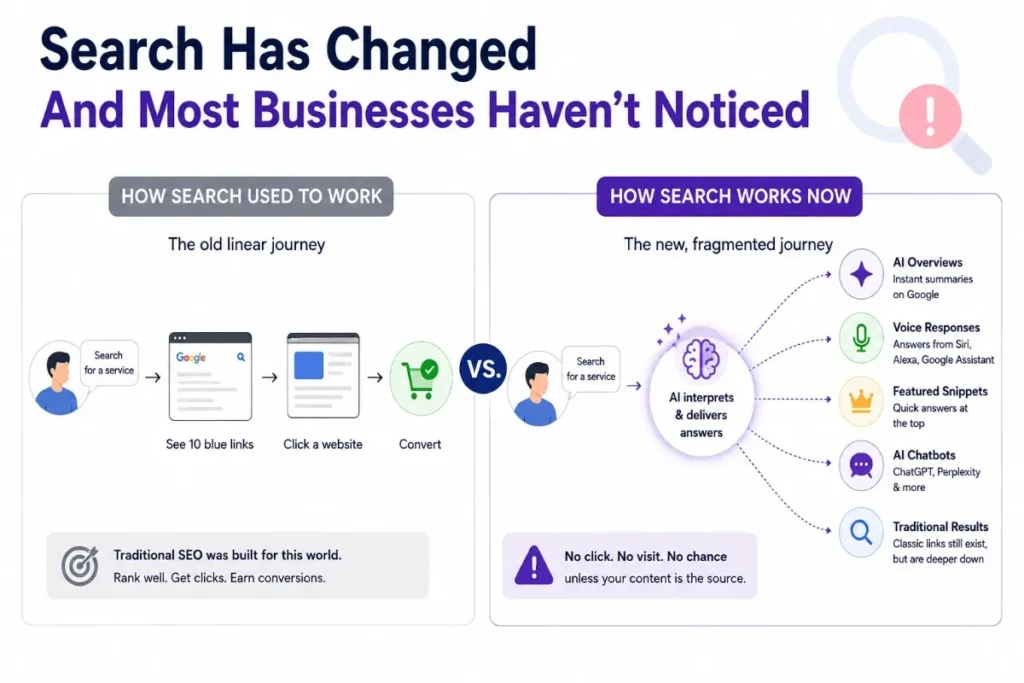
That’s the reality of search in 2026. It didn’t flip overnight. Google rolled out AI Overviews gradually through 2024, voice assistants had already been nudging users toward conversational queries for years, and tools like ChatGPT and Perplexity quietly became part of how people research before they buy. But the cumulative effect has been sharp. The search journey no longer follows a straight line from query to click to conversion. It splinters across AI summaries, voice responses, featured snippets, and traditional results often before a user ever lands on anyone’s website.
Traditional SEO wasn’t built for this. It was built for a world where Google returned ten blue links and the best-ranked page got the traffic. That world still exists, but it’s shrinking as a share of total search behaviour. AEO and GEO exist to cover what SEO alone now misses. Understanding the difference between them is where a smarter search strategy begins.
Search has changed. SEO, AEO, and GEO are no longer optional; they’re essential.
Digifinity builds unified search strategies across SEO, AEO, and GEO for businesses ready to get found everywhere it matters across India and beyond.
Explore Our ServiceWhat Is SEO And Why It’s Still the Foundation?
SEO is how your website shows up when someone searches on Google or Bing without you paying for that placement. It pulls together a few different things: the content on your pages, how fast and stable your site is technically, who links to you, and whether people actually enjoy using your site. When all of that works together, Google starts treating your page as the most trustworthy answer for a given search.
A lot of people have written SEO off because of AI search. That’s premature.Google still processes over 8.5 billion searches every single day. Most of those still end with someone clicking an organic result not an ad, not an AI summary. A business that ranks well in organic search has built something that keeps working without paying for every click. That’s rare in digital marketing.
Paid ads stop the moment your budget does. Social reach depends on algorithms you don’t control. SEO compounds. A page that earns authority today keeps delivering six months from now, two years from now. That’s what makes it the most durable digital asset most businesses can build, not the most exciting, but the most reliable.
What Search Engine Positioning Actually Means in 2026?
Most people think SEO is a one-time job. Optimise the page, watch it rank, done. Search engine positioning doesn’t work like that.
There’s a real difference between “somewhere on page one” and position 3 versus position 7. Position 3 pulls maybe 10% of clicks. Position 7 barely gets 4%. Same keyword, same page, completely different revenue. That gap is what positioning is actually about.
Google has changed a lot. Three years ago, keyword density and backlinks did most of the heavy lifting. That playbook is dead. Not dying dead.
What works now is harder to fake, which is probably the point. Google is trying to figure out if your site genuinely understands a topic or just mentions it enough times. Topical authority means going deep on a subject consistently, not publishing one article and calling it done. E-E-A-T experience, expertise, authoritativeness, trustworthiness sounds like corporate framework speak, but it’s really just Google asking: does a real person with real knowledge stand behind this content?
And if your site loads slowly or jumps around while someone’s reading, none of that content work matters. Core Web Vitals aren’t a bonus feature. They’re baseline.
The businesses holding strong rankings right now aren’t doing ten things. They’re doing all of it together with content, authority, technical health as one strategy, not a checklist.
That’s the shift. And most sites haven’t made it yet. If your current approach doesn’t connect all these pieces, Digifinity’s search engine optimization services show what a fully integrated strategy actually looks like in practice.
What Is AEO And Why It Matters for Voice & AI Search?
Search has changed. People aren’t scrolling through ten results anymore they ask, they get an answer, they move on. Answer Engine Optimisation is about making sure that answer is yours.
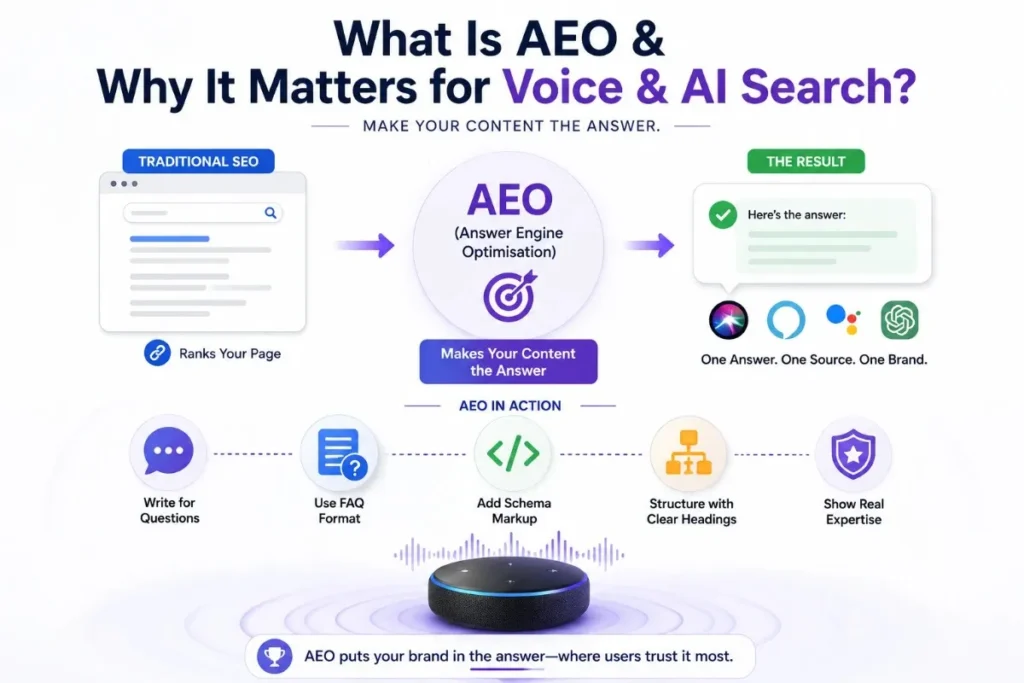
AEO is the practice of structuring content so voice assistants, AI chatbots, and Google’s featured snippet can pull it directly as a response. Traditional SEO ranks your page. AEO makes your content the answer.
When someone asks Alexa “What’s the best way to waterproof a basement?” or Google’s “How much does website design cost in India?” they get one answer, one source, one brand. AEO decides whose that is.
To make it work, your content needs to be built differently:
- Concise definitions: a machine can extract without guesswork
- FAQ sections: written the way people actually ask questions
- Schema markup: so search engines know exactly what they’re reading
- Clear heading hierarchies: that structure information logically
- Real expertise: not surface-level content anyone could write
AEO vs SEO: The Core Difference
The most useful way to understand the distinction is through intent and format. SEO optimises for discovery and helps users find your page among many results. AEO optimises for resolution and makes your content the definitive answer to a specific question. SEO drives traffic to your site. AEO often drives brand impressions without a click at all, which sounds counterintuitive until you consider that brand recall and zero-click trust-building directly influence purchase decisions downstream.
In practice, AEO and SEO work best together. Pages that earn featured snippets typically already have strong organic rankings. For businesses that rely on paid visibility alongside organic, combining AEO with a well-structured search engine marketing strategy ensures coverage at every stage of the search journey. To understand how these disciplines complement each other , read Google’s own guidance on how Search works.
What Is GEO And Why AI Overviews Are Changing Everything?
Generative Engine Optimisation (GEO) is the newest of the three disciplines. It refers to the practice of optimising content so that it is cited, referenced, or summarised by AI-powered search experiences primarily Google’s AI Overviews, but also platforms like:
- Perplexity
- Bing Copilot
- ChatGPT’s Browse feature
Where SEO focuses on ranking algorithms and AEO focuses on question-and-answer structures, GEO focuses on being the source material that AI systems trust. When Google’s AI Overview tells a user that “the average cost of kitchen renovation in India is between ₹3 lakh and ₹8 lakh”, it has pulled that figure from somewhere. GEO is the practice of making sure your content is that source.
This matters because AI Overviews are now appearing across a wide range of commercial and informational queries. The website cited in that overview receives a significant trust transfer even if the user doesn’t click through. Studies from early 2025 already showed a measurable correlation between GEO-optimised content and brand mentions within AI-generated responses. The impact is clear:
- Your brand gets cited before a user ever visits your site
- Trust transfers even on zero-click searches
- AI Overview citations directly influence downstream buying decisions
GEO Services: What They Actually Involve?
GEO is still being figured out. Tools are catching up, playbooks are half-written, and most agencies are learning on the job. But the fundamentals are clear enough to start acting on. Content needs two things: real facts and original data. AI systems don’t reward polished opinions. They pull from sources that say something specific and verifiable that others don’t. Generic advice gets skipped entirely.
Structure is just as important. Clean hierarchies, defined entities, markup that removes guesswork. And authority signals AI evaluates credibility the way a careful researcher does. Who cites this source, how long has it been trusted, what does the wider web say about it.
If you’re running paid campaigns alongside content, the two should work together. Appearing in AI answers while your ads run means you’re present everywhere buyers are looking. That’s exactly what Digifinity’s performance marketing approach is built around.
The one thing GEO has that traditional SEO doesn’t is brand monitoring inside AI responses tracking whether you appear, and how you’re described when you do. Most SEO tools don’t do this yet. They will soon. For the academic foundation, the GEO: Generative Engine Optimization paper from Princeton (2024) is still the most cited starting point in the field.
AEO vs SEO vs GEO: A Direct Comparison
Rather than treating these as separate silos, think of them as layers. Each operates at a different level of the search experience:
| SEO | AEO | GEO | |
| Full Name | Search Engine Optimisation | Answer Engine Optimisation | Generative Engine Optimisation |
| Primary Goal | Rank in organic search results | Own the direct answer | Get cited in AI-generated responses |
| Platform | Google, Bing | Voice assistants, Featured Snippets, AI chatbots | Google AI Overviews, Perplexity, Bing Copilot |
| Success Metric | Rankings, organic traffic, conversions | Snippet wins, voice answer appearances | AI citations, brand mentions in AI responses |
| User Action | Clicks through to your website | Gets answer with or without a click | Reads AI summary citing your brand |
| Content Format | Keyword-optimised pages, blogs, landing pages | FAQ structure, concise definitions, schema markup | High factual density, original data, citations |
| Best For | Discovery & traffic | Resolution & brand recall | Authority & AI visibility |
The targeting surface differs too. SEO is primarily about Google’s PageRank-influenced systems. AEO extends to voice assistants (Alexa, Siri, Google Assistant) and features snippets. GEO extends to AI Overviews, Perplexity, Bing Copilot, and LLM platforms like ChatGPT.
Measurement metrics also diverge. SEO success is measured in rankings, organic sessions, and conversions. AEO success is measured in featured snippet appearances, voice answer wins, and zero-click brand impressions. GEO success is measured in AI Overview citations, brand mentions in AI responses, and source attribution frequency.
Do You Need All Three, or Just One?
Honestly, there’s no universal answer. It comes down to who your customers are, how they search, and how crowded your space is. But for most businesses in India right now, dropping any one of the three leaves a real hole in your visibility.
Start with SEO. If your customers are still finding businesses like yours through Google and for B2B and local services, then organic search is where your money should go first. It’s not just one channel among many. It’s the foundation everything else sits on. You can’t win a featured snippet without organic authority behind the page. That’s just how it works.
AEO becomes important the moment your buyers are asking questions before they buy. “Which accounting software works best for a 10-person startup?” “How do I actually pick a pest control company I can trust?” If those kinds of searches exist in your category, owning the featured snippet for even one of them can put your brand in front of more people than a solid position 3 ranking would. The exposure is disproportionate to the effort when you get it right.
GEO is the one most businesses are sleeping on. If your audience is buying something considered a software tool, a professional service, anything with a longer decision cycle they’re probably asking ChatGPT or Gemini before they ever open Google. That’s not a prediction anymore. It’s already happening. And if your brand doesn’t show up in those AI-generated answers, you’re missing the buyer before the buyer even starts searching.
How a Local SEO Company Ties All Three Together?
Local search is where these three disciplines converge most visibly and where the stakes for businesses are highest. When a potential customer searches for “interior designers near me” or “best CA firm in Surat”, Google now returns a combination of Google Business Profile listings, organic results, and increasingly, an AI Overview that synthesises information from multiple sources.
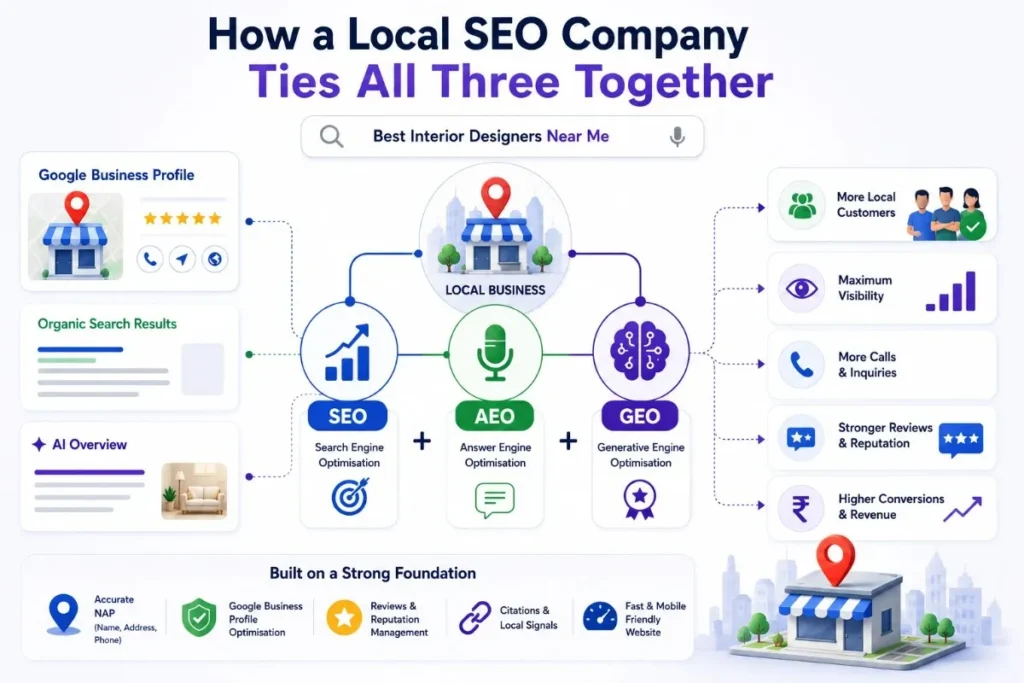
A specialist local SEO company understands how to optimise across all three surfaces simultaneously. That means ensuring your Google Business Profile is fully optimised with accurate NAP data (Name, Address, Phone), service categories, and review velocity. It means creating local landing pages with the geographic and service-specific structured data that enables AEO wins for “near me” queries. And it means building the citation consistency and topical authority that makes your business a credible source for GEO responses in AI tools that are increasingly influencing local buying decisions.
The distinction matters because local intent queries are among the highest-converting in all of search. A user typing “emergency plumber in Ahmedabad” is not researching what they’re ready to buy. Being visible at that moment, across every surface that could serve the query, is a direct revenue driver. A strong local SEO strategy also runs in parallel with a well-built website design and development foundation because a technically weak site will underperform regardless of how good the off-page strategy is.
This layered approach to local visibility is precisely what separates agencies still running 2019-era SEO strategies from those built for the 2026 search environment. For a practical look at what modern local SEO involves, Moz’s Local SEO Guide remains one of the most thorough external references available.
What to Look for in an AI SEO Services Partner in 2026?
The term “AI SEO services” is used loosely across the industry sometimes to mean using AI tools to produce content faster, and sometimes to mean genuine expertise in optimising for AI-powered search surfaces. These are not the same thing, and the distinction matters enormously for your results.
A credible AI SEO services provider in 2026 should demonstrate capability across four specific areas:
- Google’s AI content evaluation: Understanding entity relationships, semantic depth, and E-E-A-T signals that influence how AI Overviews are generated, not just keywords and backlinks.
- AEO process: Structured content creation, schema markup implementation, and systematic tracking of featured snippet performance.
- GEO capability: Creating content that earns citations in AI-generated responses, with a clear measurement framework to track when and where it happens.
- Technical SEO and local search integration: Tying all of the above to the fundamental practices that drive real traffic and real conversions.
Agencies offering only one of these capabilities are operating with a partial view of the modern search landscape. The businesses that will compound their digital visibility over the next 24 months are those partnering with teams that see the full picture.
Why Digifinity and Why It Matters Right Now?
Digifinity was built for the version of search that exists today, not the one that existed five years ago. The team works at the intersection of technical SEO, content strategy, and AI search optimization, building systems that position clients for visibility across organic rankings, answer engines, and AI-generated overviews simultaneously.
Every engagement begins with a search landscape audit specific to your industry, your competitors, and your customer’s current search behaviour. The goal is to identify where your brand is visible, where it’s absent, and where the highest-value opportunities exist across SEO, AEO, and GEO then build a roadmap with clear milestones and measurable outcomes.
If your business is ready to compete across every surface where your customers are searching Google, voice assistants, and AI-powered platforms Digifinity is the team to build that strategy with you.