
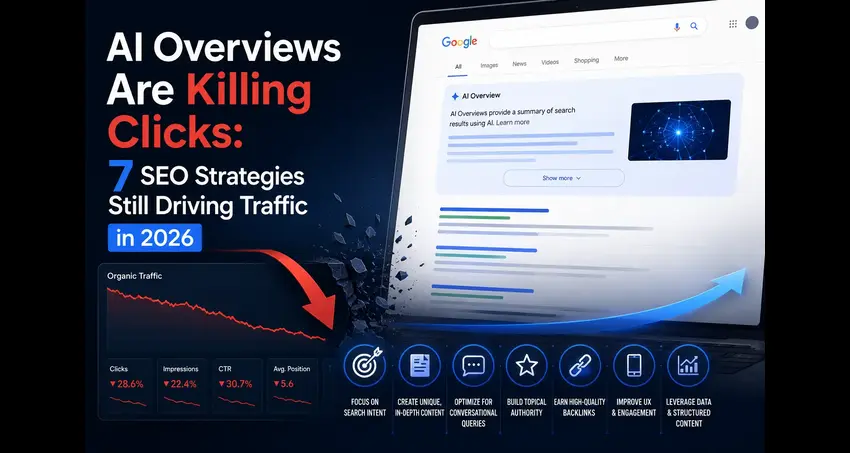
7 SEO Strategies a Leading SEO Agency Uses to Beat Google AI Overviews in 2026:
The search landscape has shifted fundamentally, and most businesses are only now beginning to feel the damage. Google’s AI Overviews the AI-generated answer summaries that appear above organic results have quietly eroded click-through rates across hundreds of industries. If your traffic reports have looked troubling over the past twelve months, this is likely a significant part of the reason.
But here is the truth that separates the agencies and brands that will thrive from those that will not: this is not the death of SEO.The businesses partnering with a forward-thinking SEO agency are already adapting, and some are growing their organic traffic precisely because their competitors are frozen in confusion.
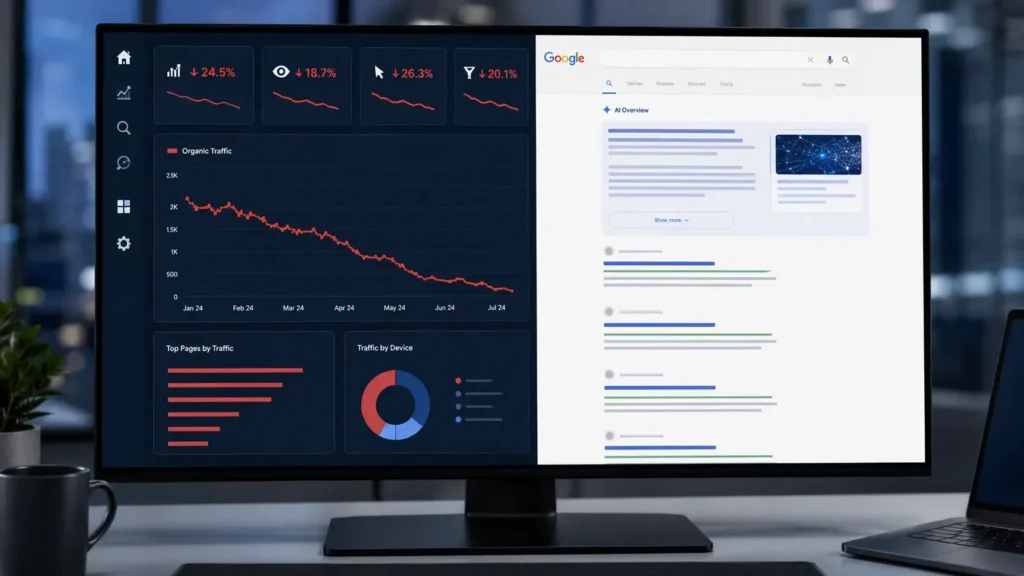
This guide breaks down exactly what is happening, why conventional tactics are losing their edge, and the seven SEO strategies that are still generating meaningful, measurable traffic in 2026 backed by data, real-world application, and the kind of strategic nuance that page-one results require.
The Click Crisis Is Real And It Is Getting Worse:
When Google rolled out AI Overviews at scale in 2024 and accelerated their presence throughout 2025, the initial industry response was cautious optimism. Perhaps, some argued, the answers would encourage deeper exploration. The data has not supported that hope.
Research from SparkToro and Rand Fishkin documented that over 60% of Google searches already ended without a click as early as 2023 before AI Overviews became a dominant presence. With AI Overviews now appearing for an estimated 30–40% of informational queries, according to tracking by BrightEdge, that zero-click proportion has accelerated further. In specific verticals finance, health, travel, and how-to content the impact has been particularly severe.
Clicks are harder to earn. We help you earn the right ones.
Digifinity builds SEO strategies for growth-focused businesses across India built for 2026
Explore Our ServicesWhat Google’s Own Data Reveals About Zero-Click Searches?
Google’s Search Central documentation and public statements from the Search Liaison team acknowledge the shift in user behaviour, framing AI Overviews as an improvement in “search quality” for users. From a user experience perspective, that is arguably accurate. From a publisher and business perspective, it represents a direct reduction in the value of ranking well for informational keywords.
The implication is clear: ranking number one for a question-based query no longer guarantees the traffic it once did. If the AI Overview answers the question completely and confidently, many users have no reason to click. This reality requires a fundamental rethink of how you target keywords, structure content, and measure the true commercial value of your SEO investment.
Why Are Traditional SEO Playbooks No Longer Enough?
The traditional SEO model to build links, target keywords, publish informational content, earn rankings, and receive traffic still has relevance. But treating it as a complete strategy in 2026 is a category error.
The specific content types most exposed to AI Overview displacement include:
| Content Type | AI Overview Exposure | Traffic Risk Level |
| Definition / What-is posts | Very High | Critical |
| Step-by-step how-to guides | High | High |
| List-based informational content | High | High |
| Product comparison roundups | Medium–High | Medium–High |
| Case studies and original research | Low | Low |
| Opinion and expert commentary | Low | Low |
| Bottom-of-funnel transactional pages | Very Low | Minimal |
| Local and service pages | Very Low | Minimal |
What the table above makes clear is that not all SEO content is equally vulnerable. The problem is that many agencies and in-house teams have invested disproportionately in the highest-risk content categories, because that content was easier to produce and historically easier to rank.
The shift now rewards specificity, authority, depth, and commercial intent. Agencies that understand this including experienced performance marketing companies are redirecting budgets and content calendars accordingly.
The 7 SEO Strategies Still Driving Real Traffic in 2026:
1. Own the Answer Box Then Go Deeper
One counterintuitive response to AI Overviews is this: get cited within them. Google’s AI Overviews frequently pull from sources it deems authoritative and well-structured. Being referenced inside an AI Overview, even without a direct click, builds brand recall and drives branded search volume over time.
To increase the likelihood of being cited, your content must:
- Answer the question cleanly and directly in the first two paragraphs
- Use structured, logical formatting that is easy for language models to parse
- Demonstrate E-E-A-T signals Experience, Expertise, Authority, and Trustworthiness visibly throughout the page
- Include schema markup that signals content type and credibility
But owning the answer box is only the first step. The content that follows must go significantly deeper than what an AI can summarise. Proprietary data, client case studies, frameworks built from direct experience, and opinions from named experts are all dimensions that AI Overviews cannot replicate. They can quote your expertise, but they cannot be your expertise.
2. Build Genuine Topical Authority, Not Just Content Volume
Google’s Helpful Content updates have systematically devalued content created primarily for search engines rather than for human readers. The practical outcome of this is that a website publishing 500 shallow blog posts is now outperformed by a website publishing 50 deeply researched, highly specific pieces that demonstrate clear subject matter expertise.
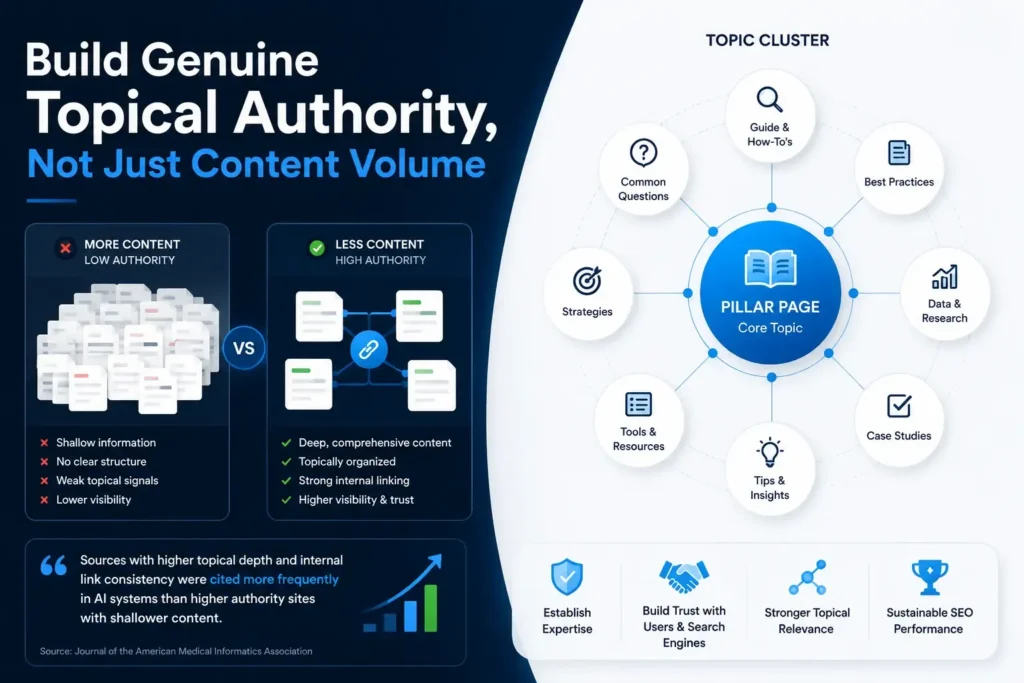
Topical authority is built by comprehensively covering a subject at every level of depth and intent. This means not just the broad informational queries, but the adjacent, specific, and nuanced questions that real audiences ask. A well-structured topic cluster with a pillar page supported by tightly linked supporting content signals to both Google and AI systems that your domain is a trusted reference on a given subject.
According to research published in the Journal of the American Medical Informatics Association examining AI citation patterns in large language models, sources with higher topical depth and internal link consistency were cited more frequently than sources with higher domain authority but shallower content. This pattern has significant implications for how SEO-focused content investment should be structured.
A strong SEO agency will not simply add more keywords or build more links. It will analyse your content architecture and identify the topical gaps that are limiting your authority signals across the board.
3. Optimise for GEO (Generative Engine Optimisation)
Generative Engine Optimisation GEO is the practice of structuring your content to be discovered, cited, and referenced by AI-powered search engines including Google AI Overviews, ChatGPT Search, Perplexity AI, and Microsoft Copilot. It is a discipline adjacent to traditional SEO but distinct in its priorities.
The key principles of effective GEO in 2026:
Cite your sources explicitly: AI systems are trained to favour content that itself demonstrates epistemic rigour. Content that references credible external data like industry reports, academic research, official statistics is more likely to be interpreted as reliable and cited in generative responses.
Use clear, parseable structure: Conversational AI engines process content linearly and prefer content with clear hierarchy, defined terms, and consistent formatting. Pages with erratic structure, heavy use of JavaScript rendering, or content buried behind interaction elements are less likely to be indexed and cited effectively.
Write for entities, not just keywords: Modern search algorithms understand entities, people, organisations, products, concepts and their relationships. Naming your authors, citing your experts, linking your organisation to recognised entities, and building content around entity relationships rather than just keyword density improves both traditional and AI search visibility.
Build consistent brand signals: Across ChatGPT Search, Perplexity, and Google’s AI Mode, the brands that appear most frequently are those with consistent, positive, high-volume brand mentions across the web. A coordinated SMM agency strategy that builds your brand presence on social platforms, forums, and third-party publications directly supports your GEO performance.
4. Structured Data Is No Longer Optional
Structured data schema markup has been technically important for years, but its strategic importance has increased significantly in the AI-driven search landscape. Here is why: schema markup helps AI systems understand what your content is, who it is from, and what it can reliably be cited as.
The schema types with the highest current impact on AI search visibility include:
| Schema Type | Use Case | Impact on AI Overviews |
| Article / NewsArticle | Blog posts, editorial content | High |
| FAQPage | FAQ sections | High |
| HowTo | Step-by-step guides | High |
| Organization | Business identity | High |
| Person | Author pages | Medium–High |
| Product / Offer | E-commerce, service listings | Medium |
| BreadcrumbList | Site navigation | Medium |
| Review / AggregateRating | Product and service reviews | Medium |
Implementing schema comprehensively including author schema that links to author profiles, organisation schema that connects to Google’s Knowledge Panel, and FAQ schema that directly feeds SERP features is one of the most technically impactful steps any business can take in the current environment.
5. Win on Brand Search and Direct Demand
Here is a metric that AI Overviews cannot touch: branded search volume. When someone types your business name, your product name, or your team’s name into Google, they are coming for you specifically. No AI Overview can intercept that intent.
The implication is clear: invest in the activities that build brand awareness and direct demand. This includes:
- Content marketing and thought leadership that puts named experts in front of audiences
- Social media presence that introduces new audiences to your brand
- PR and media coverage that creates brand recall
- Paid campaigns designed explicitly to build brand familiarity, not just immediate conversion
Businesses working with a quality digital marketing agency understand that brand building and SEO are no longer separate disciplines. They are deeply interconnected systems, and the brands that build both will be disproportionately insulated from the click-loss effects of AI Overviews. A strong visual identity and consistent messaging delivered through professional branding and designing solutions is often the foundation that makes every other marketing effort more recognisable, more trusted, and more effective.
Got it. The Semrush study is the strongest source here; it analysed 10M+ keywords and directly confirms that AI Overviews predominantly target informational queries, not transactional ones. Here is the updated section with the external link placed naturally:
6. Target Bottom-of-Funnel Queries AI Avoids
This may be the single most commercially important insight in this entire piece: AI Overviews are highly unlikely to appear for transactional, high-commercial-intent queries. When someone searches “best SEO company in india” or “best performance marketing companies for e-commerce in India,” Google understands that the user wants to make a commercial decision. It does not summarise those results with an AI Overview it shows the organic listings.
This is not anecdotal. Semrush’s analysis of over 10 million keywords confirmed that AI Overviews appear predominantly for informational queries, with commercial and transactional intent terms triggering them at significantly lower rates. The data is clear: the higher the purchase intent, the less likely an AI Overview is to appear.
This means that the pages most valuable to your business service pages, location pages, product pages, comparison pages with commercial intent are the least exposed to AI Overview disruption.
The strategic imperative is straightforward: invest heavily in the creation and optimisation of transactional content. Long-tail commercial queries even those with lower search volume convert at dramatically higher rates than informational content. A search query like “top digital marketing companies in India for B2B lead generation” may have a fraction of the volume of a broad informational term, but it arrives with purchase intent intact.
7. Create Content That AI Can Reference But Cannot Replace
The final strategy is perhaps the most enduring, because it is based not on algorithm preferences but on the fundamental nature of what AI systems can and cannot do. Large language models the technology underpinning AI Overviews, ChatGPT Search, and Perplexity are excellent at synthesising existing public information. They are structurally incapable of generating genuinely new knowledge, conducting original research, or expressing the lived expertise of real practitioners.
This creates a clear and lasting opportunity: publish content that contains things AI cannot know.
This includes:
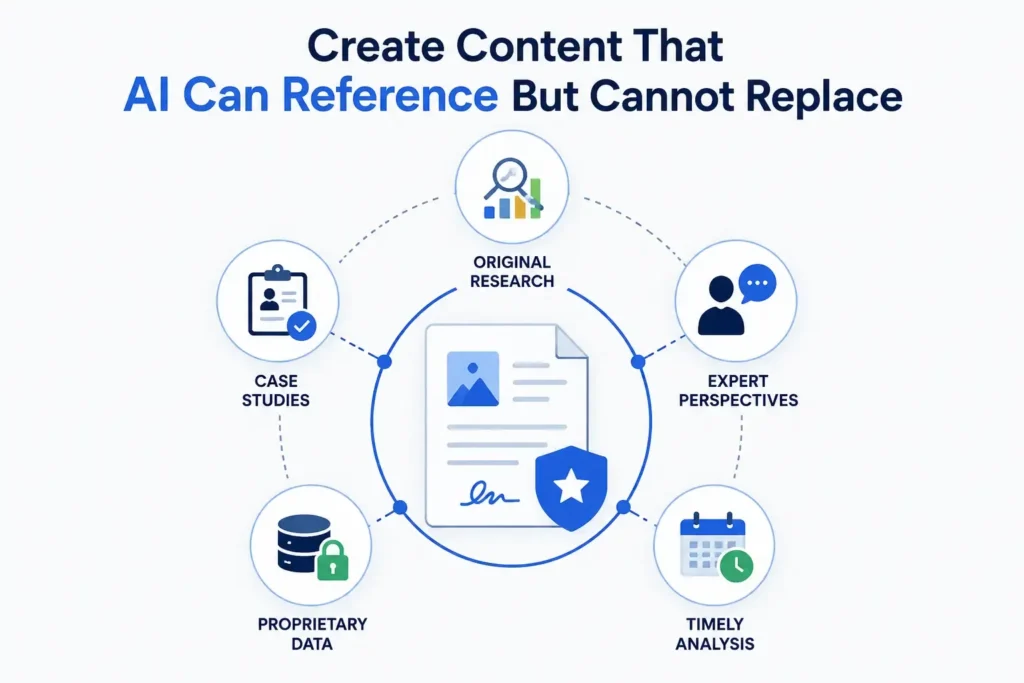
Original research and proprietary data: If your business conducts surveys, analyses client data (with appropriate permissions and anonymisation), or has access to industry data that is not publicly available, this is extraordinary content leverage. Studies, benchmarks, and original datasets attract both citations and backlinks at a scale that derivative content never achieves.
Documented case studies: Detailed, honest, outcome-focused case studies from real client engagements are impossible to fabricate and difficult for AI to replicate. They also serve as powerful conversion tools for prospects evaluating whether your expertise is real.
Named expert perspectives: Content that features specific, named experts with verifiable credentials, interviews, attributed commentary, co-authored pieces signals authority to both human readers and AI systems. This is the practical manifestation of the “Experience” and “Expertise” dimensions of Google’s E-E-A-T framework.
Timely, context-specific analysis: Commentary on recent industry events, regulatory changes, or market movements published quickly and with genuine analytical depth cannot be pre-generated by AI systems. This type of content captures high-intent readers at moments of active information-seeking.
The Role of a Performance-Focused SEO Agency in the AI Era:
The businesses navigating this transition most effectively are not those with the largest in-house SEO teams. They are those working with specialists who understand the convergence of technical SEO, content strategy, brand building, and generative AI visibility as a unified discipline.
An experienced SEO agency in 2026 should be doing more than keyword research and link building. It should be:
- Auditing your content portfolio for AI Overview exposure risk
- Identifying which content categories have commercial intent sufficient to resist AI disruption
- Implementing structured data comprehensively and correctly
- Building topical authority clusters that establish your domain as a reference source
- Aligning your social and PR activity with GEO objectives
- Monitoring AI citation patterns and adjusting content strategy in response
The agencies that frame SEO narrowly as a ranking exercise divorced from brand, conversion, and commercial strategy will consistently underdeliver for clients in this environment. The question to ask any prospective marketing agency near you is whether they understand the AI search ecosystem well enough to build a strategy that accounts for it.
Metrics That Matter When Clicks Are Declining:
One of the most important adaptations businesses need to make is updating how they measure SEO performance. If your primary metric is organic traffic volume, AI Overviews will make your SEO programme look like it is failing even when it is working strategically.
The metrics framework appropriate for the AI era:
| Metric | Why It Matters Now | How to Track |
| Organic click revenue / pipeline | Commercial value of clicks received | GA4 + CRM attribution |
| Brand search volume | Indicator of awareness and trust building | Google Search Console |
| Branded vs non-branded click ratio | Health of brand-building activity | Search Console segments |
| AI citation frequency | GEO performance indicator | Manual monitoring + tools like Semrush |
| Featured snippet ownership | SERP real estate control | Semrush / Ahrefs |
| Conversion rate by landing page | Quality of traffic, not just quantity | GA4 events |
| Share of voice in target queries | Competitive positioning | STAT / Semrush |
Shifting reporting conversations from raw traffic numbers to commercial outcomes is a sign of a mature, strategically aligned SEO programme. Any quality performance marketing company should be building dashboards around revenue impact, not just keyword rankings.
Ready to Compete in the AI Search Era?
The businesses that adapt now will not just survive the AI Overview transition they will gain competitive ground as less agile competitors lose traffic and stagnate.
If your current SEO strategy was built for a world before AI Overviews, it needs a comprehensive review. The strategies outlined in this guide require expertise in technical SEO, content architecture, structured data, GEO, and brand strategy working as an integrated system.