
How the Best Digital Marketing Agency Optimises for AI Search in 2026?
Search has quietly changed around you. Millions of users no longer type a query into Google and scroll through blue links; they ask ChatGPT, Perplexity, or Gemini a direct question and trust the answer they get back. If your website is not part of that answer, you are invisible to a fast-growing share of your target audience. Working with the best digital marketing agency is no longer just about ranking on page one it is about becoming a cited, trusted source inside AI-generated responses. This discipline has a name: Generative Engine Optimisation (GEO), and it is arguably the most significant shift in organic visibility since Google introduced PageRank.
The numbers back this up. ChatGPT now processes over 2.5 billion queries per day. Google AI Overviews handle roughly 15 billion daily searches. Perplexity has emerged as the citation-first AI platform of choice for researchers and SaaS buyers. And Gemini, powered by Google’s own index, is growing faster than any other AI search product. If your content strategy has not been updated to reflect this reality, your organic growth is already decelerating whether your analytics show it yet or not.
Why Is Traditional SEO No Longer Enough?
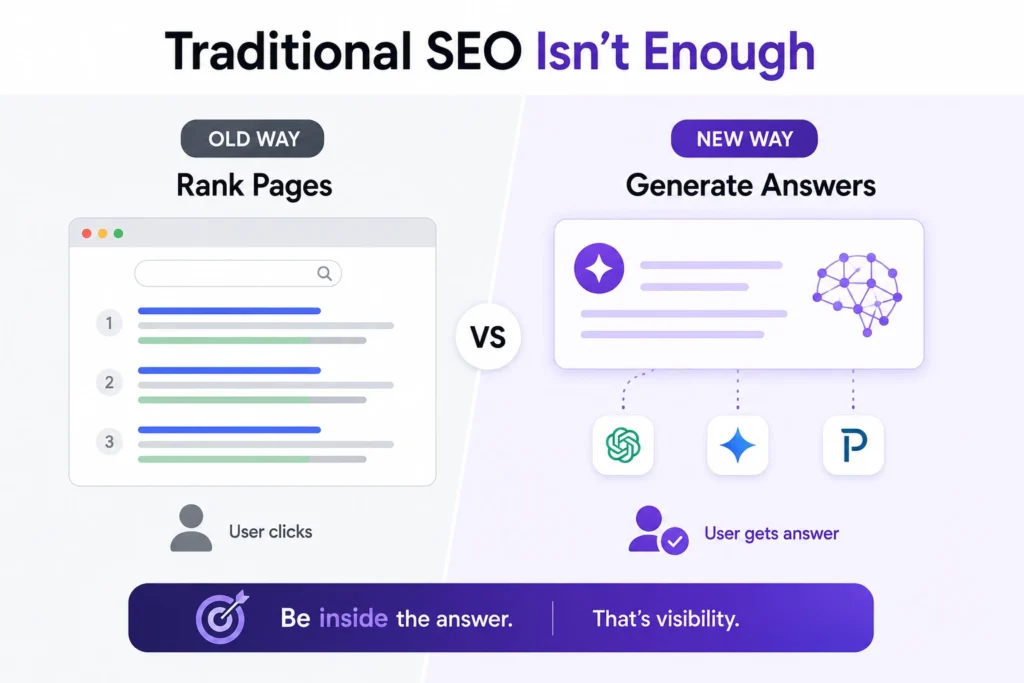
Let’s be honest about what is happening. Most businesses still operate on a keyword-ranking model that made complete sense in 2018. Target a keyword, build a page, earn backlinks, rank on page one. That model still has value but it now covers only part of the visibility landscape.
The structural problem is this: AI search engines do not rank pages. They synthesise answers. ChatGPT queries Bing’s index to pull sources. Gemini taps Google’s own search infrastructure. Perplexity runs real-time web search and surfaces citations with unusual transparency. In every case, the engine is looking for content it can trust, extract, and reference not a page optimized around keyword density.
The businesses most at risk are those with technically sound SEO but thin authority signals. Well-ranked pages that lack clear authorship, structured data, semantic depth, or freshness are increasingly bypassed by AI systems in favour of sources that demonstrate real expertise. This is not a future concern, it is already happening across industries. By 2026, more than 60% of searches are projected to end without a click, meaning AI generates the answer on-page and users never visit a website at all. Your only viable response is to be inside that answer.
What AI Search Optimisation Actually Means?
Nobody’s fully agreed on what to call it yet GEO, AEO, LLMO but they all point at the same goal. You want your content showing up inside the answer ChatGPT or Perplexity gives someone, not just sitting on page one waiting to be clicked. That’s the shift. For any best digital marketing agency worth its salt, it’s less about ranking a page and more about becoming the source an AI trusts enough to quote. Strong search engine positioning SEO remains the foundation that AI visibility is built on without it, AI platforms simply won’t encounter your content as a credible source in the first place.
This is not a replacement for conventional SEO. It is an extension of it. AI systems like ChatGPT and Gemini do not independently crawl the full internet in real time; they query established search indexes. If your website does not rank well in traditional search, AI engines are unlikely to encounter it as a potential source at all. Strong SEO services remain the foundation. AI visibility is the next floor you build on top.
Is Your Website Getting Cited by ChatGPT, Perplexity & Gemini?
Most websites rank on Google but never appear in a single AI-generated answer. Digifinity builds the content authority, schema structure, and topical depth your site needs to get cited not just ranked. If AI search is where your next customer is looking, this is where you need to be.
Explore Our ServiceUnderstanding the Three AI Platforms: What Each One Wants?
Gemini sits inside Google’s own ecosystem. It builds on everything you’ve already done for Google Search E-E-A-T signals, structured data, topical authority and extends them into AI-generated answer cards. A business that ranks well on Google is already partway to Gemini visibility. This is also why investing in GEO services now makes more practical sense than waiting for the groundwork you lay for traditional search to directly feed your AI citation potential across every platform.
| Platform | Index Source | Key Ranking Signal | Citation Style |
| ChatGPT | Bing Search | Authority + Structure | Synthesised / Inline |
| Perplexity AI | Real-Time Web | Recency + Clarity | Direct Source Link |
| Gemini | Google Index | E-E-A-T + Schema | AI Overview / Cards |
| Google AI Mode | Google Index | Topical Authority | Featured Answer |
ChatGPT uses Bing’s search index and GPTBot for web crawling. It prefers structured, authoritative content tables, numbered lists, clearly defined sections because that format mirrors how it wants to output answers. Blocking GPTBot via your robots.txt opts your site out of ChatGPT’s search features entirely.
Perplexity runs live web search at query time, which means recency is a primary ranking factor. Pages updated within the last 30 days are dramatically more likely to be cited. Perplexity also has some of the highest conversion rates for SaaS and service-based businesses, making it disproportionately valuable despite its smaller user base.
Gemini sits inside Google’s own ecosystem. It builds on everything you have already done for Google Search E-E-A-T signals, structured data, topical authority and extends them into AI-generated answer cards. A business that ranks well on Google is already partway to Gemini visibility.
Six Proven Strategies to Get Cited by AI Search Engines:
1. Build Topical Authority, Not Just Page Rankings
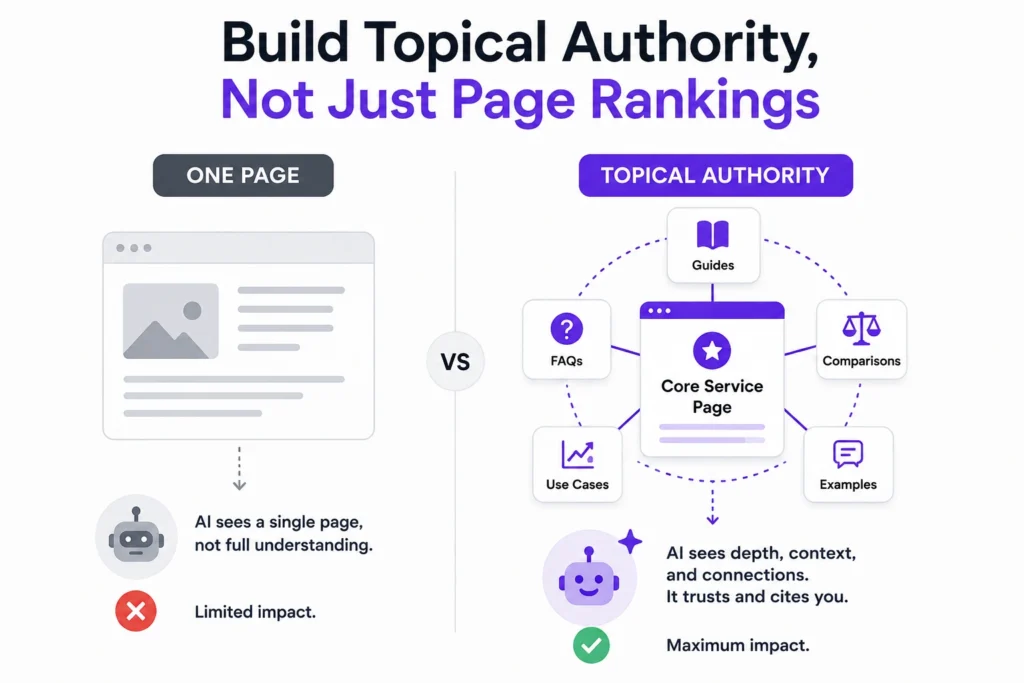
One good page won’t cut it anymore. AI systems aren’t just reading your best piece of content, they’re looking at how much of a subject your site actually covers. A site with fifteen pieces on a topic, all connecting to each other and reinforcing the same core ideas, will beat a site with one excellent article and nothing supporting it. Every single time.
The shift this requires is moving from “publish when we have something to say” to building content with a deliberate structure behind it. One strong service or product page at the centre. Around it guides, FAQs, comparisons, real use-case examples. AI engines follow those internal connections and use them to decide whether your site genuinely understands its subject, or is just skimming the surface.
2. Optimise Your Content Structure for Extraction
AI platforms don’t read pages the way people do. They scan, extract the clearest answer to a specific question, and move on. Everything else on the page barely registers. Structure, then, matters more than most people give it credit for. A few things that actually make a difference:
- Your H2 and H3 headings should work as direct answers, not section labels. “How does ChatGPT decide which websites to cite?” gets pulled. “Our Content Philosophy” gets ignored.
- Lead each section with the answer in the first two sentences, then back it up. AI systems extract from section openings more than anywhere else on a page burying the point costs you citations.
- Lists, tables, FAQ schemas use them where they fit. Not because they look organised, but because AI can parse and reproduce structured formats far more accurately than dense paragraphs.
- One section, one idea. The second a section tries to cover two things at once, it becomes harder to extract cleanly and the whole thing loses value.
3. Implement Schema Markup Properly
Scroll through most websites and you’ll find either no structured data at all, or a half-implemented setup someone added years ago and never touched again. It’s one of those things that feels technical so it keeps getting pushed down the priority list which is exactly why it’s still a genuine advantage for sites that do it properly.
Google’s structured data documentation makes it clear that schema isn’t optional anymore; it’s how you tell AI systems directly what your content is, who wrote it, and what questions it answers. Instead of a platform reading your page and guessing, schema removes that guesswork entirely. That clarity matters when the system is deciding which source to pull from in half a second.
FAQ schema is the one worth doing first. AI engines already respond in a question-and-answer format FAQ schema is just your content speaking that same language back to them. Any service page or blog post without it is working harder than it needs to.
4. Strengthen E-E-A-T Signals Across Your Site
Nobody sits down and decides to trust a website. It happens gradually, through small details: a named author with a real background, a specific case study instead of a vague claim, contact details that actually match across every platform the business appears on. AI systems work similarly, just faster and at scale.
E-E-A-T isn’t a checklist you complete once. It’s the overall impression your site leaves on both people and machines after they’ve looked at it properly. Real bylines help. Original research and documented experience help more. Third-party mentions of a quote in an industry publication, a listing on a credible directory add weight that your own content simply can’t create for itself.
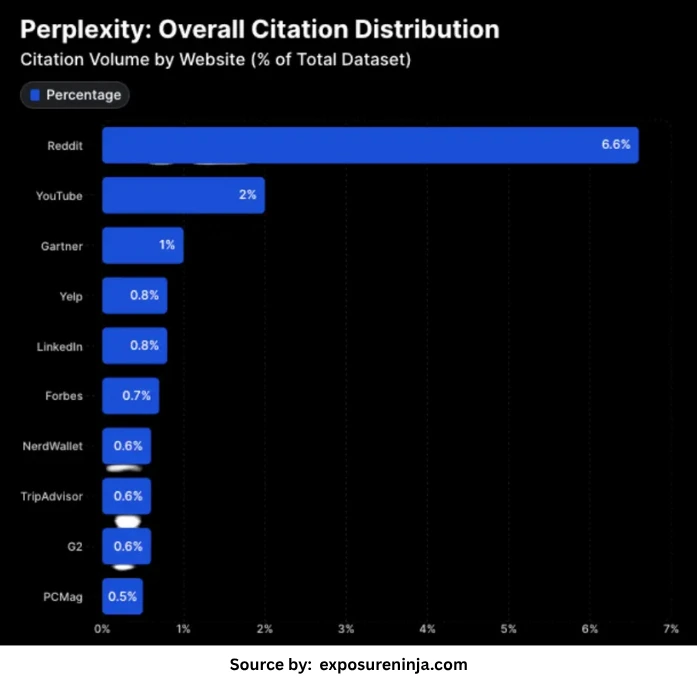
This isn’t guesswork. Data from Exposure Ninja’s AI Search Statistics 2026 shows that Perplexity’s most cited sources are platforms with strong community trust and domain authority Reddit at 6.6%, followed by YouTube, Gartner, LinkedIn, and Forbes. The pattern is clear: AI platforms cite sources people already trust, not just pages that are technically optimised.
For e-commerce this gets more specific. Your product pages, customer reviews, answered questions, and detailed specs are all part of the same picture. Every ecommerce platform India businesses depend on needs trust signals baked into its structure from day one not added as an afterthought once rankings start slipping. An ecommerce site built without these layers will keep hitting a ceiling with AI visibility, because no matter how good your blog content is, thin product pages pull the overall authority signal down.
5. Prioritise Content Freshness and Crawl Accessibility
Recency is a stronger signal in AI search than most businesses realise. Research tracking Perplexity’s citation patterns found that 76% of highly cited pages had been updated within 30 days of the query. AI systems are built to surface current, relevant information outdated content, no matter how well-written, is at a structural disadvantage.
Practical freshness strategy involves more than publishing new posts. It means regularly updating existing high-value pages with new data, revised statistics, and current examples. It means adding “last updated” dates that AI systems can parse. It means treating your content library as a living document rather than a static archive.
Crawl accessibility matters equally. Ensure your robots.txt does not block major AI crawlers GPTBot for ChatGPT, Google-Extended for Gemini, PerplexityBot for Perplexity. Use a clean XML sitemap, fast page load speeds, and logical internal linking to make it straightforward for AI crawlers to discover and index your full content depth.
6. Align Your Content with Conversational Query Patterns
There’s a difference between what people type and what people ask. Typed queries are short, fragmented, habitual “best SEO agency Ahmedabad.” AI-directed queries are the opposite. Longer, more conversational, structured like a real question “which digital marketing agency in Ahmedabad actually specialises in GEO and AI SEO?” Same intent, completely different format. If your content is only built around the first kind, it’s going to keep missing the second.
The research backs this up more concretely than most people expect. A study across Princeton, IIT Delhi, and Georgia Tech found that the right AI SEO approach can lift citation rates by up to 40%. The Princeton GEO research pinned down exactly what works content with specific statistics, named sources, clear explanations, and structured formatting consistently outperforms content without those elements inside AI-generated responses. It’s not about writing more. It’s about writing in a way that AI systems can actually use.
What AI-Optimised Content Actually Looks Like?
There is a meaningful difference between content that ranks on Google and content that gets cited by AI. The former can be technically optimised but thin on substance. The latter needs to be genuinely useful, the kind of page a knowledgeable person would recommend as the best answer to a question. Here is what that means in practice:
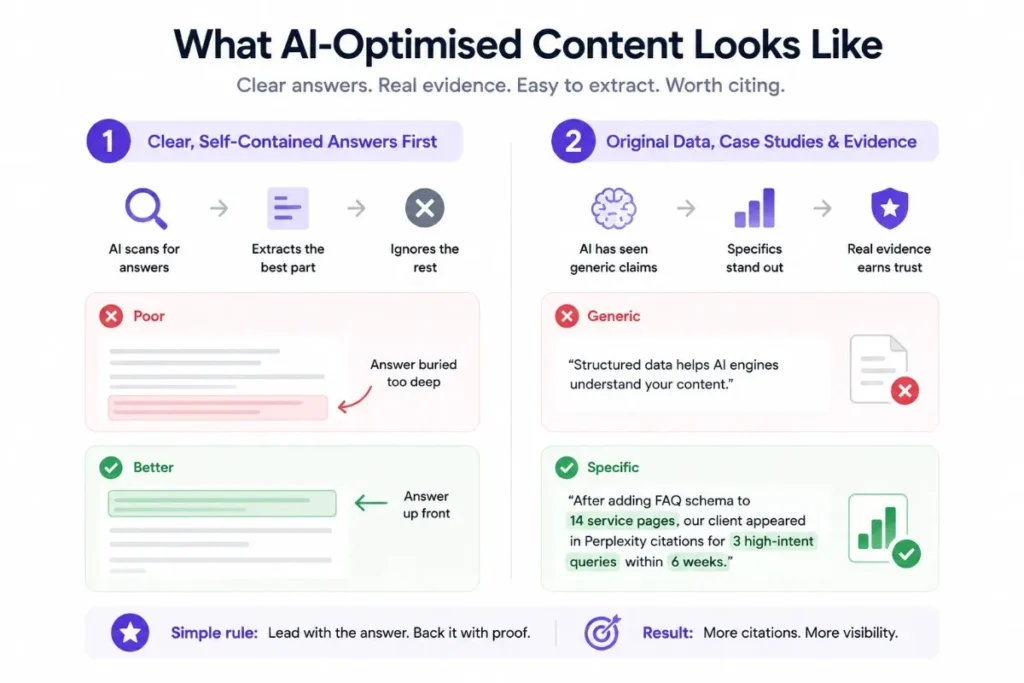
- Clear, self-contained answers near the top of each section: Most people write for humans who read top to bottom. AI systems don’t. They scan a page looking for the clearest answer to a specific question, extract that segment, and ignore the rest. So if your best insight sits in paragraph seven after three paragraphs of context-setting, it simply won’t get picked up. The fix is straightforward: lead with the answer, then explain it. A section on GEO should open with what GEO actually is, not with why search is changing. Applied consistently across your content, this one habit shift makes a bigger difference to AI citation rates than most technical optimisations combined.
- Original data, case studies, and cited evidence throughout: Here is something worth understanding about how language models evaluate sources: they have read millions of pages that say things like “structured data helps AI engines understand your content.” That sentence means nothing to them anymore. What stands out is specificity: a real client result, a named study, a concrete number. “After implementing FAQ schema across 14 service pages, one of our clients started appearing in Perplexity citations for three high-intent queries within six weeks” that is the kind of claim that carries weight. It signals that a real person with real experience wrote this, not a system generating plausible-sounding text. The more your content reads like genuine documented experience, the better it performs in AI search.
How Digifinity Approaches AI Search Optimisation?
Most agencies will hand you a keyword list and a content calendar and call it an AI SEO strategy. That’s not what we do.
Our AI SEO services are built around what we actually find not a generic template applied before we’ve looked at your site properly. Before anything else, we run an AI visibility audit opening ChatGPT, Perplexity, and Gemini and typing in the queries your actual customers are using. We want to see whether your brand shows up, what the AI says about you when it does, and who it’s recommending instead. That audit shapes everything that follows, because the gaps look different for every business.
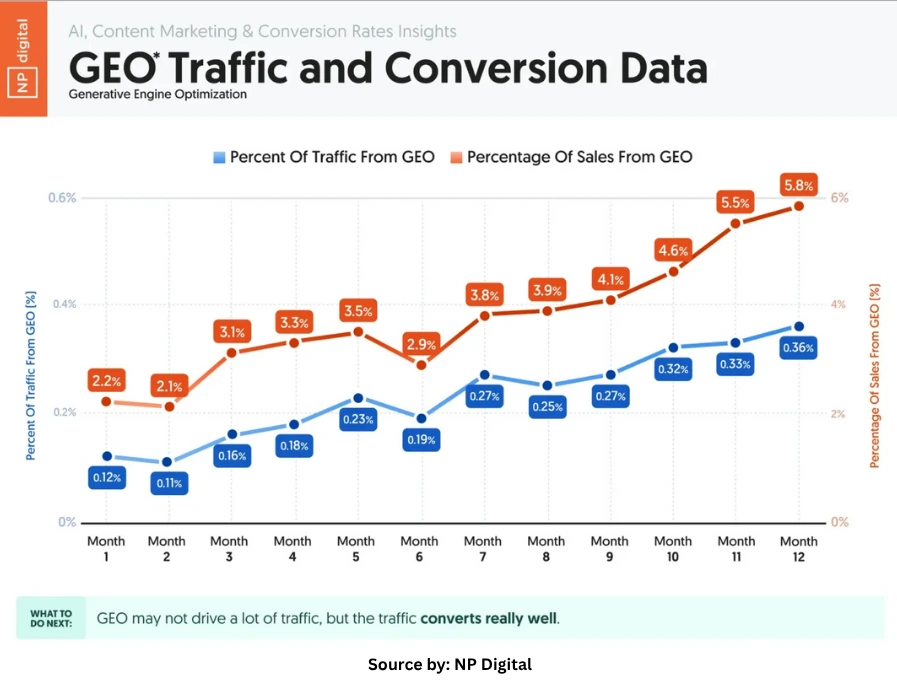
The conversion case for GEO is stronger than most people expect. Data from NP Digital across 13 companies tracked over 12 months shows that while GEO traffic volumes start small, sales conversions from that traffic reached 5.8% by month 12 nearly double what most paid channels deliver. The traffic is fewer clicks, but the intent behind each one is significantly higher.
From there we build out your topical coverage figuring out which content clusters your site needs to be taken seriously as an authority on your subject. Each piece connects back to your core service pages through deliberate internal linking, so the structure itself signals expertise, not just the words on the page. This runs alongside our performance marketing work, so what we’re doing organically and what we’re doing in paid channels are pulling in the same direction rather than ignoring each other.
ment, crawl settings, author markup, keeping content current we treat that as ongoing
On the technical side schema deploywork, not a one-time setup. AI search shifts quickly. A configuration that works well today needs monitoring and adjusting over time, and that’s built into how we operate.
Why Do Businesses Choose Digifinity for AI SEO and GEO Services?
Digifinity is a full-service digital growth agency based in Ahmedabad, working with clients across India and internationally. Our team has spent the past several years building expertise specifically at the intersection of traditional SEO and the emerging AI search landscape, a combination that most agencies are still catching up on.
We don’t sell AI SEO as a standalone product disconnected from your broader digital strategy. What separates a best digital marketing agency from the rest isn’t the service list; it’s whether organic visibility, content authority, and technical structure are all being built together rather than treated as separate workstreams. That’s exactly how we operate.
Our services span the full digital stack from custom software development company to strategic brand positioning which means we can address the technical, content, and design dimensions of AI visibility within a single coordinated engagement rather than requiring you to manage multiple agencies.