
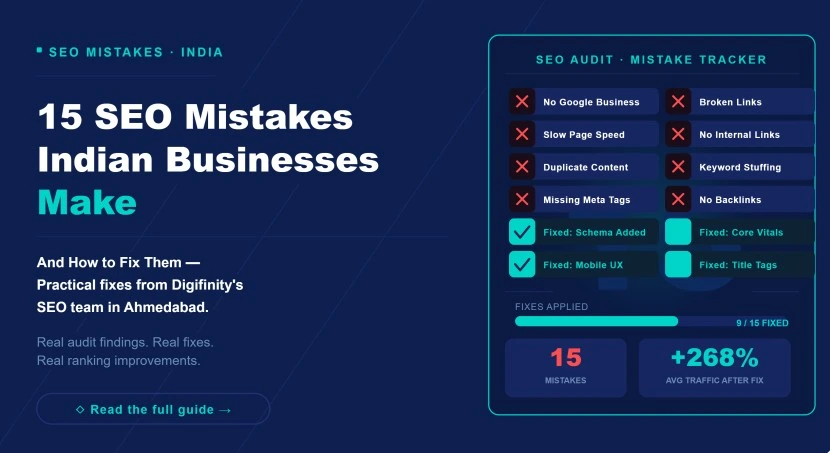
Practical Fixes From Digifinity’s SEO Team in Ahmedabad:
Search for the best digital marketing agency and you’ll get thousands of results, each one promising rankings, traffic, and leads within a few months. Some of that is genuine. A lot of it is noise dressed up as strategy. Scratch beneath most Indian business websites, though, the ones already working with an agency and the ones still doing SEO in-house, and you’ll find the same fifteen mistakes surfacing again and again, quietly capping growth long before anyone notices the pattern. A recent Think with Google study found that most consumers research a business online before ever making contact, which means these mistakes aren’t cosmetic details buried in a technical report somewhere. They sit right at the point where a customer decides whether your business exists to them at all, and that’s a far bigger deal than most owners realise until someone walks them through it.
This isn’t a list of theoretical errors pulled from a textbook. It’s what we see, repeatedly, almost predictably, when businesses in Ahmedabad and across India bring us their existing websites for an audit. Some of these mistakes are obvious once pointed out. Others hide in plain sight for years, quietly working against everything else the marketing team is trying to build. Read through all fifteen and there’s a decent chance you’ll recognise at least three or four sitting on your own site right now.
Why Do These Mistakes Keep Costing You Rankings?
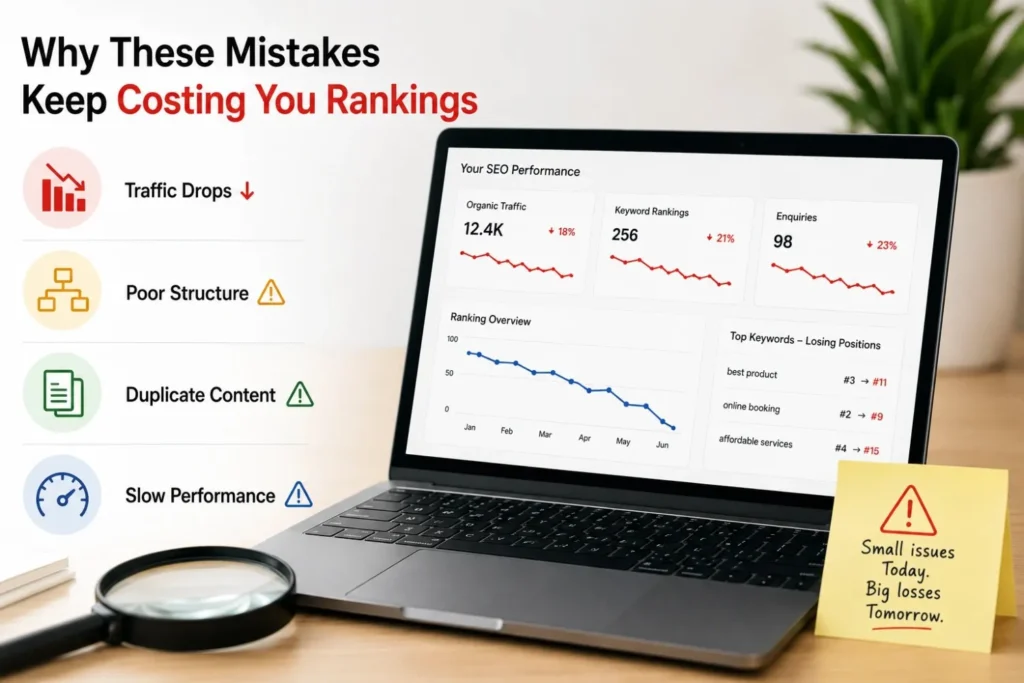
Most SEO problems don’t announce themselves. A site doesn’t crash, nobody gets an error message, traffic just quietly plateaus or drifts down. Owners assume it’s the market, or competition, or “SEO not working for our industry.” Usually it’s one or two structural issues compounding over months.
What makes this worse in India specifically is scale. Businesses expand into new cities, new product lines, new services, and the website structure never catches up. Mistakes made on ten pages become mistakes made on two hundred.
There’s also a timing problem. Owners often notice something’s wrong only after a competitor overtakes them for a keyword they used to own, by which point the damage has usually been building for months. SEO doesn’t send a warning notification before rankings slip. It just happens quietly, page by page, until someone finally asks why enquiries have slowed down.
15 SEO Mistakes Indian Businesses Make:
1. Chasing rankings instead of revenue
There’s a strange kind of pride that comes with hitting position one on Google. Teams screenshot it, share it in WhatsApp groups, put it in the monthly report. And then nothing happens. No calls, no form fills, no actual business. Why? Because the keyword had volume but no buying intent behind it. Somebody searching “what is SEO” isn’t ready to hire anyone; they’re just curious. Ranking for that term feels good and does almost nothing for revenue. Before choosing which keyword to chase next, ask a blunter question: would ranking here actually put money in the bank, or would it just look nice in a screenshot? Map every target keyword to where the searcher actually sits in their decision, and only then worry about the ranking itself.
2. Treating Google Business Profile as an afterthought
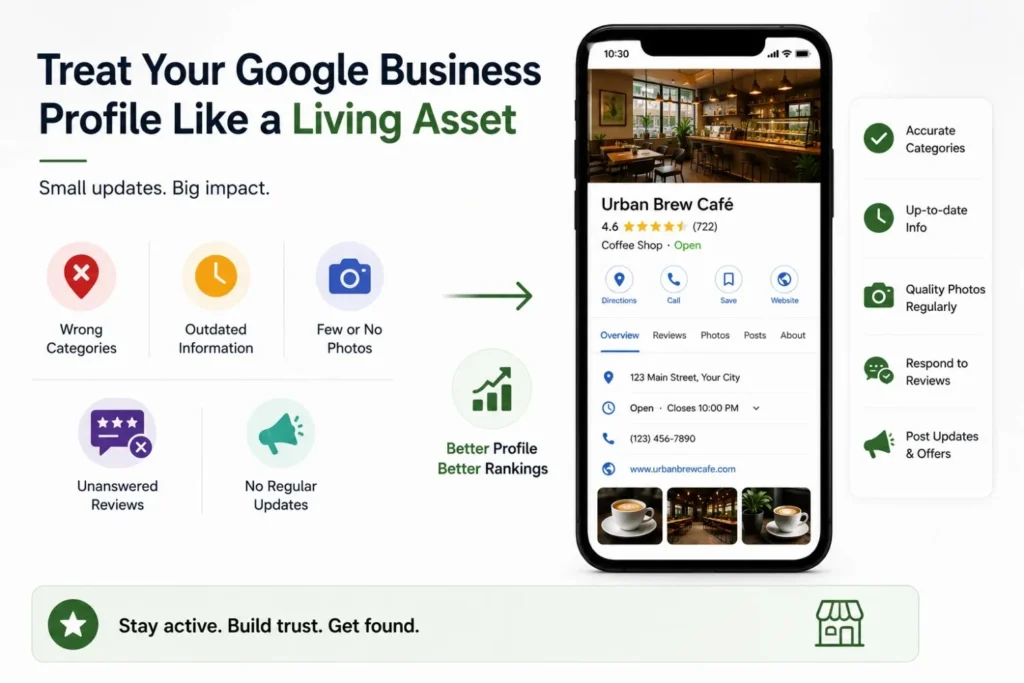
If your business has a physical location, or even serves a specific city, this is probably the single most neglected asset you own. Wrong categories. Hours nobody’s updated since 2022. Zero photos beyond whatever got uploaded on day one. Reviews sitting unanswered for months. None of it looks like a big deal individually, but stacked together it tells Google, and every customer scrolling past it, that nobody’s actually paying attention. This is exactly the gap proper local SEO services are meant to close, not a one-time job you tick off a launch checklist, but something someone checks in on weekly, replying to reviews within a day or two, adding fresh photos, updating posts. Treat it like a living part of the business, because that’s exactly what it is.
3. Publishing thin, duplicated service pages
Here’s a pattern that shows up constantly: a business expands into ten locations or ten service variants, and instead of writing ten genuinely different pages, someone just copies one template and swaps the city name each time. It saves an afternoon of work and costs months of rankings. Google reads these pages, notices they’re nearly identical, and instead of ranking all ten well, it usually buries most of them. The businesses that get this right treat each page as its own piece of content, built around what’s actually different about that location or variant, not just a find-and-replace exercise. That kind of depth is exactly what proper SEO services planning is meant to solve, structuring content so each page earns its own place rather than competing against its siblings.
Ready to Know Which of These 15 Mistakes Are Live on Your Site?
Digifinity runs a full technical and content audit against this exact checklist, so you get a prioritised fix list instead of guesswork.
Explore Our Service4. Ignoring mobile page speed
Walk through the numbers and it’s clear: well over 95% of internet traffic in India now happens on a phone. Yet plenty of business websites still behave like it’s 2015, loading slowly, images uncompressed, scripts blocking the page from rendering until everything downloads. Every extra second a page takes to load pushes more visitors to hit back before they’ve even seen the content. It’s not subtle either, rankings and bounce rate move together here almost in lockstep. Compress images properly, defer anything that isn’t critical to the first screen, and actually test the site on a mid-range Android phone over patchy mobile data, not on a laptop connected to fast office wifi where everything loads fine regardless.
5. Stuffing keywords instead of building topical depth
There was a time when repeating “best digital marketing agency” in every second sentence actually moved rankings. That time is long gone, and honestly, readers notice the awkwardness of it before any algorithm does. It reads forced, because it is forced. What actually works now is coverage, going deep enough on a subject that related questions, related terms, and related context all show up naturally across the content. According to Ahrefs’ research, this kind of topical depth and semantic coverage now outweighs raw keyword frequency by a wide margin. Building a cluster of genuinely useful, connected content beats repeating one phrase a hundred times, every time.
6. Letting internal linking happen by accident
Ask most site owners how their internal links are structured and you’ll get a blank look. Most sites link wherever it feels natural at the moment, with zero underlying logic about which pages should be gaining authority and which should be passing it along. That’s a missed opportunity sitting in plain sight. Decide first which pages actually need to rank, the ones driving revenue or capturing high-intent searches, then link to them deliberately and consistently from your highest-traffic, most relevant content. It sounds almost too simple to matter, but this single change often moves rankings faster than writing an entirely new page from scratch.
7. Overlooking technical SEO entirely
None of this shows up to a normal visitor browsing the site. Broken redirects. Orphaned pages nothing links to. Duplicate title tags across dozens of URLs. Missing canonical tags causing confusion about which version of a page should actually rank. But a crawler reads exactly this, first, before it ever gets to your carefully written content. Skip the technical layer and you’re essentially optimising content on top of a foundation that’s working against you the entire time. Run a proper crawl audit before touching another blog post. It’s less exciting work, but it’s the work that actually clears the path for everything else.
8. Skipping structured data and schema markup
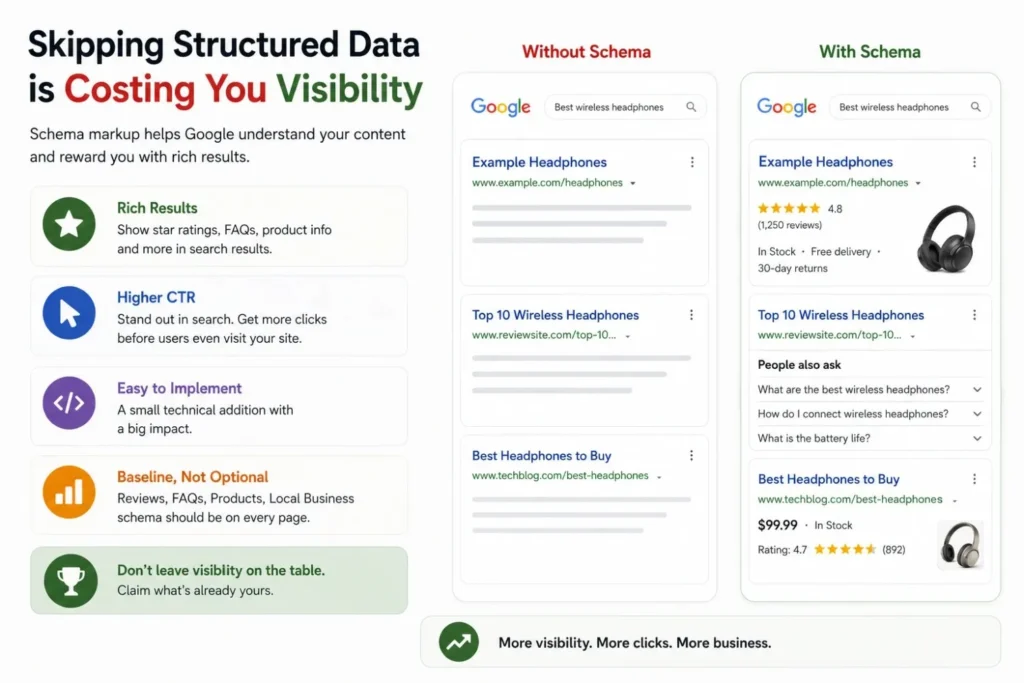
Without schema markup, Google is essentially guessing what a page represents, is it a product, a review, a local business, an FAQ? Add it, and suddenly rich results become possible: star ratings next to your listing, FAQ snippets expanding directly in search results, product details showing up before someone even clicks through. It’s a relatively small technical addition with an outsized effect on click-through rate. Businesses that skip it aren’t doing anything wrong exactly, they’re just leaving visibility on the table that costs nothing extra to claim. Implementing schema for reviews, FAQs, products, and local business details should be a baseline requirement on every page, not a nice-to-have squeezed in later.
9. Building zero real backlink strategy
Two failure modes show up here equally often. One is ignoring backlinks completely, treating them as somebody else’s problem. The other is buying a bulk pack of cheap, irrelevant links hoping volume compensates for quality. Both roads lead to the same place: a domain that never earns real authority in Google’s eyes. A handful of genuinely relevant, earned links from sites your actual customers would recognise does more for rankings than hundreds of throwaway ones ever will. It’s slower, it requires actual relationship-building or genuinely link-worthy content, and that’s exactly why most businesses skip it. Quality wins this one, decisively, every single time.
This one shows up especially fast for online stores, where a single broken backlink strategy across hundreds of product pages compounds far quicker than it does on a ten-page service site. It’s a big part of why we treat ecommerce SEO as its own specialist track rather than folding it into generic SEO work, working with a dedicated ecommerce agency changes the entire approach, catalogue structure and all.
10. Never updating existing content
Here’s a quiet one. A blog post goes live with solid statistics and useful context, ranks reasonably well for a year or two, then just sits there while the stats it quotes get older and the context around it shifts. Nobody notices the decline happening because it’s gradual, a position slipping here, a click-through rate dropping there. Most businesses have a content creation calendar. Very few have a content refresh calendar, and that gap is exactly where rankings quietly erode. Revisit older content on a schedule, update the numbers, add anything that’s changed, and often you’ll see movement faster than publishing something brand new.
11. Mismatching content to search intent
Someone typing “how does SEO pricing work” into Google isn’t ready to see a pricing table shoved in their face immediately, they want context, explanation, maybe some reassurance first. Put a hard-sell landing page in front of that search and you’ll confuse both the visitor and Google’s own understanding of what the page is for. The reverse happens too: genuinely transactional searches landing on vague, informational content that never gets to the point. Go through your top pages and honestly ask whether the format matches what the searcher actually wants at that moment, not what you’d prefer to show them.
Neil Patel’s guide to search intent covers this intent-matching problem extensively, and it remains one of the most common reasons a technically sound page still underperforms. The fix isn’t always more content, sometimes it’s the same content in a completely different format.
12. Not tracking SEO ROI at all
Rankings look great in a report. Traffic numbers climb steadily month over month. And then someone in a leadership meeting asks the obvious question: what did any of this actually get us? If nobody set up conversion tracking from the start, there’s no real answer, just vague confidence that things seem to be working. Set up proper tracking before the SEO work even begins, not six months in when the ROI question finally surfaces and nobody has data to answer it with. Traffic without attribution is just a number on a dashboard, nothing more.
13. Ignoring E-E-A-T signals
No author bios anywhere on the site. No credentials listed. No clear “who runs this business” information a visitor could actually find. For most industries this is a missed opportunity; for finance, health, or legal services specifically, it can cap rankings entirely regardless of how well-written the content otherwise is. Google has made trust signals a core part of how it evaluates content quality in exactly these sensitive categories, and sites that skip this step are competing with one hand tied behind their back. Add real author attribution, visible credentials, and transparent business details across the site, not buried on one “about us” page nobody visits.
Trust signals rarely exist in isolation either. A site with no author credentials often also has inconsistent visual branding across its pages, mismatched fonts, dated imagery, a logo that looks different on the blog than on the homepage. Google can’t measure design quality directly, but visitors absolutely notice it, and it feeds straight back into how much they trust the content they’re reading. It’s one reason working with a proper design agency ends up part of the same conversation as SEO more often than people expect, and it’s exactly what our branding and design work is built around.
14. Dismissing AI and voice search as a trend to watch later
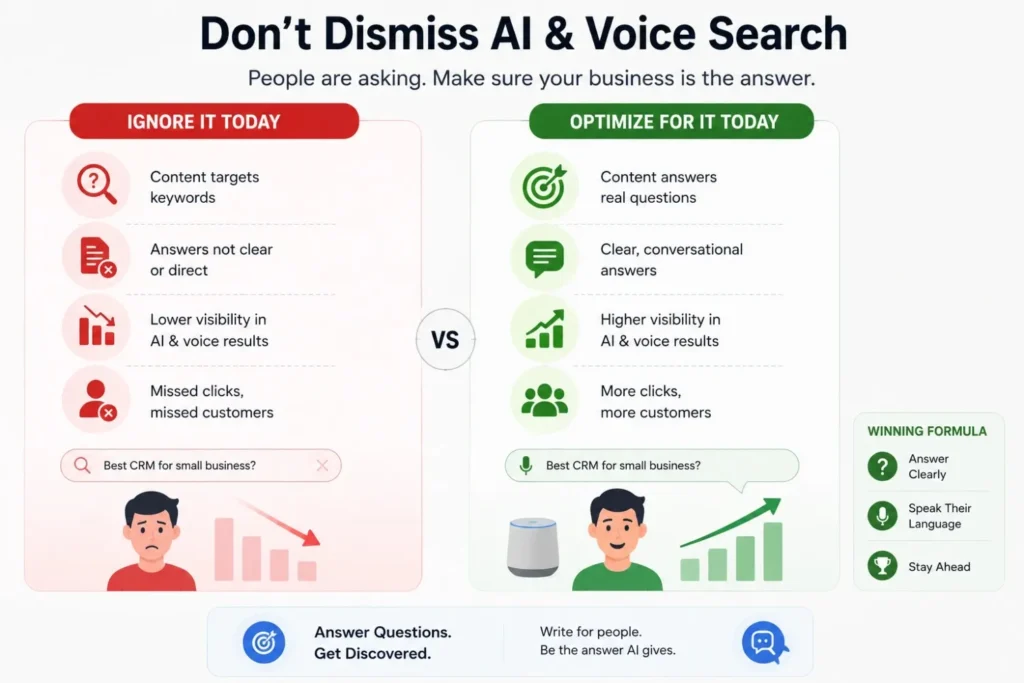
AI-driven search results and voice queries aren’t an emerging trend anymore, they’re already reshaping how people discover businesses right now, today. Content written to directly and clearly answer a specific question performs noticeably better in these formats than content written purely to target a keyword phrase. The businesses treating this as something to “look into eventually” are already behind the ones investing in AI SEO services and restructuring their content around direct answers. It doesn’t require abandoning traditional SEO, it requires writing with both a search engine and a conversational assistant in mind simultaneously, which is a different skill than keyword-first writing.
15. Treating SEO as a project instead of a process
This is the most expensive mistake on the entire list, by some distance. Businesses budget for SEO the way they’d budget for a website redesign: a fixed project, a defined scope, an end date. Then six months after the work “finishes,” rankings start sliding, and nobody quite understands why since nothing was supposedly broken. SEO was never meant to have an end date in the first place. Build it into the ongoing operating rhythm of the business, the same way accounting, inventory, or customer service get handled continuously rather than as a one-off project. Every other mistake on this list becomes far easier to avoid once that mindset shift actually happens.
Where These Mistakes Show Up Fastest
| Mistake | What It Costs You | Priority to Fix |
| Thin, duplicated pages | Multiple pages competing against each other | High |
| No mobile speed optimisation | Rising bounce rate, falling rankings | High |
| No structured data | Missed rich snippets, lower click-through | Medium |
| Weak backlink profile | Capped domain authority | Medium |
| No ROI tracking | No visibility into what’s actually working | High |
| SEO treated as one-off project | Slow, steady ranking decline post-launch | High |
A few signs your current SEO approach needs a serious rework, regardless of which mistakes above apply to you:
- Traffic has plateaued for three or more consecutive months without explanation
- Your top pages haven’t been updated in over a year
- Nobody on your team can tell you which keywords actually drive enquiries
- Your site loads noticeably slower on mobile data than on office wifi
What A Fixed SEO Strategy Actually Delivers?
Once the mistakes above get addressed, in whatever order makes sense for your site, the change is usually noticeable within a couple of months, not overnight, but noticeable.
- Consistent month-on-month organic traffic growth instead of plateaus
- Higher-quality leads that match actual buyer intent
- Reduced dependency on paid ads to maintain visibility
- A measurable, trackable return instead of guesswork
None of this happens from a single audit. BrightEdge’s ongoing research into search behaviour consistently shows that businesses treating SEO as a continuous process outperform those running occasional campaigns, by a wide margin over a 12-month period.
Why Do Businesses Choose Digifinity?
We’ve audited enough Indian business websites to know these fifteen mistakes aren’t unusual, they’re the default state for most sites that grew organically without a technical foundation. What separates a genuine fix from a temporary patch is whether the underlying process changes, not just the symptoms.
Our approach starts with an honest audit, prioritises the highest-impact fixes first, and builds a system that keeps working after the initial engagement ends. That’s the difference between an SEO vendor and an actual growth partner.
We’ve also learned that most businesses don’t need every single fix applied at once. Sequencing matters. A site with severe technical issues gains little from a content push until the crawl errors are resolved first, while a site with clean technical foundations but thin content needs the opposite priority order entirely. Getting that sequence right is often what separates a three-month turnaround from a twelve-month one.
With mobile now carrying the overwhelming majority of Indian search traffic, this sequencing conversation increasingly extends beyond the website itself. Businesses running a poorly optimised app alongside a well-optimised site are still leaking visibility, which is why mobile app development company decisions come up in the same strategy discussions as SEO far more often than they used to.