
Technical SEO Audit: 80 Checks That Actually Move Rankings in 2026
Here’s something most people don’t want to hear: your content might be fine. The rankings problem could have nothing to do with what you’ve written. Broken crawl paths, pages Google can’t properly render, schema that throws errors on every recrawl, load times that quietly push you down on mobile these are the things that kill organic traffic without ever showing up in a content audit.
We’ve been doing this long enough at Digifinity, a results-driven best digital marketing agency working with brands across India and internationally to know that when a site’s traffic drops or stalls for no obvious reason, the answer is almost always technical. And nine times out of ten, it’s fixable once you actually know what you’re looking at.
This checklist runs through 80 specific checks across crawlability, site architecture, internal linking, page speed, mobile usability, indexability, structured data, security, on-page signals, and log file analysis. We’ve built it around what we actually find during real audits, not what looks good in a slide deck and cross-referenced everything against Google’s Search Central documentation so nothing here is guesswork. Whether you’re managing a SaaS product, a local service business, or a large ecommerce catalogue, go through these 80 points and you’ll know exactly where your site stands.
Why Technical SEO Still Decides Rankings in 2026?
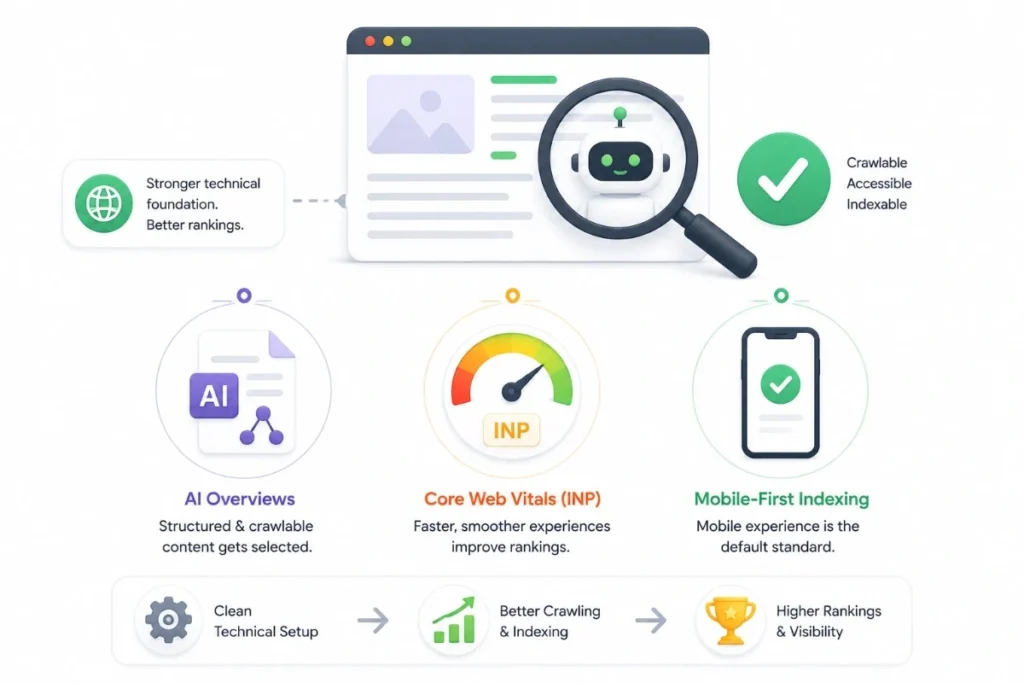
Google has evolved dramatically. It processes natural language, understands context, and rewards topical authority. But underneath all of that sits a very mechanical foundation: the crawler. If Googlebot cannot efficiently reach, read, and interpret your pages, none of the content work matters.
In 2026, three developments have made technical SEO more critical than ever. Google’s AI Overviews now pull structured, crawlable content at scale, which means pages with clean technical signals are cited far more frequently. Core Web Vitals have been deepened with the addition of Interaction to Next Paint (INP) as a stable ranking signal, raising the bar for performance across every industry. And with the majority of search traffic now arriving from mobile devices, mobile-first indexing is no longer a consideration; it is the default state of how Google processes every website.
The websites that dominate search results are not always the ones with the best content. They are the ones with the cleanest technical foundation beneath that content. That is what this checklist built by an experienced India SEO agency is designed to help you build.
Is Your Site Losing Rankings to Technical Issues You Can’t See?
Digifinity runs full 80-point technical SEO audits for businesses across Ahmedabad and India covering crawlability, Core Web Vitals, schema, and more. You’ll know exactly what’s broken and exactly how to fix it.
Explore Our ServiceWhat a Technical SEO Audit Actually Covers?
Most people think a technical audit means running Screaming Frog and fixing whatever turns red. That’s a surface scan, not an audit. Here’s what the ten layers actually involve.
Crawlability and Indexability
Crawlability and indexability aren’t the same thing; they just get treated like they are. Crawlability is whether Googlebot can reach a page. Indexability is whether it ends up in the index. A page can be crawlable but carry a noindex tag, so Google reads it and walks away. Or a page has no technical blocks at all but nothing links to it, so the crawler never bothers. Both situations end the same way: the page doesn’t rank.
This layer covers robots.txt, noindex directives, crawl budget, and server logs. Logs are what most audits skip; they show exactly which pages Googlebot visits versus which ones you want it to. Working with a team that specialices in SEO services and actually reads log data is what turns a checklist into a real audit.
Site Architecture and Internal Linking
Structure determines how Google moves through your site. Shallow and logical means fast discovery and clear signals about what matters. Deep and tangled means the crawler works harder and the important pages get less attention.
Internal links are how authority travels. Pages linked from multiple relevant places get treated as more important. Pages nobody links to are orphaned; they exist, but Google doesn’t prioritise them. It’s one of the highest-leverage fixes in SEO and costs nothing to sort out.
Page Speed and Core Web Vitals
Google breaks speed into three signals: LCP (how fast the main content loads), CLS (whether things jump around while loading), and INP (how quickly the page responds when someone interacts). All three affect rankings. The usual culprits: large images, render-blocking scripts, missing caching aren’t hard to find. PageSpeed Insights field data shows what real users experience, which is what Google actually measures. A clean lab score means nothing if real visitors are getting a poor experience.
Mobile-First Indexing
Google ranks your mobile site, not desktop. If the mobile version has less content, slower load times, or missing schema, that’s what’s being evaluated, not the polished desktop version. Still surprises most businesses.
Structured Data and Schema Markup
Schema tells Google what your content means, not just what it says. Done right, it unlocks rich results and AI Overview appearances. Done wrong or not done at all you’re invisible in placements you should be getting. Errors don’t surface anywhere obvious, so you have to test through Google’s Rich Results Test. For ecommerce, Product schema needs to stay accurate as prices and stock change.
On-Page Technical Signals
Title tags, meta descriptions, heading structure, canonical tags, URL format none of it is exciting, but errors here hit every page sharing that template. One duplicate title tag across a category wipes ranking signals across your whole catalogue.
Security and HTTPS
HTTPS has been a ranking signal since 2014. Mixed content a secure page loading something over HTTP triggers browser warnings and messes with Core Web Vitals measurements. SSL, redirects, HSTS headers keep them clean.
The Full 80-Point Technical SEO Audit Checklist:
Ten categories, 80 checks. Work through each one and you’ll know exactly what’s broken, what’s at risk, and what’s fine.
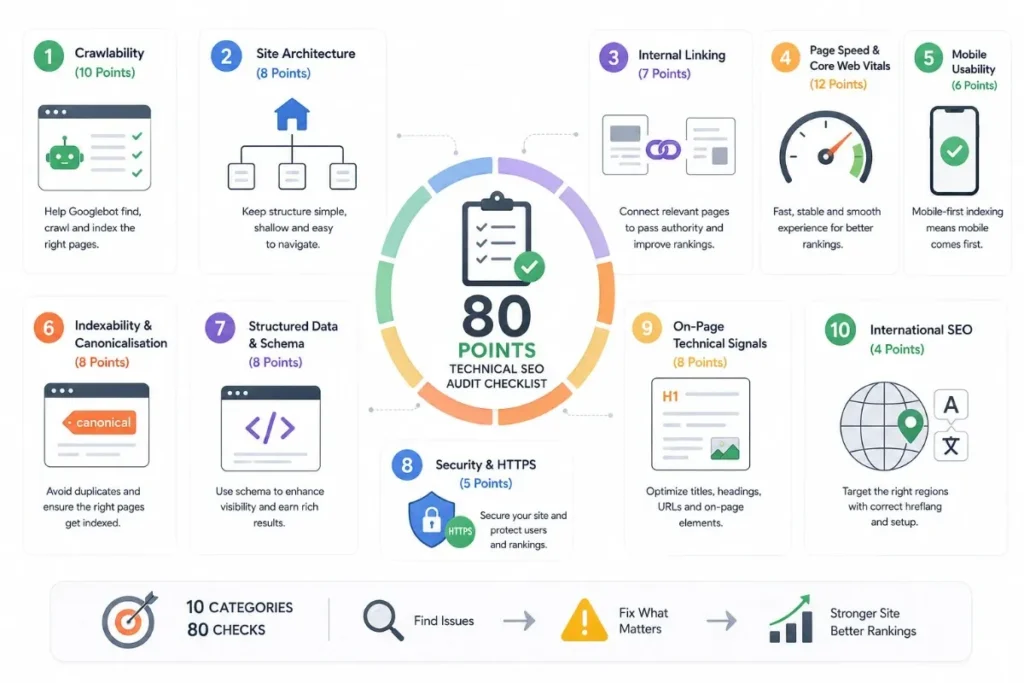
Crawlability (10 Points)
Start with robots.txt to make sure it exists, loads without authentication, and isn’t accidentally blocking pages that should rank. One wrong disallow rule can quietly deindex entire sections. Nobody notices until rankings have been sliding for weeks.
Your XML sitemap should only contain URLs you actually want indexed. No redirects, no noindexed pages, no 404s. A sitemap contradicting your noindex tags just confuses the crawler. Check Search Console Coverage for indexing errors, review server logs to see which pages Googlebot is actually visiting, and for JavaScript-heavy sites, confirm pages are rendering properly for Googlebot unrendered content that simply doesn’t get indexed.
Site Architecture (8 Points)
If reaching a product or service page takes five or six clicks from the homepage, Google isn’t prioritising it either. Two clicks to most things that matter is the target. Any page with zero internal links pointing to it is practically invisible. Keep breadcrumbs consistent, keep category depth shallow, and keep URLs clean lowercase, hyphenated, no stray parameters. Faceted navigation can balloon into thousands of near-identical URLs and quickly get canonical tags or robots.txt rules in place before it becomes a crawl budget problem. If the site has been migrated or redesigned, confirm old URLs are 301ing cleanly with no chains.
Internal Linking (7 Points)
Any page you want to rank needs links from at least three relevant pages on your site, not the footer, not a widget nobody reads. Anchor text should describe the destination page, not just say “click here.” Check for broken internal links returning 404s. Your highest-authority pages homepage, top categories, cornerstone content should be pointing toward pages that need ranking support, not just those that already rank. A nav menu with 40 links prioritises nothing. Footer links should be deliberate. And clean up redirect chains A to B where B goes to C should just go straight to C.
Page Speed and Core Web Vitals (12 Points)
LCP under 2.5s. CLS below 0.1. INP under 200ms. Compress images, serve them in WebP or AVIF, and give them explicit dimensions to prevent layout shift. Defer render-blocking scripts. Keep server response under 600ms. Set up proper caching headers and a CDN. Strip unused JavaScript and CSS. Don’t let third-party scripts block your render path. Most importantly check CrUX field data in PageSpeed Insights, not just the lab score. Real users on mobile networks are what Google actually measures.
Mobile Usability (6 Points)
The mobile version is what Google indexes. If it has small tap targets, pinch-to-read text, or horizontal overflow that’s what’s being judged. Viewport meta tag needs to be set correctly. Buttons and links need to be tappable without hitting something else. Content, structured data, and schema must all match desktop if your mobile template hides or strips anything, that’s what goes into the index. Check mobile Core Web Vitals separately. Scoring well on desktop doesn’t help if mobile is poor.
Indexability and Canonicalisation (8 Points)
Every page needs a canonical tag pointing to itself. Pick one URL format www or non-www, trailing slash or not and redirect everything else with a 301. HTTP to HTTPS, no exceptions. Check Search Console for “Duplicate without user-selected canonical” error that means Google is guessing which version to index. Hreflang needs to be bidirectional for any multilingual content. If your CMS generates URLs with session IDs, tracking tags, or sort parameters, configure parameter handling in Search Console before those variants flood the index.
Structured Data and Schema (8 Points)
Homepage gets Organisation or LocalBusiness schema. Every interior page gets a Breadcrumb schema. Blog content gets Article schema. Product pages need accurate, current schema stale price or availability data gets flagged as an error. For large catalogues, our Ecommerce SEO Services handle schema at scale so it doesn’t become a maintenance burden.
FAQPage schema is worth prioritising wherever you have FAQ content it increases rich result eligibility and makes pages more likely to appear in AI Overview citations. Test everything in Google’s Rich Results Test. Never mark up content that isn’t visible on the page that’s a manual action risk. Add VideoObject schema to any page with embedded video.
Security and HTTPS (5 Points)
Set a reminder for your SSL cert expiry don’t rely on your host to flag it. When it lapses, every visitor gets a browser warning before they reach your site. Traffic drops immediately. Every HTTP URL redirects to HTTPS all of them. Check HTTPS pages for mixed content, where a secure page loads something over HTTP. HSTS headers enforce secure connections. A Content Security Policy defines what’s allowed to load. Not every site has these in place, but they should.
On-Page Technical Signals (8 Points)
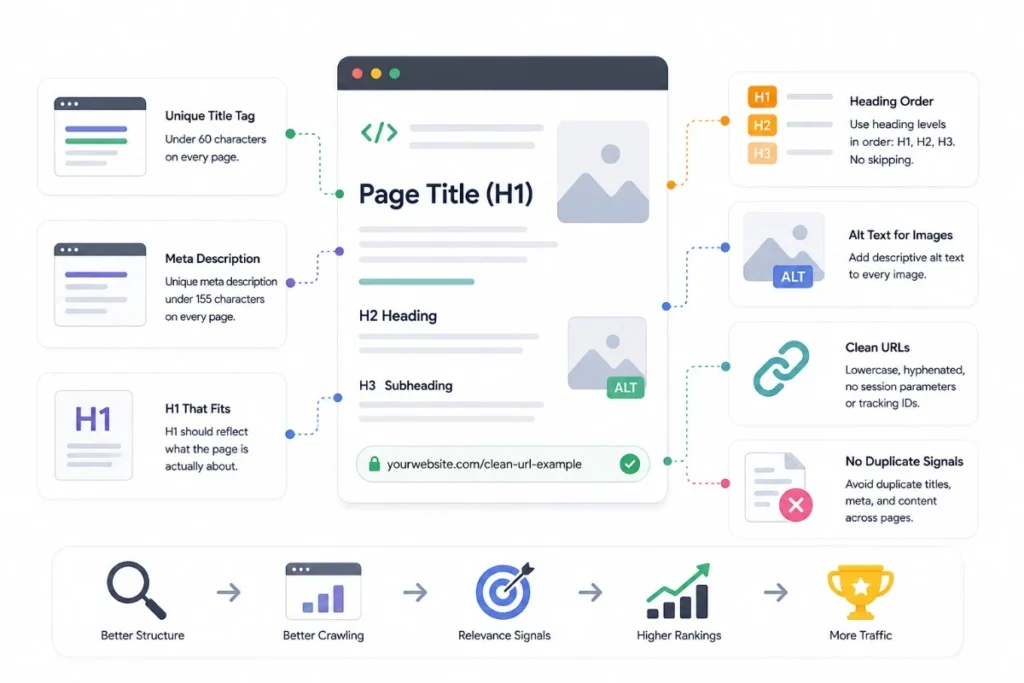
One bad template decision creates 300 pages with duplicate title tags overnight. We’ve traced traffic losses back to exactly that after site redesigns. Unique title tag under 60 characters, unique meta description under 155, on every page. H1 should reflect what the page is actually about, not your brand name. Heading levels in order: H1, H2, H3, no skipping. Alt text on every image. URLs clean, lowercase, hyphenated, no session parameters baked in.
International SEO (4 Points)
Hreflang must be bidirectional with both pages pointing at each other. Each locale needs its own canonical URL. Set up international targeting in the Search Console. Don’t publish machine-translated content without human review thin translated pages consistently trigger quality issues.
Log File Analysis (4 Points)
Priority pages should be crawled consistently, not once a month while Googlebot burns budget on parameterised URLs. Any important page with zero crawls in 30 days isn’t being re-evaluated for rankings. Screaming Frog Log Analyser is the most practical tool for this it shows Googlebot’s actual behaviour against your site structure in a way standard crawl tools can’t. Crawl frequency should match update frequency, and strong internal linking tells Google which pages are worth coming back to.
Technical SEO Issues That Kill Rankings (And How to Fix Them)
Not every technical issue hurts equally. Some chip away at rankings gradually over months you barely notice until you pull a year-on-year comparison. Others cause near-immediate drops that are almost impossible to diagnose without log data. Here are the four we find most often, and what actually fixes them.
Issue 1: Crawl Traps
Crawl traps are URL patterns usually generated by CMS filters, session parameters, or search queries that create endless loops of crawlable URLs. Each one looks unique to Googlebot, but none of them carry any real value. A site with an active crawl trap can burn through its entire crawl budget without Googlebot ever reaching the pages that actually matter.
The Fix: Block the problematic URL patterns in robots.txt, or apply rel=”canonical” tags systematically across affected URL sets. You won’t find these through standard crawl tools; you need log file analysis to see which paths Googlebot is actually following.
Issue 2: Redirect Chains
Every redirect hop in a chain loses some link equity and adds load time. A direct 301 from A to B is fine. A chain from A to B to C to D? By the time Googlebot reaches the final destination, you’ve bled equity at every step and added measurable latency on top of it. Our Search Engine Marketing team flags these alongside technical SEO fixes, since redirect chains also damage Quality Score in paid campaigns and quietly drive up cost-per-click.
The Fix: Update internal links and any known external references to point directly to the final canonical URL. Don’t rely on the chain resolving correctly to fix it at the source.
Issue 3: Slow-Loading Pages
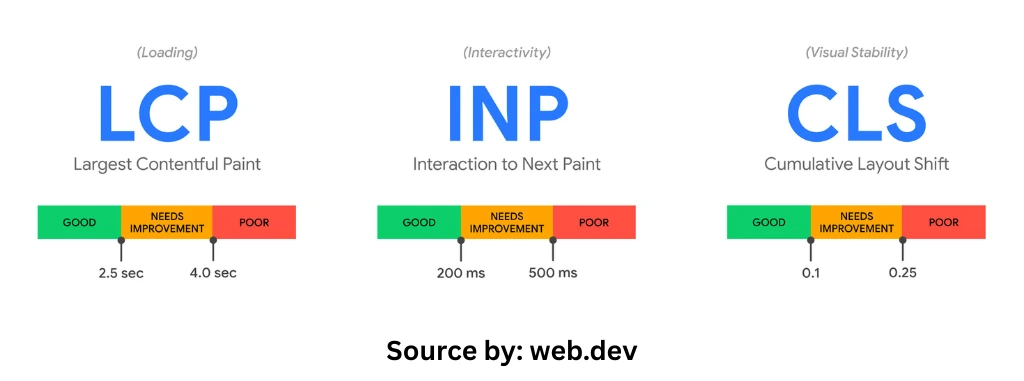
Page speed problems don’t just hurt at the moment Google crawls your site they compound continuously. Google’s CrUX data accumulates from real users over a 28-day rolling window, which means a consistently slow page is being penalised every single day, not just when Googlebot happens to visit. A clean lab score means very little if real users on mobile networks are hitting poor LCP, layout shift from lazy-loaded banners, or sluggish INP from heavy JavaScript. If you want to understand exactly how Google defines and measures each signal, Google’s Core Web Vitals documentation covers the thresholds and diagnostic steps clearly.
The Fix: Validate improvements using PageSpeed Insights field data not lab results. Compress images, defer render-blocking scripts, configure caching, and reduce third-party script load on the critical render path.
Issue 4: Thin or Duplicate Content at Scale
This one is almost exclusive to ecommerce and directory sites. When hundreds of product pages share near-identical descriptions, or category pages overlap heavily in focus, Google can’t determine which version deserves to rank and often deprioritises all of them. Our Ecommerce SEO Services handle this at catalogue scale rather than page by page.
The Fix: Combine content differentiation for priority pages with canonical and noindex decisions for low-value variants. Structured data accuracy across the affected pages needs to be part of the same cleanup not treated as a separate task.
Why Businesses Choose Digifinity for Technical SEO
There’s a real difference between agencies that understand technical systems deeply and those that run a crawler, export a report, and call it done. As India’s best digital marketing agency for growth-stage brands, ecommerce businesses, and multi-location companies, we’ve seen the full spectrum from sites with basic crawlability problems to enterprise platforms carrying years of accumulated technical debt. Our team combines development knowledge with SEO strategy, which means we don’t just find the problems; we fix them.
Rankings matter, but only if they’re driving traffic that converts. Our work extends beyond search from custom software development that gives your infrastructure the right performance foundation, to branding and design that builds authority from the first impression, to mobile app development that applies the same technical rigour to app experiences. Every SEO decision we make is made with the full digital picture in mind.