Why 2026 Demands a Deeper Comparison? Digital Marketing Company in Ahmedabad
A few years ago, the conversation around ads was simple.
Which platform is better?
That question doesn’t really work anymore, not in 2026.
Because what matters now isn’t which platform performs better overall. What matters is something far more specific: where the actual return on investment is coming from and why.
Any experienced Digital Marketing Company in Ahmedabad will tell you this. Businesses that still treat Google Ads and Meta Ads as interchangeable tools usually struggle with consistency. Not because the platforms are weak, but because they are being used without context.
The real shift has happened quietly.
User behaviour has changed, platforms have adapted, algorithms have become less predictable but more powerful, and somewhere in the middle of all this, performance marketing has stopped being about “running ads” and has become more about building systems.
This blog is not about picking a winner. It is about understanding where ROI is actually coming from and how smart marketers are structuring campaigns differently now.
Power Your Business with Next-Generation Mobile Application Development.
Enhance customer experience with innovative app solutions
Explore Our ServicesUnderstanding the Core Difference (And Why Most Get It Wrong?)
Let’s simplify this before we go deeper.
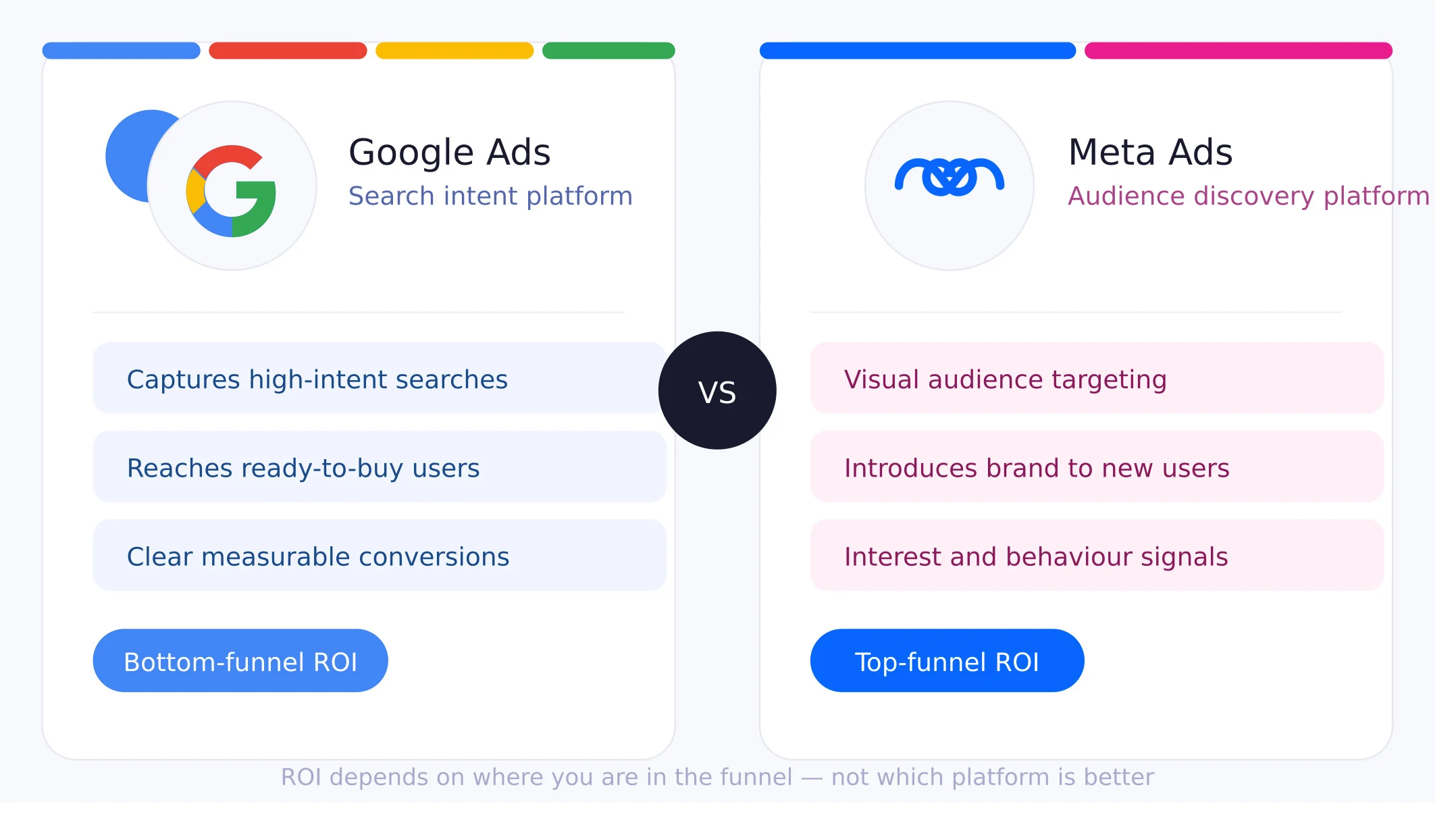
Google Ads works on intent. & Meta Ads works on attention.
That is it. That is the difference.
But this simple difference creates completely different outcomes.
When someone searches on Google, they already want something. They are not exploring, they are looking. That urgency shortens the decision cycle.
On Meta, the user is not looking for anything. They are scrolling, passive, distracted. Your ad interrupts that flow.
A Marketing Agency builds strategies around this behavioural contrast, not around platform features.
Yet many businesses still expect both platforms to behave the same way.
They expect Meta to convert like Google.
They expect Google to scale like Meta.
And that is where things start to break.
Google Ads in 2026: Still Reliable, But Not Complete
Google hasn’t lost its strength. If anything, it has become sharper.
Search intent is still the most valuable signal in digital marketing. When someone types a query, they’re telling you exactly what they need. There’s no guesswork.
A Google Ads Agency today focuses less on manual optimisation and more on feeding the system the right data. Smart bidding has evolved to a point where manual tweaks often slow things down rather than improve them.
There’s solid backing for this too. According to automated bidding strategies machine learning uses real-time signals—device, time, behaviour—to optimise conversions better than manual approaches in most cases.
In practical terms, that means campaigns that are structured correctly tend to stabilise faster and perform more consistently.
But there’s a catch.
Google only works when demand exists.
If people aren’t searching for your service, Google cannot create that demand. It can only capture it.
That’s why businesses relying only on Google often hit a ceiling.
Google Ads vs Meta Ads in 2026: Chaotic, But Scalable
Meta feels unpredictable at times. That hasn’t changed.
But what has changed is how powerful it can be when used correctly.
Unlike Google, Meta doesn’t depend on existing demand. It creates it.
A Marketing Agency approaches Meta very differently. The focus isn’t just targeting anymore—it’s creative positioning.
Because on Meta, the first few seconds matter more than anything else.
- If the visual doesn’t stop the scroll, the campaign fails
- If the messaging doesn’t connect instantly, the user moves on
- If the creative feels repetitive, performance drops quickly
Meta has also doubled down on AI-led delivery. According to Meta’s advertising ecosystem updates machine learning now plays a major role in how ads are distributed, often prioritising engagement signals over manual targeting.
That’s why audience targeting today is less about precision and more about creative alignment.
The platform decides who to show the ad to. Your job is to make sure the ad is worth showing.
So Where Is the Real ROI Coming From?
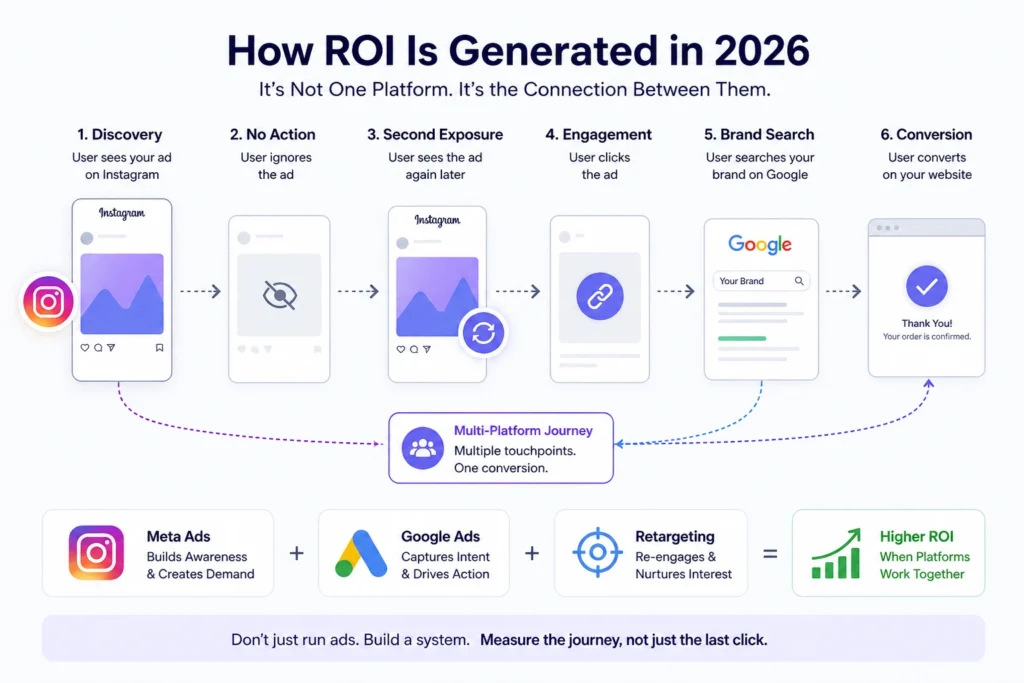
This is where things get interesting.
In 2026, ROI is rarely coming from a single platform.
It’s coming from how platforms work together.
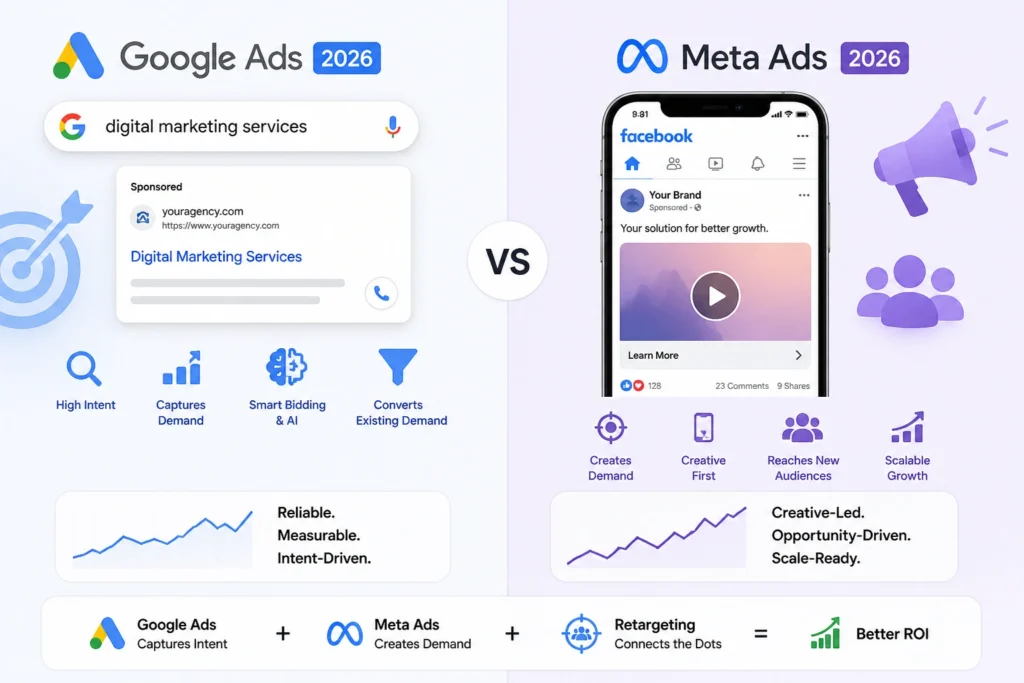
Google captures intent.
Meta builds that intent.
Retargeting connects the two.
That’s the system.
A Digital Marketing Agency in Ahmedabad that understands this doesn’t run isolated campaigns. It builds a flow.
A user might:
- See your ad on Instagram
- Ignore it
- See it again
- Click later
- Search your brand on Google
- Convert there
If you only track the last click, Google gets the credit.
But the influence started on Meta.
This is where many businesses misread performance data.
Cost vs Value: The Hidden Difference
Let’s address cost, because that’s where most comparisons begin.
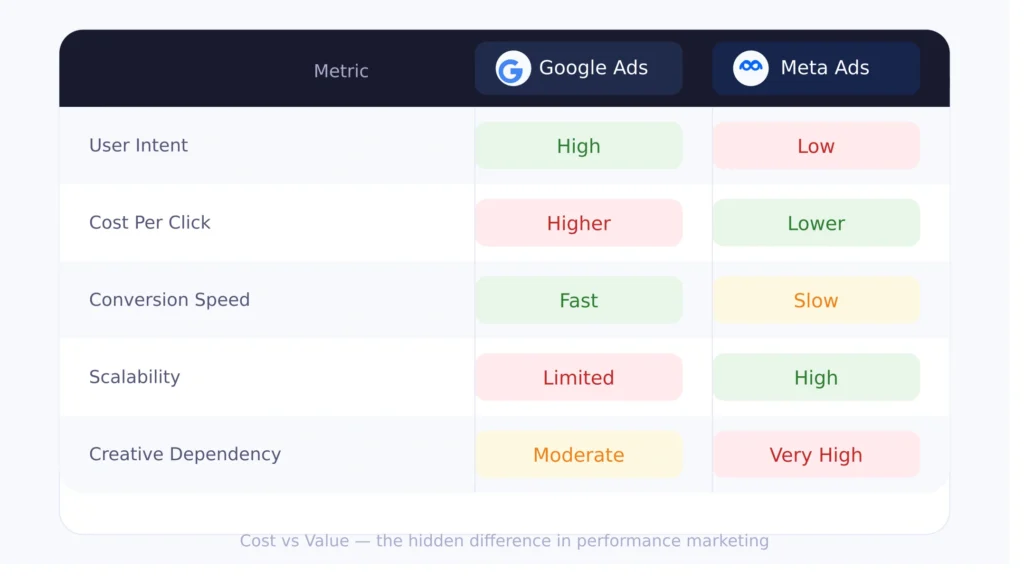
Google Ads usually has higher cost per click. That’s expected—intent-driven traffic is always expensive.
Meta, on the other hand, often delivers cheaper traffic.
But cheaper doesn’t always mean better.
Here’s the real comparison:
| Metric | Google Ads | Meta Ads |
| User Intent | High | Low |
| CPC | Higher | Lower |
| Conversion Speed | Fast | Slow |
| Scalability | Limited | High |
| Creative Dependency | Moderate | Very High |
A Marketing Agency doesn’t try to reduce cost blindly. It focuses on cost per result.
Sometimes, paying more for higher intent is actually more efficient.
Creative Has Become the Deciding Factor
This is especially true on Meta.
A Company doesn’t treat creative as a design task. It treats it as a performance lever.
Because:
- Targeting has become broader
- Algorithms decide delivery
- Creative decides engagement
The difference between an average ad and a high-performing one is rarely budget—it’s positioning.
Even on Google, creative elements like ad copy and extensions influence performance more than before.
How AI Is Changing Performance Marketing?
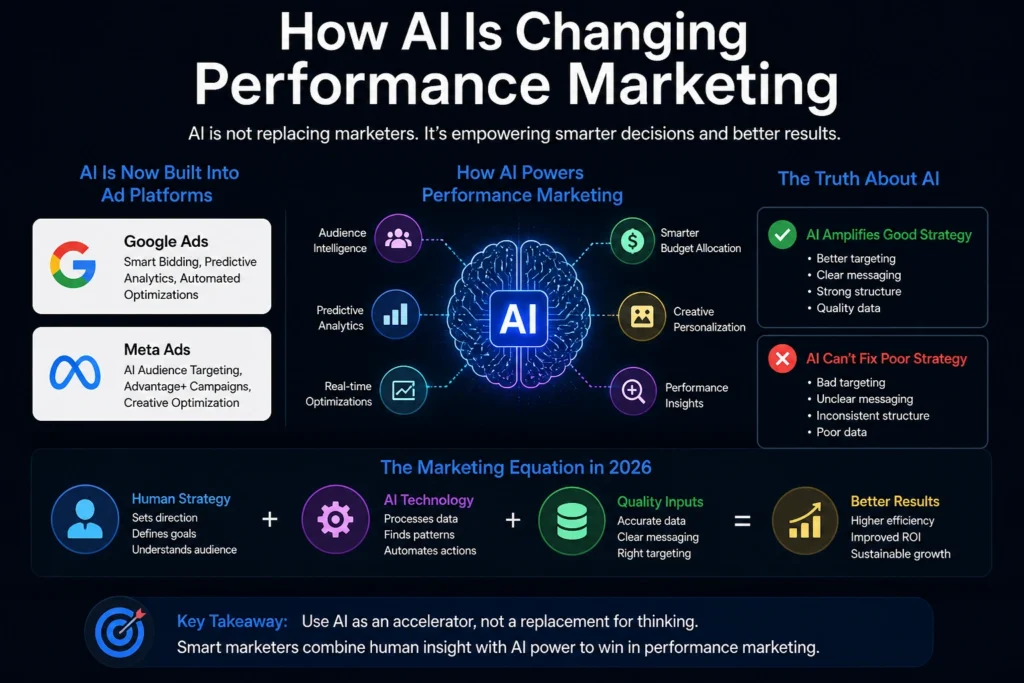
There’s no avoiding it.
AI is deeply embedded into both platforms now.
According to AI in marketing research by McKinsey companies using AI-driven strategies are seeing measurable improvements in efficiency and ROI.
But here’s the nuance.
AI doesn’t fix poor strategy.
If your inputs are weak—bad targeting, unclear messaging, inconsistent structure—the output will still be weak.
A Marketing Company uses AI as an accelerator, not a replacement for thinking.
The Real Conversion Journey Is No Longer Linear
This is something many businesses still underestimate.
Users don’t move in straight lines anymore.
They don’t:
Click → convert
They:
Discover → ignore → revisit → compare → decide
A Marketing Services provider understands that conversion is often delayed.
That’s why expecting instant ROI from Meta campaigns usually leads to frustration.
Google converts faster because intent is already there.
Meta requires patience.
Budget Allocation: Where Most Strategies Go Wrong
This is probably one of the most common mistakes in performance marketing—treating budget allocation as equal distribution across platforms. On paper, it may seem fair, but in practice, it doesn’t deliver strong results.
The problem is that every platform serves a completely different purpose in the user journey. Google Ads is built to capture existing demand, where users are already searching with intent. Meta Ads works on creating demand by introducing the brand and building interest. Retargeting then plays the role of reinforcing that interest and bringing users back when they are closer to making a decision.
A Digital Marketing Agency in Ahmedabad approaches this very differently. Instead of splitting budgets equally or based on preference, it allocates spend based on the role each platform plays in the funnel. This ensures that money is going exactly where it has the highest impact.
This shift in thinking may seem simple, but it significantly improves overall efficiency, reduces wasted spend, and leads to more consistent and predictable results.
Retargeting Is Where Conversions Actually Happen
Most conversions don’t happen on the first interaction. At that stage, users are usually just discovering the brand, trying to understand what it offers, and mentally comparing it with other options. The real decision happens later, once familiarity and trust start building through repeated exposure.
Today, retargeting is not limited to just website visitors. It works across multiple touchpoints like video viewers, users who interact with ads, people who visit profiles, and those who show engagement signals such as clicks, saves, or partial interactions. Each action reflects a different level of interest, and together they help identify how close a user is to converting.
This is important because timing makes a big difference. If you reach too early, users may ignore the message. If you reach too late, they may have already moved on. Effective retargeting ensures the brand stays present in a natural way throughout the decision-making journey, increasing the chances of conversion when the user is actually ready.
Common Mistakes That Kill ROI
Even with the right platforms, results can fall apart quickly.
Here’s where things usually go wrong:
- Expecting Meta to behave like Google
- Ignoring creative fatigue
- Not tracking multi-touch journeys
- Over-optimising too early
Avoids these by focusing on behaviour, not assumptions.
What Smart Marketers Are Doing Differently in 2026? Inside a Digital Marketing Agency in Ahmedabad
They’re not chasing platforms.
They’re building systems.
They accept that:
- No platform works in isolation
- User journeys are unpredictable
- Data needs interpretation, not just tracking
A Marketing Agency works alongside a Google Ads Agency to create continuity across platforms.
That’s where consistency comes from.
Conclusion: It Was Never About Choosing One
If you’re still trying to decide between Google Ads and Meta Ads, you’re asking the wrong question.
The real question is:
How do these platforms work together?
Because that’s where ROI is coming from in 2026.
And when done correctly, the result isn’t just better performance.
It’s predictable growth.