
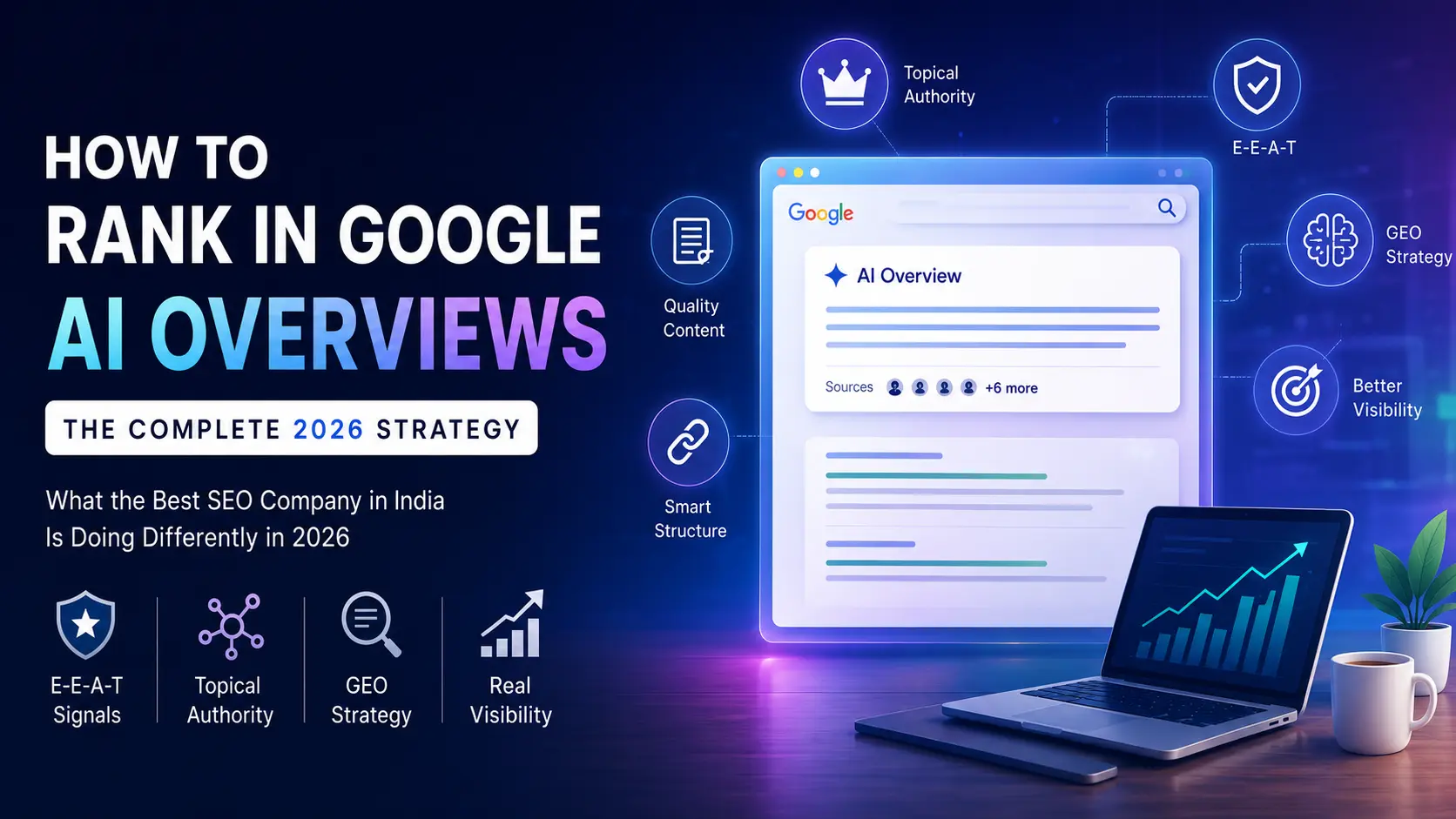
What the Best SEO Company in India Is Doing Differently in 2026?
Something changed in how people search and most businesses haven’t fully caught up yet.
If you’ve noticed your organic traffic softening despite holding your rankings, or your impressions climbing while clicks stay flat, you’re probably already feeling the effects of Google AI Overviews without knowing it. These AI-generated summaries are now answering questions directly at the top of search results, often before a single blue link appears. And for the brands that understand how this works, it’s become one of the biggest opportunities in search since Google’s featured snippets first launched.
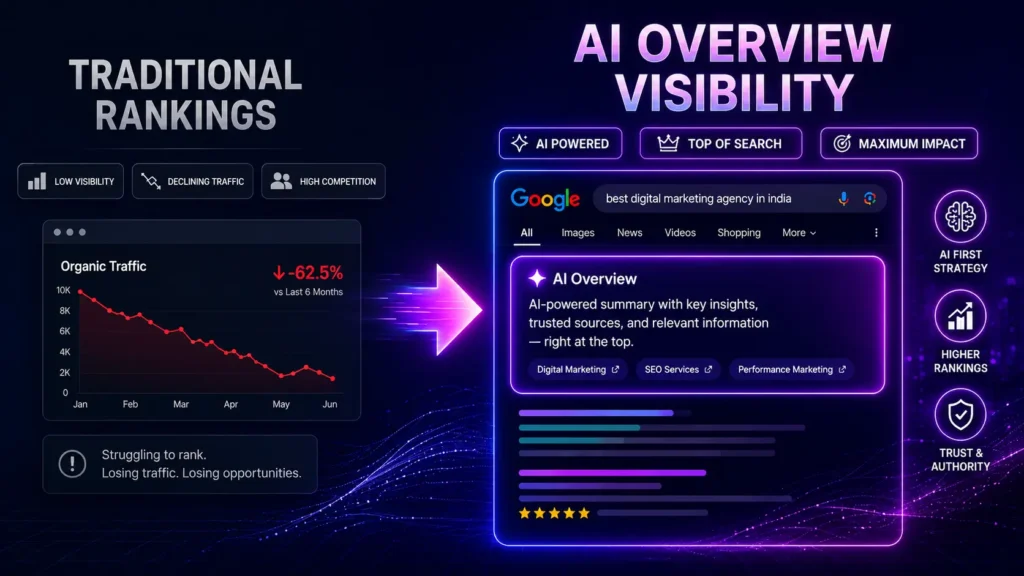
Digifinity is one of the top digital marketing companies in India and has been tracking this shift closely since it rolled out broadly in 2024. Businesses that understand how to rank in Google AI Overviews are already pulling ahead, while those still optimising only for traditional rankings are losing ground quietly. If you’re searching for a reliable SEO agency near me or trying to understand what the best SEO company in India is actually doing differently in 2026, this guide is your answer. Here’s exactly what it takes to rank in Google AI Overviews practically, strategically, and without the jargon.
Google AI Overviews: What Changed & Why It Matters?
Before getting into strategy, it’s worth being clear on what we’re actually talking about because “AI Overviews” gets used loosely and that creates confusion.
These are the AI-written response panels Google places above organic results. They were originally part of something called the Search Generative Experience, but the name changed as the rollout became permanent. What hasn’t changed is the core mechanic: instead of highlighting one source like a featured snippet does, Google reads across multiple pages and writes its own answer.
According to research published by SE Ranking, over 65% of informational queries now trigger one of these summaries. SparkToro put out data showing nearly 58% of all searches end without a single click. Read those two numbers together and something becomes clear search isn’t a funnel to websites anymore, at least not always. For a growing slice of queries, it’s the final destination.
That changes the game. Being cited inside an AI Overview and ranking on page one are two separate achievements. You can have one without the other. Right now, brands appearing inside AI Overviews are reaching users who never visit their site but walk away knowing who they are. That’s a different kind of visibility, and it compounds.
Better rankings start with a better strategy.
Digifinity builds lasting search visibility for businesses across India.
Explore Our ServicesThe Shift No One Warned Businesses About
Here’s something most SEO conversations still dance around: holding the top ranking no longer means what it used to.
A business can sit at position one for a competitive keyword and still watch its click-through rate fall off a cliff because the AI Overview above it already answered the question. That’s not an edge case. It’s happening across industries, across query types, and it’s only going to increase as Google leans harder into AI-generated responses.
This isn’t the sky falling. It’s just a recalibration of what to optimise for. The underlying logic Google uses to select AI Overview content is actually pretty consistent with what good SEO has always required: genuinely useful, credible, well-structured content from sources that have earned some authority. The difference is in how that authority is assessed and where the content ends up showing.
How Google Selects Content for AI Overviews?
This is the part most articles skip over or get vague about. So let’s be specific.
Google doesn’t just pull from whatever ranks highest. It evaluates sources for credibility, depth, and relevance and it does that at the domain level, not just the page level. One strong article on a weak domain is a much harder sell than a moderately good article on a domain with deep, consistent coverage of the subject.
E-E-A-T Is the Entry Ticket:
Google’s E-E-A-T framework has been around for a while, but its weight in AI Overview selection is heavier than most people realise. Experience, Expertise, Authority, Trust these aren’t abstract brand values. They’re signals Google’s systems actively look for when deciding whose content gets synthesised into a response.
Google Search Central is explicit about this: content contributing to AI-generated answers needs to come from sources the system considers genuinely knowledgeable. In practice, that breaks down like this:
Experience means your content reflects actual involvement. You’ve done the thing, run the campaign, managed the project, not just read about it. Expertise means the depth is there. You’re not just familiar with the topic, you understand it well enough to explain the parts most people get wrong. Authority means other credible sources acknowledge your domain as a reference point. Trust means your site is accurate, transparent, well-maintained, and technically solid.
Miss any of these consistently and your content gets passed over regardless of where it ranks.
Topical Authority Outweighs Individual Rankings:
This is probably the single most practically useful insight in this entire guide.
Google’s AI systems aren’t looking for the best individual article. They’re looking for the most trustworthy domain on a subject. A site with forty interconnected, well-written articles about e-commerce marketing is going to get cited more consistently than a site with one brilliant piece even if that one piece outranks everything else on the SERP.
Why? Because coverage signals commitment. It tells Google that this domain has invested in the subject, not just written a single article hoping to rank for a keyword. That breadth, when it’s backed by real depth and strong internal linking, is what topical authority actually looks like in practice.
Businesses that get this right by building pillar content supported by a cluster of sub-topic articles are the ones showing up consistently in AI Overviews. The ones publishing sporadically and disconnectedly are largely invisible to these systems, even when individual pieces are genuinely good.
Here is the rewritten version with reduced AI detection patterns all links preserved, nothing removed:
The 2026 Framework for Ranking in Google AI Overviews
Let’s move from principles to what you actually do about it. This framework reflects what’s working right now, based on observable patterns across multiple industries.
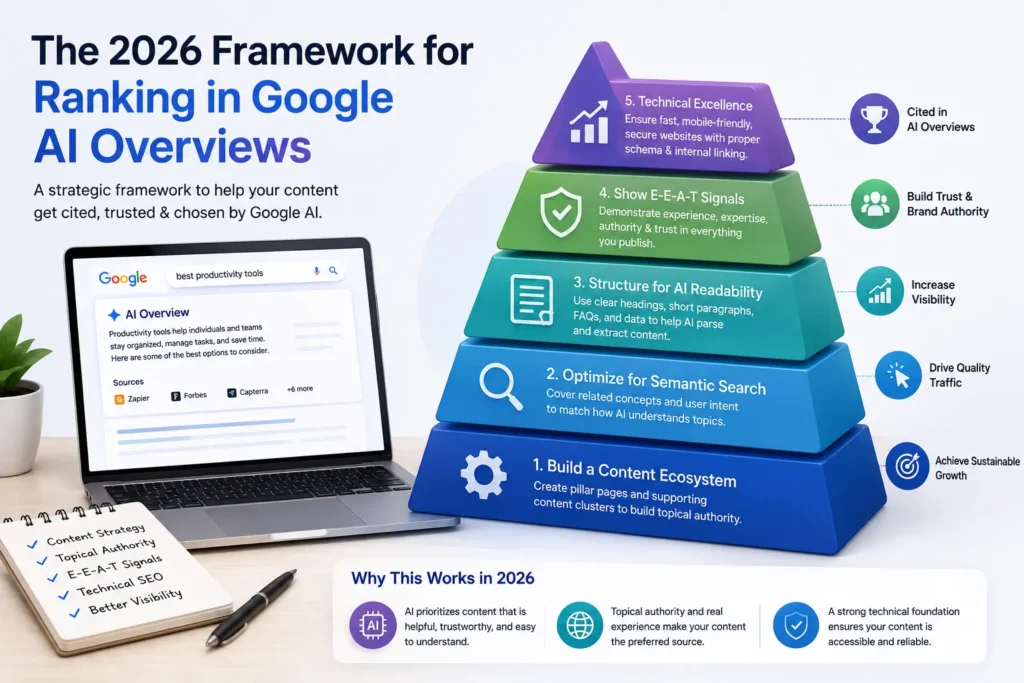
Build a Content Ecosystem, Not Just Articles
Think of your content strategy less like a publishing calendar and more like a map. Every piece should have a clear place on that map connected to related pieces, supporting a central pillar, contributing to the overall territory you’re trying to own.
Pick the core topic your business has genuine authority on. Build one comprehensive pillar page around it. Then create supporting articles that go deep on each sub-topic, each linked to the pillar and to each other where it makes sense.
For businesses with e-commerce operations, this structure compounds well. Each new piece strengthens the domain’s perceived authority, which improves the chances of older content getting cited. It’s a slow build but one that accelerates in ways paid search simply cannot replicate.
Optimise for Semantic Search, Not Just Keywords
Using keyword targeting as your primary content lens is increasingly outdated. What Google’s language models actually assess is whether your content reflects a thorough, multi-dimensional understanding of a subject and that shows up through the range of related concepts covered, not through keyword frequency alone.
Ahrefs data backs this up consistently: top-performing pages on any given topic rank for hundreds of semantically related terms. Not because someone engineered it, but because genuinely comprehensive content naturally covers the ground.
A practical test worth applying: after writing a section, ask whether a genuinely curious reader would leave with questions the content doesn’t answer. If yes, either extend the piece or create a supporting article. That’s semantic completeness in practice.
For businesses running search engine marketing campaigns alongside organic work, this matters beyond AI Overviews. Semantically richer content improves Quality Scores, which directly affects cost-per-click and ad rank. The two disciplines reinforce each other more than most teams realise.
Structure Your Content So AI Can Parse It
Here’s something worth sitting with: AI doesn’t read your content the way a person does. It parses it identifying claims, cross-checking them against other sources, and evaluating whether a passage is clean enough to serve as a summary response.
Content that’s structurally unclear, buried claims, long unbroken paragraphs, vague headings is difficult for these systems to use, even when the underlying information is solid. Content that’s logically sequenced and definition-forward is far easier to pull from.
Five structural elements that consistently support AI parsability: clear H2 and H3 headings that signal topic boundaries, short paragraphs that isolate individual claims, definitions placed before elaboration rather than after, statistics and data points with source context, and FAQ sections that mirror the conversational query patterns AI Overviews are built around.
Use First-Hand Experience as a Differentiator
The “Experience” addition to E-E-A-T wasn’t accidental. Google added it specifically because AI-generated content had become capable of sounding knowledgeable while containing no actual experience. The system needed a way to reward content from people who had genuinely done things, not just described them accurately.
For businesses, this is a real advantage if you act on it. Document your actual work. Share campaign data. Write case studies grounded in real client outcomes. Describe tests you ran and what the results were including what didn’t work.
If your performance marketing campaigns have produced specific, measurable results, that data belongs in your content. A figure drawn from your own work carries categorically more weight in an AI Overview than the same industry statistic repeated across a hundred other sites.
Technical SEO Still Has a Seat at the Table
Strong content on a technically weak site is a problem. Google has real reasons to deprioritize pages that load slowly, break on mobile, or aren’t being properly crawled and AI Overviews are no exception to that logic.
Core Web Vitals are where most sites have room to improve. Google’s PageSpeed documentation makes clear that Largest Contentful Paint, Cumulative Layout Shift, and Interaction to Next Paint aren’t aspirational targets; they factor into how pages are evaluated. Slow is a signal, and not a good one.
Schema markup is the second priority. Structured data removes interpretive work from Google’s systems. FAQ schema in particular maps closely to the conversational query patterns that trigger AI Overviews most often. HowTo and Article schema add additional content-type clarity. The question isn’t whether schema helps it does it’s whether it’s being implemented correctly.
Internal link architecture is the third. Content that isn’t well-connected within your own site is harder for Google to contextualise. Weak internal linking flattens your site architecture in ways that limit how authority flows between pages.
For businesses with web design and development, building this technical foundation into the site from the start is dramatically more efficient than trying to fix it after content is already published. The two decisions architecture and content are genuinely interdependent.
A Real-World Example That Shows This Working
There’s a SaaS business that has been targeting “email automation tools” for a while. One well-written comparison article, sitting comfortably between positions three and six. Decent traffic. No AI Overview presence whatsoever.
What they changed wasn’t the quality of their writing: it was the structure around it. Over twelve weeks they built out 22 pieces covering the topic from every practical angle:
- Automation for D2C brands, agencies, and solo operators: each segment addressed separately with context specific to how they actually use email tools
- Head-to-head platform comparisons: structured around real feature differences, not generic pros and cons lists
- Beginner setup guides and advanced segmentation frameworks: covering the full knowledge spectrum so no reader landed on a page that assumed too much or too little
- Original customer data throughout: deliverability metrics and open rate benchmarks drawn from anonymised campaign aggregates, not the same recycled industry statistics appearing on every competitor’s blog
Eight weeks after that cluster reached a critical mass of indexed, interlinked pages, something shifted. Their content started appearing in AI Overviews across more than a dozen related queries. Organic impressions were up 34% by the end of the quarter.
But the conversion rate was the number that told the real story. Visitors arriving through AI-cited content converted at a noticeably higher rate than standard organic traffic almost certainly because they arrived already knowing who they were dealing with. The AI Overview had done some of the trust-building before they even landed on the page.
The volume of content wasn’t the point. Twenty-two articles on their own wouldn’t have moved anything. What worked was the coherence of every piece reinforcing the others, Google eventually seeing a domain that genuinely owned the subject rather than just touching it.
What Most Businesses Get Wrong?
A few patterns show up repeatedly in sites that struggle with AI Overview visibility.
Publishing in isolation tops the list. A strong article with no internal links to related content is structurally invisible to the topical authority signals Google uses. It might rank. It won’t get cited consistently.
Treating keyword density as the optimisation goal is the second. The real question is always whether the content fully addresses what someone searching a given term actually needs, not how many times the keyword appears. These are different questions and they produce very different content.
Letting content go stale is the third. Outdated statistics, discontinued tool references, examples that no longer apply these quietly erode trust signals over time. Regular content audits aren’t optional for sites that want sustained AI Overview visibility.
Skipping original data is the fourth. Generic content has essentially zero scarcity value at this point. Content anchored in proprietary data, honest case studies, or original research stands apart and Google’s systems are getting better at recognising the difference.
For businesses running PPC campaigns alongside organic work, it’s worth understanding that these two channels serve genuinely different trust functions. Paid placements generate immediate visibility. AI-cited organic content builds the kind of cumulative credibility that compounds over months and years.
Generative Engine Optimisation: The Next Evolution of SEO
The term that’s emerging to describe this shift is Generative Engine Optimisation GEO. It refers to the practice of optimising specifically for AI-driven search surfaces: Google AI Overviews, ChatGPT Search, Perplexity, and whatever comes after those.
GEO isn’t a replacement for traditional SEO. It’s an evolution of it. The shared foundation is the same accurate, useful, well-structured content from credible sources. What shifts is the emphasis. Traditional SEO optimises for ranking signals. GEO optimises for citation signals. Traditional SEO thinks page by page. GEO thinks domain by domain.
A 2024 study published in arXiv by Aggarwal et al. found that websites with credible citations, embedded statistics, and clear authority signals appeared in AI-generated responses at significantly higher rates than sites with comparable content quality but weaker trust markers. Quality alone isn’t enough. Trust signals demonstrable, consistent, multi-layered are what separate cited sources from uncited ones.
The businesses building GEO strategies now are doing it alongside structured SEO services and performance-driven paid channels instead of them. The combination creates a search presence that holds across both traditional and AI-driven search, regardless of how the algorithm continues to shift.