
How Indian Jewellery Brands Can Get More Customers Through SEO?
My grandmother used to say you could tell everything about a jeweller by the way they displayed their work. Presentation built trust before a single word was spoken. Online, that trust-building starts earlier than it starts on Google, before your website even loads.
The Indian jewellery buyer today does not walk into a shop on impulse. They search. They compare. They read. They shortlist three brands, watch a few reels, check return policies, and then they buy or visit a store. If your brand isn’t appearing during that research phase, you’ve already lost the sale to someone who is. That’s the core argument for one of the best digital marketing agency for jewellery brands, and it’s not a complicated one.
According to IMARC Group, the India jewellery market was valued at USD 95 billion in 2025 and is projected to reach USD 151 billion by 2034. A meaningful share of that growth is being driven by online discovery and digital commerce. Brands that build search visibility now are positioning themselves to capture that demand as it scales.
Why Jewellery SEO Sits at the Intersection of Local and Ecommerce?
Most industries deal with either local SEO or ecommerce SEO. Jewellery brands often need both running in parallel and that’s what makes it genuinely interesting to get right.
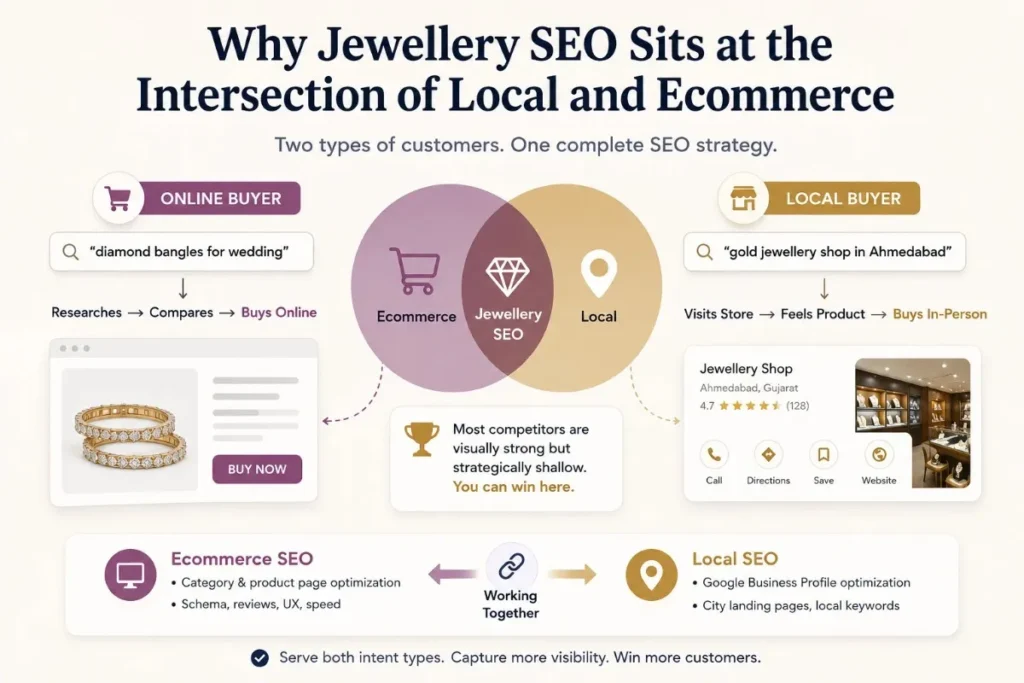
A customer searching “diamond bangles for wedding” might be happy purchasing online from a brand they’ve researched well. Another customer searching “gold jewellery shop in Ahmedabad” wants to walk in, feel the weight of the piece, and negotiate in person. Your SEO strategy needs to serve both. Small business SEO services built generically won’t account for this split; you need category page optimization and Google Business Profile management and city-specific landing pages, all working together.
The good news: most of your competitors haven’t figured this out yet. Most jewellery websites are visually impressive and strategically shallow. That gap is your opportunity.
Ready to Turn Google Search Into Your Best Jewellery Salesperson?
Digifinity works with jewellery brands and ecommerce businesses across India to build search visibility that brings real buyers not just traffic. Whether you need local SEO, product page optimisation, or a full ecommerce SEO strategy, we’ll build a plan around your catalogue and your market.
Explore Our ServiceWhat Most Jewellery Websites Get Wrong?
Walk through the average Indian jewellery brand’s website and you’ll find the same problems repeated across hundreds of sites.
Product pages with three lines of description. Category pages that are just image grids with no copy. Navigation that confuses mobile users. Images that are stunning to look at but completely unoptimised for page speed. And perhaps most commonly zero thought given to what the customer actually typed into Google to land there.
None of this is a criticism of the brands themselves. Jewellery businesses are built around craft, relationships, and trust. Digital optimisation is a different skill set. But the cost of ignoring it is real organic traffic goes to whoever shows up in search, regardless of who makes a better product. That’s exactly the gap ecommerce services are built to close fixing the structural issues so the brand with the better product actually wins the visibility too.
Here’s a quick overview of which SEO strategies matter most for jewellery ecommerce brands:
| SEO Strategy | What It Does for Jewellery Brands | Priority Level |
| Local SEO | Gets you found in city-specific searches like ‘gold jewellery shop in Pune’ | High |
| Product Page SEO | Ranks individual product listings for buyer-intent searches | High |
| Category Page SEO | Captures volume searches like ‘silver earrings online India’ | High |
| Technical SEO | Fixes site speed, mobile issues, and crawlability | Critical |
| Content Marketing | Builds topical authority and drives top-of-funnel traffic | Medium |
| Schema Markup | Enables rich results with price, rating, availability | Medium |
Local SEO: Getting Found in Your City Before Anything Else
For jewellery brands with physical stores, local SEO is the fastest route to qualified traffic. When someone searches “bridal jewellery near me” or “platinum ring shop in Surat,” Google serves results based on proximity, relevance, and authority signals, not just website quality.
A well-configured Google Business Profile with accurate NAP details, updated photos, and genuine customer reviews goes a long way. But local SEO for jewellery doesn’t stop there. You need dedicated landing pages for each city you operate in, not pages where you’ve swapped the city name and kept everything else identical, but pages that speak to local buying patterns, regional festivals, and the products that sell in that market specifically.
This is where local SEO services built for Indian businesses make a genuine difference. A properly structured local SEO campaign for a jewellery brand typically produces visible results within three to five months, particularly in Tier 2 cities where search demand is growing but competition hasn’t caught up.
Product and Category Page SEO: Where Revenue Actually Comes From?
If you want to know where SEO services deliver the clearest ROI for jewellery brands, it’s here. Product and category pages are the ones that rank for buyer-intent searches for the queries that come from people who are ready to make a decision.
Category Page Optimisation
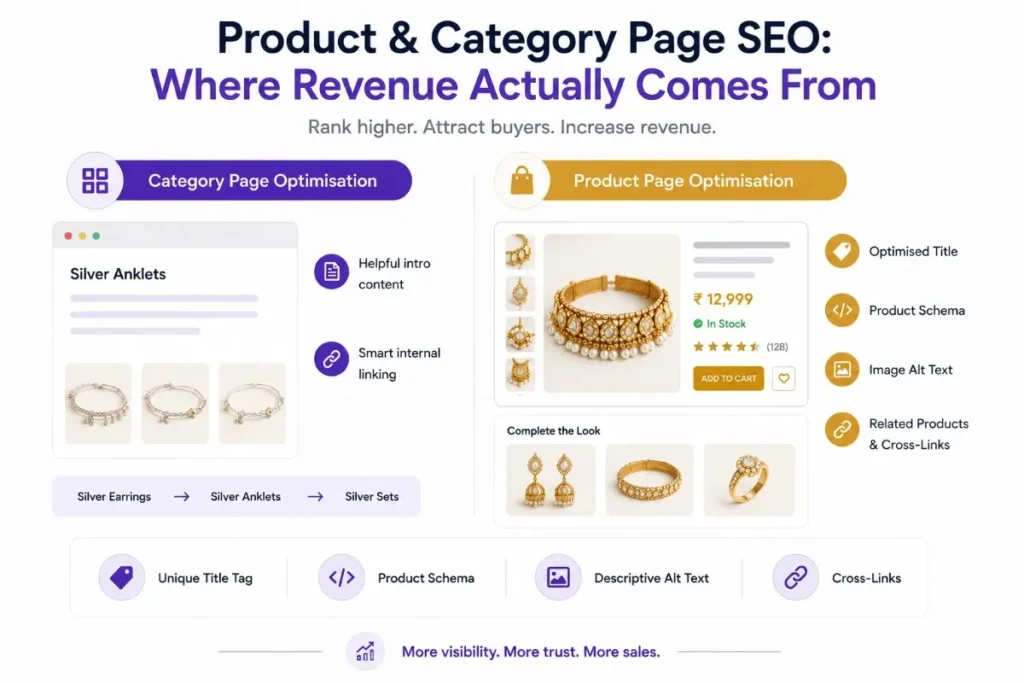
A category page for “silver anklets” or “kundan bridal sets” cannot just be a photo grid. It needs 150–200 words of introductory copy that contextualises the collection, includes the target keyword naturally, and answers the questions a buyer actually has before scrolling purity level, hallmarking, occasions, care instructions. Google reads this content. So do buyers who are still deciding whether to trust you.
Internal linking within category pages also matters more than most brands realise. Linking from “silver earrings” to “silver anklets” to “silver jewellery sets” builds topical clusters that signal to Google you’re a comprehensive resource not just a page that happened to mention silver.
Product Page Optimisation
Every product page is a ranking opportunity that most jewellery brands waste. The title tag formula that works: [Product Name] – [Metal/Stone] – [Occasion or Style] – Buy Online India. The description needs to do more than list specs; it should explain who this piece is for, what it pairs with, and what makes it worth the price. Context builds both SEO relevance and purchase confidence.
Key elements every jewellery product page needs:
- A unique title tag with product name, material, and a buyer-intent modifier like ‘buy online’ or ‘free shipping India’ this single change can lift click-through rates noticeably, especially for competitive product types like diamond rings or gold chains where multiple brands compete for the same query.
- Product schema markup including price, availability, and aggregate rating according to Search Engine Journal, structured data that enables rich snippets gives your listing a visual advantage over plain-text results, which matters enormously when buyers are scanning multiple options in a single search.
- Accurate, descriptive image alt text not ‘product-image-1.jpg’ but something like ‘gold kundan choker necklace for bridal wear’ which feeds both standard web search and Google Images, one of the most underutilised traffic sources for jewellery brands.
- Cross-links to related products and complementary pieces a ‘complete the look’ section or ‘pairs well with’ module which reduces bounce rate, increases average session time, and signals to Google that your catalogue is interconnected and worth exploring.
Technical SEO: The Silent Reason Some Jewellery Sites Don’t Rank
Technical SEO is unglamorous work. Nobody posts about it on Instagram. But it’s often the reason a jewellery website with beautiful products and decent content simply refuses to rank.
Page speed is the most common culprit. Jewellery websites are image-heavy rightly so but those images need to be compressed, resized for device, and served in modern formats like WebP. A site with poor Core Web Vitals scores sees users bounce before even engaging with the content, and Google uses these metrics as a ranking signal sites with “Good” scores across all three metrics receive preferential treatment in search results.
Crawlability is the other major issue. Filter-generated URLs (colour, size, metal type), product variant duplication, and missing canonical tags can mean Google is spending its crawl budget on hundreds of near-identical URLs instead of your most important pages. A proper technical audit surfaces all of this and prioritises fixes by impact.
Our ecommerce SEO services begin every jewellery brand engagement with a full technical audit because fixing structural issues first means everything built on top of it (content, links, local presence) actually sticks.
Content Strategy: Building the Kind of Authority Google Trusts
Jewellery is bought with emotion. The buyer purchasing an anniversary gift, preparing for a daughter’s wedding, or treating themselves after a promotion isn’t just looking for a product, they’re looking for confidence that they’re making the right choice. Content that speaks to these moments builds organic traffic and brand trust at the same time.
Think about the questions your buyers are genuinely typing: Which is better, 18kt or 22kt gold? How do I care for silver jewellery? What should I buy for a South Indian wedding? These are real search queries with real traffic behind them. Answering them well positions your brand as the expert, not just another seller.
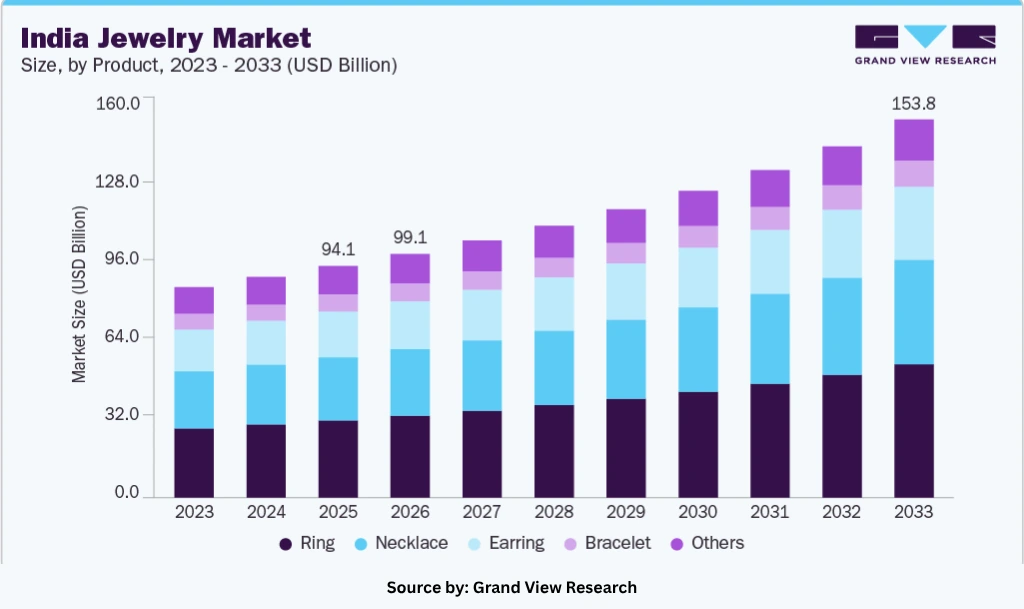
Seasonal content works particularly well for jewellery. A buying guide for Dhanteras published in August will rank well before the season peaks. A bridal jewellery trends piece published in January captures couples planning summer weddings. And the opportunity is only getting bigger. According to Grand View Research, the India jewellery market is expected to reach USD 153 billion by 2033, meaning the pool of online buyers searching for jewellery will keep expanding year on year. When this content works in combination with search engine marketing strategies, you end up owning both the organic and paid positions for high-intent queries which is a meaningful competitive advantage.
High-performing content formats for jewellery brand SEO:
- Buying guides by occasion or recipient ‘jewellery gifting guide for anniversaries,’ ‘what to buy for Karva Chauth’ attract buyers early in their decision journey, earn backlinks naturally from wedding and lifestyle blogs, and build the kind of authority that compounds over time rather than disappearing when ad spend stops.
- Comparison content between metals, stones, or jewellery types ‘gold vs silver jewellery in 2025,’ ‘lab-grown vs natural diamonds India’ ranks for high-volume informational queries and introduces your brand to buyers who didn’t know you existed before that search.
- Care and maintenance guides ‘how to clean diamond jewellery at home,’ ‘how to prevent silver from tarnishing’ generate year-round long-tail traffic, reduce post-purchase anxiety, and lower return rates by helping customers maintain what they’ve bought.
- Craftsmanship and sourcing content especially for premium or artisanal brands where provenance matters builds the kind of trust that Google’s EEAT framework specifically rewards: demonstrable experience, expertise, and authenticity.
Why Working With the Best Digital Marketing Agency Matters for Jewellery Brands?
Jewellery SEO isn’t something you can set up once and leave running. The catalogue changes with seasons, Google’s algorithm evolves, and competitors are constantly adjusting their strategies. What works this quarter may need revisiting next quarter. That’s the reality of ecommerce SEO: it rewards consistency and penalises neglect.
The brands that see the strongest organic growth are the ones that treat SEO as an ongoing business function, not a one-time project. They monitor rankings, audit technical health regularly, update content to reflect current buying trends, and build links proactively. Partnering with the best digital marketing agency for your niche means this work happens systematically not reactively when rankings drop.
At Digifinity, we work with ecommerce businesses across India to build search visibility that generates real revenue, not just traffic. Our approach combines technical precision with content strategy and commercial thinking because ranking well is only useful if it leads to enquiries and sales.