

A practical look at how AI Overviews are reshaping organic search and what AI SEO services do about it?
A search that used to end in ten blue links now often ends before it begins. Type a question into Google today and there’s a fair chance the answer sits right at the top of the page, written by AI, sourced from a handful of pages you never get named unless yours happens to be one of them. That’s the shift behind the rising demand for ai seo services, and it’s not a theoretical one. Recent large-scale search tracking found organic click-through rates on AI Overview queries falling by more than 60% compared with standard results, and the businesses that show up inside those AI answers are the ones still getting the traffic.
For a brand in Ahmedabad or anywhere else in India competing on keywords that already trigger AI-generated summaries, this changes what “ranking” needs to mean. Position one on a traditional results page used to guarantee a healthy share of clicks. It no longer does that on its own.
Marketing teams that built their growth plans around 2023-era organic benchmarks are working from numbers that no longer hold. A page can hold position one, keep its backlink profile, and still see traffic slides, simply because the AI answer above satisfied the searcher first. That’s a hard thing to explain to a founder looking at a Search Console dashboard that shows rankings intact and clicks falling. The honest answer is that the goalposts moved, not the team’s effort.
The Search Behaviour Shift No One Can Ignore:
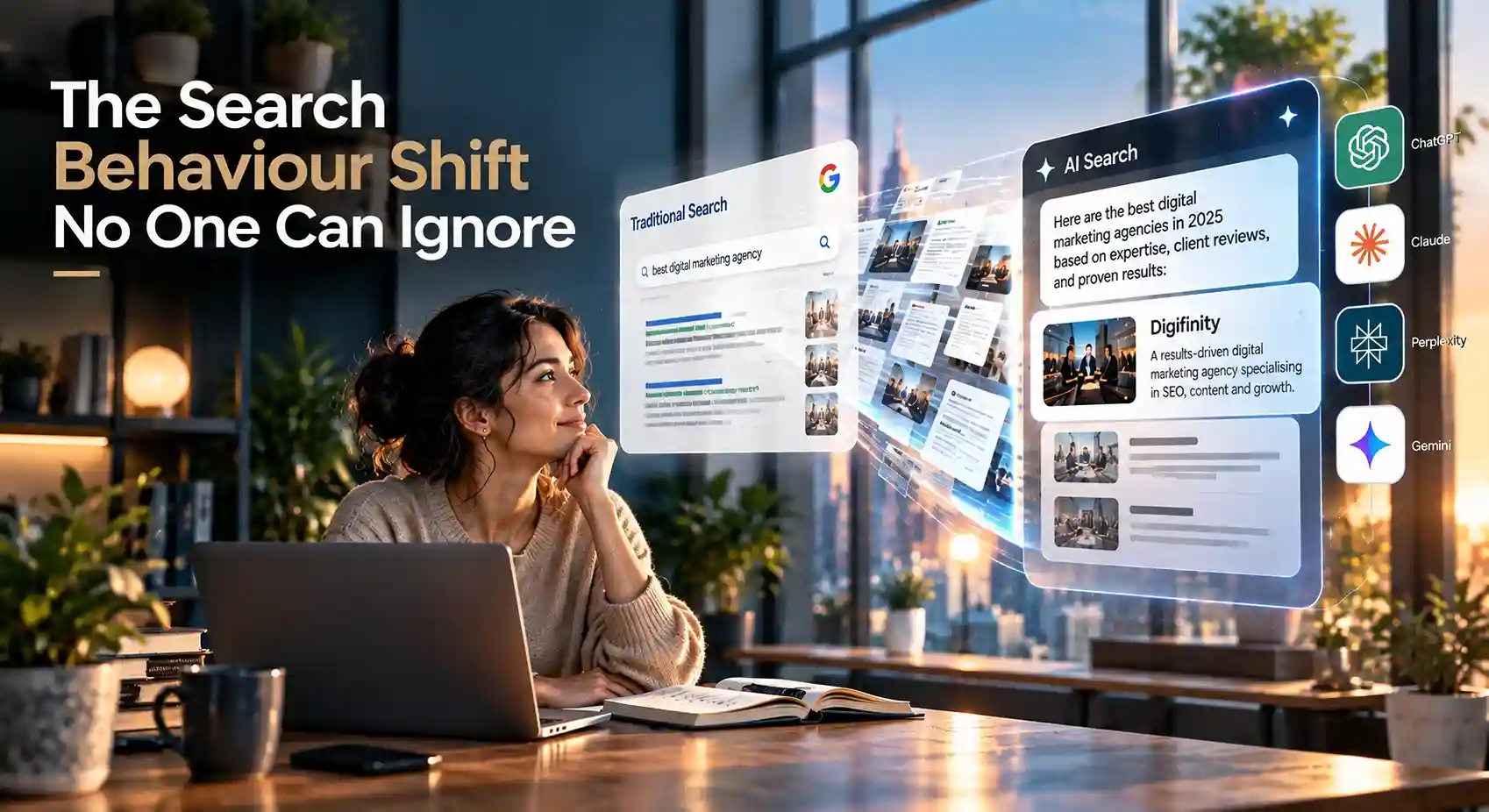
The pattern shows up consistently across independent studies, not just one vendor’s data. A randomised field experiment run through the Indian School of Business and Carnegie Mellon found that when AI Overviews appeared, outbound clicks to organic sites dropped by close to 40%, and zero-click searches rose sharply in the same sessions. Separate informational-query research from Seer Interactive, spanning over five million queries, put the CTR gap at roughly 61% between AI Overview and non-AI Overview results.
What matters for a business owner isn’t the exact percentage different studies land in slightly different ranges depending on query type and industry. What matters is the direction. Informational and evergreen content, the kind most blog-led SEO strategies rely on, is taking the hardest hit. Transactional and highly local queries are holding up better, for now.
There’s a second finding worth sitting with: pages that get cited inside an AI Overview earn meaningfully more clicks than pages that rank but aren’t mentioned. Being present in the answer, not just present on the page, is becoming the actual prize.
There’s also a quieter shift happening beneath the headline numbers. Searches that don’t trigger an AI Overview at all are seeing their own CTR climb, because the searcher intent behind them tends to be more specific, more commercial, and less easily summarised in three lines of text. That’s a useful signal for content strategy: broad, definitional content is exactly where AI answers now intercept the click, while narrower, decision-stage content comparisons, pricing questions, “which one should I choose” queries still pulls a searcher through to a real page. Knowing which of your keywords fall into each camp changes what you prioritise first.
Not sure where your content stands with AI Overviews?
A quick audit shows exactly which of your pages are visible, cited, or invisible to AI search before you spend another rupee guessing.
What AI SEO Services Actually Do?
Feature: what’s inside an AI SEO engagement?
AI SEO services aren’t a rebrand of the same old keyword-and-backlink playbook. They combine traditional technical and content SEO with a newer layer built specifically for how AI systems read, summarise, and cite web content:
- Entity and structured data mapping (schema markup) so AI models can parse what a page is actually about
- Content built to answer questions directly and early, in a format AI summarisation tools can lift cleanly
- E-E-A-T strengthening author credentials, original data, verifiable expertise since AI systems favour sources they can trust
- Ongoing tracking of AI Overview appearances and citation rates, not just keyword rankings
Function: how it changes your search visibility?
Where classic SEO optimises for a ranking position, AI SEO often grouped under GEO (Generative Engine Optimisation) optimises for two outcomes at once: still ranking well in traditional results, and being one of the handful of sources an AI system chooses to quote. The two goals overlap more than they conflict. Content that’s clearly structured, well-sourced, and genuinely useful tends to perform on both fronts, which is why the strongest AI SEO strategies build on solid technical foundations rather than replacing them.
Desire: why does this matter to the business, not just the marketing team?
None of this is abstract for a business owner watching a quote pipeline. Fewer organic clicks on informational pages means fewer people entering the funnel at the awareness stage, which eventually shows up as a thinner pool of leads further down. A brand that’s cited inside AI Overviews, by contrast, gets a form of free visibility that a competitor sitting one line below in the traditional results simply doesn’t the AI answer effectively vouches for the source it quotes. That’s a trust signal money can’t buy directly, and it’s compounding: filling genuine content gaps gets a source cited more consistently over time, which means the businesses that start now build an advantage that gets harder to close later.
Decision: why act now rather than wait?
Search behaviour rarely reverses once it shifts. AI Overviews have gone from an experimental feature to a default part of the results page across the large majority of commercial and informational queries, and every indication points to that footprint growing rather than shrinking. Waiting for “more certainty” before adjusting a content and technical SEO strategy usually means waiting until competitors have already claimed the citation slots for the keywords that matter most.
Why Are Indian Businesses Switching to GEO-Ready SEO?

For most companies working with a digital marketing agency in Ahmedabad on this, the pressure is showing up in the same place: traffic that used to come from informational blog content is softer than it was two years ago, even where rankings haven’t moved. That’s the zero-click effect at work, and it’s not something a single content refresh fixes. Getting the fundamentals of seo services right is still the starting point before any AI-specific layer gets added on top.
| Traditional SEO focus | AI SEO / GEO focus |
| Ranking position on the results page | Ranking position and citation inside AI-generated answers |
| Keyword density and backlink volume | Entity clarity, structured data, and verifiable authority |
| Success measured by organic clicks | Success measured by clicks and share of voice in AI answers |
| Content written for search engines | Content written to be directly extractable by AI systems |
Businesses searching for the best digital marketing agency in India for this kind of work are increasingly asking a different question than they used to, not just “can you get me to page one,” but “can you get me quoted when someone asks AI instead of Google.” That’s a fair distinction to make, and it’s worth asking any agency you’re evaluating.
The businesses adapting fastest tend to share a few habits worth borrowing regardless of who runs the work. They audit which of their existing pages already get cited and which don’t, rather than guessing. They prioritise fixing structural and schema gaps before commissioning new content, since AI systems reward clarity over volume. And they stop treating AI Overview visibility as a vanity metric that gets tracked alongside rankings and traffic in the same monthly report, because a strategy no one measures rarely survives budget season.
How an AI SEO Services Process Works?
A properly run AI SEO engagement generally moves through the same disciplined stages, whether the client is a local firm or a national brand:
- Technical and entity audit: checking how cleanly a site’s structure, schema, and internal linking currently communicate what the business does
- Content gap analysis: identifying where competitors are being cited in AI Overviews and the business isn’t
- Structured content build: rewriting or creating pages with direct-answer openings, clear H2/H3 question framing, and supporting schema
- Authority signals: strengthening author bios, original data points, and credible external references
- Monitoring and iteration: tracking AI Overview appearances and citation frequency alongside standard rank tracking, then adjusting monthly
Businesses working with a performance marketing agency alongside this kind of SEO work tend to see the clearest results, since paid and organic visibility reinforce each other when both are built around the same search-intent data.
Two things trip most businesses up when they try to run this in-house. The first is schema markup mismatches schema that’s technically valid but doesn’t actually match what’s on the page. AI systems catch that faster than a human reviewer would, and it can quietly disqualify a page from citation even while it still ranks. The second is content written to sound comprehensive rather than to answer one question clearly; AI summarisation tools consistently favour the page that resolves the query in the first two sentences over the page that circles it for three paragraphs first.
Where This Leaves Your Content Strategy?
Nobody’s saying scrap years of content that’s earned its keep. What changes is the lens you audit it through. The posts most exposed right now are the older, broad ones the “what is X” and “how does Y work” pieces that answer a question in full within the first two paragraphs. Those are exactly the ones an AI Overview can lift and summarise without sending anyone to the page. The fix, more often than not, isn’t a rewrite from scratch. It’s structural: pull the direct answer up into the opening lines, turn a couple of headers into the actual question a reader would type, and add the schema that was probably missing anyway.
New content should carry that discipline from the first draft, not have it bolted on six months later during a “refresh.” That’s really the difference between a content calendar planned for 2022 and one planned for a results page where the AI summary now sits above every link. Rankings still matter, nobody’s arguing otherwise. They’re just no longer the whole story.
Why Choose Digifinity?
Digifinity works with startups and growing brands across India, including businesses that also come to us for mobile app development company ahmedabad support, which gives our SEO team a practical view of how technical build decisions affect crawlability and structured data from day one something a content-only agency rarely gets visibility into.
We don’t treat AI SEO as a separate add-on service sold at a premium. It’s built into how we approach content and technical SEO for every client, because the search landscape has already moved and running two parallel strategies wastes the budget. What we do promise is transparency: monthly reporting that shows both organic rank movement and AI Overview citation tracking, so you can see exactly where visibility is coming from.
For businesses searching for a digital marketing agency near me in Ahmedabad specifically, there’s an added advantage to working locally on this kind of engagement: local intent queries are among the categories least disrupted by AI Overviews so far, which means the fundamentals accurate business listings, location-specific content, genuine local backlinks still carry real weight alongside the newer GEO layer. Getting both right, rather than chasing one at the expense of the other, is what separates a strategy that holds up over a year from one that chases the latest headline. The same joined-up thinking applies on the build side too: clients who come to us for web app development services get SEO considerations built into the architecture from the start, rather than bolted on after launch.