
How Best SEO Company India Builds Rankings Without Backlinks?
Let’s be honest most SEO conversations in India still revolve around one thing: backlinks. How many do you have? Where are they coming from? How fast can you build more?
It made sense for a long time. Links were the backbone of Google’s PageRank system, and for years, chasing them produced real results. Agencies built their entire revenue model around link outreach. Clients spent lakhs every quarter just to move the needle. And some of that still works today nobody is claiming backlinks are dead. If you’re looking for the best SEO company in India, you already know the rules are changing fast.
But here’s what’s actually happening in 2026: businesses with half the links are outranking businesses with double the domain authority. Not because they got lucky. Because they took a completely different approach to how they build content and it’s called topical authority.
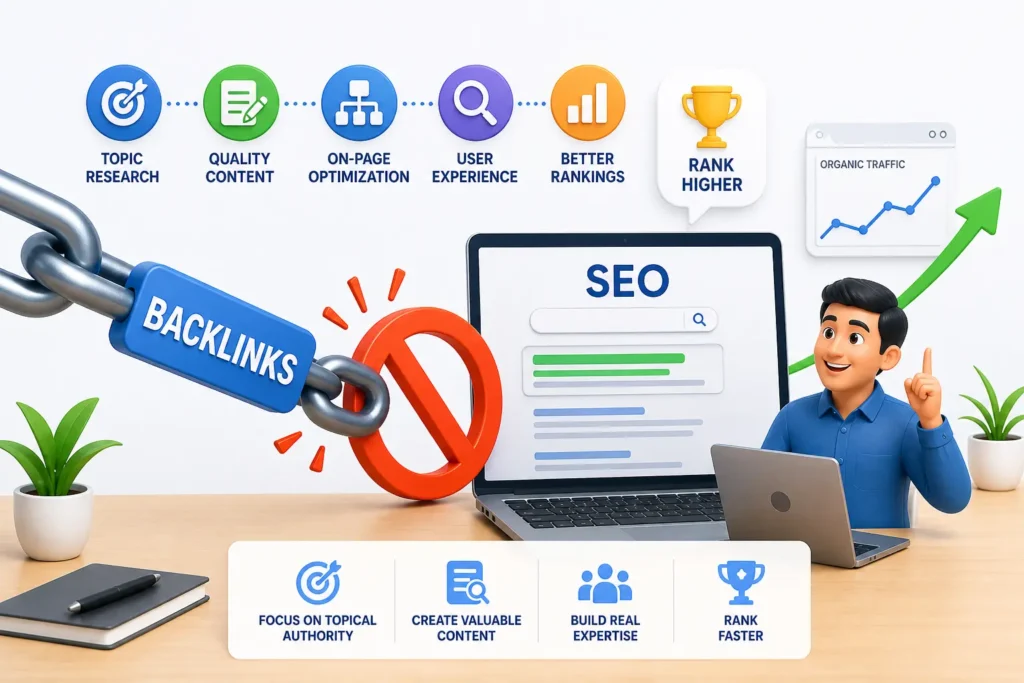
The top-performing SEO agencies aren’t winning because of link volume anymore. They’re winning because of content depth, semantic structure, and the ability to become the most trusted source on a topic within Google’s eyes. That shift has been building for years, but 2026 has made it undeniable.
Google’s Helpful Content System, the explosion of AI Overviews, and the rise of ChatGPT and Perplexity as mainstream search tools have all pushed in the same direction. Search engines are getting better at understanding what a website genuinely knows, not just who’s pointing links at it. And Google’s own representatives have confirmed that backlinks are no longer in the top three ranking signals. Content quality and demonstrated expertise now lead the way.
If you’re running a business in India and still building your entire SEO strategy around link acquisition, this guide is going to change how you think about search. What follows is a practical, honest framework for building topical authority, the kind that ranks faster, holds longer, and doesn’t collapse when an algorithm update hits.
Good SEO isn’t built overnight. It starts with the right strategy.
Digifinity partners with businesses across India to build authority, trust, and long-lasting search rankings.
Explore Our ServicesWhat Is Topical Authority And Why Every Best SEO Company in India Is Talking About It in 2026 ?
Here’s the simplest way to think about topical authority: Google wants to send its users to websites that actually know what they’re talking about. Not just pages that have one good article on a subject websites that cover that subject so thoroughly that there’s no reason to go anywhere else.
When you search “how to fix a leaking tap” and Google shows you a plumbing company’s website, it’s not just because that page has backlinks. It’s because that website has covered plumbing topics from thirty different angles: materials, tools, DIY guides, when to call a professional, cost breakdowns and Google has recognised it as a genuinely authoritative source on the subject.
That’s topical authority. And the data behind it is striking.
A study analysing over 253,800 search engine results concluded that page-level topical authority is the single largest on-page ranking factor for Google rankings more influential than the domain’s overall traffic volume. That’s not a minor detail. It means that a focused, well-structured website on a specific topic can outrank a much larger domain that happens to have a tangentially related page.
Research from Whitehat SEO adds further weight to this: topic clusters drive 30% more organic traffic and receive 3.2 times more AI citations than standalone posts. In a world where AI Overviews are eating into traditional click-through rates, those citations are enormously valuable.
The E-E-A-T Connection You Cannot Afford to Ignore:
Google’s E-E-A-T guidelines get thrown around a lot in SEO conversations but most of the time they stay frustratingly abstract. Topical authority is where they actually become something you can see and measure.
The groundwork was laid back in 2013 when Hummingbird shifted Google away from matching keywords toward understanding meaning. What followed the Knowledge Graph, the Medic update, BERT was Google progressively getting better at evaluating what a site actually understands, not just what words it contains. Each update moved the needle a little further in the same direction.
By 2026 that shift is far enough along that E-E-A-T isn’t purely a content quality question anymore. It’s a structural one. How your pages relate to each other, how completely you cover a subject, how logically your content is organised all of it feeds into how Google reads your authority on a topic.
For any SEO agency serious about delivering results right now, this isn’t an optional consideration sitting somewhere on a checklist. It’s the thing everything else is built on. Get topical authority wrong and the rest of the strategy is working against itself.
Topical Authority vs. Backlinks: A Direct Comparison
Nobody is telling you to ignore backlinks entirely. A strong backlink from a highly relevant, trusted source still carries meaningful weight. But the days of building rankings purely through link volume without a coherent content strategy underneath are genuinely over.
The more useful question isn’t “links or topical authority?” It’s “which gives me a more durable competitive position over the next two to three years?”
Over 66% of all backlinks created in the last nine years are now dead gone, broken, or devalued. Link decay is a real and underappreciated risk in long-term SEO planning. Topical authority, by contrast, compounds. Every new piece of content you add to a cluster strengthens the authority of everything already in it.
Here’s how the two approaches compare directly:
| Factor | Backlink-Heavy SEO | Topical Authority SEO |
| Time to Results | 6–18 months | 3–6 months |
| Cost Structure | High (outreach, PR, agency fees) | Moderate (content-driven) |
| Sustainability | Volatile links can be lost or devalued | Compounding improves over time |
| Google AI Overviews | Partial eligibility | Strong eligibility |
| ChatGPT / GEO Visibility | Weak | Strong |
| Control | External depends on third parties | Internal fully owned |
| Scalability | Diminishing returns | Increases with content depth |
For businesses evaluating an SEO agency near me or weighing up performance marketing companies for long-term growth, that table tells a clear story. Topical authority is a more defensible position – one you own entirely, that grows without relying on what someone else decides to link to.
How to Build Topical Authority: A Step-by-Step Framework?
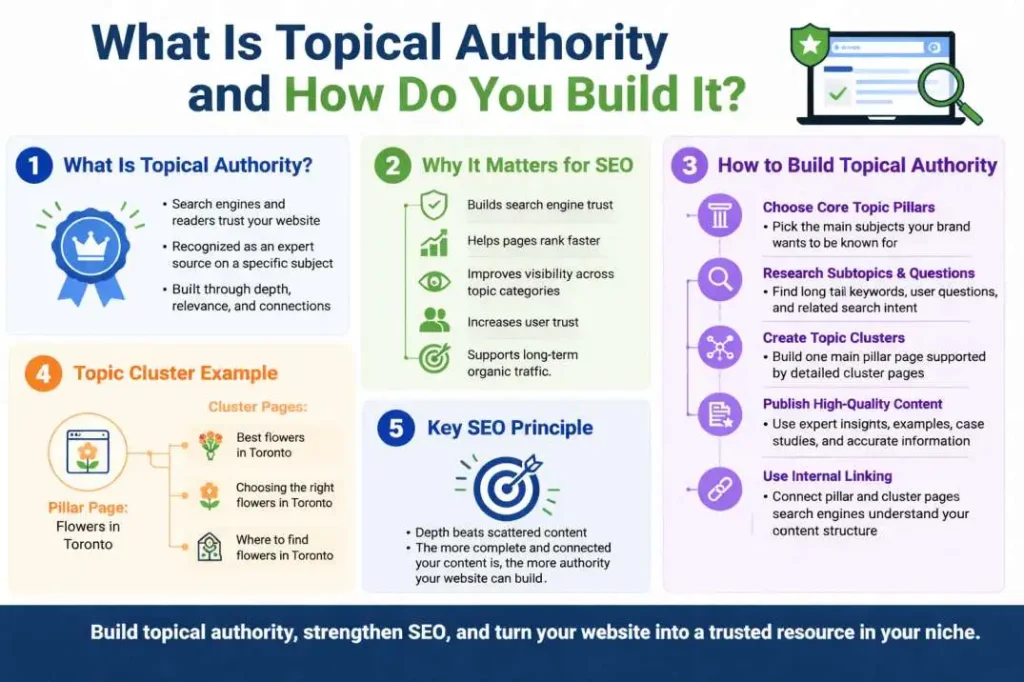
Building topical authority well is less about how much content you produce and more about how intelligently that content is structured. A hundred unconnected blog posts won’t get you there. Thirty tightly organised, interlinked pieces built around a clear topic architecture will.
Here’s how to do it properly.
Step 1 – Define Your Core Topic Domains
Before you write a single word, you need to know what topics you’re actually trying to own. These aren’t just the services you offer, they’re the broader subject areas your audience actively searches for and that connect naturally to your business.
A marketing agency might identify SEO strategy, paid search, content marketing, social media management, and performance marketing as its core topic domains. An e-commerce brand selling kitchenware might focus on recipes, cooking techniques, kitchen organisation, and product care.
The mistake most businesses make is trying to build authority across too many domains at once. It spreads your content effort thin and dilutes your semantic signal to Google. Pick two or three domains to start, build genuine depth in those, and expand from there. Use tools like Ahrefs, Semrush, or Google Search Console to prioritise based on commercial intent and realistic competitive opportunity.
Step 2 – Build a Pillar and Cluster Content Architecture
The pillar-cluster model is the most proven structural framework for topical authority, and it works because it mirrors how Google actually maps content relationships.
Your pillar page covers a core topic comprehensively – think of it as the definitive guide. Your cluster pages go deep on specific subtopics, each one linking back to the pillar and cross-linking with related cluster content where it makes sense.
For example, a pillar page on “SEO for Indian Businesses” could sit at the centre of a cluster that includes articles on local SEO tactics, technical audit frameworks, on-page optimisation, Google Business Profile management, and keyword research methodologies. Each cluster piece deepens your overall topical footprint.
HubSpot’s implementation of this model produced a 50% increase in organic traffic within one year and improved rankings across more than 300 target keywords – without changing their link building approach. The shift was purely structural.
Whitehat SEO’s research adds that Google’s December 2025 Helpful Content Update rewarded sites with clear topic authority – clustered sites gained an average 23% in organic visibility, while sites covering too many unrelated topics lost roughly 18%.
Step 3 – Conduct Semantic Keyword Mapping
Topical authority SEO requires a fundamentally different mindset around keyword research. You’re not just picking one target keyword per page and optimising for it. You’re mapping the full semantic field to every related concept, question, entity, and variation that Google associates with your topic domain.
Tools like Semrush’s Keyword Magic Tool, Google’s People Also Ask section, and AI-assisted research tools help you identify primary keywords, secondary variations, LSI terms, entity-based keywords, and question-format queries. Each cluster page then addresses a specific segment of that map, ensuring your content covers the topic from every meaningful angle.
Semrush’s content study found that articles with 3,000 or more words generate three times more organic traffic than shorter pieces. Long-form content performs better in topical authority strategies because it satisfies multiple search intents within a single piece rather than forcing users to click through multiple pages.
The best SEO company in India treats semantic mapping as a living process reviewed quarterly as search behaviour shifts and AI search engines surface new query patterns that simply didn’t exist in earlier keyword research cycles.
Step 4 – Optimise for Google AI Overviews and GEO
Generative Engine Optimisation is the newest and arguably most important frontier in SEO right now. Google AI Overviews, ChatGPT Search, and Perplexity are increasingly answering queries directly within search results — and the content that gets cited in those answers is generating enormous value.
AI-sourced website sessions grew 527% year-over-year between 2024 and 2025. When a brand is cited in an AI Overview, organic click-through rate is 35% higher than for standard organic results. Being present in these AI-generated answers isn’t a bonus feature of your SEO strategy, it’s becoming a primary traffic channel.
To earn those citations, your content needs to be structured differently than traditional SEO content. The non-negotiables are:
- Factual precision: every claim should be specific, verifiable, and sourced where possible
- Clear definitions and named entities: AI systems extract content they can confidently identify and reference
- Data points and expert references: cited content consistently outperforms opinion-based writing in AI selection
A Yext study analysing 6.8 million AI citations found that websites with topic clusters receive 3.2 times more citations than single-page competitors, and that bidirectional internal linking increased citation probability by 2.7 times. The connection between topical authority and GEO visibility is not theoretical it’s directly measurable.
Step 5 – Execute a Disciplined Internal Linking Strategy
Internal linking is the infrastructure that makes topical authority actually work. Without it, you can have thirty excellent cluster articles and Google still won’t understand how they relate to each other or to your pillar page.
The rule is simple: every cluster page links to the pillar, the pillar links to every cluster page, and related cluster pages cross-link with each other wherever genuine topical overlap exists. Anchor text should be descriptive and keyword-rich not “click here” but “SEO services in Ahmedabad” or “content cluster strategy for Indian businesses.”
If you’re working with a top digital marketing company in India, internal linking governance should be part of your monthly content operations, not a one-time setup task that gets forgotten as soon as the site goes live.
The Topical Authority Execution Framework:
| Phase | Action | Output | Timeline |
| 1. Audit | Map existing content to topics | Gap analysis report | Week 1–2 |
| 2. Cluster | Group keywords into topic clusters | Semantic content structure | Week 2–3 |
| 3. Create | Produce pillar + cluster content | Topical depth and coverage | Month 1–3 |
| 4. Interlink | Connect all related pages | Authority flow and crawlability | Ongoing |
| 5. Measure | Track rankings and topical coverage | Iterative growth data | Monthly |
| 6. Expand | Add subtopics, refresh older content | Compounding authority | Quarterly |
This framework works in phases not as a single big-bang project. Businesses working with a search engine marketing agency in Ahmedabad can layer paid amplification on top of this organic programme during the early months, building brand awareness and driving traffic while the content authority takes root.
Real-World Results: What Topical Authority Actually Delivers
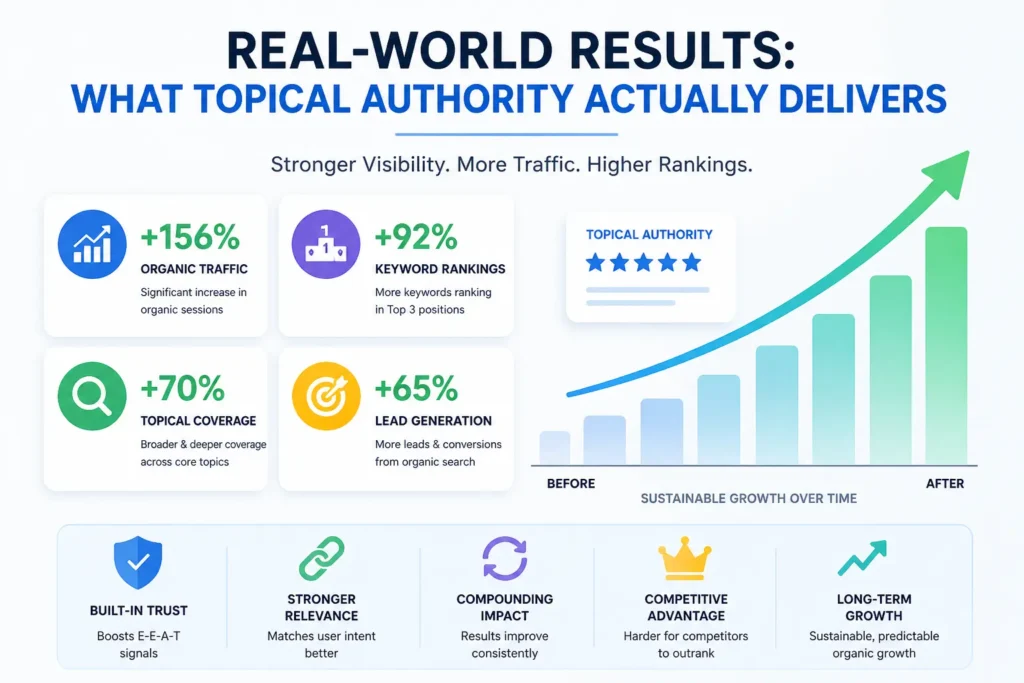
The numbers behind well-executed topical authority strategies are hard to ignore, and they come from real implementations not projections.
One marketing agency implemented a topic cluster strategy for an e-commerce client and grew organic blog traffic from 500 monthly visitors to nearly 190,000. That’s a 37,900% increase driven entirely by strategic content architecture, with no link acquisition campaigns running in parallel.
Research by HubSpot found that websites implementing topic clusters saw a 43% average increase in organic traffic. A separate Semrush study found that those same sites had 15% higher domain authority than comparable sites without topic clusters suggesting that content depth drives link acquisition naturally, not the other way around.
These outcomes aren’t outliers. They reflect what leading SMM agencies and SEO practitioners are observing across markets: a well-structured topical authority programme consistently outperforms link-heavy approaches in both speed of results and long-term durability. The deciding variable isn’t budget it’s the quality of the strategy and the discipline of execution.
Common Mistakes That Undermine Your Topical Authority Strategy:
Even when teams understand topical authority, the real challenge is execution. Small mistakes often seem harmless in the beginning, but over time they weaken your SEO performance and limit your ability to build real authority.
One of the most common issues is publishing content in isolation. Many businesses create blog posts without connecting them properly. When your articles don’t link back to a pillar page or to each other, Google struggles to understand how your content is related. As a result, each page works individually instead of contributing to a stronger topical signal.
Another mistake is trying to cover too many topics at once. It may feel like you’re doing more work, but in reality, it reduces depth. Instead of building strong authority in one area, your content becomes spread out and less impactful.
Shallow cluster content is another problem that quietly affects rankings. Supporting articles should go deeper into the topic, not repeat what’s already written. When content feels repetitive, it doesn’t add value and search engines notice that.
Content freshness also plays a big role. Publishing once and forgetting about it is not enough. Search intent changes, competitors improve their content, and outdated pages slowly lose visibility if they’re not updated.
Finally, many teams ignore entity-based SEO. Without including relevant tools, concepts, and recognised terms, your content lacks context. This makes it harder for Google especially AI systems to fully understand your topic.
Key mistakes to avoid:
- Publishing content without internal linking
- Covering too many topics without depth
- Creating repetitive or shallow cluster content
- Not updating older content regularly
- Ignoring entity-based SEO and context
Fixing these doesn’t require a complete rebuild, but it does require a more structured approach. When your content is connected, updated, and built with depth, your topical authority becomes much stronger and that’s what leads to consistent, long-term rankings.
Technical SEO Foundations That Amplify Topical Authority:
Great content architecture built on a technically flawed website is like building on sand. The content strategy creates the opportunity technical SEO determines whether search engines can actually access, crawl, and understand it.
Clean crawl architecture is the baseline. Googlebot needs to be able to efficiently access and process every page in your content cluster without wasting crawl budget on redirects, broken links, or blocked resources. Orphaned pages cluster content with no internal links pointing to them are invisible to Google’s topic mapping systems regardless of how well-written they are.
Schema markup, particularly Article, FAQ, and HowTo schemas, directly supports AI Overview eligibility and featured snippet capture.Over 23% of websites still don’t use structured data, which means that implementing it properly is genuinely differentiating in most competitive niches. For businesses competing for the best SEO company in India positioning, schema implementation is one of the faster wins available.
Core Web Vitals aren’t optional. Maintaining Largest Contentful Paint under 2.5 seconds and Cumulative Layout Shift below 0.1 protects the rankings that your content strategy earns. Poor page performance undoes good content work, users bounce, and Google notices.
XML sitemap structure, organised to reflect your topic cluster hierarchy, helps search engines understand the content relationships across your domain and prioritise their crawling more effectively.
Measuring Topical Authority: KPIs That Actually Matter
Topical authority doesn’t produce a single clean metric like domain authority or a backlink count. It’s measured through a combination of signals that, together, tell you whether Google is recognising your expertise and rewarding it.
The four KPIs worth tracking consistently are:
- Keyword coverage rate: measures what percentage of your target keywords within a topic domain you hold a position for in Google’s top 50 results. Top-10 rankings often come later, but a rising coverage rate tells you Google is starting to associate your domain with the topic and that’s the first real signal
- Topic cluster traffic share: tracks what proportion of your overall organic sessions come from your content cluster pages. As topical authority builds over months, this number should grow not because your homepage or service pages are doing worse, but because your cluster content is pulling in an increasing volume of relevant traffic
- Featured snippet and AI Overview capture rate: increasingly the most commercially valuable KPI to monitor. AI Overview appearances correlate with a 35% higher click-through rate compared to standard organic listings, a performance differential that compounds as AI search surfaces expand
- Average position improvement across the cluster: tracking the mean ranking change for all pages within a topic cluster over a rolling 90-day window gives you the clearest direct signal that your topical authority programme is delivering measurable results
Google Search Console, Ahrefs’ Content Gap analysis, and Semrush’s Topical Authority score are the core tools for tracking these KPIs. A monthly review with a quarterly strategic assessment is the rhythm that works for most established content programmes.
Why is Digifinity the Right Partner for This Strategy ?
Knowing the framework and executing it consistently are two very different things. Topical authority strategies require ongoing editorial discipline, regular content audits, semantic keyword reviews, and technical monitoring all coordinated around a coherent strategic plan. Most businesses simply don’t have the internal capacity to do this at the level required to compete for page-one rankings in competitive niches.
Digifinity is a full-service digital marketing agency based in Ahmedabad that has been helping businesses build genuine search authority not just traffic spikes across B2B, e-commerce, and professional services sectors. The approach integrates topical authority content strategy with performance marketing to ensure that organic visibility converts into actual business outcomes, not just impressions.
If you’ve been searching for an SEO agency near me with a real results-driven methodology, or if you’re evaluating the best SEO company in India for a growth mandate that goes beyond vanity metrics, Digifinity is worth a conversation.