

Retargeting campaigns are seen as one of the simplest forms of paid advertisements. The visitor lands on your website, doesn’t convert and then you show an ad to him again. It makes sense since the consumer would already be aware of the brand.
That very reason is why many campaigns often fail.
In case your retargeting campaign is no longer working for you, the problem will seldom lie in raising budgets or developing another ad. It might rather be related to such issues as audience burnout, poor targeting, mismatched message, poor offer, landing page conversion problem or buyer intention change.
It becomes important for companies that engage the services of a digital marketing company in Ahmedabad to understand this difference, as retargeting should not be done in isolation. It has to be integrated with activities such as searching, social media activity, website visits, etc.
This is reflected in Google’s advertising materials when it states that there are cases where customers may have seen several advertisements before making a conversion, and therefore, it would be unfair to measure only the last interaction for assessing the impact of the advertisement on the conversion since Google’s attribution is based on data.
To put it simply, a retargeting campaign may be underperforming in the dashboard but still impacting conversions—or profitable but getting too much credit.
However, it is not just the case of “fixing the ads”. The purpose is rather diagnosing the whole retargeting process.
What Retargeting Ads Are Supposed to Do ?

Retargeting is effective since past experiences add more context.
A visitor to the service page, having gone through different product pages, going through the checkout process, or downloading some resources does not qualify as being the same type of customer as a visitor that stays on the home page for five seconds. Social Media Management can be used to distinguish such customers. However, most campaigns group them together.
This eliminates one of the major strengths of retargeting, which is behavioral intent.
A good retargeting strategy asks three things:
What did he or she do?
When did he or she do it?
What should he or she see next?
For instance, consider an ecommerce visitor who has seen a pair of shoes three times within the past week. The generic ad saying “Discover our Collection” may not have the same impact on the customer compared to the product-specific advertisement that highlights shipping, refunds, reviews, or limited offers.
The point here is not the advertising medium but the level of customer experience provided.
The Google Ads program lets advertisers specify the length of audience membership time, and the recommendation is to think about the sales cycle when choosing the length of membership time for users in a particular segment. The official documentation from Google states that the maximum membership duration of Google Display & Search data segments is 540 days.
This means that a retargeting audience of 30 days could be appropriate for some businesses and entirely inappropriate for others. Social Media Marketing Services will work with businesses to come up with the most suitable retargeting duration.
Whereas a luxury furniture business that takes six weeks to consider has a different retargeting strategy compared to a fashion online store that sells a product worth $30, retargeting is not just “targeting people who visited your website”. Retargeting involves advertising to previous visitors based on their intent.
Fix Your Retargeting With a Digital Marketing Company in Ahmedabad
We fix tracking, segment your audiences and rework your ads so retargeting brings visitors back to buy.
Why Retargeting Ads Stop Converting ?
If your previous lead-generating or sales-producing campaign suddenly stops performing, you should avoid changing all the factors instantly.
Identify the root cause.
There are specific recurring failures within retargeting campaigns.
Audience Fatigue and Overexposure :
The most obvious challenge is also one of the most common challenges: Your advertisement has been seen by people too often.
Relevance is the key for retargeting; repetition kills the relevance.
Meta’s official retargeting guide explains how businesses can retarget people who have previously interacted with their website, products or brand and use their behaviour to deliver more relevant advertising.
This is a good link for external authority in this segment since it proves your argument concerning retargeting effectiveness being based on audience relevancy and customer intent.
A visitor may initially respond positively to an advertisement because it reminds them about a product or service they were considering. For e-commerce companies, after seeing the same creative repeatedly for several weeks, the advertisement becomes background noise.
It doesn’t mean the customer has ignored your business. It could only be that the customer is oblivious to the advertisement.
Google Ads offers a frequency capping option for Display & Video campaigns to ensure that the same person sees an advertisement less frequently.
Frequency can never be considered a one-size-fits-all figure applicable to all campaigns.
If the service you sell needs more consideration and costs higher, then frequency might not hurt.
The more pertinent question would be:
At what point does each extra dollar of ad spending no longer yield an incremental return on investment?
When conversions go down even as impressions increase, look at frequency first before spending more money.
Your Audience Segments Are Too Broad :
The all website visitors retargeting audience can be convenient to use; however, convenience does not constitute strategy.
Consider these visitors:
- A user who viewed your pricing page.
- Someone who read a blog article.
- Someone who visited your careers page.
- A person who viewed five products.
- Someone who abandoned checkout.
- A previous customer.
- Someone who already requested a quotation.
They have entirely different commercial purposes.
When both are put together in a marketing strategy, they make one message cover various psychological states.
It is here that audience segmentation takes on a vital role in social media marketing services and paid advertisements.
A more sophisticated structure might look like this:
| Audience | Likely Intent | Suitable Message |
| Homepage visitor | Low | Brand credibility |
| Blog reader | Low–medium | Educational content |
| Service-page visitor | Medium | Benefits and proof |
| Pricing-page visitor | High | Objection handling |
| Product viewer | High | Product-specific reminder |
| Cart abandoner | Very high | Purchase completion |
| Existing customer | Retention | Cross-sell or loyalty |
The aim is not to divide up users into dozens of audiences just because one can.
The aim is to segregate users if their next best message differs in significance.
The Buying Intent Has Changed :
The decline of a campaign may occur even in cases when the target audience and the campaign itself do not change because the customer has changed.
Market environment changes. Competitors make better propositions. Prices rise. Consumer values change. Seasonal need goes away. A product loses its appeal. The process of selling slows down.
For instance, the retargeting campaign that was very effective during the promotional season continues working even after the campaign comes to an end. The advertisement system works properly, but the motivation for purchasing is gone.
This is why it makes sense for a digital marketing agency to look at campaign effectiveness in terms of the context of the business instead of platform metrics alone.
A 25% increase in CPA is not automatically an advertising problem.
It could be:
- a weaker offer,
- higher competitor pricing,
- lower seasonal demand,
- reduced sales-team follow-up,
- changes in lead quality,
- tracking changes,
- or a combination of these factors.
Your Creative Has Become Stale :
Creative fatigue is not necessarily about looking at the same visual again and again.
The reason why the creative is old is that the idea itself has become predictable.
Simply switching the background color with the same headline, offer, and value proposition doesn’t constitute a creative refresh.
An effective retargeting creative must develop depending on customer objections.
Let’s take an example of a software firm that goes through a sequence like this:
Step 1: “See how the platform works”
Step 2: “See how businesses apply it”
Step 3: “How costly manual process is”
Step 4: “See what implementation looks like”
Step 5: “Schedule a consultation”
This is especially critical when firms are putting money into social media management, as organic and paid content should not be considered as two entirely different channels. Organic content is capable of recognizing which topics, arguments, and messages get engagement, and through paid retargeting, conversion-driven creative can be created.
Your Offer Is No Longer Competitive :
Some times the advertisement works just fine.
The challenge is in the offer.
Consider three competing firms going after the same customers:
Competitor A offers free shipping.
Competitor B offers a 15-day return policy.
Competitor C offers nothing to sweeten the pot.
Even the best possible retargeting creative might have trouble overcoming this.
It does not necessarily mean that all businesses require a discount offer.
An offer can be enhanced by means of guarantees, implementation schedules, free consultations, demonstrations, free delivery, package deal, better payment terms, more support, transparency, and better evidence.
In the case of expensive services, the offer only requires addressing uncertainties.
Instead of saying,
“Contact us today.”
The re-targeted ad can say,
“Not sure which marketing channel deserves your next £10,000? Schedule a campaign audit and find out where you are wasting money on your existing campaigns.”
The second offer gives a reason to take action.
Your Landing Page Is Killing Conversions :
An effective advertisement cannot indefinitely make up for an ineffective landing page.
This is one of the most frequent reasons why advertisers may determine that their retargeting campaign isn’t converting, when in reality the issue lies beyond the click and could potentially need help from a performance marketing agency.
A visitor may click because the advertisement is relevant, only to encounter:
- a slow-loading page,
- a generic homepage,
- unclear messaging,
- too many form fields,
- weak trust signals,
- inconsistent pricing,
- confusing navigation,
- poor mobile usability,
- no clear next step.
Since retargeted visitors have already been exposed to your brand, it is best that the landing page enables them to move on with what they are supposed to do rather than start all over again.
For instance, when your ad says:
“Get a free PPC audit”
but your landing page says:
“Welcomes to our digital marketing agency. Discover our services.”
it will be an immediate shift in message.
It causes unwanted cognitive dissonance.
Your Tracking or Attribution Is Misleading You :
Prior to reconstructing your marketing campaign, make sure that you have reliable metrics.
A sudden dip in the reported number of conversions doesn’t always equate to a similar dip in real-world results.
According to Google, attribution gives credit for interactions with advertisements during the buying process. It further states that data-driven attribution takes into consideration all interactions on the path to conversion, and not only the last one.
Check whether something changed in:
- conversion events,
- Google Tag Manager,
- Google Analytics,
- consent configuration,
- CRM integration,
- purchase tracking,
- lead-status imports,
- attribution settings,
- landing-page URLs,
- thank-you pages.
However, if tracking had failed two weeks ago, a Social Media Marketing Agency could optimize its marketing campaigns on the basis of incorrect information.
How to Diagnose a Retargeting Campaign That Has Declined ?
Do not start with the creative.
Start with the funnel.
According to HubSpot, the marketers can diagnose the problems that may affect the success of campaigns through the analysis of sources of traffic, engagement, conversion, attribution, and behaviors of the audience. The approach you have suggested is supported by the information in the article.
A helpful diagnostic framework goes like this:
Audience → Delivery → Engagement → Click → Landing Page → Conversion → Revenue
Each stage answers a different question.
| Stage | Metric to Examine | Potential Problem |
| Audience | Size and composition | Poor segmentation |
| Delivery | Reach and frequency | Overexposure |
| Engagement | CTR / engagement rate | Weak creative |
| Click | CPC | Rising auction pressure |
| Landing page | Engagement and exit behaviour | Page friction |
| Conversion | CVR | Offer or UX issue |
| Revenue | ROAS / profit | Poor commercial quality |
This will help to avoid making one of the costliest errors with paid media, which is assuming that the ad was at fault for something wrong that happened downstream in the funnel.
Example:
CTR down + frequency up
Probably creative fatigue.
CTR flat + conversion rate down
Probably landing page, offer or intent issue.
CTR up + conversion rate down
The ad could be driving poor quality leads.
Conversions up + revenue down
Possible lead quality, average order value or sales process issue.
Platform conversions down + CRM sales flat
Check attribution and tracking before making any changes.
Digital Marketing Services could assist in determining if the drop in income is related to poor lead quality, order values, or problems in the sales process.
This is far more useful a tool for diagnosis than focusing solely on CPA.
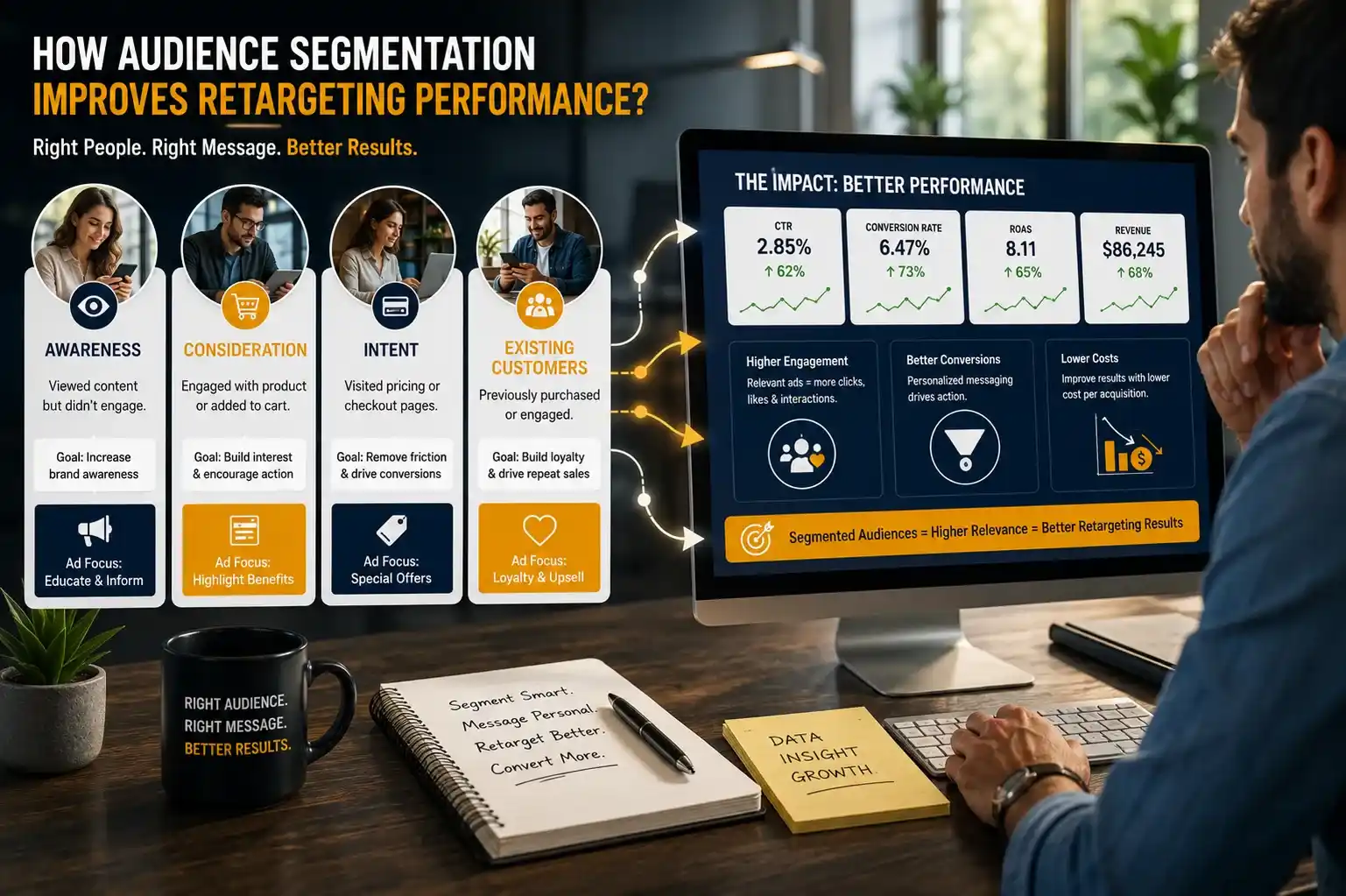
How Audience Segmentation Improves Retargeting Performance ?
The proper way is not to regard the audience as a demographic chart.
They regard it as a set of behaviors.
Segment by Behaviour :
Behaviour shows what the visitor really did.
For instance:
One page seen for ten seconds is not the same as five pages of services visited and a brochure downloaded.
Some important indicators of behaviour are: pages seen, products seen, days since last visit, number of visits, form usage, videos watched, cart actions, checkout actions, and previous purchases.
Segment by Intent :
Behaviour becomes more meaningful when it’s understood as intent.
A pricing page visit is more meaningful than a blog page visit.
A product comparison visit is more meaningful than a home page visit.
A checkout abandonment is more meaningful than a product page visit.
This means you can build an intent hierarchy:
Awareness → Consideration → Evaluation → Purchase → Retention
Your retargeting campaign needs to push people up this hierarchy rather than show them the same ad over and over.
Segment by Customer Status :
The existing client should be treated differently from the prospective one.
The former may require either cross-selling, upselling, replenishment offers, loyalty communications, educational information about the product, or referral marketing.
The latter requires motivations to become a client.
Such a classification takes on special significance when an enterprise utilizes services of a social media marketing agency together with paid media, since the same audience is able to communicate with both organic content and paid ads.
The more channels used, the greater the need for coordination of the audience.
How to Fix Retargeting Ad Fatigue ?
“Making more ads” is not necessarily the first solution.
Make more pertinent messages.
A system to test creativity could group variation into four categories:
| Variable | Examples |
| Hook | Problem, benefit, result, urgency |
| Proof | Review, case study, statistic, demonstration |
| Offer | Consultation, discount, bundle, guarantee |
| Format | Video, carousel, static, testimonial |
Alter only one major variable at a time if possible.
This will enable you to see exactly what makes performance better.
For instance, if the original creative of the campaign reads:
“Grow Your Business With Digital Marketing”
the subsequent creative should not read:
“Take Your Business To The Next Level.”
Such is merely a cosmetic alteration.
However,
“Your Google Ads Are Bringing In Leads—Are They Profitable?”
such raises a commercial issue.
The audience is aware of the brand.
The advertisement does not have to use all its space introducing itself.
It must show why the action should be taken.
Control Frequency :
This is why the frequency aspect needs to be considered, as retargeting will inherently limit the impressions to a smaller group of people. A custom software development company will be able to create tools for tracking and analyzing this audience behavior.
Google offers frequency capping possibilities for its Display & Video campaigns in order to control how often users get exposed to ads.
But don’t try to reach some kind of general frequency goal.
Evaluate frequency in terms of the conversion rate, CPA, CTR and revenue.
When CPA starts growing significantly with increased frequency, this means that the target audience is already saturated.
At this moment, you may update your creative, reduce audience life time, increase number of qualified audiences, create exclusions, move users through the funnel, decrease budget, or update the message.
As Google states, reducing data segment duration helps to get a fresher audience and, possibly, more conversions, but can also result in reduced audience size.
Match Retargeting Messages to the Customer Journey :
A much more effective retargeting strategy is when the message takes into account the reason why the prospect hasn’t converted yet.
Imagine a B2B service company.
A person reads an article on SEO but doesn’t contact the company.
First, he/she sees the message that provides useful content.
After visiting the page on SEO service, the next message is about methodology.
After visiting the page on prices or contact information, the next message talks about commercial objections.
The process may go as follows:
Content → Service → Proof → Objection → Conversion
With each step, one gets the next message.
It’s more sophisticated approach than just advertising the service over and over again.
A digital marketing company in Ahmedabad that works for local businesses can implement this framework in sectors such as health care, ecommerce, real estate, professional services, and education. The only thing that changes is the message, and the same logic applies: determine the intent and remove the barrier to entry.
Why Your Landing Page May Be the Real Problem ?
Retargeted visitors will often need less education compared to cold traffic.
Therefore, the landing page must be geared towards decision-making.
In case of a high-intent visitor, concentrate on the following:
Relevancy
It must be relevant to the ad.
Proof
Show cases studies, success stories, results, certifications, etc.
Clarity
Tell the visitor what they can get and what happens next.
Risk reduction
Address issues of cost, installation, support, guarantees, etc.
Action
Tell the visitor the next step to take.
In practice:
Every retargeting ad must lead somewhere.
If the ad speaks about a certain product, take the visitors to that product page.
If it speaks about consultation, direct them to the consultation page.
If it talks about checkout abandonment, direct them to the right purchase page.
Do not direct every retargeting visitor to the homepage
Retargeting Optimisation for Ecommerce Brands :

A unique benefit that comes with ecommerce retargeting is product level behavior. One will always be able to recognize the product categories and products that the individual has looked at, their shopping cart and checkout history, buying habits, past purchases, and even purchase frequency. Digital Marketing Company can capitalize on such information.
That allows for very precise targeting.
A person who saw the item but did not put it in their cart might need some convincing.
A person who put it in their cart and then left might need some friction taken out.
A person who just bought it should not really see the same acquiring ad anymore.
A simple ecommerce framework looks like this:
| User Behaviour | Retargeting Objective |
| Product viewed | Re-engage |
| Multiple product views | Reinforce value |
| Added to cart | Remove purchase friction |
| Checkout started | Recover purchase |
| Purchased | Retain / cross-sell |
| High-value customer | Increase lifetime value |
The trick lies in avoiding the equal importance of each customer.
A customer who has earned a lifetime value of $500 cannot necessarily be treated the same as one who has never bought anything.
Retargeting Optimisation for Lead Generation :
Generating leads needs a completely different mindset.
A lead does not always equal a worthwhile conversion.
A campaign might create many more forms but fewer qualified leads.
When dealing with service companies, consider the process after the conversion:
Ad click → Form fill → Qualified lead → Sales call → Proposal → Client
And that is when the use of CRM is crucial.
If Campaign A produces 100 leads for $20 each.
Campaign B produces 60 leads for $30 each.
At first glance, Campaign A seems better.
But imagine:
- Campaign A produces 10 qualified opportunities.
- Campaign B produces 25 qualified opportunities.
Campaign B is commercially stronger despite having a higher cost per lead.
This is why a sophisticated digital marketing agency should optimize for business impact over volume on the platform itself.
How Social Media Marketing Supports Retargeting ?
Retargeting need not exist independent of organic social media marketing.
Organic interaction can be an invaluable means of gaining insight into one’s audience.
Sprout Social shows you how the social engagement data and behavior of your audience can help you understand your customers’ interests. That helps support your idea that information from social media can help guide better retargeting efforts.
For instance, if there is a pattern of people asking about prices on organic postings, then the paid retargeting can include an answer to price-related objections.
Where audiences react highly to customer stories and testimonials, then retargeting can be based on testimonials.
Where educational content works well, the retargeting strategy can focus on educating potential customers.
This generates a cycle in which:
Organic content → Audience insights → Paid retargeting → Conversion data → Creative insights → Organic content
And this is much more powerful than having social media management and paid ads run separately.
How to Measure Retargeting Performance Correctly ?
Retargeting should not be analyzed only on the basis of clicks and impressions. Look at CTR, CPC, conversion rate, CPA, ROAS, number of qualified leads, and revenue to see if your campaigns have any real business value. Digital Marketing Services can assist you in connecting these metrics to the overall performance of your campaigns. In lead generation campaigns, combine data from advertising with CRM performance in order to know which campaigns deliver qualified leads and which ones generate more inquiries. The attribution and conversion analysis is also critical here.
A Practical Retargeting Campaign Recovery Framework :
When performance drops, use this six-stage recovery process.
Stage 1: Validate Tracking
Verify conversion tracking in Google Analytics, Google Ads, Facebook Pixel (Meta), and your customer relationship management tool. Bad tracking could mean making incorrect optimization choices.
Stage 2: Analyse Audience Quality
Examine your retargeting segments and exclude any that are not relevant or have already been converted. Segmentation can be done according to user behavior and intent.
Stage 3: Diagnose Frequency
See if your ads are being shown to many of your users. Increased frequency and reduced CTR/conversions can point towards ad fatigue.
Stage 4: Rebuild the Message
Revamp your Social Media Marketing Services approach by making advertisements which tackle today’s issues of your customers’ needs, concerns and buying motives.
Stage 5: Audit the Landing Page
Ensure that the landing page is aligned with the advertisement and offers a clear path for conversion. Enhance the offer, trust signal, and CTA when needed.
Stage 6: Measure Commercial Outcomes
Conversions, quality leads, cost per action and revenue must be prioritized over just impressions and clicks. Retargeting optimization must be oriented towards business performance metrics.
When Should You Rebuild Your Retargeting Campaign ?
The case where you may need to reconstruct your retargeting campaign is where there is continued poor performance even after optimization. Such poor performance may occur due to very wide audience segmentation, tracking problems, out-of-date creatives, or where your campaign is not matching the customer journey anymore. Where there have been major changes such as behavioral changes by the audience, changes in the offer, changes in landing pages or change in the goal of your business, reconstruction may be the solution. This can be done through a Digital Marketing Company.
How a Digital Marketing Company in Ahmedabad Can Help Fix Retargeting ?
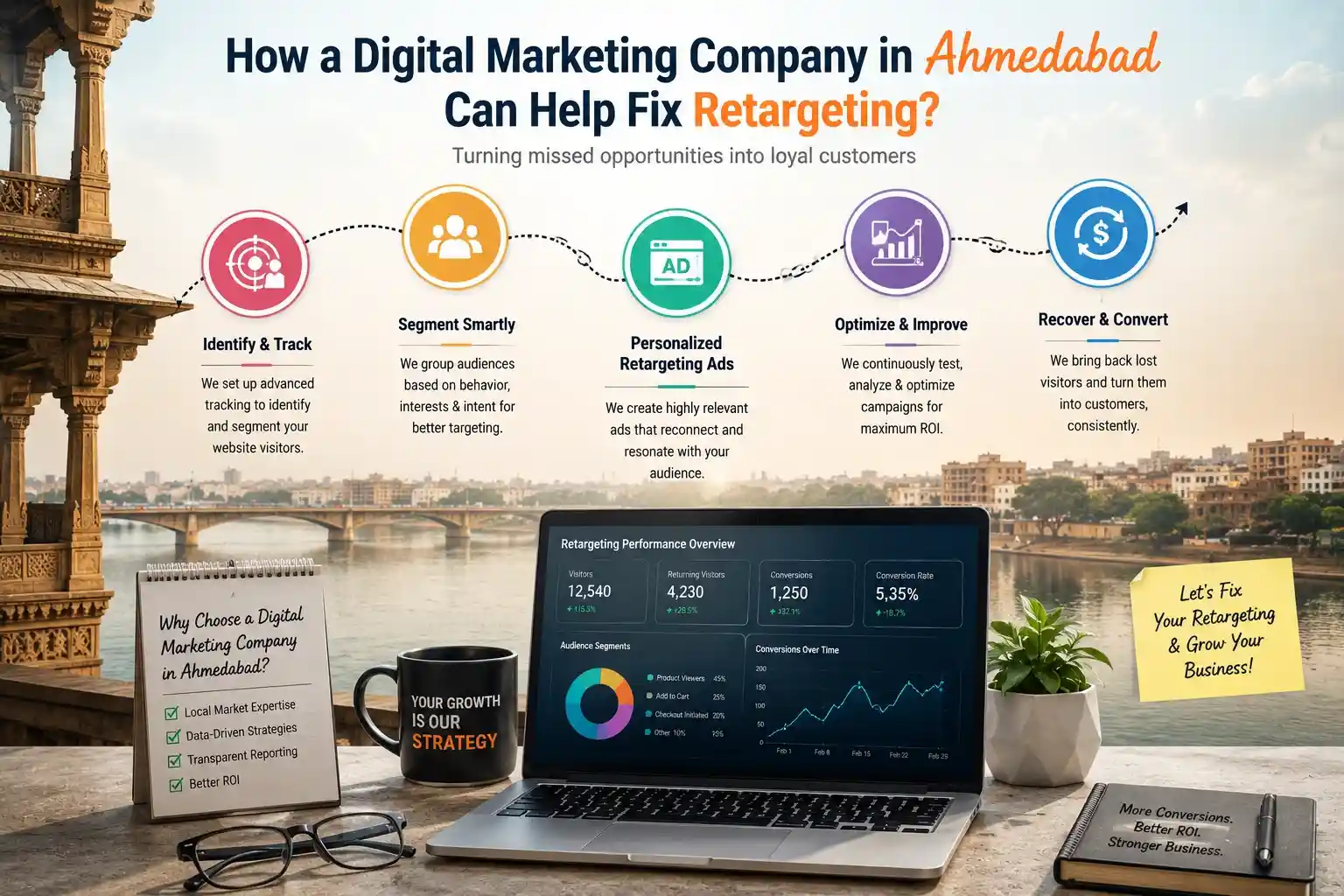
Firms frequently seek professional help when their advertising performance seems challenging to assess.
The worth of an experienced agency cannot just be the ease of using advertising channels. The majority of advertising channels are quite easy to use.
What actually counts is building a system linking together:
Targeting + creativity + landing pages + measurement + attribution + sales figures + optimisation.
It is only natural for such a team to figure out what caused a change in performance first.
This is especially true in the case of ecommerce brands where retargeting is supposed to make that connection between advertising efforts, product awareness, and behavior.
A Simple Retargeting Audit You Can Run This Week :
Begin by analyzing the size of the target audience for your retargeting campaign, the frequency of exposure, CTR, conversion rate, CPA and ROAS to determine where the performance has been lacking. Confirm if your target audience includes irrelevant or converted prospects, if the same creatives are repeatedly exposed, and if your landing pages align with your advertisements. Web App Development Services may also be of help in improving the landing page experience and the tools associated with your campaign. Ensure that the conversion tracking is set up properly and that you compare your current performance with past performance in similar periods.
The Bigger Lesson: Retargeting Is a Customer-Journey Problem
Retargeting should not be considered only a method of showing ads to users who have been to your site already. It is an important stage in a larger process, during which each step brings the user one step closer to converting. The user could find out about your brand via SEO, interact with your social media account, visit the services page and come back via the retargeting ad. An efficient marketing team knows these stages and creates messages according to the current user intention and not by constantly showing him/her the same ad. By linking retargeting with social media, search and landing-page optimization, the company can create a more relevant path via Digital Marketing Services.
Final Takeaway :
Asking yourself “Why aren’t my retargeting ads converting anymore?” doesn’t necessarily mean that your advertising platform is the reason for this lack of conversions.
Go back to the basics.
It could be that your target market is just tired. Your segmentation is too wide. The creative is outdated. The offer isn’t as good as it used to be. The landing page is causing friction. You’re using incorrect conversion tracking. Or maybe your audience just acts differently than they did during the launch of your campaign.
The best retargeting campaigns revolve around intention, relevancy and progress.
Rather than asking:
“How do I get this individual to see another ad?”
ask:
“What is it that needs to happen before this person is ready to make the next move?”
This question transforms the whole marketing campaign.
In addition to those evaluating a marketing partner, this is also the standard by which performance partners should be measured. The partner you choose shouldn’t just tell you how many impressions, clicks, and conversions there have been; he/she should tell you why things have changed, what the numbers mean, and what to do about it next. That’s where a Digital Marketing Company in Ahmedabad comes in.
Retargeting is most effective when it ceases to operate as an iteration of ads and becomes a continuation of the customer’s journey.
And where the campaign fails to convert, the answer is seldom to raise one’s voice.
The answer is to become more relevant.