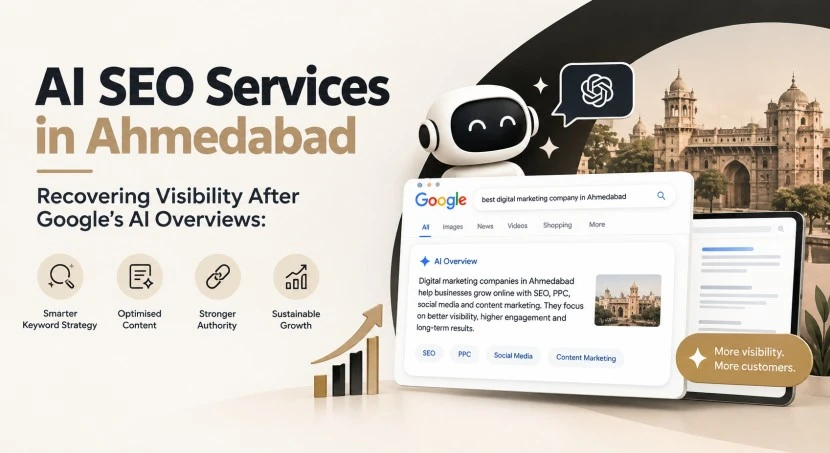
Recovering Visibility After Google’s AI Overviews:
You didn’t lose your rankings. That’s the part that confuses most business owners when they first notice the drop. The keyword is still on page one, the technical audit still comes back clean, and yet the phone has gone quieter and the contact form fills up slower than it did eighteen months ago. What’s changed isn’t your position on the page. It’s what sits above it.
Digifinity is a digital marketing agency in Ahmedabad, and this is now one of the most common conversations we have with clients. Our ai seo services exist specifically for this shift: businesses ranking well by the old rules and losing ground anyway, because Google’s AI Overviews now answer the question before anyone reaches the blue links. According to Google Search Central’s own documentation, AI Overviews and AI Mode use a technique called query fan-out, issuing multiple related searches across subtopics to construct a single generated answer. Your page can be technically perfect and still get summarised out of the click entirely.
This isn’t a niche problem confined to publishers or news sites. It reaches CA firms, D2C brands, SaaS companies and local service businesses alike, anywhere a search question can be answered in a paragraph rather than a page visit.
Why Your Traffic Dropped: The AI Overviews Shift?
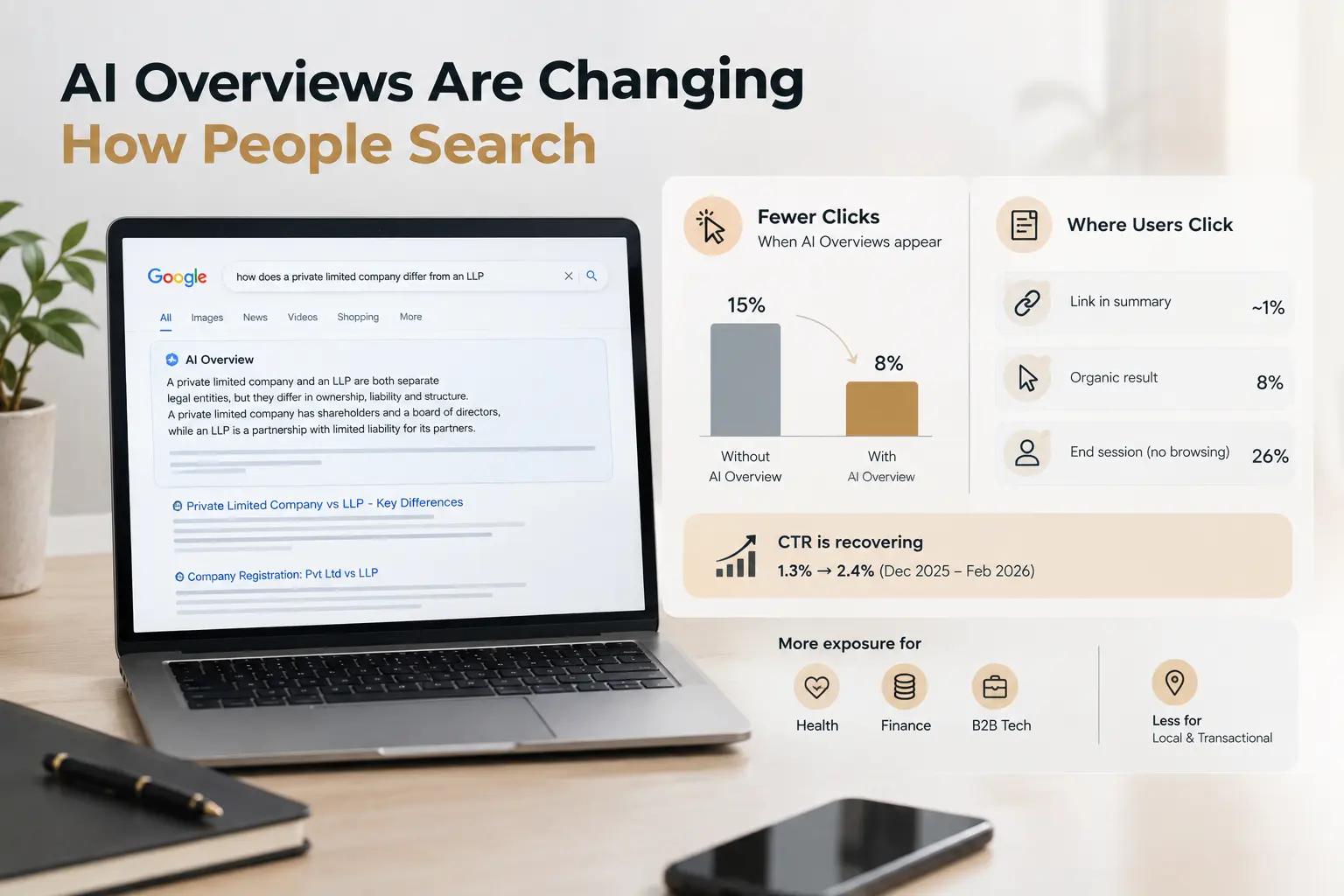
Search hasn’t stopped working. It’s stopped sending traffic the way it used to for a large slice of queries. Google now displays an AI-generated summary above the organic results for a meaningful share of searches, and when that summary appears, fewer people scroll down to click a link. Pew Research Center tracked this directly: in their analysis of real browsing data from 900 US adults, users clicked a traditional search result just 8% of the time when an AI summary was present, compared with 15% when it wasn’t roughly half the click rate.
The effect compounds depending on how informational your content is. Pages built to answer a direct question (how does X work, what is the cost of Y, which option is better for Z) are exactly the pages AI Overviews are designed to summarise. Purely commercial, high-intent pages are less exposed, but even they aren’t immune once AI Mode and conversational search grow.
Data points from Pew Research Center’s browsing panel study, and consistent with wider industry tracking. One Search Engine Land report on Seer Interactive’s research found organic CTR for informational queries had fallen 61% since mid-2024 when an AI Overview was present, with even non-AI-Overview queries showing softer clicks. The picture isn’t static, though. A follow-up Search Engine Land piece tracked CTR climbing from 1.3% in December 2025 to 2.4% by February 2026 on AI Overview queries, an early sign that users are adapting and that being cited still carries value, just not the value it used to.
What this means practically: the businesses recovering fastest aren’t the ones abandoning SEO. They’re the ones restructuring content so it earns citation inside the AI answer and still gives searchers a reason to click through for the detail the summary can’t fit.
There’s also a vertical dimension to this that generic advice tends to skip over. Health, finance and B2B technology queries trigger AI Overviews far more often than local service or transactional searches, which means a CA firm answering “how is a private limited company taxed differently from an LLP” is more exposed than a restaurant fielding “best thali near me.” Knowing where your own query mix sits on that spectrum changes how aggressively you need to act, and it’s usually the first thing worth mapping before touching a single page.
The other pattern worth naming honestly: not every drop in traffic is an AI Overview problem. Seasonal demand, algorithm updates unrelated to AI features, technical regressions after a site migration, these all produce similar-looking graphs. Part of a proper diagnosis is ruling these out first, rather than assuming AI Overviews are to blame simply because the phrase is everywhere in marketing conversations this year.
Ready to Recover the Traffic AI Overviews Took?
Get a clear audit of where you’re losing clicks and what it will take to earn them back.
What AI SEO Services Actually Cover?
AI SEO, sometimes called AEO or GEO depending on which analyst you’re reading, isn’t a replacement discipline sitting apart from traditional SEO. It’s traditional SEO fundamentals, applied with a second target: not just ranking in the ten blue links, but being the source an AI system chooses to cite, summarise, or recommend when it constructs an answer.
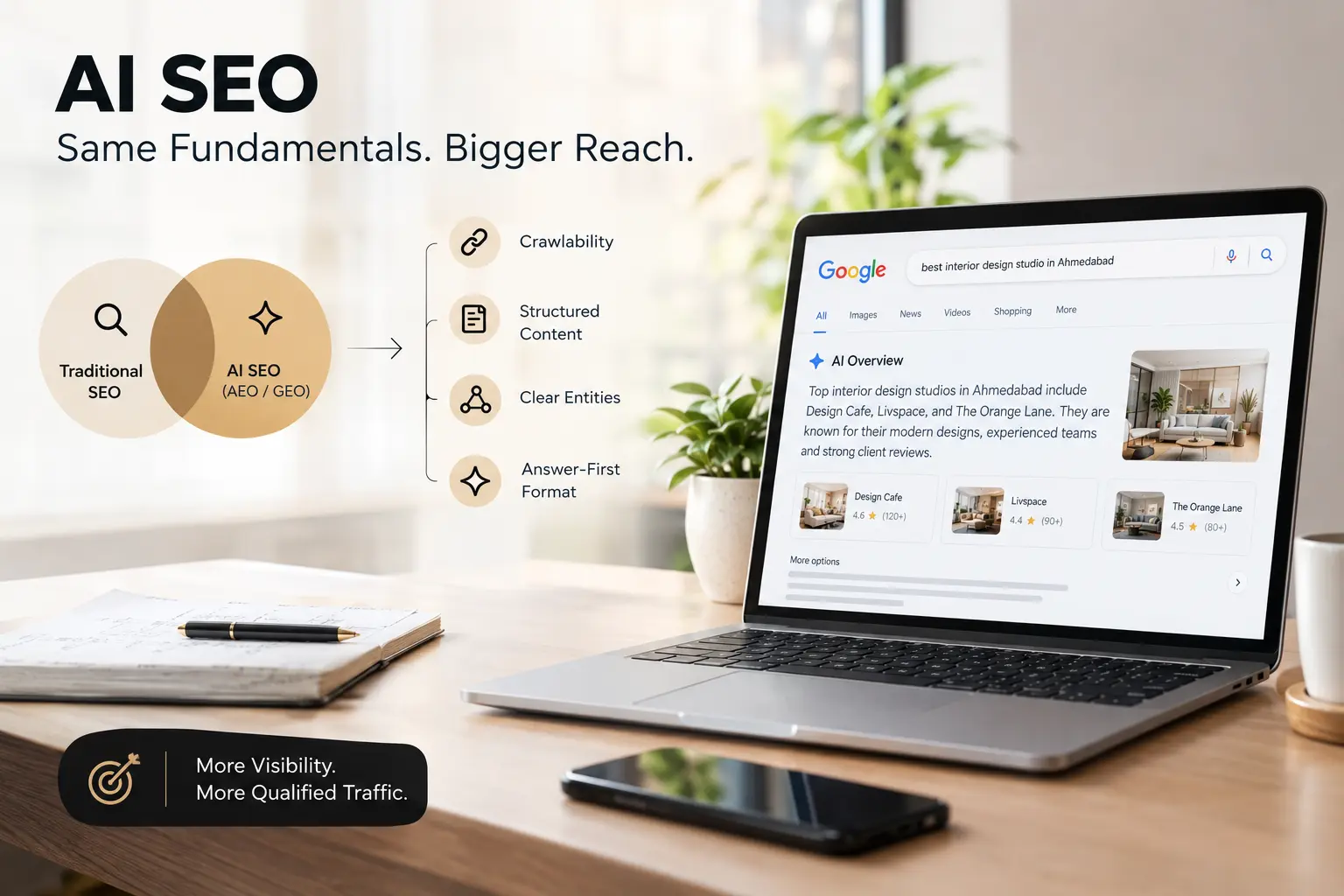
That means the work still starts with the basics Google itself points to crawlability, structured internal linking, content that resolves a specific question clearly but it’s layered with newer requirements: content structured for extraction, clear entity signals, answer-first formatting, and a site architecture an AI system can parse without ambiguity. Our seo services in Ahmedabad work now build this in as standard, rather than treating it as an add-on service.
The businesses that get this wrong usually make one of two mistakes. They either chase AI citations at the expense of the commercial pages that actually convert, or they ignore AI search entirely and watch their informational traffic erode quarter after quarter. Neither is a strategy. The right approach treats AI visibility as one more surface to earn trust on, alongside classic organic rankings, not instead of them.
Core Components of Our AI SEO Services:
AI Overview visibility audit: mapping which of your existing pages already trigger AI Overviews, and where you’re losing citation to competitors
Answer-first content restructuring: rewriting key pages so the direct answer sits in the first few lines, with supporting depth beneath it
Entity and schema clarity: strengthening structured data so AI systems can correctly identify what your business does, where, and for whom
Citation-worthy content architecture: building topic clusters that give AI systems multiple reasons to reference your site rather than a single thin page
Technical crawlability review: the same fundamentals Google’s own guidance points to, checked and fixed properly rather than assumed
Ongoing AI SERP tracking: monitoring not just rankings but whether and how often you’re being cited inside generated answers
Benefits and Business Impact:
The immediate benefit clients notice is stabilisation. Traffic that was sliding month over month flattens out, then starts recovering, because the pages most exposed to AI Overview summarisation get restructured to still earn a click. But the deeper benefit is qualitative. Visitors who do click through after seeing an AI summary tend to be further along in their decision, since the AI has already answered the basic question for them. AI-referred traffic converting at a noticeably higher rate than average organic traffic is a pattern showing up consistently across industry data through 2026, and it lines up with what our own clients are reporting once their citation rate improves.
There’s a compounding effect too. A site that earns AI citations on informational content tends to build the same entity trust signals that help with local pack rankings, voice search and even how confidently a performance marketing companies campaign can retarget an already-informed audience. It’s not a channel that operates in isolation from the rest of your marketing.
There’s also a defensive benefit that’s easy to underrate until you’ve seen the alternative. Businesses that leave their content untouched aren’t standing still; they’re gradually losing ground to competitors who are earning citations in their place. We’ve seen this play out across a jewellery brand, an overseas education consultancy and a logistics operator in the past year alone, each in different sectors, each seeing the same underlying pattern once their query mix was mapped against current AI Overview coverage. None of them needed a complete rebuild. What they needed was a clear-eyed audit and a prioritised list of which pages to fix first, because trying to restructure an entire site at once is usually a waste of budget when a handful of high-traffic pages are doing most of the damage.
How Our AI SEO Process Works?
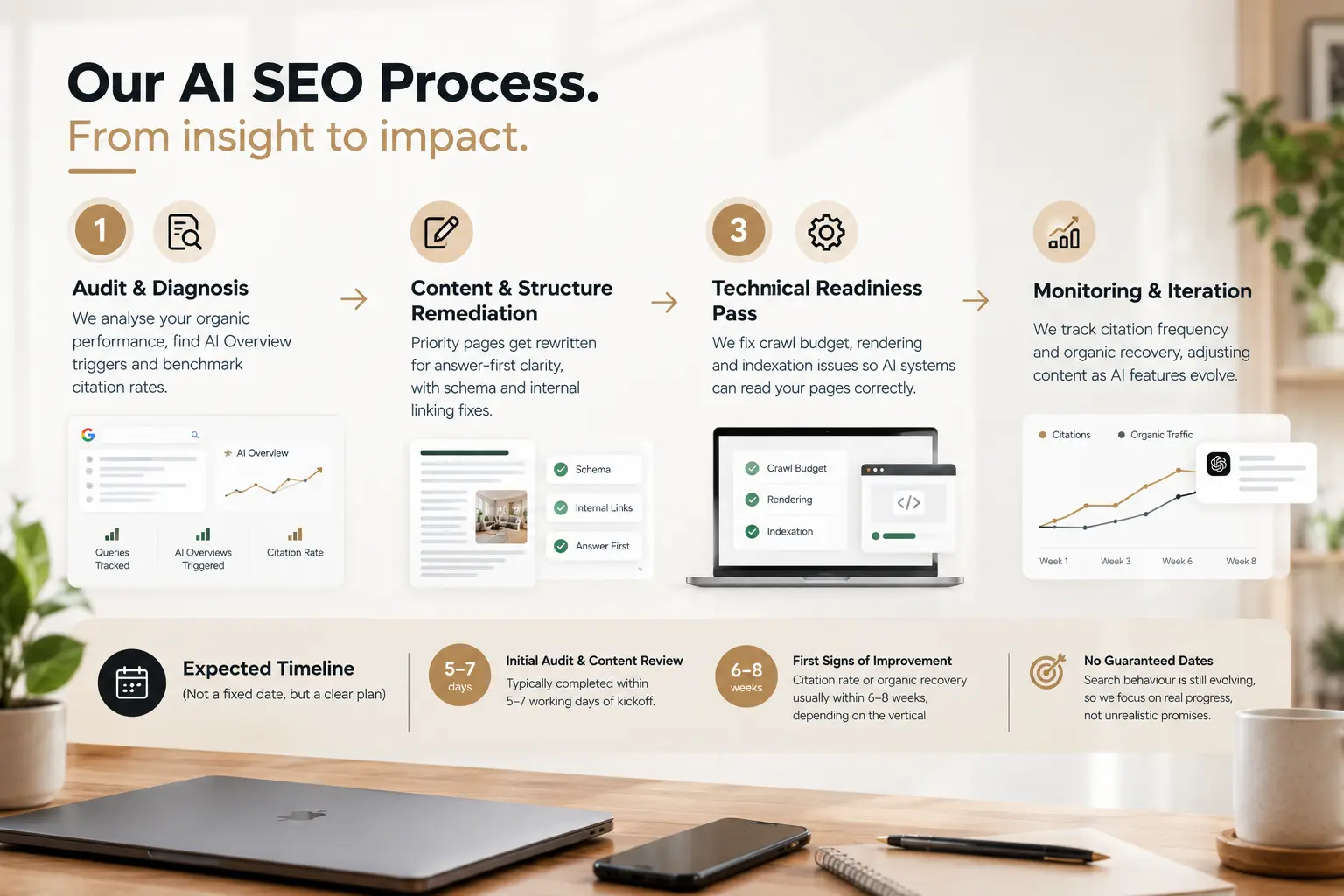
Audit and diagnosis: We pull your existing organic performance, identify which queries are triggering AI Overviews against you, and benchmark current citation rates.
Content and structure remediation: Priority pages get rewritten for answer-first clarity, supported by schema and internal linking fixes.
Technical readiness pass: Crawl budget, rendering, and indexation issues get resolved so nothing blocks AI systems from reading the page correctly.
Monitoring and iteration: We track citation frequency and organic recovery on a rolling basis, adjusting content as Google’s AI features evolve.
Two things clients usually want to know upfront, and we tell them plainly rather than overselling the timeline:
Initial technical and content audit: typically completed within 5–7 working days of kickoff
First measurable shifts in citation rate or organic recovery: usually observable within 6–8 weeks, depending on how competitive the vertical is
We don’t promise a fixed date for full recovery, because no one honestly can. Search behaviour is still moving, and any agency claiming a guaranteed AI ranking is telling you what you want to hear rather than what’s true.
Why Choose Digifinity?
There are a lot of agencies in Ahmedabad claiming AI SEO expertise right now, mostly because the phrase is trending. What’s harder to find is a team that treats this as an extension of solid SEO fundamentals rather than a gimmick sold on top of a generic content calendar.
We work across sectors CA firms, D2C brands, healthcare, education, logistics and the pattern holds everywhere: businesses that ignored the AI Overview shift for a year are now paying more, in time and budget, to catch up than they would have spent addressing it early. We’d rather have an honest conversation with you now. That includes being clear when a client’s site also needs foundational work, whether that’s a website design company rebuilding because the current site can’t support the content structure AI systems need, or an ecommerce website design overhaul because product pages are too thin to earn any citation at all.
If you’re seeing the traffic drop and can’t explain it from your rankings alone, that’s usually the AI Overview effect. The fix isn’t panic. It’s a structured, honest look at what’s actually happening on the SERP, followed by work that earns visibility on both the old search and the new one.
Four years in, we’ve stopped pretending every client needs the same fix. Some come to us with a technically sound site where only the content needs restructuring. Others have a platform that was never built to support the depth or structure this moment demands, in which case the honest recommendation is development work before content work, not after. Either way, the starting point is the same: an audit that tells you, in plain terms, where your traffic is actually going and what it will realistically take to bring it back.