
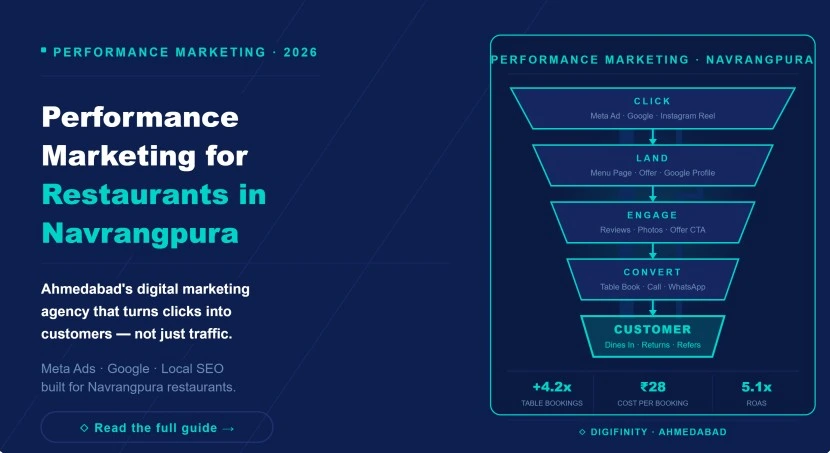
Get Found First When Ahmedabad Searches for a Marketing Partner That Actually Delivers:
Hire a digital marketing agency in Ahmedabad the way most businesses do, and you already know the pattern. A promising kick-off call, a flurry of reports full of impressions and reach, then six months of quiet before an email asks whether you’d like to renew. Nobody ever quite explains why the phone stopped ringing.
That gap is basically the whole problem with how marketing gets sold in this city. A restaurant in Navrangpura isn’t just competing with the place two streets over anymore. It’s up against every Zomato listing, every Reel showing up in someone’s feed, every paid ad sitting above the map pack on Google. Same story for a showroom on CG Road, a manufacturer exporting out of the industrial belt, or a D2C brand trying to build a national footprint from a Gujarat base. According to Google’s own SEO Starter Guide, businesses that treat their online presence as a single connected system, rather than separate SEO, ads and social projects, consistently outrank the ones that don’t. Which is probably why so many businesses get decent traffic and flat revenue at the same time.
Not sure where your current marketing spend is actually leaking? A quick account and website audit usually shows exactly where the money’s going, and where it isn’t. Explore our services.
Why Marketing in Ahmedabad Doesn’t Work the Way It Used To?
Vanity metrics used to get a pass. Nobody could easily trace a rupee spent to a rupee earned, so an agency showing you reach and impressions felt like proof of something. That excuse doesn’t really hold anymore. Attribution tools, call tracking and CRM integrations mean a business owner can now see, almost in real time, whether a campaign’s actually working or just running.
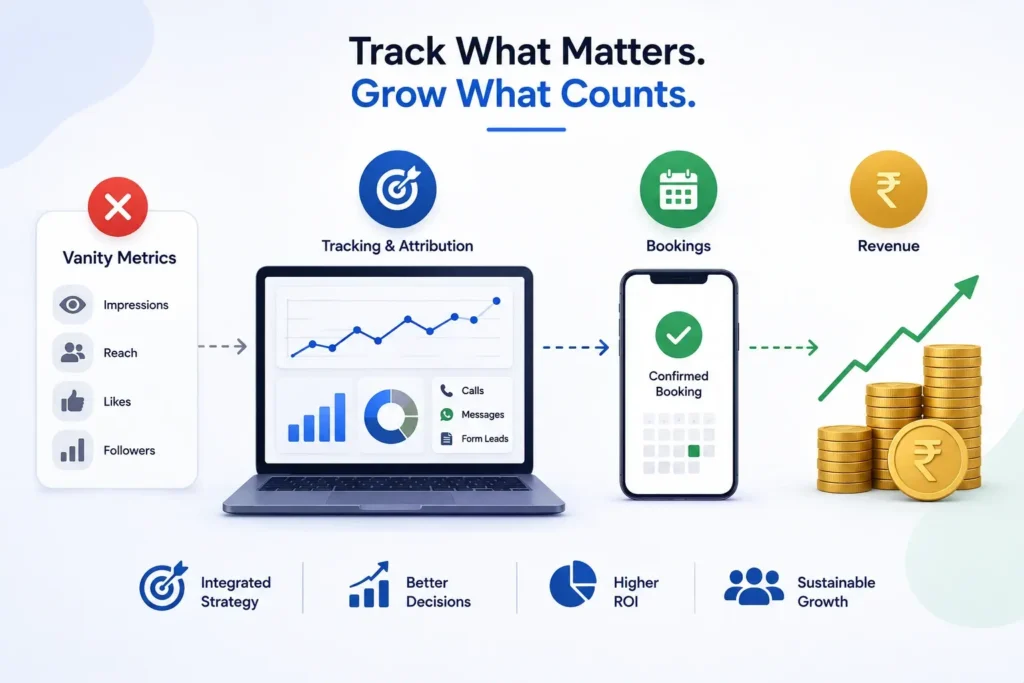
A few signs tend to show up together when that gap’s been left unchecked for too long:
- Reports full of impressions and reach with nothing tying back to bookings or actual revenue
- SEO, ads, social and the website handled by different people who never really talk to each other
- A Google Business Profile that hasn’t been touched since it was set up
- Cost per lead climbing every quarter with nobody able to say exactly why
Most businesses we onboard have already paid someone else to learn this the hard way, and the complaints repeat themselves fairly predictably. A restaurant doesn’t care how many people saw an ad; it cares how many tables filled up on a Friday night. None of the pieces above talk to each other in most setups, so the brand experience ends up inconsistent and the data never rolls up into anything usable.
Ahmedabad’s own competitive set has matured quickly too. Businesses that treated their Google Business Profile as an afterthought a couple of years ago are now losing ground to competitors who treat performance marketing as a discipline rather than a task someone handles on the side.
Are your restaurant’s ads eating into your budget without packing the house?
A performance marketing audit breaks down exactly where you are losing money and which campaigns will actually fill your tables.
Explore Our ServiceWhat Working With Us Actually Looks Like?
We start every engagement with an audit, not a pitch. Nobody gets a channel recommendation before we’ve actually looked at your current search visibility, your competitors’ spend patterns, your website’s technical health and whatever customer data already exists. Strategy built on assumptions is expensive. Strategy built on evidence is repeatable, and honestly, most of the difference between an agency that works and one that doesn’t comes down to which of those two it’s actually doing.
From there, one team runs every channel in parallel rather than handing pieces off to different vendors who never quite talk to each other. Our SEO Services in Ahmedabad, your paid campaigns, your social content and your site all pull from the same data and the same goals, so a landing page built for a Google Ads campaign also holds up for organic search, and a promotion running on Instagram shows up correctly on the website and the Google Business Profile at the same time.
Search visibility carries more weight here than most business owners assume. Search Engine Journal’s research into local buying behaviour keeps pointing to the same pattern: a large share of nearby purchase decisions start with an online search, well before anyone walks in or picks up the phone. A business that’s invisible at that moment isn’t losing a click. It’s losing the customer entirely, often to a competitor who simply showed up first.
Not Every Ahmedabad Business Needs the Same Marketing Mix:
Ahmedabad isn’t one market, and treating it like one is probably the fastest way to burn through a budget without much to show for it. A restaurant in Navrangpura, a jewellery showroom on CG Road and a B2B manufacturer exporting out of the industrial belt aren’t competing for the same customer, the same search intent, or even the same buying timeline, yet plenty of agencies still run near-identical strategies across all three because it’s easier than building something specific.
Restaurants and cafés live and die on local intent. Someone searching “restaurants near me” tonight isn’t researching, they’re deciding, which means Google Business Profile accuracy, review volume and geo-targeted ads matter more than a beautifully written blog post nobody’s going to read before dinner. Retail and D2C brands sit further up the funnel. Buyers compare, scroll, screenshot, come back a few days later, so retargeting and content that builds trust over multiple visits earns its keep here in a way it wouldn’t for a restaurant. Service businesses and B2B, manufacturers, consultancies, exporters, tend to have a longer, more considered sales cycle again, often involving a phone call or a site visit before anything’s signed, so lead quality matters far more than lead volume.
Roughly, it breaks down like this:
| Business Type | Where the Budget Should Go First | Typical Decision Window | What Actually Matters |
| Restaurants & cafés | Local SEO, geo-targeted ads, Google Business Profile | Same day to a few days | Table bookings, footfall, delivery orders |
| Retail & D2C brands | Paid social, retargeting, content | A few days to a few weeks | Cart adds, repeat purchase rate, AOV |
| Service businesses & B2B | Search, LinkedIn, case study content | Weeks to a couple of months | Qualified calls booked, not raw lead count |
Run the same ad set, same creative and same messaging across all three, and the blended numbers can still look perfectly fine on a monthly report. That’s the trap. Decent averages are very good at hiding genuinely poor performance sitting inside each individual segment.
Worth knowing the scale you’re competing in, too. Dentsu’s annual report on India’s advertising industry has tracked double-digit year-on-year growth in digital ad spend for several years running, and a growing share of that is shifting away from print and hoardings straight into search and social. More budget entering the same auction generally means the cost of getting noticed only goes up from here, particularly around festival and wedding season.
Where Most Digital Marketing Spend in Ahmedabad Actually Goes Wrong?
A few mistakes show up often enough across the businesses we onboard that they’re worth naming directly, since most of them are avoidable and none of them are particularly complicated to fix once someone’s actually looking.
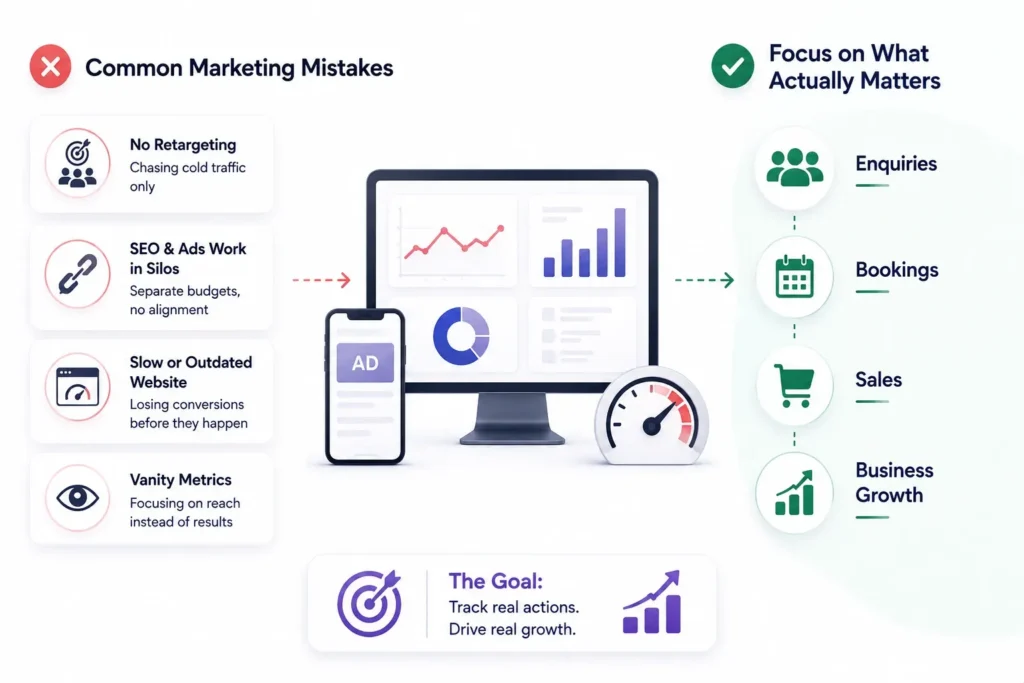
- Running paid ads without ever building a retargeting layer, so the entire budget chases first-time visitors who convert at a fraction of the rate warm traffic does
- Treating SEO and paid media as two separate budgets that never inform each other, even though a keyword expensive to rank for organically is usually just as expensive to bid on through Google Ads
- Sending paid traffic to a slow or outdated website, which undoes most of the work the ad just did
- Measuring success by reach or impressions instead of actual enquiries, bookings or sales
That last one’s the one we see most often, and it’s oddly the easiest to fix once someone’s willing to look past the vanity numbers. Reach tells you who saw something. It doesn’t tell you who bought anything.
How SEO and Paid Media Actually Reinforce Each Other?
Paid and organic aren’t really competing for the same job, even though budgets often get split as if they are. A customer who sees your ad but doesn’t convert on the spot will frequently go and search your brand name, or the product category, on Google before deciding anything. If the organic presence at that point is thin or missing entirely, the click you already paid for effectively goes to waste, sometimes straight to a competitor who happened to rank where you didn’t.
This compounding effect gets stronger the longer both channels run together. Paid data shows which keywords and audiences actually convert, which then sharpens what the SEO content strategy prioritises. Organic rankings, once they’re established, reduce how hard the paid budget has to work to stay visible for the same terms. Businesses that fund only one side of that loop tend to plateau faster than the ones building both at once.
What This Means for the Business, Not Just the Dashboard?
Working with one accountable partner instead of three disconnected vendors tends to show up in three places. Cost per acquisition falls over time because search and paid media start reinforcing each other instead of competing for the same budget line, which is a big part of why we run as a dedicated Performance Marketing Agency alongside SEO rather than treating them as separate line items. Lead flow gets more predictable because campaigns are optimised against a shared data set rather than isolated platform metrics that don’t talk to each other. And the digital presence starts compounding, since a website ranking well organically means the paid budget doesn’t have to work as hard just to fill the gap.
Running a restaurant and tired of ads that generate likes instead of bookings? Talk to our restaurant marketing team, they’ll walk you through what a campaign built around footfall actually looks like.
How Does Work Actually Get Done?
- Discovery and audit, reviewing the current digital footprint, competitors and whatever customer data already exists before recommending anything
- Strategy and channel mapping, deciding which channels earn budget first, based on where the customers actually are rather than where it’s easiest to run ads
- Build and launch, websites, apps, campaigns and content going live on a shared timeline instead of in silos
- Optimise and scale, weekly and monthly reviews against revenue metrics rather than vanity ones, with budget shifted toward whatever’s actually working
The optimise-and-scale stage is where most of the actual gains happen, and it’s also the stage agencies tend to under-invest in once a campaign’s technically “live.” A launch that goes reasonably well in week one still needs weeks of adjustment, creative rotation and budget reallocation before it’s running anywhere close to efficiently, and treating launch as the finish line rather than the starting point is a quiet, common way results plateau early.
Tools We Work With:
Google Ads, Meta Ads Manager, Google Analytics 4, Search Console, SEMrush, Ahrefs, HubSpot and Zoho CRM sit alongside modern development stacks for websites and apps, React, Next.js, Flutter and native iOS and Android frameworks depending on the project.
What Does This Actually Cost?
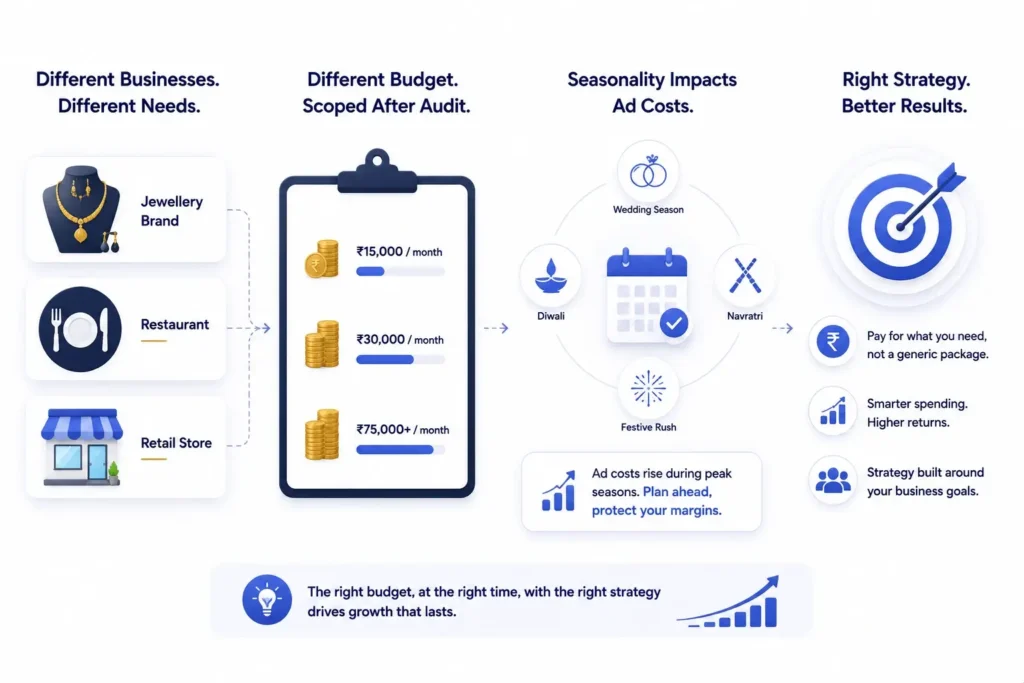
Jewellery brands and restaurants don’t need the same budget, and neither do a single-location business and a multi-city retail chain. A restaurant running local ads and basic SEO on a ₹15,000 monthly spend doesn’t need enterprise-grade reporting dashboards built for a retail brand doing ₹50 lakh a month in online sales, and pricing both the same way would shortchange one and overcharge the other. So rather than publish flat packages that rarely fit anyone accurately, we scope pricing after the audit. You end up paying for a strategy built around your business, not a generic retainer everyone gets regardless of what they actually need.
Seasonality matters here too, more than most first-time clients expect. Wedding season, Diwali, Navratri and the run-up to major festivals push cost-per-click up sharply across almost every category in Ahmedabad, as every local business competes for the same audience at the same time. Kantar’s festive season research has tracked this same spike in ad auction pricing across Indian markets for years running, which is exactly why planning budget increases ahead of those windows, rather than reacting once costs have already climbed, tends to protect margin far more effectively than scrambling mid-campai
Why Do Businesses in Ahmedabad Stick With Us?
Most agencies here specialise in one or two channels and quietly outsource the rest, which is exactly where accountability tends to fall apart. Keeping search, paid, social and development in-house, including working with a top website development company in India internally rather than farming builds out, means there’s no handoff for responsibility to get lost in. Reporting stays tied to revenue and bookings, not impressions. And being based in Ahmedabad ourselves means understanding the local search behaviour, the festival and wedding-season spending patterns, and the actual competitive set a business is up against, insight that’s genuinely hard to replicate from an agency running things out of another city.