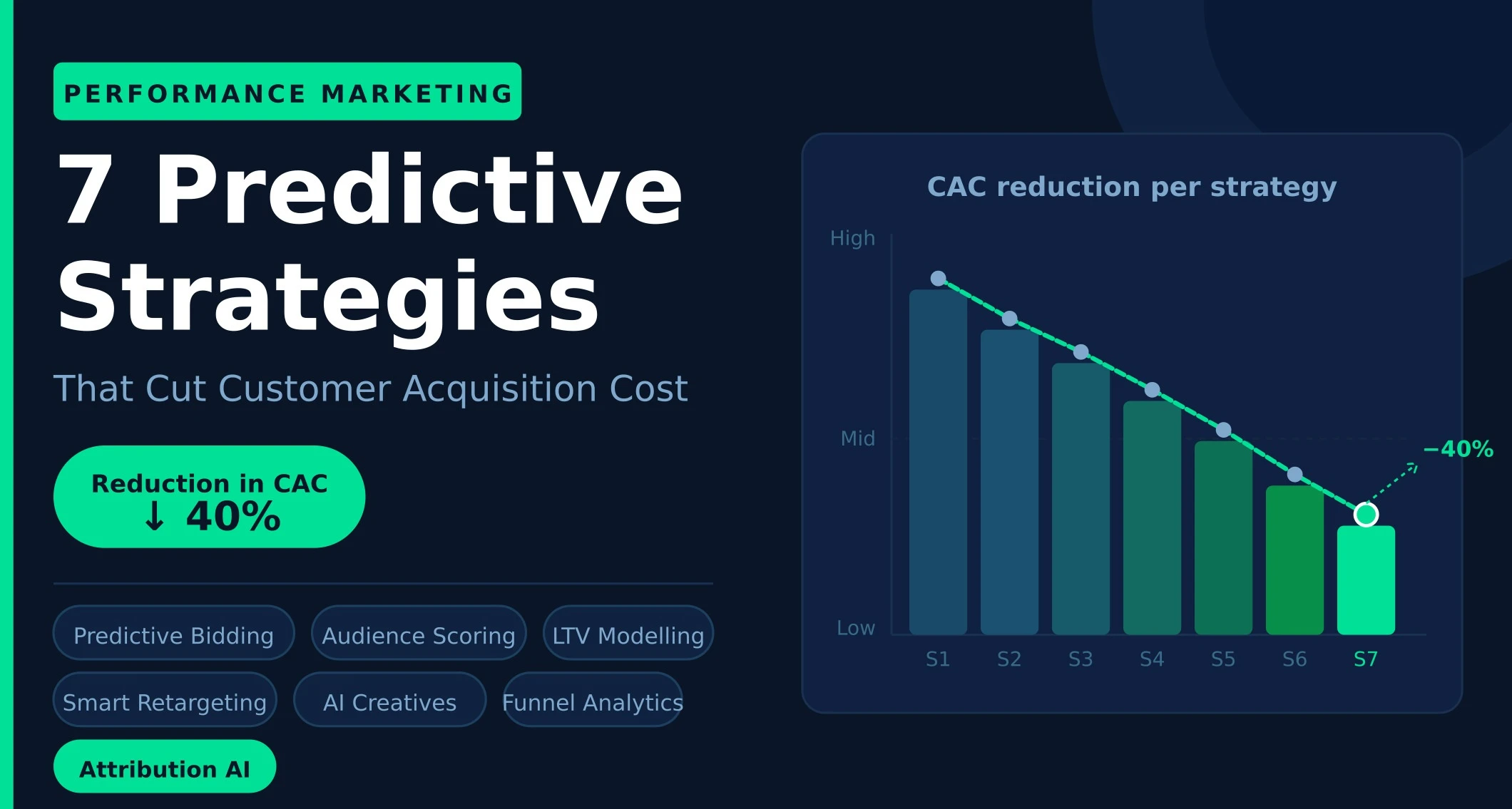
Digital Marketing Company in Ahmedabad: Cut CAC 40% & Boost ROI via AI
Digital Marketing Ahmedabad: Stop Burning Ad Budget
Let’s start with something most businesses don’t want to hear.
They are not losing money because marketing doesn’t work.
They are losing money because they don’t understand what is actually working.
On paper, everything looks fine. Campaigns are running. Ads are getting clicks. Leads are coming in. Dashboards look active.
But behind that surface-level data, something very different is happening.
Customer Acquisition Cost keeps rising. Conversion quality keeps dropping. ROI becomes inconsistent.
I’ve seen this pattern repeatedly across businesses spending anywhere from ₹1 lakh to ₹50 lakh per month. The problem is not lack of data; the problem is that most brands react to data instead of predicting outcomes.
This is where the approach of a modern Digital Marketing Agency in Ahmedabad becomes very different. Instead of waiting for campaigns to fail, it identifies patterns early and adjusts before losses grow.
That is the real foundation of predictive performance marketing.
According to McKinsey research, companies using predictive analytics in marketing reduce acquisition costs by up to 40 per cent. But the real insight is not the tool itself; it is how deeply you understand user behaviour before spending money.
Explore our eCommerce growth solutions to boost conversions, optimize performance, and drive long-term scalable revenue growth.
Discover more services tailored to accelerate your business success online.
Explore Our ServicesWhy CAC is Increasing ? (Even When Your Campaigns Look Fine)

Most marketers assume everything is fine because numbers look stable on the surface.
Traffic is coming in. Ads are running. Leads are being generated.
But CAC still increases quietly.
The reason is simple: the digital ecosystem has changed.
Competition has increased significantly across every industry. More advertisers are fighting for the same audience, which automatically increases cost per click and cost per acquisition.
At the same time, user behaviour has changed. People no longer click impulsively; they compare options, research deeply, and delay decisions.
Privacy changes like iOS updates and cookie restrictions have reduced tracking accuracy.
Most campaigns also rely on outdated targeting logic, which fails to capture real intent.
Even HubSpot reports that over 60 per cent of marketers have seen a consistent rise in CAC year over year.
The reality is simple: marketing is becoming more expensive not because platforms are broken, but because strategies are outdated.
Strategy 1: Predictive Audience Segmentation (Stop Guessing Your Audience)
Let’s be honest.
Most audience targeting is still based on assumptions.
- “Our audience is 25–40 years old”
- “They’re interested in fitness”
- “They live in metro cities”
That’s not enough anymore.
Most targeting still starts with assumptions: age group, location, interests, income bracket.
But these are not predictive signals anymore.
According to Predictive segmentation works differently. Instead of asking who might buy, it focuses on who is most likely to buy right now.
A strong Social Media Marketing Agency in Ahmedabad builds audience clusters based on actual behaviour such as website activity, engagement patterns, and purchase signals.
Instead of one broad audience, users are divided into meaningful groups like high-intent visitors, returning users, price-sensitive browsers, and cold traffic.
We implemented this approach for a skincare D2C brand. Initially, their campaigns were targeting a broad audience. After shifting to behavioural segmentation, budget was redirected towards high-intent users, weak segments were paused, and overall CAC dropped by 36 per cent.
The key shift was simple: we stopped guessing and started reading behaviour.
Strategy 2: AI-Driven Media Buying (Manual Optimisation is Slowing You Down)
One hard truth in performance marketing is that manual optimisation is no longer fast enough.
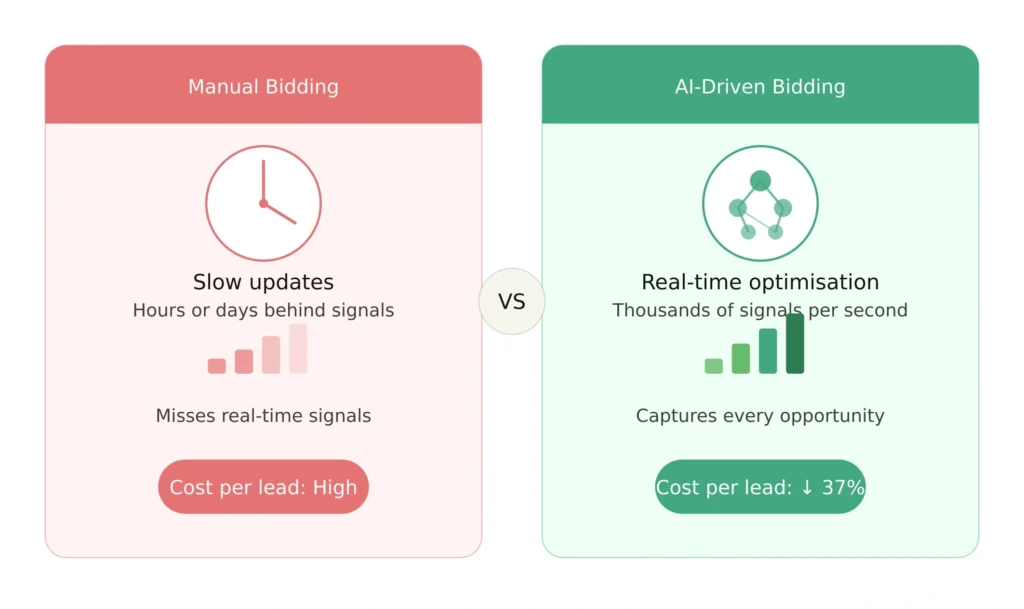
Platforms like Google Ads process thousands of signals in real time. These include behavioural patterns, device usage, time signals, and conversion probability models.
A modern Performance Marketing Agency AI-driven bidding systems that adjust in real time instead of waiting for manual updates.
We tested this on a live campaign where everything remained identical except for bidding logic. Manual bidding versus AI-based bidding produced a 37 per cent lower cost per lead in the AI version, along with better lead quality.
Even Google confirms that automated bidding systems consistently outperform manual optimisation in most campaign structures.
The real issue today is not access to automation; it is resistance to trusting it.
Strategy 3: Intent-Based Funnel Mapping (Not Everyone is Ready to Buy)

This is one of the biggest mistakes in marketing.
Treating all users the same.
But think about it.
Someone discovering your brand today is very different from someone ready to purchase.
Simple Funnel Breakdown
| Stage | User Mindset | Strategy |
| Awareness | Exploring | Educational content |
| Consideration | Comparing | Case studies |
| Decision | Ready to buy | Offers |
One of the most common mistakes in marketing is treating all users the same.
But user intent changes at every stage of their journey.
Someone discovering your brand is not ready to buy. Someone comparing options is in a different mindset. Someone ready to purchase behaves completely differently.
A structured funnel solves this.
Awareness stage focuses on education. Consideration stage focuses on comparison. Decision stage focuses on conversion.
A Custom Software Dvelopmenet approach can also support this strategy by building tailored digital systems that guide users through different stages effectively.
A Digital Marketing Company in Ahmedabad applied this model for a B2B brand. Instead of pushing offers immediately, they educated users first, built trust, and then introduced conversion-driven messaging.
The result was better lead quality and lower CAC without increasing ad spend.
Strategy 4: Predictive Creative Testing (Most Ads Fail Here)
Even perfect targeting fails if creatives are weak.
Most brands still test creatives randomly or scale too early without sufficient data.
A strong E-commerce Growth Solutions uses predictive testing to identify which hooks, visuals, and formats are most likely to perform before scaling.
Across multiple campaigns, consistent patterns emerge. Clear messaging always performs better than clever messaging. Human faces outperform abstract graphics. Short videos outperform static visuals.
Strategy 5: Attribution That Reflects Reality (Not Just What Looks Good on Reports)
Attribution is where most marketing decisions go wrong.
Most businesses still rely on last-click attribution, which only credits the final interaction before conversion.
But real customer journeys are not linear.
A user might see an Instagram ad, visit a website, leave, search on Google later, click an organic result, and finally convert through remarketing.
Last-click attribution only gives credit to the final step, ignoring everything that influenced the decision.
A strong Performance Marketing Agency uses multi-touch attribution models and GA4 data to understand the full journey.
With the support of Mobile Application Development businesses can also build better tracking systems, event-based analytics, and first-party data pipelines that make attribution more accurate and actionable.
In one case study, a service business was over-crediting Google Ads. After switching to predictive attribution, it became clear that organic and social channels were assisting heavily. Budget redistribution improved CAC by 28 per cent.
What a Smart Setup Looks Like
A strong uses:
- Data-driven attribution (Google Analytics 4)
- Multi-touch attribution models
- Assisted conversion tracking
This helps you:
- Understand actual conversion drivers
- Allocate budgets correctly
- Scale profitable channels
Real Example
We worked with a service-based business where:
- 70% of conversions were credited to Google Ads
After implementing predictive attribution:
- We discovered organic + social were assisting heavily
- Budget was redistributed
Result:
- 28% improvement in CAC
- Better overall ROI
Strategy 6: Real-Time Optimisation by a Digital Marketing Company in Ahmedabad (Speed = Profitability)
Most campaigns fail not because of strategy, but because of delay.
By the time insights are reviewed, budgets are already wasted.
Real-time optimisation solves this by adjusting campaigns based on hourly performance signals.
For example, if mobile users convert better than desktop users, budget should automatically shift. If evening traffic performs better than morning traffic, bids should adjust accordingly.
In one campaign, applying this logic reduced wasted spend by 22 per cent while improving conversion efficiency.
Strategy 7: First-Party Data Strategy (Your Competitive Advantage):
With increasing privacy restrictions, third-party data is becoming less reliable.
First-party data has become the most valuable asset in digital marketing.
This includes website behaviour, CRM data, purchase history, and email engagement.
A retail brand struggling with high CAC integrated CRM data into their campaigns. This allowed them to retarget high-value users and exclude low-intent traffic.
The result was a 40 per cent reduction in CAC and improved customer lifetime value.
Final Framework: How All Strategies Work Together:

Predictive performance marketing is not about isolated tactics. It is about system thinking.
Segmentation identifies high-value users. AI bidding optimises spend. Funnel mapping aligns messaging. Creative testing improves engagement. Attribution improves decision-making. Real-time optimisation saves budget. First-party data strengthens targeting.
When all of these work together, CAC naturally reduces over time.
Marketing strategy framework shows that integrated, data-driven systems consistently outperform siloed campaign approaches in improving ROI and reducing acquisition costs.
Final Thoughts:
CAC does not decrease because you spend more money. It decreases because you spend more intelligently.
That is the real difference between average marketing and predictive performance marketing.
Businesses that adopt this system stop guessing, start predicting, and optimise before losses happen.
That is what separates scalable brands from struggling ones.