
Why Website UX Matters More Than Ever in 2026 ?
The laws of competition online have shifted dramatically. In the past, companies could get ahead by employing strong advertising campaigns, doing extensive work on their SEO strategies, or even just having an aesthetically pleasing website design. For the year 2026, all the businesses that will dominate search rankings and AI-powered answers will share one feature – outstanding UX.
In today’s competitive digital environment, for Indian companies to grow, good UX on their websites is not just an element of design anymore, but a growth strategy.
Whether you run a business in the healthcare, manufacturing, education, professional services, retail, real estate, software-as-a-service (SaaS), or e-commerce space, your website functions as your key digital sales person. Every touchpoint that a customer experiences on your website influences their level of trust, lead generation, conversions, and income growth.
This change has brought about a major difference in the way all Web Development Company In Ahmedabad thinks about their approach to websites. Instead of concentrating on design or function alone, companies are now putting money into creating digital ecosystems that concentrate on usability, accessibility, performance, and conversions.
Web Content Accessibility Guidelines (WCAG) provide the means for making web content more accessible for people with disabilities. As per the guidelines, web content should be perceivable, operable, understandable, and robust. Perceivable implies that web content needs to be presented in such a way that the users are able to perceive it (even if using assistive technology). Operability refers to a website being usable by the user through various kinds of input devices. Understandability relates to clarity of information provided. Robustness is about ensuring compatibility with current and future user agents and browsers.
The Business Cost of Poor Website UX :
Businesses often do not consider how the cost of having an inefficient website is actually affecting their finances. Nonetheless, inefficient website experience leads to tangible losses in several areas of business operations.
Consider the following common website problems:
| UX Problem | Business Impact |
| Slow loading speed | Increased bounce rates |
| Confusing navigation | Reduced enquiries |
| Poor mobile usability | Customer abandonment |
| Weak trust signals | Lower conversion rates |
| Complex forms | Reduced lead generation |
| Poor accessibility | Lost customer segments |
For instance, a manufacturing company that makes large-value B2B leads may be losing millions each year due to the complex quotation request process. In the same way, a business that runs an e-commerce website can have cart abandonment rates of more than 70%.
Therefore, the Customer Experience is considered to be a key topic in the strategy of every Web Development Company nowadays.
User Experience Has Become a Revenue Driver :
Today, business executives have realized that the user experience of a website influences all aspects of growth metrics like:
- Organic search visibility
- Customer acquisition cost
- Conversion rates
- Lead quality
- Customer retention
- Brand perception
- Customer lifetime value
- AI search discoverability
A site is not merely supposed to relay information. It should direct its visitors towards achieving certain business objectives without any hassle.
Imagine a healthcare institution trying to book appointments. In case the patients cannot find the profiles of the doctors, appointments, or any means of contact, the institution loses income instantly.
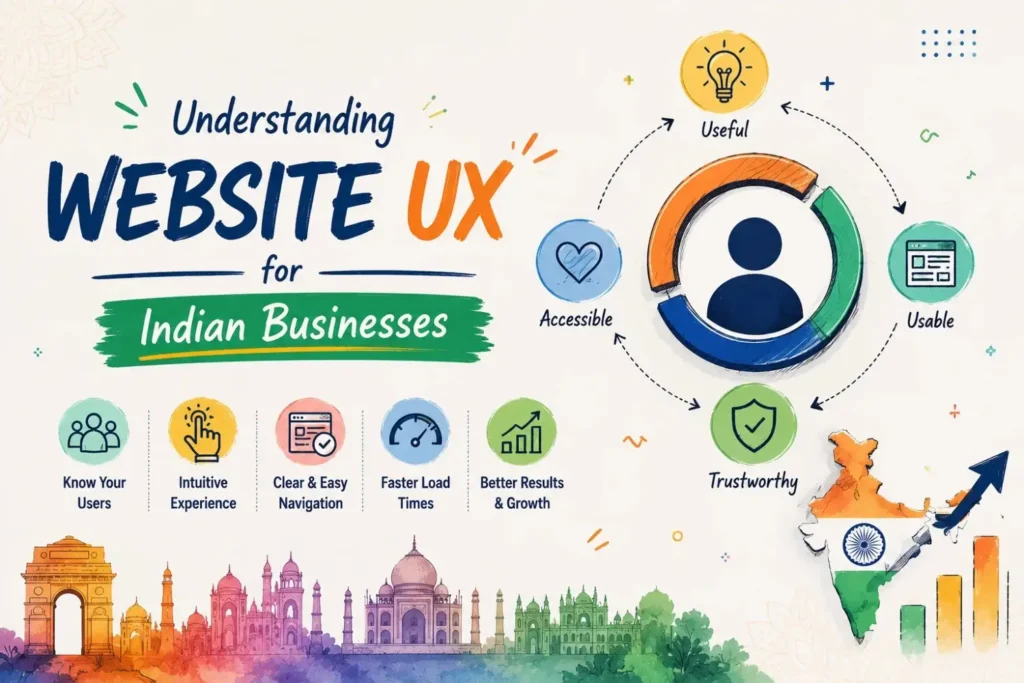
Understanding Website UX for Indian Businesses :
Though extensively used, the term user experience is one of the most confusing terminologies in web design and digital marketing.
What Is Website UX?
Website UX refers to the complete experience a user has when interacting with a digital platform.
The Website Development cost in India is not only related to the cost of development of the website; it involves everything that makes interaction with the website convenient and easy, from website speed and ease of navigation to website information architecture, accessibility, mobile usability, efficient content display, search capability, visual hierarchy, smooth conversion process, and trust factors.
UX Versus UI: Understanding the Difference
Businesses tend to confuse User Experience with User Interface Design. While the two have much in common, their functions are distinct.
| User Experience (UX) | User Interface (UI) |
| User behaviour | Visual appearance |
| Customer journey | Design aesthetics |
| Information flow | Colours and typography |
| Conversion strategy | Interface components |
| Usability | Visual engagement |
| Customer psychology | Branding elements |
A visually attractive website can still deliver a poor user experience.
The Four Pillars of Website User Experience
Modern website UX can be divided into four foundational pillars.
1. Usability
Users should be able to complete tasks quickly and intuitively.
The organization needs to look at the ease of use for finding necessary information by users on the website. The navigation process needs to be logical and forms need to be user-friendly. Also, the content should be clear and useful in helping them reach their goals.
2. Accessibility
Every website needs to be designed for everyone, regardless of whether they have some form of disability, and this is where the Web Design Company in Ahmedabad helps immensely to meet these requirements.
Accessibility considerations include:
- Screen reader compatibility
- Keyboard navigation
- Colour contrast
- Text readability
- Alternative image descriptions
3. Performance
Website speed directly influences user satisfaction and conversion rates.
Performance optimization involves quick loading time, image optimization, and optimized code structures to ensure efficiency. It is also involved in ensuring shorter server response time. The aspect of mobile responsiveness also makes sure that the site is responsive across all devices.
4. Trust
Trust continues to be one of the vital factors that converts an audience.
Credibility is an important quality which businesses have to prove by using testimonials of customers, case studies, and even some necessary certification of the enterprise. It is also important to add signs of safety and provide clear contact details. Social proof will also help to boost confidence.
Take your business to the next level with our expert services.
Get customized strategies that connect your brand with the right audience.
Explore Our ServiceThe Evolution of Website User Experience in India :
The digital environment of India has witnessed a lot of change in the last decade.
Fast uptake of smartphones, cheap access to the internet, digital payments, and AI-enabled search experiences have transformed consumer expectations.
Consequently, companies cannot depend on old methods of building websites from five to ten years ago.
Take for instance the local businesses which still use desktop-based websites that were created some years back. Although such sites might still work effectively, they create bad user experience in modern smartphones.
Thus, businesses looking for expansion are increasingly making use of mobile first design approaches using partners from Website Design Company In Ahmedabad.
Customer Expectations Have Changed :
Today’s consumers demand much more than just the basic functionalities of a website. Where the previous set of demands consisted of the provision of information, contact form, basic design, static pages, and desktop compatibility, now the consumers demand personalized services, immediate responses, interactivity, dynamism, and mobile first approach to the website.
Today, people will compare their experiences on all websites to that of Amazon, Google, Netflix, and other successful FinTech products.
The Rise of AI Search and Generative Experiences :
The one of the most important developments of 2026 is that of search through artificial intelligence.
Users increasingly discover businesses through:
- Google AI Overviews
- Conversational search engines
- AI assistants
- Voice search
- Generative search platforms
These platforms prioritise websites that demonstrate:
- Expertise
- Trustworthiness
- Clear information architecture
- Strong user engagement
- Semantic relevance
- Exceptional user experience
This change has converted website UX from an added advantage to an absolute need in business.
Core Principles of High-Performing Website UX :
Although the trends in website design continue to change every year, the principles of creating an exceptional user experience do not deviate from each other significantly. Companies that continually create leads, sales, and engagement for customers know that good UX depends on tested frameworks of psychology and behavior.
For a modern website development charges, these principles serve as the foundation of every successful digital project
Simplicity Creates Higher Conversion Rates :
Businesses often make the mistake of trying to communicate too many things at once.
In today’s context, the cognitive overload faced by users is quite common when presented with too many menu items, too many calls to action, and complicated visual elements. Moreover, long paragraphs and multiple messages can also hamper the user’s ability to concentrate on any particular aspect.
Research conducted by the Nielsen Norman Group consistently demonstrates that reducing cognitive friction improves usability, customer satisfaction, and conversion performance.
Consider these examples:
| Poor UX Practice | Improved UX Practice |
| 15 navigation items | 5-7 navigation items |
| Multiple CTAs | Single primary CTA |
| Dense paragraphs | Scannable content blocks |
| Complex forms | Progressive forms |
| Heavy animations | Purposeful interactions |
The objective is not to remove information but to organise it intelligently.
Website Speed Is Now a UX Requirement :
The website performance has moved from being just an optimization technique to becoming a critical aspect of user experience.
By 2026, users expect that websites should open almost immediately. Even delays of up to one second will make a big difference.
Slow websites may negatively affect the performance of businesses by decreasing users’ satisfaction and organic search ranks. Slow websites also reduce the ability of businesses to generate leads, convert prospects into clients, retain customers, and achieve AI search visibility.
This is the reason why the best web development company nowadays include performance engineering right at the beginning of the website design process.
Accessibility Is Becoming a Competitive Advantage :
Accessibility has always been seen as a matter of compliance. On the contrary, accessibility has developed into an important business advantage.
Accessibility helps everyone by improving the readability, making navigation easier, and allowing tasks to be accomplished faster. It also helps engage users while helping to improve SEO and overall web experience.
Trust Signals Drive User Decisions :
People who visit a website continuously make judgments regarding trust prior to doing anything else. For instance, they always question whether it is legitimate, whether their data is safe, if other people have availed of the service before, and if the company has the expertise for that.
Signs of trust include customer reviews, customer logos, industry credentials, secure badges, awards and recognition, validated reviews, case studies, and clear contact details. Trusting factors such as these often carry more weight in converting customers for service-oriented businesses compared to prices themselves.

Essential UX Elements Every Indian Business Website Needs :
No matter what the industry is, every company website needs to have certain basic aspects of user experience.
The following aspects should be considered when planning and developing a website by a website design company in ahmedabad.
Homepage Experience
Most companies’ websites will still see their home pages as being the most impactful pages.
Your visitors need to recognize right away who you are, what it is that you sell or service, and what makes them able to trust your company. There needs to be direction as to what step they need to take next, whether it is to contact you, get a quote from you, or make a purchase.
A good website should have a well-defined value proposition complete with an effective headline and a subheading that explains its function. Including trust elements, an effective call to action, proof of concept, and testimonials will boost your credibility.
Navigation Architecture
Navigation is still one of the most under-appreciated elements of website UX.
An efficient navigation system will help minimize decision fatigue by making it convenient for the user to access whatever he needs. It must reduce extra clicking, make content more accessible, cater to the users’ search intentions, and lead them towards conversions.
Mobile Experience Design
The digital environment of India is inherently mobile-first.
Therefore, mobile interactions need to stop being considered as mere derivatives of desktop web pages.
Mobile First Optimisation is the creation of an optimized experience on smartphones and tablets. This consists of large tap targets, simple menus, fast load time, less content per screen, touch interactions, optimized form designs and optimized checkout process.
Information Architecture
The term ‘information architecture’ is concerned with the organisation and structuring of information.
Misleading Information Architecture leads to confusion.
Information Architecture that is very strong creates clarity.
The effectiveness of website development cost depends on the efficiency of website design, which includes the rational categorization of information, semantic structure, relations between the pages. The predictable navigation and search engine-friendly architecture of the website helps both users and search engines find the content.
Forms and Lead Generation
Lead-generation forms are some of the most valuable elements of a website.
Unfortunately, many companies continue to make forms overly complicated.
Consider this comparison:
| Poor Form Design | Effective Form Design |
| 12 required fields | 4 required fields |
| Multiple dropdowns | Simple text inputs |
| No validation | Real-time validation |
| Generic labels | Contextual guidance |
| No trust signals | Privacy assurances |
Reducing friction during lead submission often produces immediate improvements in conversion rates.
Website UX Trends Dominating 2026 :
The advancement of technology is taking place at a rapid rate. Organizations that do not consider any change in customer behavior face the danger of becoming invisible.
Here are some UX trends that will influence web experience designs throughout India in 2026.
AI-Powered Personalisation
Website Personalization Is Being Revolutionized by Artificial Intelligence.
Web pages nowadays have the capability to adjust themselves for every user who lands on their page, by giving personalized recommendations for them, along with personalized call-to-actions, search results, and entire experience.
Such levels of personalization will definitely increase conversion rates.
Conversational Experiences
People want prompt replies and this has been the reason behind the emergence of conversational interfaces today. Some of them are AI chatbots, intelligent support services, guided searches, interactive product discovery, and intelligent lead qualification.
The use of conversations by companies has been shown to result in better customer satisfaction, better leads, faster responses, and higher conversion rates.
Zero-Friction User Experiences
One of the most significant UX trends for 2026 is making things easier for customers, and a web design company in ahmedabad can help you to achieve that with the help of these innovative solutions.
The basic principle behind frictionless experience is to reduce efforts on the part of users and to build trust; ensuring that customers can easily do their job on the website.
Accessibility-First Design
Accessibility has become a major business priority.
The digital revolution, involving the utilization of AI and inclusive technologies, is being considered more and more as an important factor that contributes to economic development and improvement of service delivery. As stated by the World Bank Digital and AI initiatives, those countries and organizations which will engage themselves in digital infrastructure and data development along with the responsible use of AI will benefit greatly.
AI Search Optimisation and GEO
Perhaps the most important development in 2026 is the emergence of Generative Engine Optimisation (GEO).
Businesses must now optimise websites for:
- Google AI Overviews
- ChatGPT Search
- Gemini
- Perplexity
- Voice assistants
- Generative search engines
GEO optimisation requires:
- Clear information architecture
- Strong topical authority
- Semantic content structures
- Entity optimisation
- Question-answer frameworks
- Experience-driven content
This move has transformed the way each and every web development company in ahmedabad looks at websites.
Whereas in the past companies created sites for either search engines or people, nowadays companies have to optimize their online experiences for both people, standard search engines, and AI-based discovery engines at once.
UX and SEO: The Critical Relationship in 2026
However, for quite some time, the two have been seen as separate disciplines with SEO being more about rankings and UX focusing on design and usability.
In 2026, that distinction no longer exists.
The development of Google algorithms, intelligent search capabilities, and user behavior signals has ensured that there is an intrinsic connection between website experience design and SEO success. Companies that are unable to offer good user experiences find it challenging to stay visible on both conventional and generative searches.
The change in times has drastically altered the way every modern website design firm operates. They now need to have skills that involve technical SEO, consumer psychology, conversion optimization and digital experience.
Why Search Engines Care About User Experience ?
Search engines have one primary objective:
Deliver the best possible answer and experience to users.
Even an optimally designed website that does not meet the user’s intent because of its slow loading time, poor navigation, annoying pop-ups, or mobile optimization will be considered a failure.
In addition, many search engines currently analyze various indicators associated with user experience when judging the quality and relevance of websites. Such indicators include speed of web page loading, mobile usability, user engagement, website accessibility, structure of content, information architecture, navigability, and responsiveness.
User Behaviour Signals Matter More Than Ever
Modern search algorithms increasingly evaluate behavioural indicators.
Important engagement signals include:
- Bounce rate
- Session duration
- Pages per session
- User interactions
- Repeat visits
- Conversion actions
While these metrics may not function as direct ranking factors individually, they collectively indicate whether users find a website valuable.
Consider two competing businesses:
| Website A | Website B |
| Slow loading | Fast loading |
| Poor navigation | Clear navigation |
| High bounce rate | High engagement |
| Low conversions | High conversions |
| Limited trust signals | Strong credibility |
With time, Website B is bound to perform better at searching due to its superior user interface.
This is what accounts for the growing trend of companies using web design and development techniques that incorporate aspects of both SEO and UX.
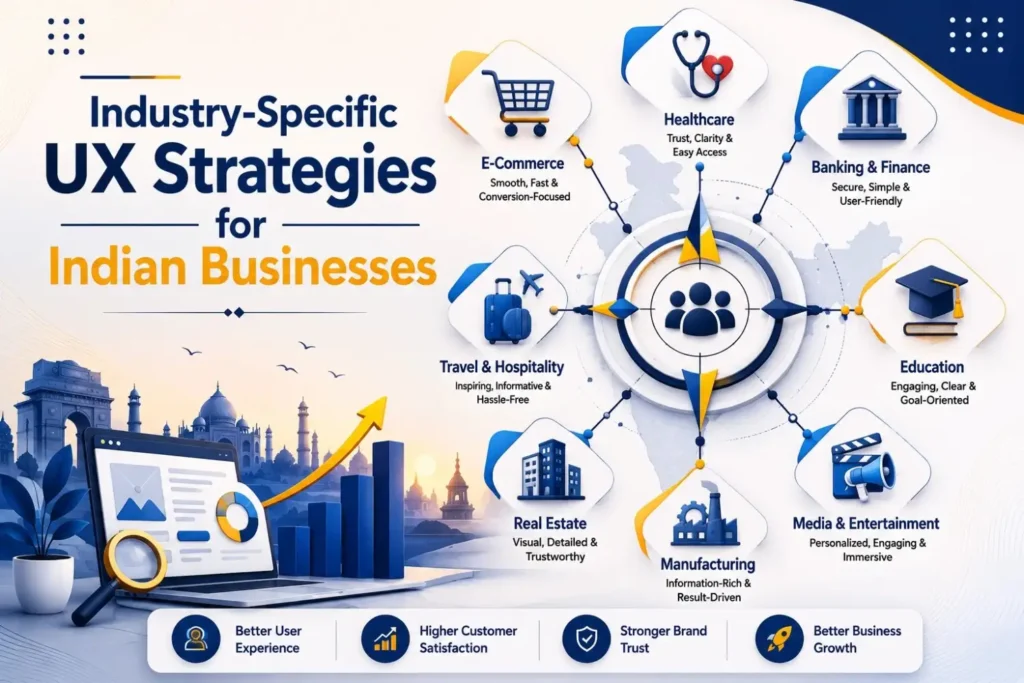
Industry-Specific UX Strategies for Indian Businesses :
In any industry, there are different needs of customers, their decision-making process, and the conversion path.
An effective web designing company will realize that good UX design strategies differ a great deal from one industry to another.
Healthcare Websites
Healthcare remains one of the most trust-sensitive industries.
The patients always demand instant and accurate information and the ability to reach out to trusted medical experts. They are also searching for fast appointment booking services and fast access to the services in emergencies. The strong trust signals are of equal importance as well, to make sure the patient feels safe and satisfied.
Healthcare websites should prioritise:
| UX Priority | Business Benefit |
| Doctor profiles | Increased trust |
| Appointment booking | Higher conversions |
| Mobile usability | Improved accessibility |
| Patient testimonials | Greater confidence |
| Emergency contact access | Better user experience |
Manufacturing Websites
Manufacturing buyers follow complex decision-making processes.
Websites of manufacturing companies should concentrate more on providing clear product classification, technical specifications, and downloadable materials. Also, such web sites should be equipped with effective RFQ (Request for Quote) tools, case studies, and industrial expertise.
Well-designed manufacturing sites strike a good balance between technical content and ease of use.
Educational Institutions
Students and parents usually consider three things while making their choices, including course information, admission procedure, and faculty knowledge. Placement statistics and campus facilities are some of the other things that students and parents prefer while searching for an institution.
The use of educational websites needs to emphasize easy navigation because this will assist the user in easily locating useful information without any difficulty. Educational websites need to have good search capabilities, mobile optimization, well-structured content, and other features that promote usability. Visual storytelling can also enhance learning.
E-Commerce Platforms
Modern e-commerce companies operate in highly competitive digital environments.
As such, UX design strategies should focus on ease of discovery, customization, and improved search optimization to make it easier for users to find what they require. Strategies aimed at making the check out process easy and gaining the trust of the consumer should also be employed.
Advanced searching aids in discoverability; product filters improve usability. Reviews create trust, and quick checkout boosts conversions. Personalisation will aid in generating revenues.
SaaS and Technology Companies
Software purchasers consider various aspects, including the value of software, usability of software, its installation difficulty, return on investment, and quality of customer support before taking any action. It helps them to know if the software is practical, worth it, and appropriate for their organization.
Thus, the SaaS sites must offer users demonstration, tutorials, and success stories so as to establish credibility. They must incorporate ROI calculators and trial opportunities that assist the user evaluate the worthiness of the product before making an informed decision.
The use of interactivity is becoming more prevalent among companies providing web app development services to enhance lead quality and conversion rates.
Website Development Cost in India for UX-Focused Websites :
A very frequent question that comes up in the business world is:
What is the cost of developing a website professionally in India in 2026?
This is dependent upon several considerations such as function, complexity, integration, customization needs, and UX approach.
Understanding Website Development Cost in India
An investment is needed for a website that aims at lead generation, improved conversion rate, brand building, and visibility in AI searches.
Typical cost ranges include:
| Website Category | Estimated Investment |
| Basic business website | ₹40,000–₹1,20,000 |
| Professional corporate website | ₹1,50,000–₹5,00,000 |
| Advanced business website | ₹5,00,000–₹15,00,000 |
| E-commerce platform | ₹2,00,000–₹20,00,000+ |
| Enterprise website | ₹10,00,000–₹50,00,000+ |
| SaaS platform | ₹15,00,000–₹1 crore+ |
Factors Affecting Website Development Costs
Several factors influence total project investment.
User Experience Research
User experience research techniques entail interviewing users, developing personas, journey mapping, analyzing competitors, and behavioral research. These techniques enable the researcher to gain insight into the user’s needs, motivation, and behavior.
UI/UX Design
Interface design in a professional setting consists of wireframes, prototypes, design systems, visual identity, and interaction design. They all come together to form a coherent user experience throughout the entire product.
Development Complexity
The cost of development depends on a number of factors such as front-end frameworks, back-end technologies and API integration. The costs are also determined by the degree of scalability and security required since complex systems are costly to develop.
Content and SEO Strategy
More and more, professional websites will now incorporate SEO planning, GEO optimization, and a solid content strategy. These websites also have schema markups and semantic structure for search engine understanding.
Website Development Charges by Business Type
| Business Type | Approximate Investment |
| Local business | ₹50,000–₹2 lakh |
| Healthcare | ₹2 lakh–₹8 lakh |
| Manufacturing | ₹3 lakh–₹12 lakh |
| Educational institutions | ₹2 lakh–₹10 lakh |
| E-commerce | ₹2 lakh–₹20 lakh |
| Enterprise businesses | ₹10 lakh+ |
The ROI of Investing in Professional UX
In a study conducted by Forrester Research, it is found that businesses who invest wisely in terms of user experience tend to yield good results from customer interaction, conversions, and better customer retention.
Consider a B2B company generating:
- 10,000 monthly visitors
- 1% conversion rate
- Average customer value of ₹2,00,000
Increasing conversions from 1% to 2% effectively doubles revenue opportunities without increasing traffic acquisition costs.
In 2026, website investment decisions should no longer focus solely on development costs.
Instead, businesses should evaluate:
“How much revenue, trust, visibility, and competitive advantage can this digital experience generate over the next five years?”
The answer to that question ultimately determines the true value of professional website UX investment.
How a Web Development Company Builds UX-First Websites ?
It takes more than just the ability to create visually appealing websites or possess technical skills to have an efficient business website in 2026. It is through the process involving all these disciplines that successful digital experiences become possible.
A professional custom software development company normally uses a user-oriented approach that is geared towards ensuring maximum customer satisfaction and success of the business.
Phase 1: Business Discovery and Strategic Research
The first step that any successful company undertakes is investing time in the process of learning about the following: business goals, income expectations, demographic groups, positioning in the market, competition, problems of clients, etc.
The discovery stage assists in finding answers to important questions like the target customer profile, what problems the customers are facing, what actions should be taken by the user, and what factors are currently impeding conversion rates.
Phase 2: User Research and Persona Development
The modern approach to user experience design is highly dependent on consumer research.
Common examples of research methods include customer interviews to determine user motivations and behavioral analysis to uncover areas of friction. Competitor benchmarking helps uncover market norms, and journey mapping allows for the visualization of the entire customer journey. Furthermore, analytics assessment is another method used to reveal areas of poor performance.
Phase 3: Information Architecture and User Journeys
Information architecture forms the structural foundation of a website.
This process includes:
- Sitemap creation
- Navigation planning
- Content hierarchy
- User flow mapping
- Conversion path optimisation
The objective is to create intuitive pathways that minimise cognitive effort.
For example:
Manufacturing User Journey:
Homepage → Product Category → Technical Specification → Case Study → Enquiry Form
Healthcare User Journey:
Homepage → Doctor Profile → Availability → Appointment Booking → Confirmation
Phase 4: Wireframing and Experience Design
Wireframes are developed before designing the visuals for a product in order to create the basic framework of the product. These wireframes define the layout of pages, content hierarchy, navigational system, user interaction flow, and conversion path. This phase of the design process ensures that there is clarity in the framework of the design and saves unnecessary costs in the future.
Phase 5: UI Design and Visual Experience
User journeys are validated, after which comes the visual design process. Visual interface design is all about keeping brand integrity, making a clear visual hierarchy, making it readable and making sure that it is accessible. The other priorities of interface design include mobile compatibility and emotional engagement.
A Professional website design company in ahmedabad makes sure that the visuals do not take precedence over usability but actually enhance usability.
Phase 6: Development and Technical Optimisation
Website development in current times involves front-end as well as back-end development, performance optimization, security, API integration, schema mark-up, SEO, and accessibility.
Phase 7: Testing and Continuous Improvement
Launching websites is no longer the end point. Businesses which are doing well constantly optimize user behavior, conversions, search results, mobile functionality, and overall customer satisfaction. Sometimes, optimization pays off even more in the long run than the cost of developing the website.
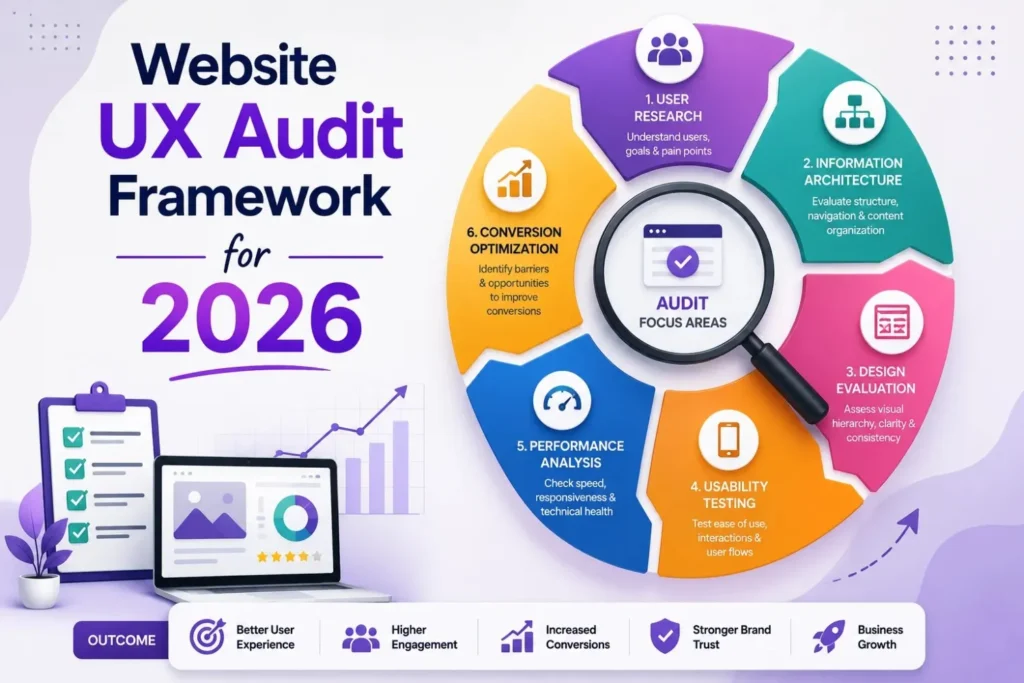
Website UX Audit Framework for 2026 :
Businesses should regularly audit their websites to identify opportunities for improvement.
The following framework provides a practical evaluation model.
Technical Experience Audit
Evaluate:
| Technical Factor | Assessment Criteria |
| Website speed | Loading performance |
| Mobile responsiveness | Device compatibility |
| Security | HTTPS and protection |
| Accessibility | WCAG compliance |
| Core Web Vitals | User experience metrics |
User Experience Audit
Assess navigation, readability, searching abilities, forms, visual hierarchy, and flow to make sure that the website experience is smooth and functional for users. These aspects help to detect problems with usability and increase the effectiveness of users’ interactions with the website.
Issues that can be thought of include how easy it is for users to accomplish their tasks and how intuitive and goal-driven the customer journey is. Companies should also make sure that actions that matter are noticeable and accessible because it will have an effect on website development cost in india.
Conversion Audit
Evaluate:
- Call-to-action placement
- Form completion rates
- Lead generation performance
- Checkout processes
- Customer onboarding
Businesses often discover that relatively small UX improvements generate significant revenue increases.
SEO and GEO Audit
Assess the structure of the semantic content, internal links, schema markup, entity optimization, topic authority, and AI search preparedness to achieve superior site performance. Sites that have been optimized for search and generative searches have major competitive advantages.
For more insights on SEO and website optimisation strategies, you can refer to this guide on Ahrefs.
Real Business Examples and Mini Case Studies:
Case Study 1: Healthcare Provider
A multi-speciality healthcare organization collaborated with an organization in order to acquire more patients.
Challenges:
- High bounce rates
- Poor mobile experience
- Low appointment bookings
- Confusing navigation
Solutions:
- Mobile-first redesign
- Simplified booking journeys
- Enhanced trust signals
- Improved content architecture
Results:
| Metric | Improvement |
| Appointment bookings | 1.32 |
| Organic traffic | 0.76 |
| Mobile conversions | 1.14 |
| Bounce rate | -39% |
Case Study 2: Manufacturing Company
A B2B manufacturing firm looking to optimize its lead generation and improve its online presence.
Challenges:
- Poor user engagement
- Weak product categorisation
- Limited technical content
- Low enquiry volume
Solutions:
- Industry-focused information architecture
- Technical resource library
- Product comparison tools
- Improved lead capture processes
Results:
| Metric | Improvement |
| Organic traffic | 0.91 |
| Qualified leads | 0.58 |
| Session duration | 0.73 |
| Enquiry conversions | 44% |
Case Study 3: E-Commerce Brand
A newly developed retail brand targeting customers from India needed better conversion rates, affecting website development costs directly.
Challenges:
- High cart abandonment
- Slow checkout experience
- Weak mobile usability
- Low customer retention
Solutions:
- Checkout optimisation
- Personalised experiences
- Improved search functionality
- Mobile-first redesign
Results:
| Metric | Improvement |
| Revenue | 0.61 |
| Conversion rate | 0.49 |
| Customer retention | 0.28 |
| Cart abandonment | -24% |
Conclusion :
A good website user experience has now become one of the key competitive strengths for companies today. In 2026, it is not enough to just have a great UX in terms of aesthetics; it also affects revenue generation, customer acquisition, brand credibility, search engine ranking, AI discovery, and customer retention.
The companies which use UX well have greater efficiency in the performance of search engines, AI, and customer communication. At last, the winners of the future will not be only web-site developers, but more importantly, creators of good UX.