

The education technology space in India has evolved from merely uploading educational content on the internet. Contemporary users demand speed, user-friendly interface, personalized learning paths, payment security and a seamless experience across mobile phones, tablets and laptops.
This means that for an ed-tech startup, the website is not merely a digital brochure but also its means to acquire customers, learn about them, sell them on its services and provide customer support.
This is why selecting the appropriate web development services is more of a business strategy than just a technical issue.
The edtech market in India remains ripe with opportunities. According to IBEF, quoting data from the sector, India’s edtech market size stood at about ₹32,670 crore in 2025 and is expected to grow to about ₹2,99,790 crore in 2034. India’s Ministry of Education’s technology-based learning programs are also another example of how digital learning has become a well-settled component in India’s education landscape.
The message for the entrepreneur, thus, is clear – simply having a technologically sound website is not sufficient anymore. The site needs to be able to serve all these purposes simultaneously.
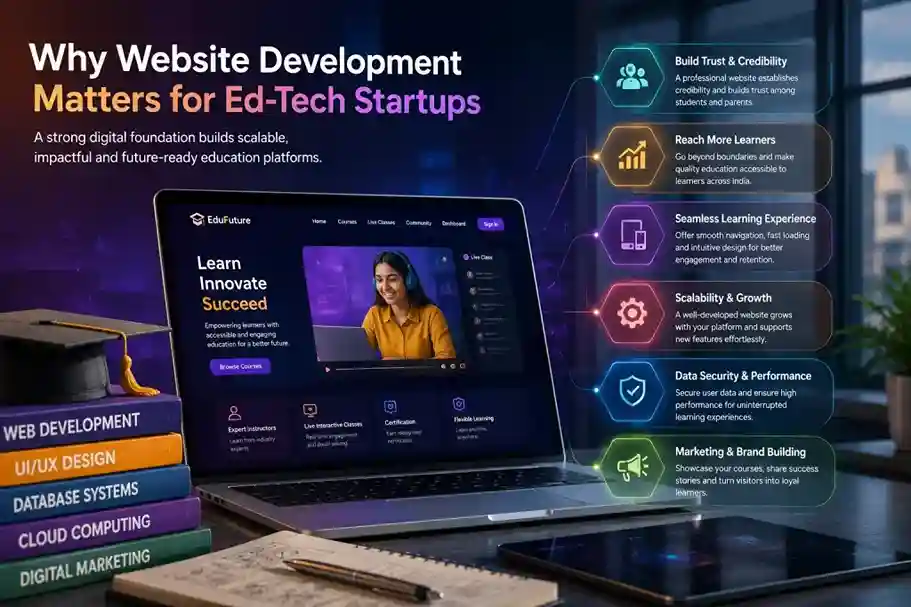
Why Website Development Matters for Ed-Tech Startups ?
An ed-tech startup usually has multiple target audiences who engage with the company’s website: students, parents, teachers, institutions, business clients, and even investors.
These audiences ask different questions.
The student may want to know if the course is appropriate for his level of skill. The parent may want credibility, results, and safety. The teacher requires effective management of course content. The corporate buyer may require information on mass enrollment.
Poor website design forces all these audience groups to go through the same path.
Good website development services actually develop an information architecture based on the way users make their decisions.
For instance, an online coding website may have its key journey mapped out in this way:
Course discovery → Course Comparison → Instructor Credibility → Curriculum → Pricing → Enrollment → Payment → Learning Dashboard
This is completely different from designing web pages such as Home, About Us, Services, and Contact.
The website is now part of the product itself.
For a new startup, differentiation must be achieved not only on the level of the product but also on that of the website.
What an Ed-Tech Startup Website Needs to Achieve ?
A successful education website generally has five commercial jobs:
| Business objective | Website responsibility | Example |
| Acquisition | Attract relevant visitors | SEO landing pages |
| Education | Explain the offering | Course pages and curriculum |
| Conversion | Turn visitors into leads or customers | Enrolment and checkout |
| Learning | Deliver the product | LMS and student dashboard |
| Retention | Bring learners back | Progress tracking and notifications |
The problem that most start-ups face is that they optimise the first three areas only.
They spend huge amounts of time on beautiful landing pages but ignore the learning environment.
It causes friction once there is an acquisition.
A better strategy would be to look at the website as a system in which marketing pages are followed by course discovery. Course pages should address concerns before proceeding with the checkout.
Here is where expert web development services in ahmedabad can make a commercial difference.
Core Features to Include in an Ed-Tech Website :
Student Registration and Personalised Dashboards :
The process must be easy but secure at the same time.
The ed-tech website would require either email registration, mobile OTP, or social login based on the company’s business model.
Once the user is registered, he/she should not land on the dashboard randomly.
The dashboard should immediately answer:
- What am I learning?
- What have I completed?
- What should I do next?
- How am I progressing?
- What assessments or lessons are pending?
As an example, one can consider a competitive exams website which shows the list of coming tests, recent grades obtained, subject areas in which performance is weak, and modules for study revision.
Course Catalogue and Search :
With more and more courses, navigation turns into a product problem.
Where a platform has 15 courses, navigation is not an issue. Where it has 500 courses, it is.
The website should therefore support:
- Category filtering
- Skill-level filtering
- Course duration
- Instructor filtering
- Pricing
- Ratings or reviews where appropriate
- Search suggestions
- Related courses
Search functionality must also take into account search engine optimization.
Course pages should have unique URLs instead of JavaScript-based content; this is an essential SEO point to keep in mind for a web development agency.
LMS and Learning Delivery :
The learning management system forms the core of a lot of learning technology start-ups.
The current LMS would have videos, PDFs, quizzes, assignments, certifications, progress tracking, and teacher communication systems.
But the functionality must be in accordance with the learning model.
If it is for live coaching, then scheduling, attendance, and live class integrations will be more important.
In case of a self-paced learning system, the delivery of videos, tracking of progress and assessment will become more important.
There is no one way of building an LMS.
The first step should be to map the learning model and decide on the functionality that the LMS should provide.
There are white-label LMS for start-ups who need a pre-built learning infrastructure.
Assessments and Progress Tracking :
Features of assessments may become a big distinguishing factor.
Not just to show the percentage of progress made in a course, the learning management system can measure:
Participation → assessment performance → topic-level weaknesses → recommended action
This creates opportunities for personalised learning.
For instance, in case a particular student is performing poorly in algebra-based questions, a website design company can develop a website that suggests a certain revision module before accessing an advanced topic.
The key thing is that the data needs to result in action.
To collect all sorts of metrics on your learners without producing some actionable recommendations is useless complexity.
Payments and Subscription Management :
In an education technology website, the payments/subscriptions should be designed keeping in mind that the payment process is a part of the overall experience for the user and not just as an afterthought. Based on the business model, it is possible that the site needs to provide services like one time purchase of the courses, monthly/yearly subscriptions, trial periods, discount coupons, packages of courses, etc. For Indian users, the payment process must be simple and speedy as well.
Difficult payment systems may prompt learners to stop the enrollment process despite being ready to enroll. This implies that the process of enrolling needs to be safe and straightforward to create trust and enable easy communication regarding prices.
Communication and Support :
Education purchases often involve uncertainty.
A performance marketing agency may help make sure that students looking for courses have access to the right information regarding course suitability and technical support.
Therefore, support could be embedded in the website by means of contextual FAQs, support forms, chat, knowledge bases and tickets. The idea is not to cover everything with a chatbot.
The goal is to find out when users become confused and provide them with necessary information at that point.
Make your brand stand out.
Explore our marketing solutions and unlock new growth opportunities.
Explore Our ServiceChoosing the Right Technology Architecture :
The most crucial decisions include selection of architecture, which will suit the business at this moment, not causing any technical debts.
There are three broad approaches.
| Approach | Best suited for | Main advantage | Main limitation |
| CMS-based website | Content-led education businesses | Fast deployment | Can become restrictive at scale |
| Custom website | Product-led ed-tech startups | High flexibility | Higher development investment |
| Hybrid architecture | Growing platforms | Combines speed and flexibility | Requires stronger technical planning |
A startup which offers educational articles and sells a few courses may not require a fully customised platform right from the start.
On the other hand, an enterprise which is offering adaptive learning, complex assessments, multiple dashboards and institutional reporting may very well require more customisation.
It is clear that a competent web design company must suggest technology based on the requirement rather than the expensive one.
APIs and Integrations :
Ed-tech websites rarely operate alone.
They may connect with:
- Payment gateways
- Video hosting platforms
- CRM systems
- Email marketing platforms
- WhatsApp or communication tools
- Analytics platforms
- Examination systems
- Mobile applications
- Accounting software
API architecture should be designed upfront.
If each integration is implemented manually within the platform itself, then it will cost much later on.
With modularity, it becomes possible to replace each component without changing the whole website.

Why Responsive Web Design Is Non-Negotiable ?
A responsive website is critical to ed-tech companies due to the fact that students can access education through smartphones, tablets, laptops and desktops. The website needs to automatically adjust itself depending on the screen size without affecting user-friendliness. It is even more critical in India as phones are one of the major ways of accessing digital content. Google too recommends responsive website as the ideal way of creating mobile-first websites.
In regard to ed-tech websites, responsive web design is not only about fitting the content of a regular desktop site onto a small screen. Lessons, courses, video lectures, registration forms, payment portals, quizzes and student dashboards have to be user-friendly on touch screens as well. It is necessary for buttons to be of proper size, for content to be legible and for navigation to be convenient.
A responsive website will also improve search visibility and user engagement. With Google’s mobile-first index, Google predominantly relies on the mobile version of the website content to index and rank the website. Mobile usability is an important aspect of building an SEO-friendly educational platform.
Performance Should Be Designed Into the Website :
Performance is especially vital for education platforms since there could be videos, images, interactable features, scripts, and third-party components on learning pages.
In terms of optimizing an ed-tech platform, one must consider:
Image optimization: Use images of appropriate sizes instead of unnecessarily large files.
JavaScript management: Do not load scripts that are not necessary for the particular page.
Caching: Cache static content and content that is suitable.
Lazy loading: Lazy-load non-essential components while making sure that the essential content is available to search engines.
Test performance based on real user data, particularly when developing ecommerce website design, because developers have access to fast internet connections at work.
SEO-Friendly Website Development for Ed-Tech Startups :
A visually appealing education website may still not perform well commercially if search engines cannot find its contents.
For this reason, SEO must be integrated into the development process rather than be introduced later on.
Build a Search-Friendly Information Architecture :
Think of the case of ed-tech firm focused on data analytics learning.
Rather than releasing hundreds of blog posts in isolation, the website could create thematic organization such as:
Data Analytics → Beginner Courses → Excel → SQL → Python → Power BI → Projects → Certifications → Career Guidance
This would establish connections between business and information pages.
A user looking up “best SQL course for beginners” could get into the website via an information page and then go to the course.
It is way better than just releasing random posts based on keyword search volume.
Create Indexable Course Pages :
Every important course should have a dedicated, crawlable URL with meaningful information.
A strong course page may include:
- Course overview
- Learning outcomes
- Curriculum
- Duration
- Difficulty level
- Instructor information
- Pricing
- FAQs
- Assessment details
- Certification information
- Enrolment CTA
The objective is to satisfy the user’s decision-making process on one authoritative page.
Use Structured Data Carefully :
It can assist Google in comprehending the nature of the page and is a crucial element in SEO services that could enable the eligible content to be used in search results.
According to Google, “Structured data is useful because it explicitly indicates the meaning of page content, though having it implemented correctly does not necessarily mean that you’ll have a rich result.” For an ed-tech website, the use of appropriate structured data may be worth considering when it makes sense.
Optimising an Ed-Tech Website for AI Overviews and GEO :
Search behavior is evolving.
People are asking whole questions and not just using keywords.
Like this:
“What is the best online data analytics course for those who lack any programming experience?”
It makes the content requirement different.
The education technology website requires well-organized content that answers specific questions.
So, in case of GEO, concentrate on answering questions and not on fancy phrases.
Such as:
“Learn Python in an industry-defining course.”
Use:
“Our Python basics course includes variables, data types, functions, loops, file I/O operations, and data analysis techniques. It is meant for those who have no background in programming.”
The revised version is more comprehensible to humans and also more searchable.
This is a key reason why web development services and content strategy now have to integrate.
Security, Privacy and Accessibility :
Education platforms manage sensitive information.
Based on their business models, this can range from learner profile details to financial information, grades, certificates, and institutional information.
It is important that security be viewed as an architectural component and not an add-on.
Key components of security include HTTPS, authentication, access control, secure APIs, updates, backups, monitoring and proper payment processing.
Accessibility should be given more importance.
The guidelines set out by the W3C’s WCAG 2.2 cover how to make web content more accessible. This set of guidelines is based on four core principles, namely Perceivable, Operable, Understandable and Robust.
In the case of an educational business, however, accessibility is particularly important since the product that will be used by customers is knowledge acquisition. Some examples of accessibility in interfaces may be keyboard navigable navigation, sufficient color contrast, labeling, video captions, visible focus states, accessible form validation, proper headings.

How a Web Development Agency Should Approach an Ed-Tech Project ?
A website for ed-tech does not merely consist of the choice of technology to be used, and the development of the necessary pages. An experienced web development agency needs to start by knowing the business model of the startup, its target students, the way education is delivered, and the revenue generation model of the company. It will help the development of the website to align with the business goals and the UX.
1. Discovery and Business Mapping
Stage one involves analyzing how the ed-tech business works and what the website is supposed to accomplish. It is important for the agency to consider such issues as the target audience, business model, content and structure of courses, delivery method, lead generation channels, technologies that are being used by the company and its plans regarding further growth. For instance, an online platform offering self-paced courses would have different needs compared to a business delivering live lessons.
2. User Journey Design
After the business requirements have been established, the agency is supposed to design the experiences of different users. There should be proper navigation and functionality available on the website for each type of user through the provision of good website development services. The users can be students, teachers, administrators, parents, and institutional buyers.
3. MVP Definition
The startup needs an experienced agency that can assist it in distinguishing between those aspects which are crucial for the launch and those which need to be developed after launch. At the very first stage, it may feature registration, courses, payments, the learning dashboard, and basic testing, whereas advanced analytics, personalized recommendations, mobile applications, and institutional reporting may come later on. Through building the right MVP, the startup can test out its business model without utilizing all its development budget on unnecessary aspects.
4. Development and Integration
Once the structure and requirements are finalized, the development process for the front-end, back-end, database architecture and integration can begin. Ed-tech portal may require integration with the payment gateway, video service provider, CRM system, analysis tool, communication and mobile app. Careful planning of such integrations is important in order to make the platform flexible and each service replaceable independently of the entire website.
5. QA and Performance Testing
Search engine marketing needs to be thought about right from the beginning. Quality assurance needs to happen during the process of development, and not just right before the go-live date. The agency needs to test the website in various browsers, screen sizes, mobile devices and connection speeds, along with all the forms, payment gateways, authentication and dashboard access for different roles. The site needs to be monitored for performance problems as well.
6. Launch and Continuous Optimisation
It is important to consider that starting up the website must be seen not as the end of a project, but only its first step towards optimization. The company will need to track organic traffic, users’ behavior, conversion rate, course registration, performance and feedback from customers after the launch. All these factors may give information about the points at which the potential customers have difficulties or leave their paths. Improvements in navigability, content, landing pages, performance and other features can then be made according to their importance for the business.
Common Website Development Mistakes Ed-Tech Startups Should Avoid :
Another pitfall would be basing the website on internal company structure.
The user does not care if the firm has divisions for programs, teaching and partnerships. The website design company must consider the user first and help them find the correct solution immediately.
The other error is to value form over function.
No matter how spectacular an animation, it won’t make up for a convoluted course catalogue.
The other error is to include all possible features in version one.
Additional features equate to additional development time, maintenance and potential failures.
Yet another big problem is waiting to think about SEO until after the development process is complete.
Any modifications to URLs, navigation, page templates and structure after a site goes live become additional tasks.
The final error is to overlook post-launch maintenance.
Launching a website doesn’t complete the process.
A Practical Ed-Tech Website Development Framework :
A useful way to evaluate an education platform is through the L-E-A-R-N framework:
| Stage | Focus | Key question |
| L — Learner | UX and audience | Who is using the platform? |
| E — Experience | Design and usability | Can users complete tasks easily? |
| A — Architecture | Technology | Can the platform support growth? |
| R — Reach | SEO and discoverability | Can the right users find it? |
| N — Numbers | Analytics and optimisation | Is the platform producing business results? |
This model ensures that technical improvements remain connected to business success.
For instance, even when a page has great aesthetics, it can be a failure because it is receiving irrelevant traffic from searches.
In the same way, a web design company must make sure that having a highly scalable architecture is of value because the course offering will be comprehensible to the students.
The best website combines all five.
How to Measure Website Success After Launch ?
Traffic alone is not enough.
An ed-tech startup should monitor metrics across the entire funnel.
| Stage | Useful metrics |
| Acquisition | Organic traffic, branded searches, landing-page visits |
| Engagement | Course-page engagement, returning visitors |
| Conversion | Enrolment rate, lead rate, checkout completion |
| Learning | Course completion, assessment performance |
| Retention | Repeat learning, subscription renewal |
| Technical | Core Web Vitals, uptime, error rate |
| Commercial | Revenue per learner, customer acquisition cost, lifetime value |
This is a crucial point.
Imagine that your SEO efforts double organic traffic but have no effect on the enrolment numbers.
The problem might not be with the SEO.
Perhaps you need better course positioning, poor landing pages, confusing prices, or problems with the purchasing process.
This more evolved approach needs to work in conjunction with marketing and analytics teams, and not in isolation with the website.
Cost and Investment Considerations :
Building an ed-tech platform can be expensive depending on its complexity and the functionality that it needs to have. This is especially true when the platform is part of a growing industry where the investment in technology should cater to future expansion.Ecommerce website design can also influence platform costs when online course purchases and payments are involved. According to MarketsandMarkets, India’s ed-tech and smart classrooms market was valued at approximately US$ 8.88 billion in 2025 and is projected to reach US$19 billion by 2030, highlighting the scale of the opportunity for businesses investing in education technology.
An entry-level marketing website will demand entirely different levels of investment compared to one having LMS, subscription payments, assessments, teacher dashboards, analytics, and mobile applications.
The question should not simply be: “How much does website development cost?” Instead, the founders should estimate:
Website development cost + Infrastructure cost + Maintenance + Integrations + Content + SEO + Optimisation
A cheap website which will have to be redeveloped after six months can turn out to be much more costly than the proper MVP.
What is better is building the minimum architecture necessary for testing your business model and offering further options for development.
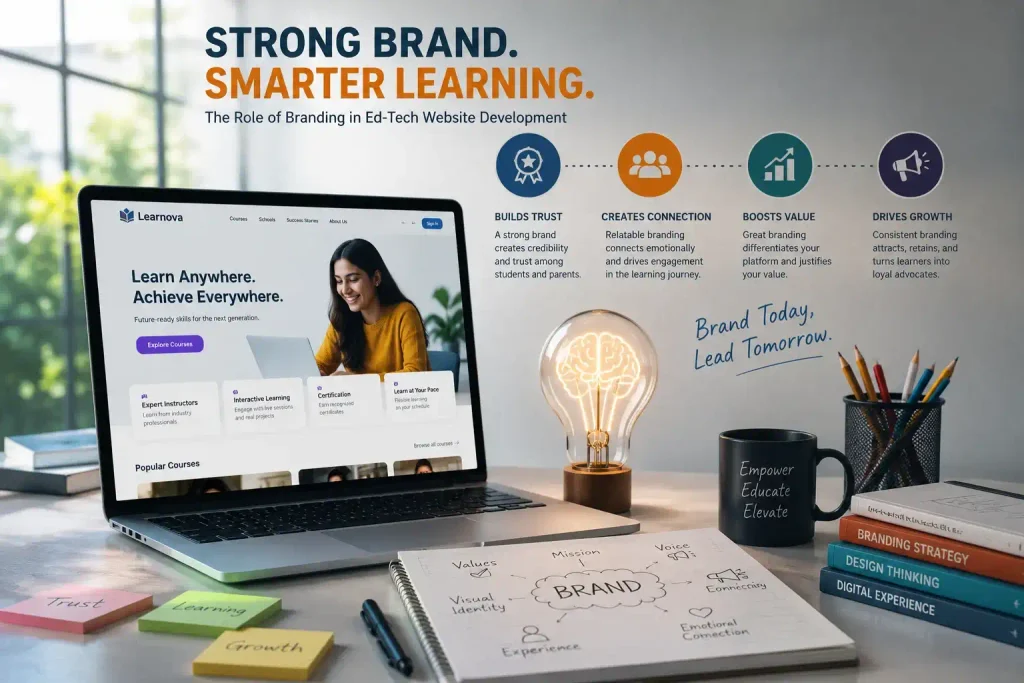
The Role of Branding in Ed-Tech Website Development :
Technology brings about functionality, but branding brings about recognition and trust.
For an educational technology platform seeking the learners’ dollars and attention, it is essential to have a coherent visual language in all the online spaces.
This is where branding and designing services can complement development.
For instance, a similar typeface, color scheme, iconography, and messaging hierarchy should be carried from the Google landing page to the course dashboard. This reduces cognitive friction and makes the company appear more established.
When Should an Ed-Tech Startup Add a Mobile App ?
All new businesses do not need an app right away.
It is possible to confirm a business model through a responsive site, even without developing other applications.
The value proposition of an application increases when there is frequent access needed, offline learning, push notifications, and device-specific functionality or engagement.
What matters is finding the solution to the user problem.
If the site is difficult to navigate, simply porting the problems to an app will not help.
Mobile development should be considered by startups once they get to the stage when it makes economic sense to develop applications.
Final Takeaway :
For ed-tech startups from India, developing a website is more of an infrastructure strategy than a single buy of a website.
The best platforms incorporate intuitive learning along with scalability, responsive web design, technical SEO, performance, accessibility, security, and conversion-oriented journey.
For entrepreneurs, the practical considerations are straightforward:
Design around the learner. Architect around the business model. Scale around the future. Optimize around the results.
Such a site will be able to do far more than simply rank on Google. Such a site can become the digital framework for bringing together acquisition, education, conversion, and lifetime value.
This is, ultimately, the difference between a good education site and an effective ed-tech platform.