
Yes, AI tools are capable of developing an excellent website in 2026.
However, there is one important difference between the websites that look good and those that actually work good as a business tool.
With the advent of advanced artificial intelligence technologies, the process of creating layouts for pages, coding, writing, and developing interactive websites is possible. Coupled with skilled web development services, AI can assist companies in building efficient, easy-to-use, and appealing websites.
The difficult part is what follows the first generation.
Is the website properly structured? Can it be accessed? Will it load quickly enough on mobile phones? Can search engines properly crawl the website? Is the content really useful? Does it have a proper checkout process? Can it be integrated with a CRM? Can customer data be safely managed? Can it be scaled?
This is where the real distinction comes between AI-generated code and professional web development services.
This point becomes even more important considering Google’s current guidelines. Their guidelines for AI Search continue to focus on crawlability, technical SEO, valuable original content, good page experience and quality-first approach, not some magic “AI SEO” techniques.
Hence, the realistic answer by 2026 would be:
AI is capable of creating websites. However, AI cannot automatically figure out the business issue which the website solves.
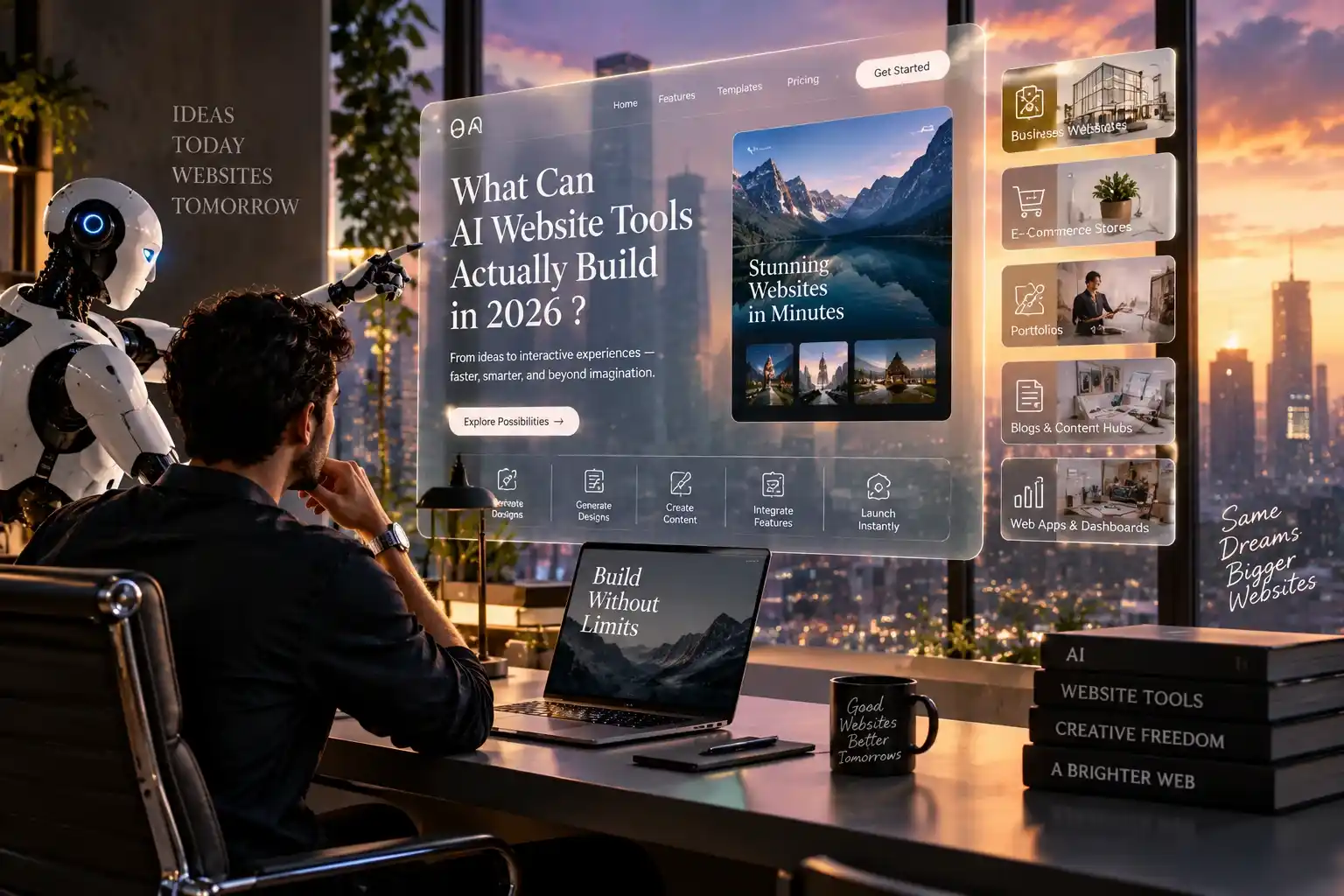
What Can AI Website Tools Actually Build in 2026 ?
The abilities of AI website builders go beyond mere text generation, thus assisting a web development agency in making their work better and faster.
A contemporary workflow that includes an AI can create a functional front-end web application out of something like:
“Build a responsive website for a technology business to business company. The website should include: homepage, services page, case studies, contact form and mobile navigation.”
The workflow is capable of building the base web application in a matter of minutes.
It marks an enormous change in website production process.
Before, even an elementary website had to go through numerous different stages: wireframing, design, coding, content creation and testing. Now, AI can reduce some of those steps into one workflow.
But, the quality of the results depends on the quality of input.
AI can now generate complete website structures :
AI tools are increasingly capable of turning natural-language instructions into page structures.
They can suggest:
- Navigation systems
- Hero sections
- Service sections
- Pricing layouts
- FAQs
- Contact forms
- Testimonials
- Calls to action
- Responsive layouts
- Basic animations
- Content structures
For a business that simply needs an online presence, this is extremely useful.
Imagine a consultancy firm that is starting up with five key services. Rather than wasting several days coming up with a wireframe, the firm can use AI technology to evaluate different structures, and then collaborate with web development services in Ahmedabad to create a website out of the best one.
The key term here is “starting point.”
The AI-produced design should not be automatically considered the final website design.
AI Can Build a Website. Can It Build One That Converts?
AI tools are fast, but they can’t replace strategy, brand voice, or conversion-focused design. Our team blends the best of AI with expert web and marketing strategy to launch sites that rank, engage, and generate leads.
AI can write and modify website code :
Development has also been revolutionized by AI coding assistants.
A developer can ask the AI software to develop a React component, explain an error, refactor a function, create CSS or even provide solutions to specific implementation issues.
According to the Stack Overflow Developer Survey of 2025, 84% of people surveyed either use or plan on using AI in their development process, while 51% of professional developers use AI in their work on a daily basis.
It means one thing – the conversation is no longer about “AI against developers”.
Professional development itself has become AI-assisted.
AI can create layouts, copy and visual concepts :
AI can also speed up the creative side of website production.
A marketing team can use it to explore:
- Homepage messaging
- CTA variations
- Product descriptions
- Section structures
- Colour combinations
- Image concepts
- Headline alternatives
- FAQ structures
It is particularly important in the discovery process of the website development services when teams have to look at different options before proceeding towards any particular direction.
The problem lies in the assumption that creating ten alternatives implies the selection of the tenth one automatically generates the optimal outcome.
AI creates more options.
Human skill decides whether the option needs to survive.
Where AI Website Builders Perform Surprisingly Well ?
There are some instances where an AI website builder is commercially very sensible.
In simple cases, an AI website builder will remove any unnecessary development cost.
Landing pages and simple business websites :
Landing page for a campaign is perhaps one of the best use cases.
If a marketing firm needs a landing page for a new advertising campaign to launch, that landing page will need a headline, an offer, supporting copy, a form, trust factors, and a call-to-action button.
There might not be much point in wasting weeks on crafting an entire customized architecture from scratch.
AI can generate the first architecture within no time, and then designers and developers can tweak the experience.
The very same idea is applicable in case of brochure sites for freelancers and consultants or even small firms working with a professional website design company.
If there are between five and ten pages with basic functions and simple content, then it is possible for AI to do most of the work.
Prototypes and MVPs :
AI becomes all the more useful when the aim is to learn as opposed to shipping a product.
Consider the case of a software firm that has an idea about building a user dashboard and it’s not sure if the users really want it.
Shipping a refined product at this stage might lead to wastage of a lot of efforts.
Instead, the process of AI-based development can help build an interactive prototype fast.
The firm can test its workflow on the user side to see if there is any friction and validate the idea before moving forward into production development.
Basic ecommerce websites :
AI could also be employed to design easy ecommerce solutions.
For instance, an ecommerce solution for a retailer offering 20 items would not require much customization of the commerce platform.
AI could assist in producing product descriptions, categories, promotional areas and some basic frontend components.
On the other hand, ecommerce is where companies should be extra cautious since ecommerce website design requires a proper combination of these three elements.
A website selling products is not simply a collection of attractive pages.
It involves:
- Payments
- Customer data
- Inventory
- Product variants
- Shipping
- Returns
- Analytics
- Search
- Performance
- Security
- Conversion optimisation
As these systems become more commercially significant, it makes less sense to take for granted that their AI-generated output is production-ready.
Where AI Still Struggles With Professional Websites ?
Artificial intelligence has developed an astounding ability to build websites, but to create a working website and to build a professionally designed digital platform are two very different things. The problems with AI arise in cases where the creation of the website needs some amount of strategizing, functionality, or technical knowledge. Although artificial intelligence can provide coding and designs very quickly, it cannot figure out the context of the business behind the website.
Business Strategy and Positioning :
The professional site should be able to articulate well why the customers need to select their company instead of others. In the case of a performance marketing agency, AI can formulate well-structured headlines, service descriptions, and value propositions; however, it does not have complete knowledge of competitive advantages, client’s issues, and market standing without the input of humans. Hence, other businesses working in the same sector will end up having a site with similar language and making similar claims of being reliable and professional.
Positioning needs customer research, competitive analysis, and knowledge of what makes a company unique. HubSpot – Competitive Positioning resource shows how companies can define their competitive edge, analyze their competition and position themselves better through these activities. It thus corroborates the argument that effective website messaging requires positioning as opposed to just using AI-generated content. This means that human input is necessary in coming up with messages that resonate with the targeted customers and help achieve the business objectives of the company. AI will be useful in generating content but not at the expense of the positioning process itself.
UX Decisions and Conversion Architecture :
A web design company could leverage AI to create aesthetically pleasing layout, navigation menu, and call to action (CTA), but for UX to be successful, one needs to know how actual visitors act. The choice of form length, placement of testimonials, the way of highlighting CTAs and designing navigation can greatly affect the conversion rate. It all depends on target users and the business goals.
Using all the knowledge from the user experience design and analysis, combined with business understanding, professionals are able to create a site that will nudge its visitors into taking actions. The process includes the layout testing, user behavior analysis and continuous conversion journey optimization. AI can offer valuable suggestions, however, human skills are necessary in order to make proper decisions.
Technical SEO and Information Architecture :
An HTML page creation does not automatically mean that you will have an SEO-friendly website. Good websites need proper planning of their information architecture, their URLs, internal links, meta data, canonicalization, redirection, sitemap XML and proper indexing. AI technology can help in all of these areas, however, it might not know how each page needs to work together in order to build its authority and organic growth.
The guidelines from Google also show that web sites included in the AI-based search experience require solid technical structures as well as crawlable and user-friendly content. This means that for companies that spend money on website development services, SEO needs to be taken into account at the stages of architecture and development, not after these have been accomplished.
Complex Integrations and Custom Functionality :
This is where limitations of the AI can be felt the most, as a website must interact with the outside world. The company might need integrations with the CRM, payment gateway, bookings, inventory management system, ERP system, marketing automation system or a customized API. The AI will be able to create parts of the integration code but the actual implementation of such an integration will demand certain considerations regarding security, error handling, reliability and more.
However, a site handling customers’ data or doing transactions requires more than just code that works well during the initial tests. The site will require architectural and security measures, proper testing and continuous monitoring in order for it to continue being reliable. Moreover, professional developers are required to help deal with any unforeseen challenges in addition to keeping the integrations and maintaining the system. Website development services may be helpful in this regard.
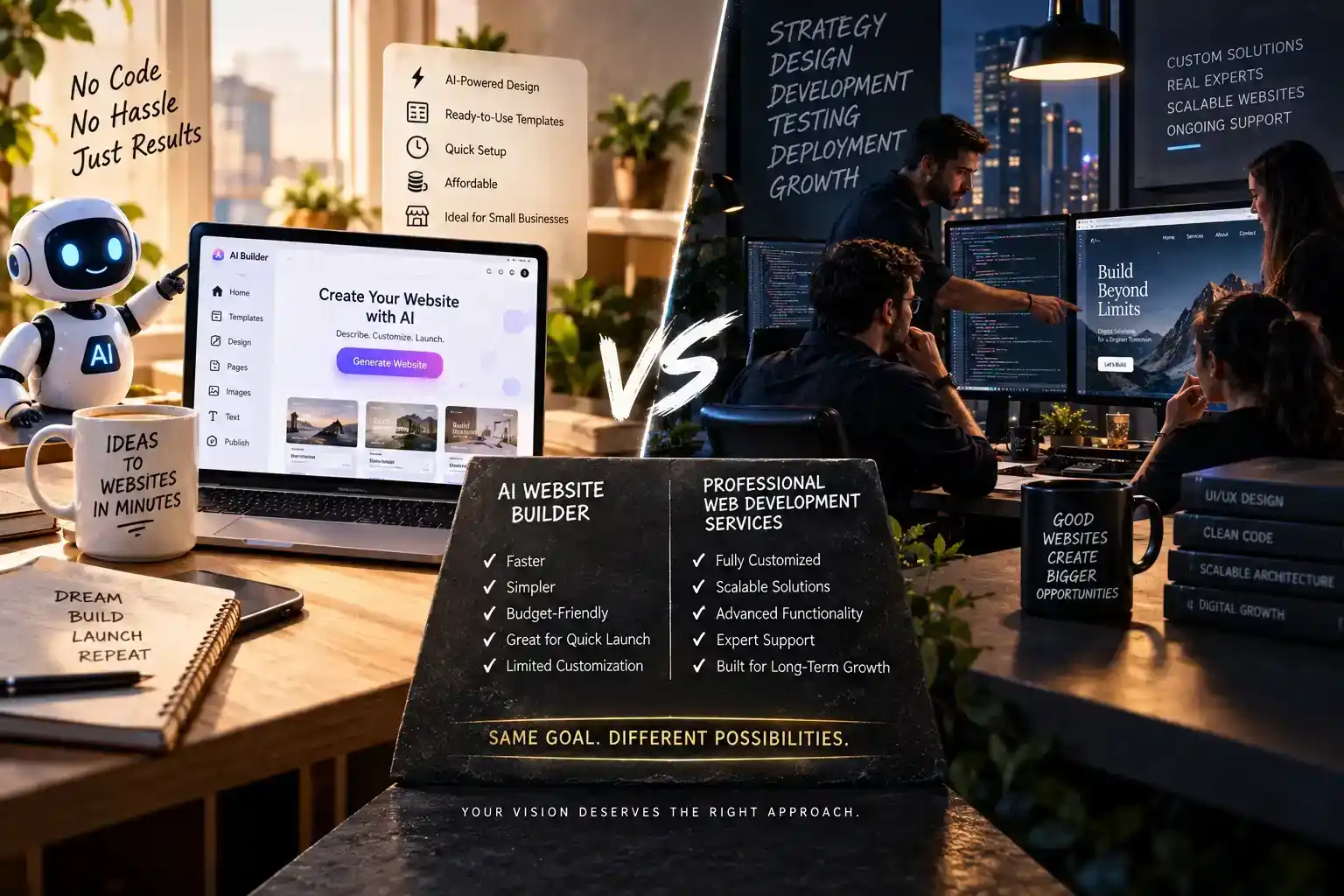
AI Website Builder vs Professional Web Development Services :
The decision should not be based solely on whether AI can technically produce the website.
It should be based on business risk and business value.
| Factor | AI Website Builder | Professional Web Development Services |
| Initial speed | Very high | Moderate to high |
| Upfront technical skill | Low | Higher |
| Basic landing pages | Excellent | Excellent |
| Custom functionality | Limited to moderate | High |
| Complex integrations | Riskier | Stronger |
| Strategic UX | Requires human input | Usually included |
| Technical SEO | Requires validation | Can be built into architecture |
| Scalability | Depends on platform | Can be engineered around requirements |
| Accessibility | Requires testing | Can be systematically tested |
| Security | Platform-dependent | Can be reviewed and controlled |
| Long-term maintenance | Varies | Dedicated support possible |
| Accountability | Often limited | Clearly assigned |
| Best use case | Simple sites and prototypes | Revenue-critical websites |
The critical issue here is that AI and professional development do not need to be separate from each other.
A good agency can take advantage of AI to speed up professional development.
It is better than replacing development with AI, especially where responsive web design is required.
Can AI Build an SEO-Friendly Website ?
Of course, the AI can be used to create an SEO-friendly website, however, the creation of a website by the AI does not necessarily mean that the website is optimized for the search engines. The AI can help with the structuring of the pages, metadata, content generation, internal links, and even code but all this requires evaluation according to the real search intentions and SEO needs. The website should be technically accessible, properly structured, helpful to the visitors, and on relevant topics that the potential customers are looking for.
Technical SEO :
Technical SEO is one aspect of the process where AI can be of some use in generating useful content, but it must be verified by humans as well. AI can create title tags, meta descriptions, headings, XML sitemaps, and schema markup. However, to have a SEO-friendly site, there needs to be adequate crawlability, indexing, canonicalization, URL structure, redirects, internal links, and fast rendering. These aspects can be taken care of using SEO services.
Google’s advice on designing AI-based search experiences does not depart from the basics of SEO. Web pages must be crawlable by search engines, offer relevant content, and meet all other technical requirements. This implies that enterprises can’t think that incorporating AI automatically makes their web page superior to others in Google Search.
Content and Search Intent :
Although an AI can generate content fast, it doesn’t necessarily mean that the content is relevant. The first step towards building a good SEO plan is to figure out what people expect from their search results. For instance, the person looking for “web development agency” might be considering different providers, whereas the individual who typed “how much does website development cost” is still exploring his options.
AI may help find potential topic ideas, structure information, and even generate the first drafts of the copy; however, businesses need to fill it with real expertise, fresh ideas, illustrations, and data that truly represent the company and its services. Web development agency may also assist with building a professional website that will showcase this expertise. It becomes especially critical considering the fact that publishing tons of AI-generated content in order to target specific keywords does not necessarily make a website better. On the contrary, the goal is to build pages that really meet the needs of the searcher and prove why the company is the right choice.
Structured Data and AI Search :
Structure data helps search engines to get more details about some certain information present within the webpage. Artificial Intelligence (AI) may help the developers to create appropriate schema markup, although it still needs to reflect the actual visible content of the page. The inclusion of too much or irrelevant structured data would not make up for poor content, bad website structure or poor UX. Schema markup becomes valuable when the purpose of the inclusion is to provide machines with readable data about content and entities present within the page.
The guide from Semrush demonstrates how schema markup helps search engines to get machine-readable data about the entities of the webpage.
A website design company can assist companies that aim at Google AI Overviews and similar generative search experiences through providing them with a solid base through good page architecture, useful information, credible content, proper headings, internal linking, and technical accessibility. The emphasis must still be put on SEO basics and not on the optimization of AI alone. A solidly designed website is supposed to cater to the needs of both users and search engines, with the latter just being one of the many SEO tools.
What a Human Developer Still Does Better ?
The future for the development of websites will definitely not be “humans disappear, AI builds everything”.
What will realistically happen is that humans will instruct increasingly sophisticated AI systems.
Translating business requirements into architecture :
The client may state:
“We need a website that generates more leads.”
This is not a technical specification.
However, a good team will have to find out:
Whom are the leads?
Which are the most valuable services?
What kind of information should the prospects have prior to reaching the company?
Where are the leads lost now?
What CRM receives the request?
What follows after the completion of the form?
What should be tracked?
Moreover, this method is helpful for aligning the site with the goals of search engine marketing, which includes not only lead generation but also online visibility.
Quality assurance and debugging :
AI-created code can be extremely helpful.
It can also be sneakily incorrect.
The Stack Overflow Survey from 2025 revealed that 46% of developers do not believe in the correctness of AI tools output, while 33% do believe in it. The same study has revealed that 66% of developers were annoyed by AI solutions which were “nearly correct, but not quite”.
This distinction is crucial.
“Nearly correct” code is actually more harmful than plainly incorrect code, since it might pass the test in the beginning.
Professional coding should therefore be tested on actual devices, browsers and user scenarios.
Performance optimisation :
Though an ideal website can be developed from a developer’s laptop, it can actually have poor performance in real life use cases. As such, testing of the performance of a website should be done based on realistic parameters involving a variety of devices, internet speeds, screen resolutions, and others. Some of the factors that could be considered include the size of images, JavaScript, external scripts, fonts, etc.
The use of AI will enable the developers to see what could be the problem regarding the performance of the site and ways in which it can be improved. In spite of that, developers must assess the performance of the website before and after carrying out the improvement measures for an e-commerce website design.
Security and integrations :
The need for security becomes highly significant in cases where a website gathers any personal data or does any payment processing.
AI can generate the code to authenticate.
But that doesn’t necessarily make the whole authentication system secure.
There has to be someone who goes through the permissions, dependencies, data, error states, API exposure, and all possible vulnerabilities.
That’s one of the many reasons why professional developers are essential for organizations with their business linked to a website.
When AI Is the Right Choice ?
AI is often the right choice when the cost of failure is low and the requirements are simple.
A small business might need a basic website containing:
- About
- Services
- Portfolio
- Testimonials
- Contact
Provided there are no integration complexities, and the company has somebody able to review the results, AI would be very effective.
The same goes for temporary campaign pages and early prototypes.
The point is to first determine the function of the website and only then decide on what engineering effort should be invested in, usually with professional web design company consultation.
A site that is meant only to establish credibility does not need to have the same structure as the one that processes hundreds of transactions.
When You Need a Web Development Agency ?
The moment you feel that your website plays a crucial role in your business expansion and not just the existence of your business, then you need to think about the professional service for the development of your website. When your website has a capacity of bringing new clients to your business, makes sales through the website, has special needs, interacts with your CRM or other business system and needs technical SEO, then the professionals will definitely make it easy for you.
Professional web development service for the ecommerce brands or well-established organizations will help to minimize the technical risks as well as create the website which fulfills your marketing and conversion needs. There is no need to depend completely on the AI in such cases.
A Better Model: AI-Assisted Web Development
The strongest approach in 2026 is often neither “AI only” nor “humans only”.
The use of AI and expert knowledge in responsive web design may lead to designing effective and user-friendly websites.
It is an AI-assisted development process for professionals.
Workflow could be structured this way:
Business discovery → architecture → AI-assisted design → AI-assisted development → human verification → testing → SEO validation → deployment → monitoring
The model uses the advantages of AI and at the same time ensures responsibility of humans.
Use AI for acceleration, not accountability
AI is great for cutting down repetition.
For example, a developer may use it for the initial draft of a component without having to code every single detail.
A designer may use it for exploring different directions in the layout.
A content strategist may use it for organising research.
An SEO professional may use it for uncovering content gaps.
However, the choice is up to you in the end.
Such an approach also mirrors how professional developers actually apply AI.
The Stack Overflow survey proves the great extent of AI usage but, at the same time, raises concerns related to accuracy, security and complex tasks.
The main takeaway is not that one shouldn’t use AI.
It is that:
One should use AI for creating leverage and then validate its results.
How to Evaluate an AI-Built Website Before Launch ?
Before posting the website that was developed using an AI tool, it is important to conduct a proper review process and even opt for professional web development services.
| Area | Questions to Ask |
| Business | Does the website communicate a clear commercial proposition? |
| UX | Can users reach important information quickly? |
| Mobile | Does the experience work properly on smaller screens? |
| Performance | Are pages loading efficiently under realistic conditions? |
| SEO | Can search engines crawl, understand and index important pages? |
| Content | Is information original, accurate and useful? |
| Accessibility | Can people with different abilities use the site effectively? |
| Security | Are forms, authentication and integrations properly protected? |
| Conversion | Is there a clear next action for each important page? |
| Analytics | Are meaningful actions being measured? |
| Scalability | Can the architecture handle future requirements? |
| Maintenance | Can another developer understand and maintain the system? |
Accessibility deserves particular attention.
The W3C’s WCAG 2.2 is the current international standard for web accessibility, covering areas such as perceivability, operability, understandability and robustness.
An artificial intelligence website is thus not considered finished just because its buttons function.
It is necessary to check other elements like keyboard navigation, focus state, readable text, interaction targets, and forms.
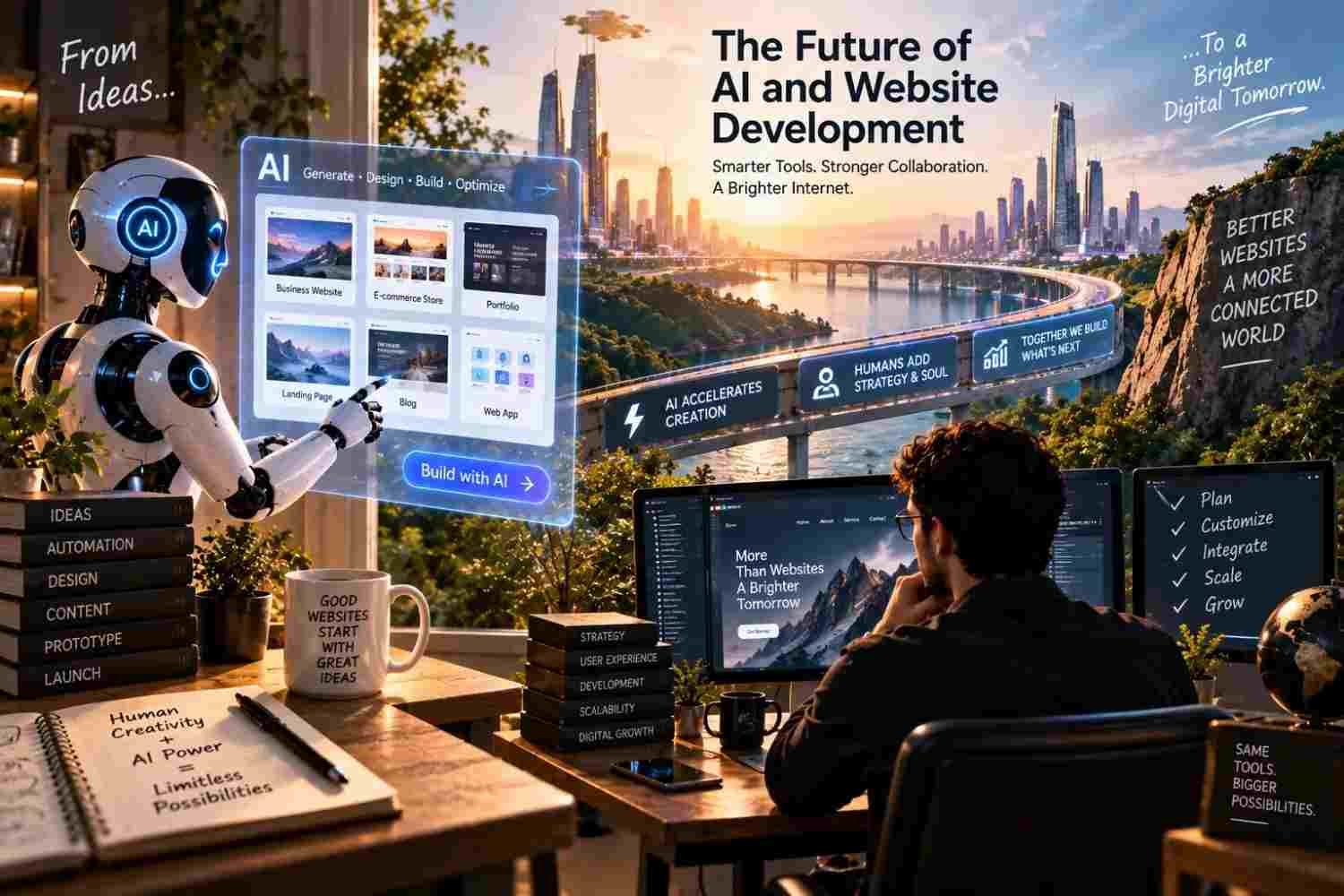
The Future of AI and Website Development :
It appears that the future of AI in website development services will be geared more toward faster, more intelligent, and more collaborative methods rather than totally taking over from human developers. There are many tools that can now be used by businesses to make the process of coding, testing, prototyping, content optimisation, and even generating design ideas in a matter of moments instead of hours or days. This can prove beneficial for any business wishing to develop websites.
However, the rise of AI will make strategic skills more crucial as website construction becomes more convenient. Once everyone can make a decent website, qualities like unique branding, UX design, technical SEO, accessibility, security, website performance, and conversion optimization are bound to play a greater role in determining the success of those websites. It seems that the expertise of professionals is unlikely to decline but only change, with developers and web development agencies leveraging AI in their work for increased productivity while maintaining their strategic thinking, technical know-how, and quality control. A web development agency can help you apply such an approach in your business.
Final Verdict: Can AI Actually Build a Good Website in 2026?
There are no doubts about the ability of AI-powered tools to create an efficient website in 2026, especially when it comes to landing pages, business websites and e-commerce platforms. AI tools can cut down the development time and automate routine tasks, which makes professional-looking websites easier to build by companies with low technical capacity.
Nevertheless, the creation of a good business website is not only about appealing design and automatic coding. Such aspects as performance, technical SEO, accessibility, security, conversions and scalability should be well planned and managed manually. It becomes critical for companies whose future success depends on their website.
Therefore, the best way out of this situation will be the combination of both AI tools and manual work of professionals. The role of AI will consist of acceleration of the research, design, coding and content creation processes, while the professionals will take care of strategy, quality and technical side of things. In 2026, the most profitable way of using AI tools will be in the development sphere.