AI Search, Google Rankings And Measurable Growth Under One Roof:
A client asked us last month whether hiring a Digital Marketing Company in Ahmedabad still made sense now that their team had started using ChatGPT for research instead of typing into Google. It’s a fair question, and one we hear more often each quarter. Similarweb’s 2026 research actually settles part of the argument: the overlap between ChatGPT users and Google users has sat at roughly 95% for eight straight months. People aren’t swapping one for the other. They’re running both, often in the same session, for different reasons.
That distinction matters more than most agencies let on. Maybe you’re comparing quotes right now, or trying to work out whether your current marketing spend still makes sense. Here’s the honest version: Google hasn’t gone anywhere. What’s changed is how people arrive at your business in the first place, because that journey has quietly split into two separate paths. A digital marketing company still building for only one of them is already behind.
Why “Does Google Still Matter With ChatGPT” Is the Wrong Question?
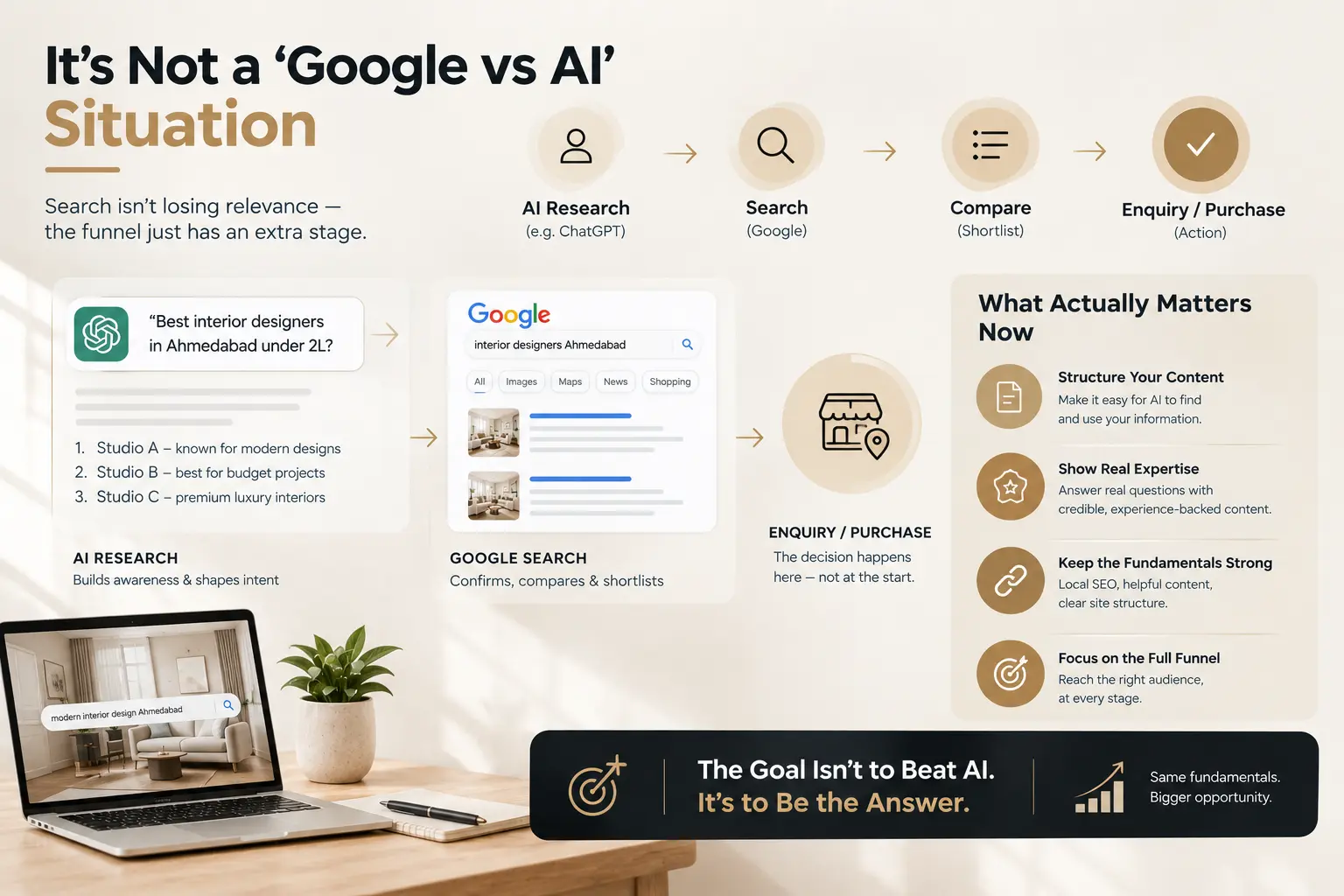
The framing itself is the problem. It assumes a winner-takes-all shift, the kind where one channel replaces another the way streaming replaced DVD rental. Search doesn’t work that way, and the data doesn’t support the panic either. Google still processes the overwhelming majority of transactional and navigational queries in India the “near me,” “best,” “price,” and “buy” searches that drive actual enquiries. What’s changed is the research phase sitting in front of those queries.
Someone comparing options now might ask ChatGPT to summarise a category before they ever open Google. By the time they do search, their intent is sharper and their shortlist is shorter. That’s not Google losing relevance. That’s the funnel getting an extra stage, one most businesses haven’t adjusted their content for yet. We’ve watched clients lose visibility not because their rankings dropped, but because their content was never structured to be the source an AI answer pulls from in the first place. The rankings were held. The upstream influence didn’t.
This is also where a lot of agency advice falls apart. Plenty of consultants are now selling “AI-proofing” as if it’s a separate discipline requiring a new toolkit and a new invoice line. In practice, the fundamentals barely move. What’s often labelled answer engine optimisation is mostly clear structure, genuine expertise, and content that answers a real question, the same things that have always earned trust with search engines. The businesses struggling aren’t the ones ignoring AI they’re the ones who never had strong foundations to begin with, and AI search is simply making that gap visible faster.
What a Modern Digital Marketing Company in Ahmedabad Actually Solves?
Most business owners we speak to aren’t short on marketing activity. They’re running ads, publishing content, maybe posting on social media a few times a week. What’s usually missing is coordination, a reason the SEO work, the paid campaigns, and the website all point in the same direction instead of competing for the same budget conversation.
A capable digital marketing agency doesn’t sell you eleven disconnected services and hope something sticks. It looks at where your actual bottlenecks are. For some businesses, that’s visibility nobody’s finding them, in Google or in AI answers, and it usually starts with properly structured SEO services in Ahmedabad rather than a quick technical patch. For others, it’s conversion traffic arrives but the website doesn’t hold it. And for a growing number, it’s structural: the content exists, but it’s written in a way neither search engines nor AI systems can easily extract and trust.
This is precisely why we get asked, fairly often, what makes a best digital marketing company in India worth choosing over a cheaper freelancer or an in-house hire. The honest answer isn’t speed or price. It’s whether the team understands how search, AI retrieval, and conversion psychology interact and whether they’ll tell you plainly when a channel isn’t worth your money yet, rather than selling you a retainer you don’t need.
Ready to Build Visibility That Works Across Google and AI Search?
Get a practical audit of where your current SEO, AI visibility, and paid efforts stand and what’s actually worth fixing first.
Core Services We Bring Together:
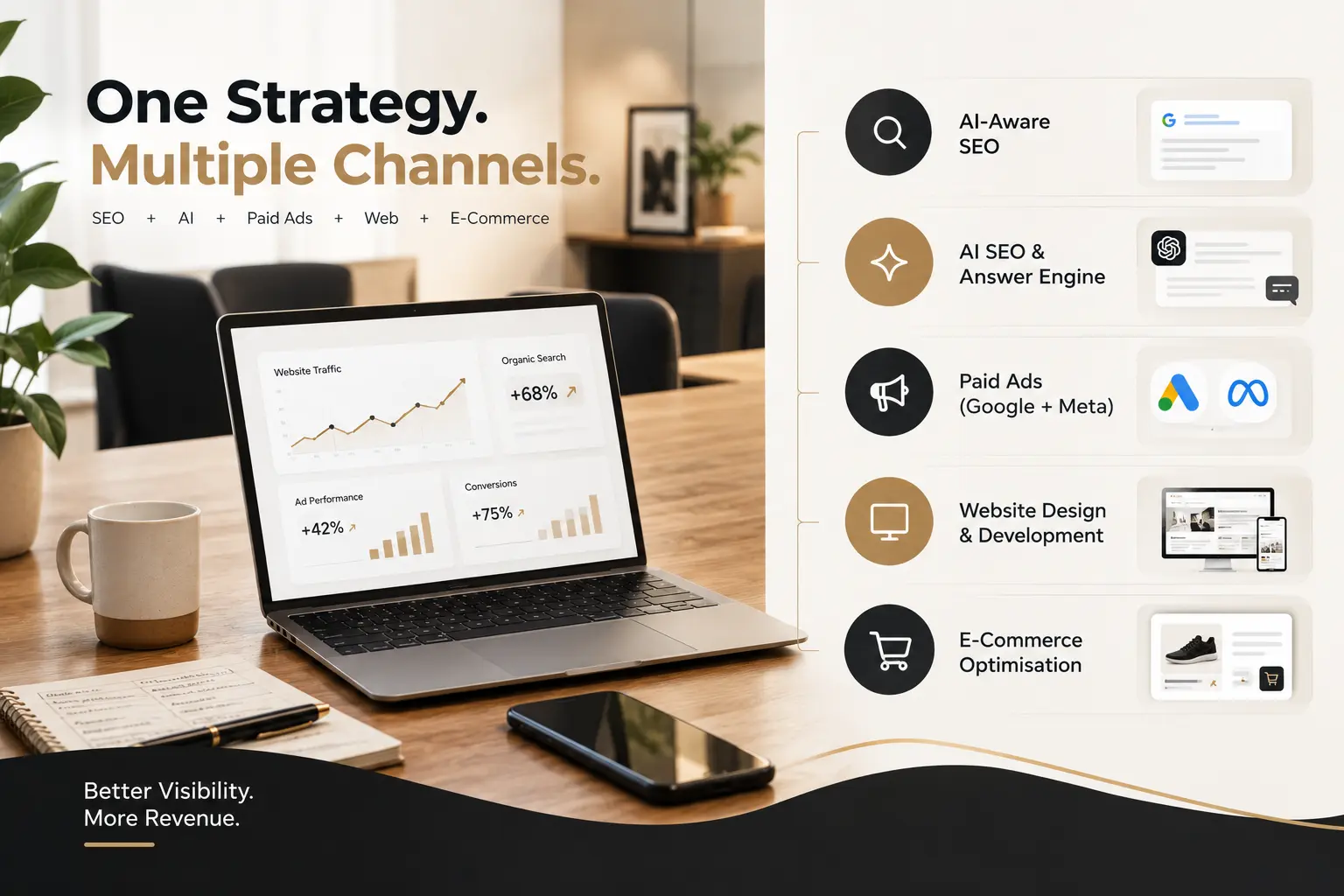
Rather than treating each discipline as a silo, we build them to reinforce one another. A stronger site improves ad performance. Better structured content improves both organic rankings and AI citation odds. Here’s what sits under one roof:
- AI-aware SEO: technical SEO, on-page structure, and content built to be genuinely answerable, not just keyword-matched
- AI SEO and answer engine optimisation: structuring pages so AI systems can extract clear, citation-worthy answers alongside classic ranking factors
- Performance marketing companies discipline applied to Google Ads and Meta: controlled testing, intent segmentation, and spend tied to commercial outcomes rather than impressions
- Website design and development: sites built to load fast, read cleanly for crawlers, and actually convert once someone lands
- Ecommerce store optimisation: product visibility, checkout friction, and marketplace management for stores that need more than just traffic
Google Search vs AI Answer Engines Where Each Still Wins:
Neither system has “won.” They’re suited to different moments in a buyer’s journey, and treating them as interchangeable is where most strategies go wrong. According to Google’s own AI Search guidance, the same fundamental SEO principles that support classic rankings also support inclusion in AI Overviews; there’s no separate rulebook, just a different surface pulling from the same signals.
| Factor | Google Search | AI Answer Engines (ChatGPT, AI Overviews) |
| Best suited for | Transactional, navigational, “near me” queries | Research, comparison, early-stage questions |
| What earns visibility | Rankings, backlinks, technical SEO, relevance | Clear structure, direct answers, citation-worthy content |
| User intent stage | Ready to act or compare shortlisted options | Exploring, learning, narrowing down choices |
| Click-through behaviour | High for commercial queries | Often zero-click; visibility matters more than clicks |
| What businesses should optimise for | Keyword relevance, page experience, authority | Extractable answers, schema, factual clarity |
The practical takeaway is that businesses ranking well on Google but invisible in AI answers are capturing bottom-of-funnel demand while losing the earlier research stage entirely. Fixing that isn’t a separate project. It’s usually a content restructuring exercise layered onto SEO work you’re likely already paying for.
Business Impact: What Changes When Search and AI Overlap?
For most Ahmedabad businesses we work with, enquiry quality shifts before enquiry volume does. Someone who has already compared options through an AI tool tends to show up further along in their thinking. They ask sharper questions and need less convincing, because part of the persuading happened somewhere else before they ever reached your site.
- The first 90 days are mostly unglamorous work: fixing crawlability, adding schema, trimming page speed, and rebuilding content so it reads cleanly for a person and an algorithm alike.
- Give it six to twelve months and the compounding starts to show. Rankings settle. AI tools begin citing the site more often, and paid campaigns convert better too, simply because the landing page finally matches what the click promised.
None of this changes the discipline underneath it. A slow, confusing site that people don’t quite trust won’t suddenly start performing in AI answers just because the algorithm shifted. Fixing that sits squarely in website design company territory, not some new AI-specific service. If anything, businesses with tidy foundations keep pulling further ahead of the ones without, and that gap isn’t closing any time soon.
Our Process: How We Build Visibility Across Both?
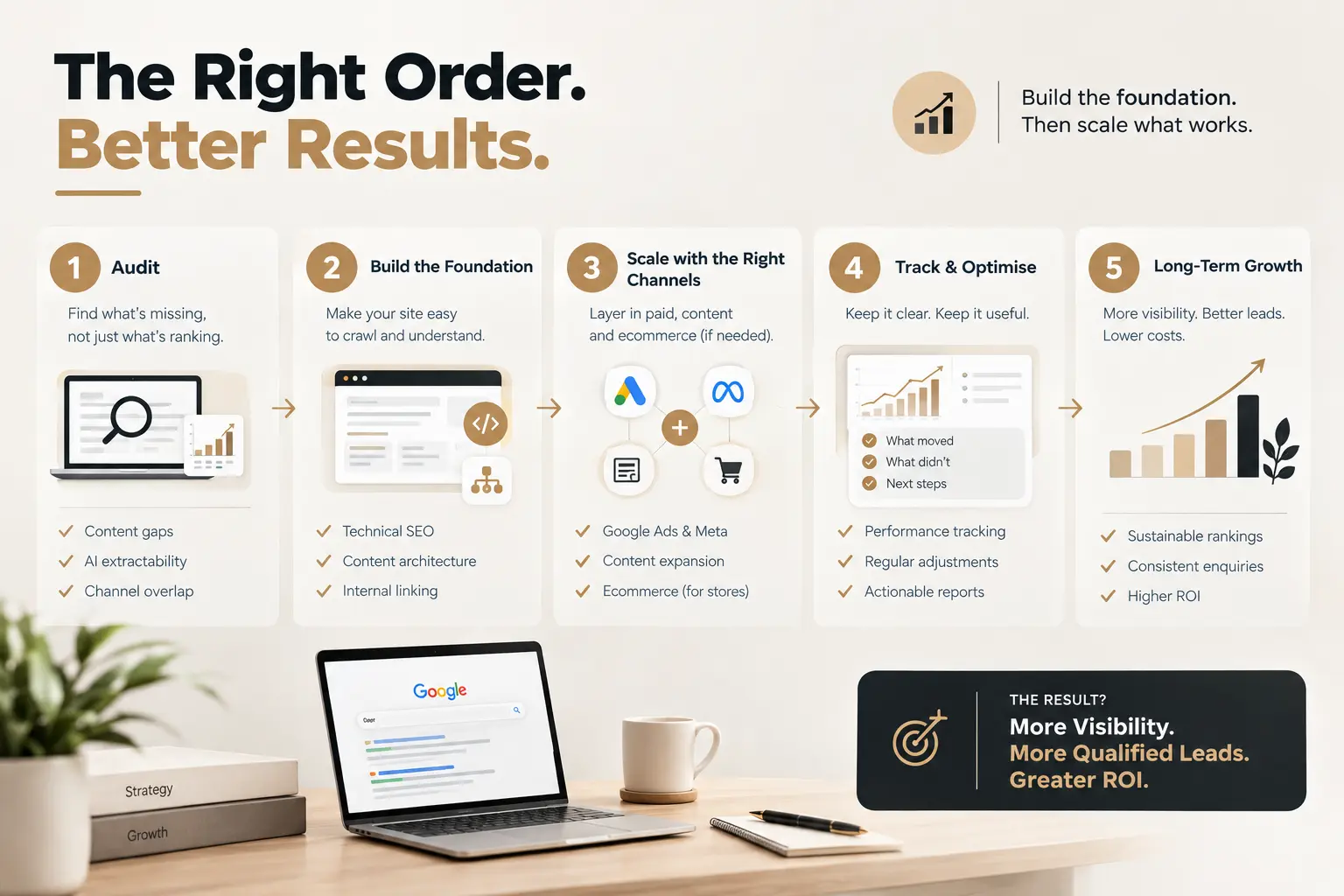
We start with an audit that looks past rankings alone. That means checking whether your existing content actually answers the questions your buyers are asking, whether an AI system could reasonably extract a clean answer from your pages, and where your paid and organic efforts are working against each other rather than together.
From there, the work moves into structure before scale. Technical SEO and content architecture come first, because neither Google nor an AI answer engine trusts a site that’s difficult to crawl or contradicts itself across pages. Only once that foundation is solid do we layer in paid campaigns, content expansion, or for stores specifically ecommerce website design work, depending on where your specific bottleneck sits. Reporting stays plain throughout what moved, what didn’t, and what we’re doing differently next month, rather than a dashboard full of vanity metrics nobody asked for.
This sequencing is deliberate. We’ve seen too many businesses spend on ads before their site could convert the traffic, or chase AI visibility before their basic on-page SEO was sound. Getting the order right saves months of wasted budget.
Why Choose Digifinity as Your Digital Marketing Agency?
We’re based in Ahmedabad, and that’s not incidental. Working closely with businesses across Gujarat has taught us how local buying behaviour actually differs from generic playbooks written for other markets: what builds trust here, what timeline expectations are realistic, and which channels genuinely move the needle for a CA firm versus an ecommerce brand versus a real estate developer.
Four years in, we’ve run over a thousand campaigns and kept a client retention rate above 95%, not because we promise the moon, but because we say no to work that won’t serve a client’s stage of growth. If your priority right now is fixing a broken website rather than running ads, we’ll say so, even if it means a smaller invoice this quarter. That kind of honesty is rarer than it should be in this industry, and it’s the reason most of our new clients arrive through referral rather than a cold pitch.
We’re also not guessing our way through the AI search shift. AI search behaviour in India is evolving quickly, and we track it as part of how we plan client strategy, not as an afterthought bolted onto a standard SEO retainer.