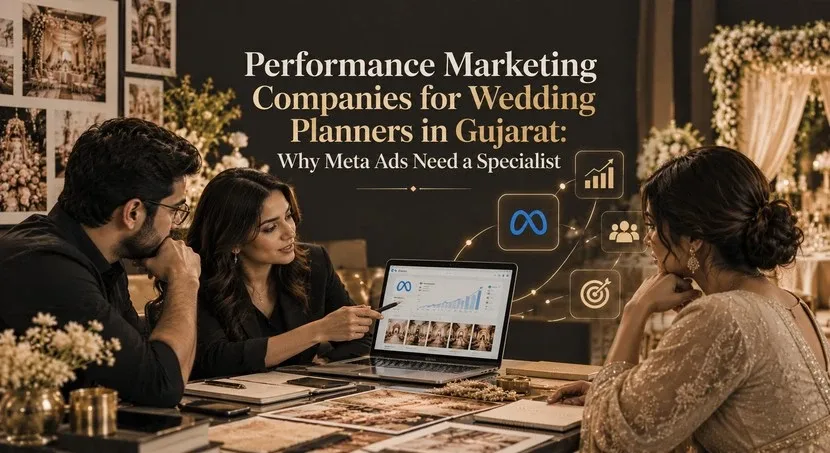
For a business built entirely on visuals, timing and trust, generic ad management rarely converts.
Most wedding planners in Gujarat don’t start looking for performance marketing companies because business is slow. They start looking because the phone has gone quiet between seasons, referrals have plateaued, and a few thousand rupees spent “boosting” a post on Instagram produced likes but not a single inquiry. Yet marketers across industries now rank lead quality over reach as their single most important KPI and wedding planning is one of the clearest examples of why that shift matters. A planner doesn’t need a thousand followers admiring a mandap setup. They need twenty engaged couples filling out an enquiry form before the next booking season opens.
That gap between “the post did well” and “the calendar is full” is where most wedding planners’ marketing quietly fails them.
Why Wedding Planners Struggle With Generic Marketing?
The wedding industry doesn’t behave like most other local businesses, and that’s exactly where standard ad management falls short. Bookings cluster around a narrow season October through February across most of Gujarat which means a planner has perhaps four or five months to fill a calendar that has to sustain them the rest of the year. Miss that window with slow or poorly targeted campaigns, and there’s no second chance until next season.
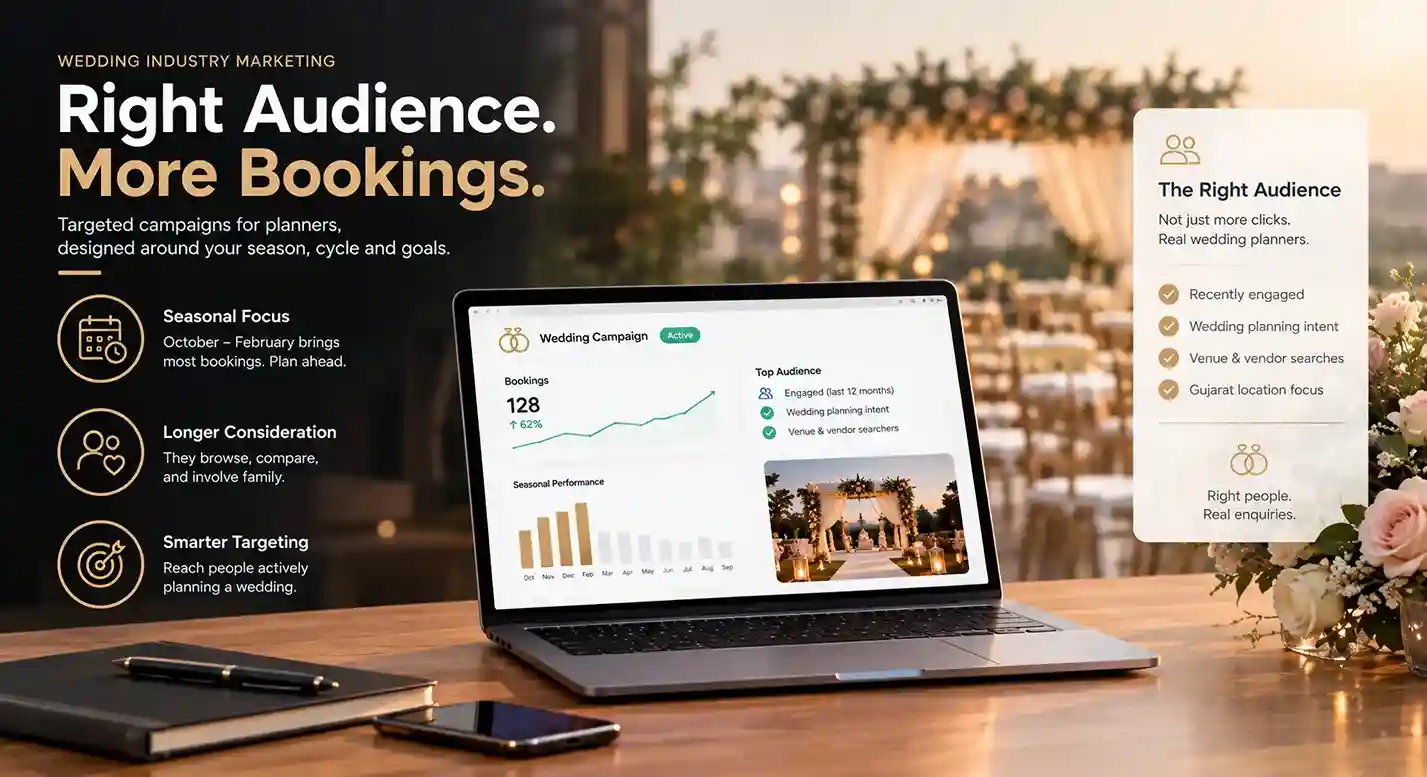
The sales cycle is also unusually long and high-stakes. A couple doesn’t enquire and book within a day; they browse, compare three or four planners, revisit a portfolio multiple times, and often involve family in the decision. An agency running generic “boost post” campaigns has no way to stay in front of that couple through weeks of consideration, let alone prove which inquiry actually turned into a signed contract.
Then there’s the budget problem specific to this industry: planners are frequently sold broad, location-only targeting that reaches anyone in Ahmedabad rather than people actively planning a wedding, engaged in the last twelve months, or searching for venues and vendors. The spend disappears into an audience that was never going to enquire in the first place.
Where Couples Actually Discover Wedding Planners Today?
A decade ago, most planners were found through a relative’s recommendation or a wedding they’d attended themselves. That’s changed. Couples now start their search online, scroll through portfolios on their phones, and shortlist planners weeks before anyone in the family is consulted. India’s digital ad spend growth has climbed steadily every year for exactly this reason buying decisions across nearly every category, weddings included, now begin on a screen rather than a phone call.
What makes this tricky for planners is that the decision rarely happens in one sitting. Research on the messy middle of buying shows people spend increasingly longer comparing options before committing bouncing between a planner’s Instagram, their website, and a friend’s opinion, sometimes over several weeks. A planner who only shows up once, in a single boosted post, is invisible for the rest of that journey. A planner who shows up consistently, across that entire window, is the one who gets the inquiry.
Tired of a calendar that depends entirely on last season’s word of mouth?
Digifinity delivers result-driven SEO strategies for growth-focused businesses across Ahmedabad and India built for 2026.
What Performance Marketing Actually Looks Like for a Wedding Business?
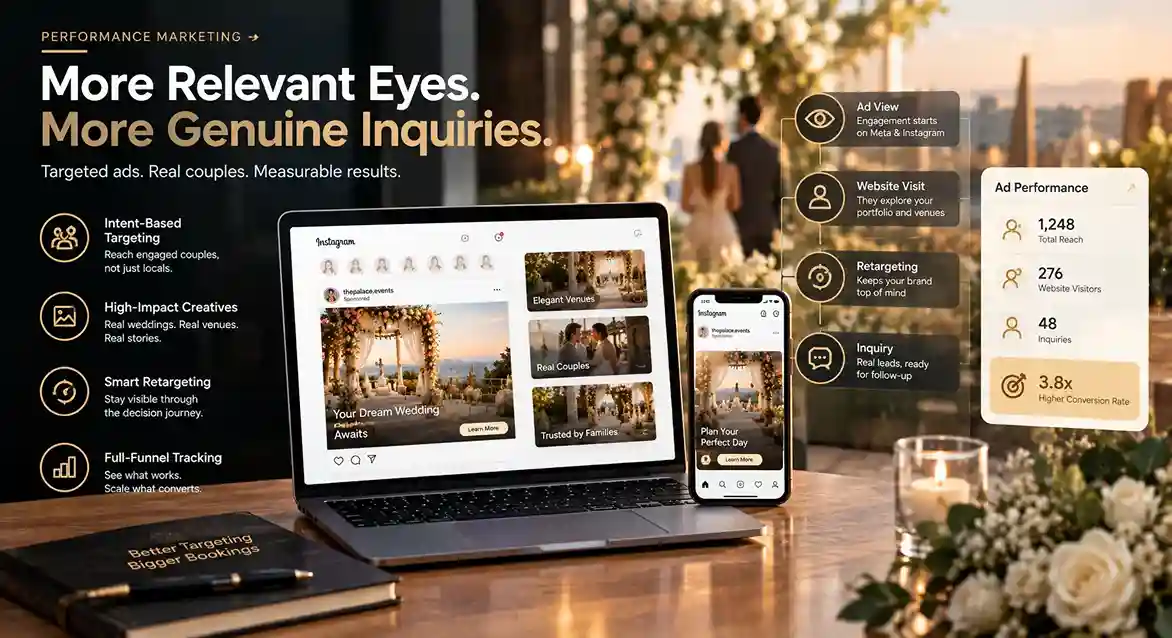
A performance marketing partner built for this industry treats every rupee of ad spend as traceable to one outcome: a genuine enquiry that can be followed up and closed. That means Meta and Instagram campaigns built around portfolio-quality creative real weddings, real venues, real testimonials shown specifically to people signalling wedding-related intent, not a broad location audience.
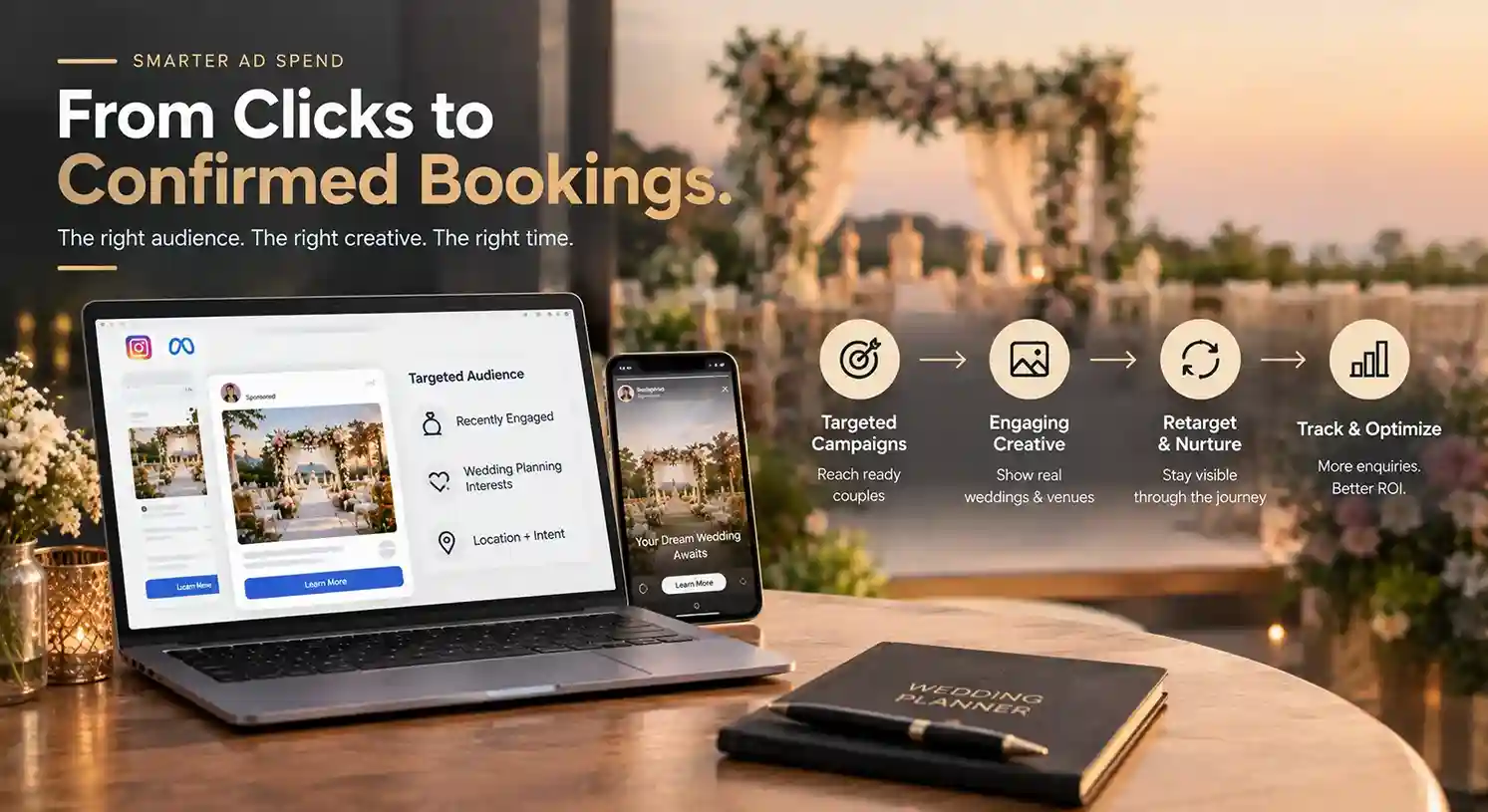
It also means the campaign doesn’t stop at a single ad. Couples who visit the website or engage with a reel but don’t enquire get retargeted through the consideration window, so the planner stays visible right up to the point of decision, a tactic that consistently improves ad performance for exactly this kind of long, back-and-forth buying decision. And every inquiry is tracked back to the exact ad, audience and creative that produced it, so the budget can shift toward what’s actually converting rather than what simply looks good in a monthly report.
Core Services a Wedding-Focused Marketing Partner Should Offer:
Meta and Instagram Ads management: audience targeting built around engagement signals and wedding-season timing, not broad demographics
Creative direction for portfolio content: turning existing wedding photography and reels into ad-ready assets that convert, not just impress
Lead capture and CRM/WhatsApp integration: so an enquiry from an ad reaches the planner’s phone immediately, not buried in a Meta dashboard
Retargeting funnels: keeping the brand visible to couples still comparing planners weeks after their first visit
Seasonal budget scaling: front-loading spend ahead of peak booking months rather than spreading it evenly across a year with no bookings in half of it
A capable partner should also be able to speak to the best seo company side of the business a planner ranking on Google for “wedding planner Ahmedabad” gets free, compounding enquiries that paid ads alone never will.
How Much Should a Wedding Planner Budget for Meta Ads?
Budgets in this category vary more than planners expect, mostly because two very different things get lumped under “ad spend”: the media budget paid to Meta, and the cost of producing creative worth showing. A planner working with an existing library of strong wedding photography and reels can often start lean, since the ad spend only needs to cover distribution and testing. A planner with thin or dated content usually needs to budget for a short creative shoot first, because no amount of targeting rescues an ad nobody wants to stop scrolling for.
As for the media budget itself, the first month or so is best treated as a testing phase, not a growth phase. Keep the daily spend modest, split it across two or three audience segments, try a handful of different creatives, and watch closely to see which combination is actually bringing in enquiries at a cost that makes sense. Scaling comes after that, once a pattern emerges and even then, spending should rise and fall with the booking calendar, not sit flat all year. A planner putting the same budget behind June as November is quietly burning money in the slow months while under-funding the exact weeks when demand peaks.
It’s also worth budgeting separately for retargeting. Because the decision window is long, a portion of spend needs to be reserved specifically for staying in front of couples who’ve already shown interest, rather than pouring everything into cold audience reach. Planners who skip this often see a burst of initial interest that quietly fades, simply because nothing brought those couples back for a second look.
The Business Impact of Getting This Right:
For a wedding planner, the real value of performance marketing isn’t a prettier ad it’s a fuller calendar with less dependency on referrals. Referral-only growth is fragile: it depends on how many weddings a planner ran last season and how happy those clients were to recommend them. Paid, tracked campaigns remove that ceiling, generating a steady stream of new enquiries independent of how the last season went.
It also changes how a planner spends money. Once enquiries are tied back to specific campaigns, it becomes obvious which ad creative, which audience, and which time of year produce bookings worth pursuing and which spend was never going to convert. That clarity alone often pays for the campaign.
None of this works, though, if the planner’s website design company partner has left them with a slow, unclear enquiry form. Ad spend sending couples to a clunky website is money lost before the funnel even starts.
How the Campaign Runs, Season to Season?
Portfolio and audience audit: reviewing existing content, past clients, and where enquiries have historically come from
Creative build: turning real wedding photography and video into ad formats suited to Instagram and Facebook feeds and reels
Campaign launch with tracked enquiry forms: every lead source recorded from day one, not added later
Early optimisation window: the first two to three weeks used to identify which audiences and creatives are actually producing enquiries
Retargeting activation: re-engaging website visitors and profile viewers through the couple’s decision-making weeks
Season-end reporting: a clear view of cost per enquiry and cost per booking, used to plan the following season’s budget
Common Mistakes Wedding Planners Make With Meta Ads:
Plenty of planners do spend money on ads and still don’t see much for it. Usually it comes down to a handful of habits that are easy to fall into. Tapping “Boost Post” straight from the Instagram app is the big one. It feels like running an ad, but the algorithm behind it is chasing likes and comments, not enquiries. So the post ends up in front of people who enjoy wedding content, not people actually booking a planner.
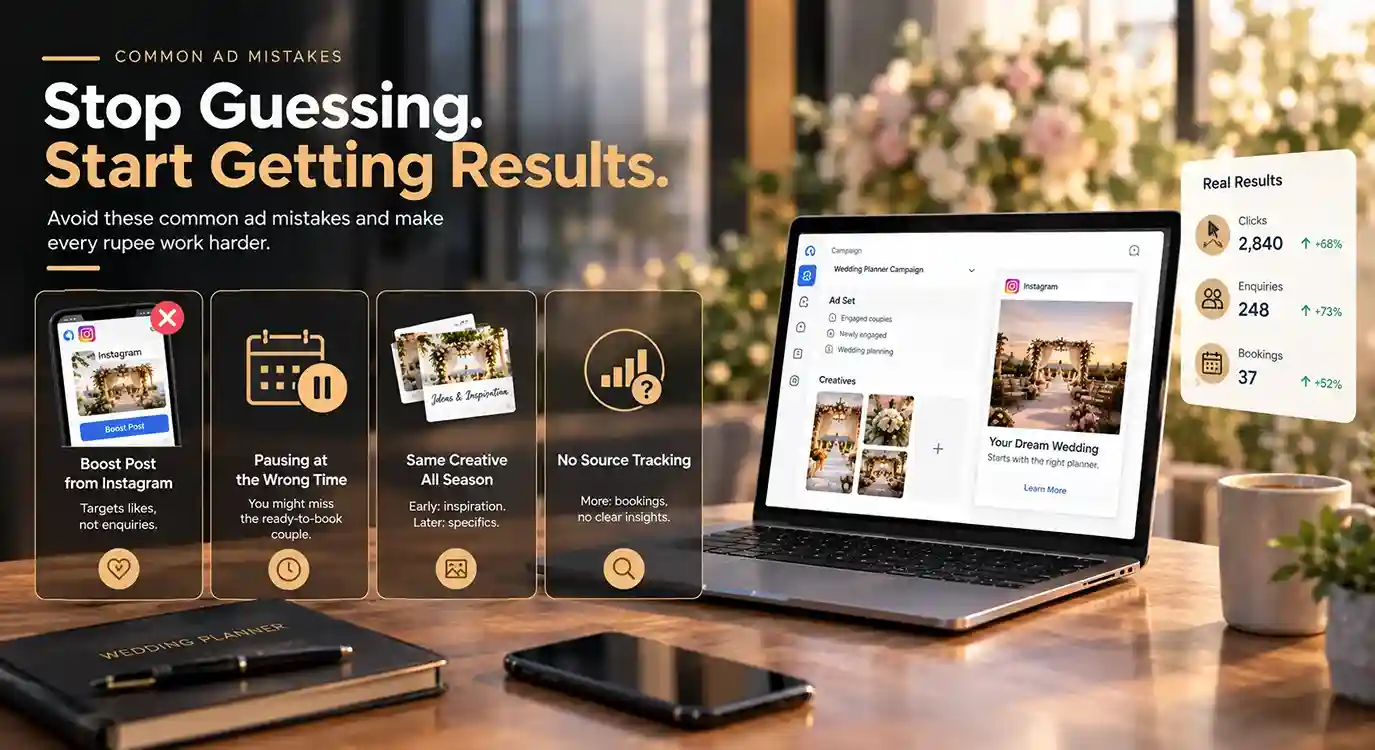
Timing trips people up too. The moment enquiries slow down, a lot of planners pause the campaign right when a couple who saw the ad three weeks ago is finally sitting down to shortlist. Wedding decisions don’t move in a straight line, and pulling back during that lull means missing the exact moment the ad was building toward. Sticking with one set of creative all season doesn’t help either. A couple browsing in September wants inspiration and ideas; by December, with a shortlist narrowing, they’re after specifics: what’s included, what dates are open, what it actually costs. An ad built for the browsing stage rarely lands once someone’s comparing final options.
Finally, many planners never separate their enquiries by source, so a season can end with plenty of bookings and no real understanding of which ad, audience or offer actually drove them which means every season restarts from guesswork rather than building on what worked.
Referral-Only Marketing vs a Managed Meta Ads Campaign:
Why Digifinity Works With Wedding Planners Across Gujarat?
Wedding planning isn’t a generic local business, and it shouldn’t be marketed like one. What matters here is a team that understands the seasonality, the visual-first buying decision, and the long consideration window unique to this industry and builds campaigns around that, rather than reusing a template built for restaurants or gyms.
That’s reflected in how Digifinity runs ppc services in india for clients in this space: campaigns planned around booking seasons, not calendar months, with reporting that shows enquiries and bookings, not just reach.