

Built for developers, brokers and property brands who need enquiries, not just impressions:
Most property brands in Ahmedabad already run some form of paid advertising, yet the leads rarely match the spend. That gap is usually the first sign a business needs a proper digital marketing company in Ahmedabad, not another freelancer running ads on the side. Research from real estate marketing analysts shows that nearly all property buyers now begin their search online, ahead of any other channel Searchlab research on, Real Estate Marketing Statistics 2026, which means a weak digital presence isn’t a minor gap anymore it’s the difference between being found or being scrolled past before a buyer even reaches your listing.
The frustrating part is that most developers and brokers aren’t short on effort. Boards go up, listings get shared, a Facebook page gets updated every few weeks. What’s missing is structure: a system that turns that visibility into tracked, qualified enquiries rather than likes and comments that never convert into a site visit.
Why Real Estate Marketing in Ahmedabad Rarely Performs the Way It Should?
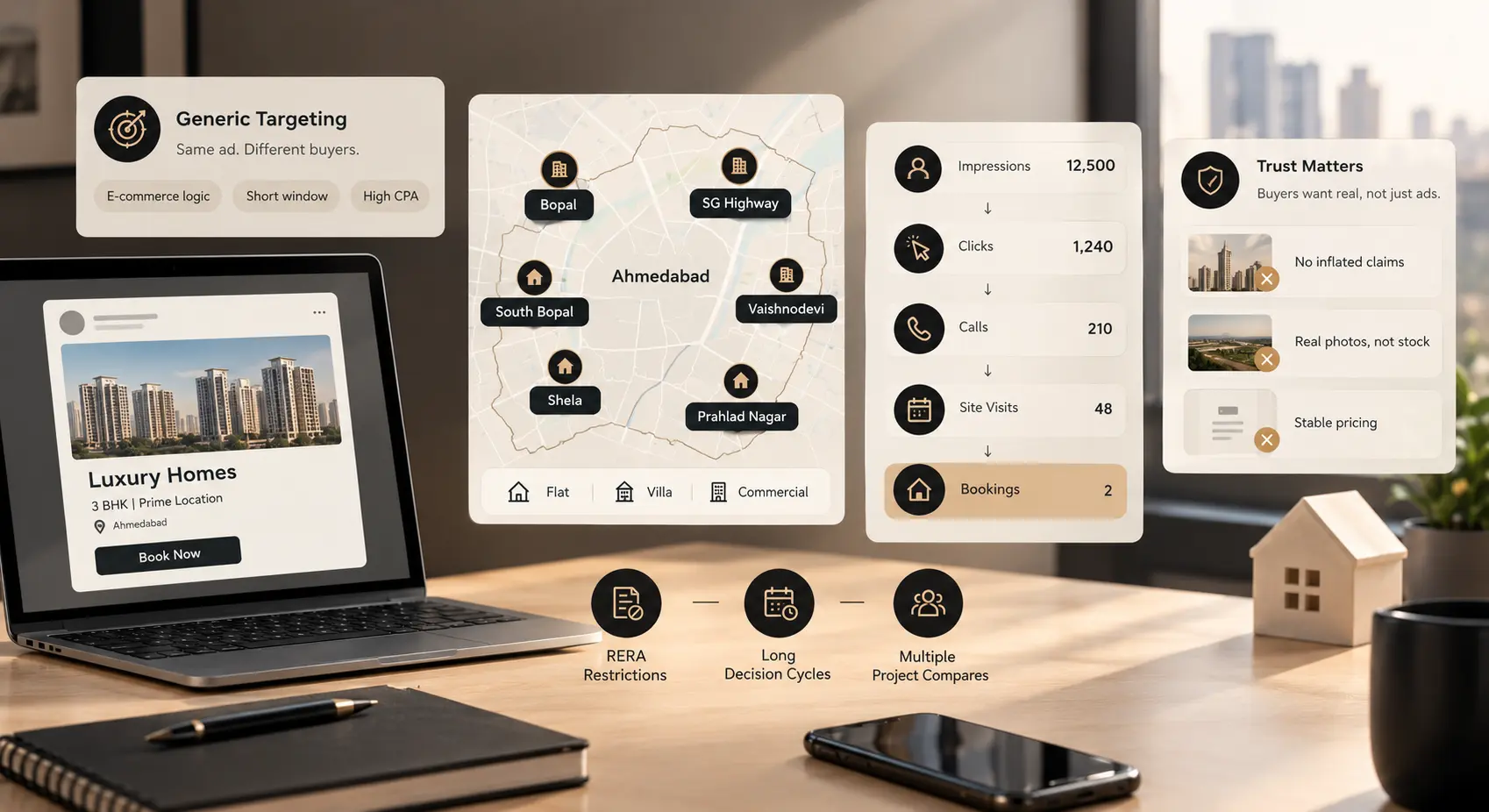
Property is a considered purchase. Buyers don’t convert on the first click, and that single fact breaks most generic marketing setups before they even begin. Campaigns built for e-commerce or services get pointed at real estate with the same targeting logic, the same short attribution windows, and the same “boost the post” mindset and then the agency wonders why cost per lead keeps climbing month after month.
Ahmedabad makes this harder still. SG Highway, Bopal, South Bopal, Shela intent shifts sharply between them, and a campaign that treats the whole city as one audience ends up showing a 3BHK listing to someone who was actually after commercial space across town. Put a buyer hunting a ready-to-move flat near Prahlad Nagar next to one comparing under-construction options in Vaishnodevi and you’ll find they have almost nothing in common. Most campaigns lump them together anyway, mainly because a single “Ahmedabad real estate” audience is quicker to set up than doing it properly.
Then there’s RERA’s messaging restrictions on top, decision cycles that stretch for weeks, and buyers who’ll typically look at four or five projects before ringing anyone. Put all that together and it’s not hard to see why developers keep describing their spend as “active but not productive” accounts fill up with impressions and clicks, phones fill up with calls that go nowhere, and at the end of the month nobody can actually point to which rupee produced a booking. That gap between activity and outcome is where most marketing budgets in this city quietly disappear. It’s a gap that’s only getting harder to ignore, given how much of the buying journey has already gone digital ANAROCK’s consumer sentiment research pegs online activity at roughly 60% of the entire property-buying process now, up sharply from pre-pandemic levels.
There’s also a trust problem specific to property. Buyers are wary of inflated claims, stock photography that doesn’t match the actual site, and pricing that shifts once they call. Campaigns that lean on generic promises rather than verifiable detail tend to generate enquiries that go cold the moment a prospect realises the ad oversold the project.
See Everything We Build, Not Just the Ads
Ads are one part of a larger system. Have a look at how we handle websites, SEO, and technical delivery alongside campaigns, so you know exactly what’s included before we talk numbers.
What a Digital Marketing Company in Ahmedabad Should Actually Be Doing for You?
The fix isn’t more spend, it’s better structure. A capable agency treats real estate marketing as a funnel with distinct stages, not a single campaign that’s expected to do everything at once. Awareness, consideration and inquiry each need different creativity, different budgets, and different success measures, and conflating them is where most of the wasted spend originates.
This is where working with established performance marketing companies pays off over ad-hoc boosting. A structured performance approach separates top-of-funnel reach from bottom-of-funnel lead capture, so the budget isn’t spread evenly across an audience that was never going to convert this quarter. For a developer launching a new tower or a broker managing several live projects at once, that separation alone tends to cut wasted spend within the first few weeks of a properly built account.
It also means accepting that not every enquiry needs the same follow-up speed or the same sales approach. Someone who has watched three site videos and visited your landing page twice is a different lead from someone who filled a form after seeing one static ad. Treating both the same way, which happens constantly when marketing and sales aren’t aligned, is one of the quieter reasons good campaigns still underperform at the booking stage.
What Our Meta Ads and Digital Marketing Work Covers?
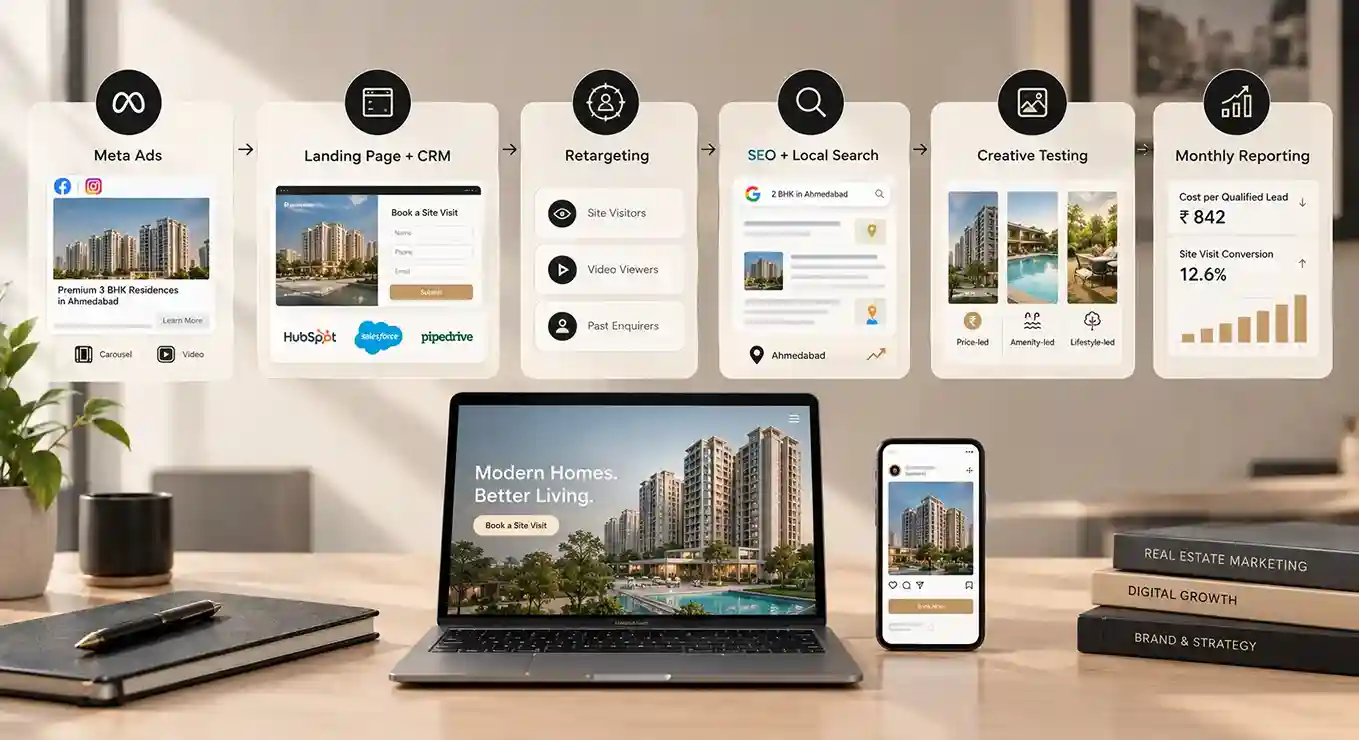
Real estate campaigns on Meta perform differently from almost every other category, mainly because the buying decision takes weeks or months rather than minutes. A campaign built around single-session conversions, the kind that works well for retail or food delivery, simply doesn’t reflect how someone actually decides to buy property. It also helps that the channel itself has earned its place NAR’s technology survey found social media now produces agents’ highest volume of quality leads, ahead of both CRM and MLS referrals, and Meta remains the anchor platform behind that shift. Our work for property clients typically includes:
- Meta Ads set-up across Facebook and Instagram, with carousel and video formats built specifically for site visits, floor plan walkthroughs, and project launches, rather than repurposed brochure images
- Lead form and landing page integration synced to a CRM, so a WhatsApp enquiry or a form fill reaches your sales team within minutes, not the next morning
- Retargeting sequences for warm audiences site visitors, video viewers, and past enquirers since most buyers need several touchpoints before booking a visit
- On-page and local search work supported by our SEO services in Ahmedabad team, so organic and paid visibility reinforce each other rather than compete for the same budget
- Creative testing across ad angles price-led, amenity-led, and lifestyle-led to identify what a given locality actually responds to, since a message that performs in Bopal often falls flat in Maninagar
- Monthly reporting built around cost per qualified lead and site-visit conversion, not vanity reach numbers that look impressive but tell you nothing about pipeline health
None of this works in isolation. Ad creative without proper landing pages loses leads at the last step, and lead capture without CRM integration means enquiries sit unattended while a prospect moves on to the next developer’s ad. The value comes from these pieces working as one connected system rather than a collection of separately managed tasks.
What Changes for Your Business Once This Is in Place?
The immediate shift most clients notice is qualification. A structured funnel filters out casual browsers earlier, so the leads reaching your sales team are further along and easier to convert into site visits. That has a direct effect on how your team spends its time: fewer calls that go nowhere, fewer “just browsing” conversations, and more time spent with people who’ve already seen the pricing, layout, and location before they pick up the phone.
Sales teams usually put it simply: it’s the difference between chasing a lead and just following up with one. Once the funnel is doing its job, the person on the other end of the call already has some interest going in. You’re not starting from zero, explaining what the project even is. That alone tends to pull the timeline from first contact to site visit tighter.
There’s also a slower, less obvious payoff. Ahmedabad buyers don’t decide overnight, and they usually end up seeing the same few developer names again and again before they finally pick up the phone. That repetition is what advertising earns you, provided it’s actually consistent rather than switched on for a launch week and off after. Give it a few months and the retargeting pools start doing real work accounts that stay live tend to see enquiry costs settle lower, simply because Meta’s delivery system needs a steady run of data to get efficient. Stop and restart every quarter, and it never quite gets there.
There’s a knock-on effect for sales cycle length too. Buyers who arrive already familiar with your brand, having seen retargeting ads across several weeks, tend to move from enquiry to site visit faster than cold leads. That shortened cycle matters directly to cash flow on active projects, particularly during launch phases when developers are watching booking velocity closely.
How We Build and Run a Campaign?
There’s a rough sequence we follow on every account, though “sequence” makes it sound stiffer than it is. It’s really just the order in which skipping a step tends to bite you later.
We start by going through whatever’s already there: old ad accounts, past performance numbers, the current landing page if one exists. This step alone often turns something up: a pixel that stopped firing months ago, a form nobody’s actually checked. Half the time it explains on its own why earlier attempts didn’t work.
From there it’s about figuring out who the campaign should reach, and honestly, at what point in their search. We don’t treat Ahmedabad as one audience; a message that does well in Bopal can fall flat in Maninagar, so this gets mapped locality by locality rather than city-wide.
Creative comes next: Reels, carousels, video walkthroughs, all built for that specific project rather than pulled off a shelf. Buyers can usually tell when an ad was clearly shot for someone else’s launch, and it costs you more than most agencies want to admit.
Once a campaign actually goes live, the first fortnight gets watched closely daily, not weekly. Catching a delivery or targeting problem in week one is cheap. Catching it in week four, after the budget’s already spent, is not.
And then it’s ongoing optimisation shifting spend toward whatever’s converting once cost per lead settles down, pausing whatever isn’t. No particular sentimentality about it.
What doesn’t happen is a one-time build that runs untouched for months. Inventory shifts, prices move, a project hits possession and the messaging needs to keep up. If an account’s still running pre-booking creative six months after handover started, that’s usually the clearest sign nobody’s been minding it.
The Platforms and Tools Behind the Work:
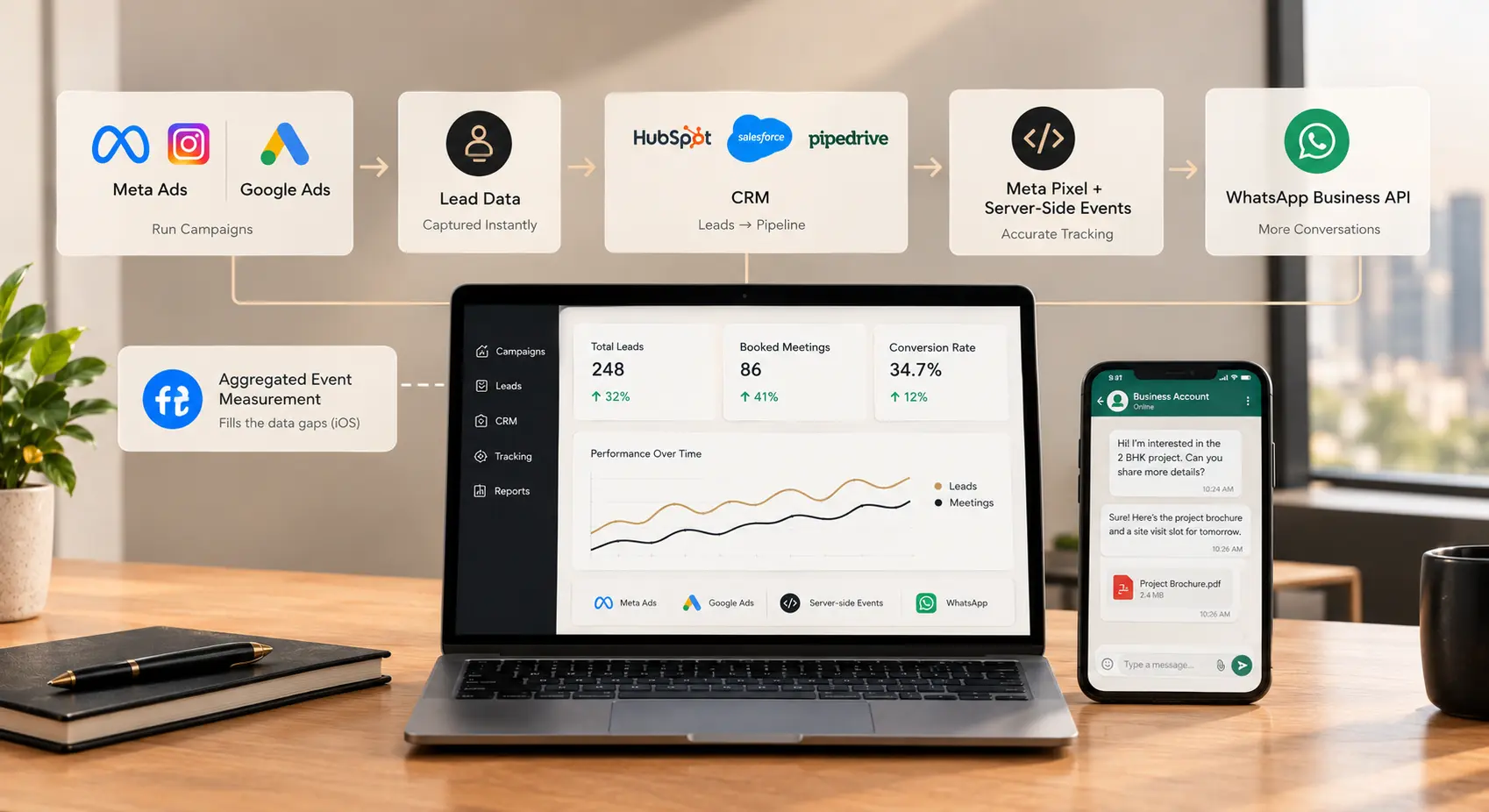
Campaigns run through Meta Ads Manager and Google Ads, and lead data gets routed straight into CRM tools nobody’s chasing a spreadsheet to find out who filled a form yesterday. Tracking runs on Meta Pixel plus server-side conversion events, and this part matters more than most agencies let on. iOS privacy changes have quietly limited what ad platforms can see on their own, so without solid server-side tracking, a campaign can look like it’s underperforming in the dashboard when it’s actually doing fine or the other way round. This is exactly the gap Meta’s own Aggregated Event Measurement framework was built to close, using statistical modelling to reconstruct results the platform can no longer see directly.
WhatsApp Business API tends to get folded into this stack as well, mostly because a large share of buyers here would rather message than fill out a form. Route that into the same CRM as your form and call leads, and the sales team stops juggling three separate inboxes trying to piece together who said what.
What This Costs, and What Decides It?
Budgets for real estate campaigns in Ahmedabad vary by project size, launch stage, and how many localities you’re targeting at once. Rather than quoting a flat number that won’t hold up across different projects, here’s how engagement typically scales:
| Engagement level | Best suited for | What’s included |
| Starter | Single project, one locality | Meta Ads set-up, lead form integration, monthly reporting |
| Growth | Multi-project developers, active launches | Meta Ads + Google Ads, retargeting, landing page optimisation |
| Scale | Portfolio-level marketing across localities | Full-funnel campaigns, CRM integration, dedicated account strategy |
The right tier usually becomes obvious once we’ve reviewed your current spend and enquiry data, which is also why the discovery step happens before any pricing conversation, not after. Committing to a budget tier before understanding what’s already working, or not working, tends to produce mismatched expectations on both sides.
It’s also worth being direct about timelines. Meta Ads accounts for considered purchases like property typically need four to six weeks of consistent spend before cost per lead stabilises. Developers expecting week-one results are usually disappointed, not because the strategy is wrong, but because the algorithm and the audience both need time to respond.
Why Ahmedabad Real Estate Brands Choose Digifinity?
Developers rarely need just advertising. A launch usually needs a landing page that loads properly on mobile, a CRM that doesn’t drop leads, and creative that’s ready before the campaign date, not scrambled together after. Having marketing and technical delivery under one roof, including ecommerce website design capability for property portals that need booking or payment flows, means fewer handovers between teams and fewer excuses when something underperforms.
We’ve worked with brands across Gujarat who came to us after fragmented agency setups left marketing and website work disconnected, often with one vendor managing ads and another managing the site, neither accountable when leads dropped through the gap between them. Bringing both together, with one team accountable for results, is usually what shortens the gap between “campaign is live” and “site visits are booked.”
That single point of accountability also changes how problems get solved. When a landing page is loading slowly and hurting conversion rate, we can fix it the same week rather than filing a request with a separate web vendor and waiting for their availability. For developers running time-sensitive launches, that speed of response is often worth more than any single tactic in the campaign itself.