
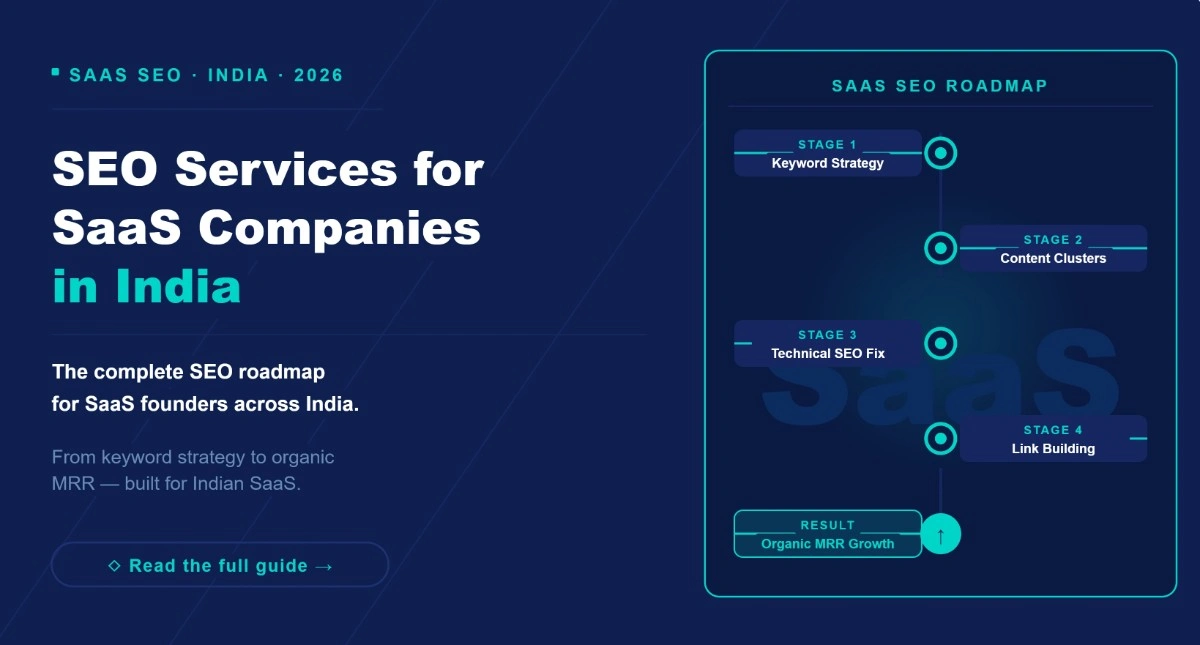
The Complete SEO Roadmap for SaaS Founders Across India:
Most SaaS founders in India discover the problem the hard way: paid ads stop the moment the budget stops, and the pipeline dries up with it. That’s the gap proper SEO services are built to close not by chasing rankings for their own sake, but by making sure the right buyer finds your product at the exact moment they’re comparing options. It’s the kind of structured, long-term thinking you’d expect from a best digital marketing agency in Ahmedabad.
That principle isn’t unique to us. Google’s own SEO documentation makes the same point: search stays valuable precisely because buyer intent already exists before a visitor lands on your site. For a SaaS company, that intent is the entire game. The buyer has already decided they have a problem, so the content just needs to be there when they go looking.
The frustrating part is that most agencies selling SEO to software companies still run the same playbook they’d use for a local bakery blog posts, backlinks, and a monthly report nobody reads. SaaS buying cycles don’t work that way. A founder evaluating a project management tool doesn’t convert on the first visit; they read a comparison page, check a pricing breakdown, skim a few reviews, and come back three times before booking a demo. SEO built around that reality looks completely different from generic content marketing, and it’s the difference between traffic that inflates a vanity metric and traffic that actually books calls.
Why SaaS Companies in India Struggle to Generate Organic Leads?
Four patterns show up again and again when we audit SaaS websites, and each one quietly caps how much organic pipeline a company can generate:
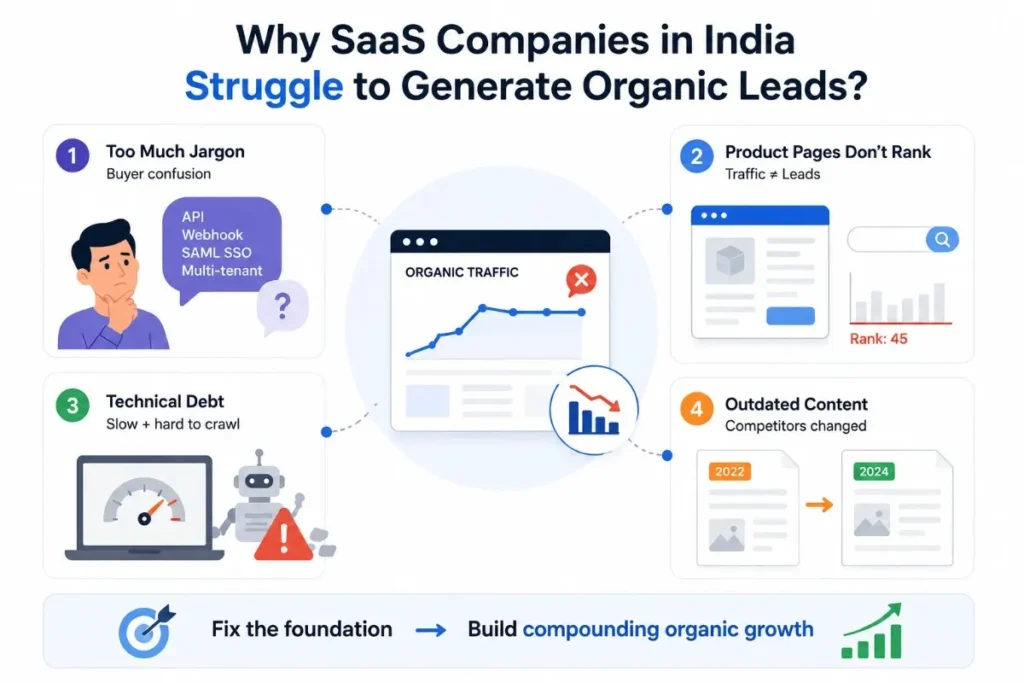
- Content speaks the founder’s language, not the buyer’s. Technical jargon dominates pages that should be answering a much simpler question: “will this fix my specific problem?”
- Product pages are built for conversion but never for search. They rank nowhere, so all the SEO weight ends up sitting on a blog that doesn’t actually sell anything.
- Technical debt quietly throttles the crawl budget. Slow page loads, orphaned pages, and duplicate content that Google can’t be bothered to untangle and this is usually the one that costs the most.
- Content gets built once and never revisited. A comparison page written when you had three competitors is still live two years later when you have twelve, still naming pricing that changed eighteen months ago.
None of this is unique to India, but the competitive dynamics here add pressure most Western playbooks don’t account for. Indian SaaS companies are frequently competing against both domestic startups and established global players for the same English-language keywords, while also needing content that resonates with a buyer base spread across time zones, industries, and company sizes. Generic SEO advice rarely survives contact with that complexity.
Google notices when a page stops reflecting reality, and so do prospects who land on it mid-decision. Treating SEO content as a living asset rather than a one-off deliverable is one of the simplest shifts that separates SaaS companies with compounding organic growth from those stuck rewriting the same three blog posts every year.
Not Sure Where to Start SEO, Paid Ads, or Both?
Digifinity helps SaaS companies across India find the right channel mix, organic, paid, or both. No guesswork, just a plan built around your funnel and your budget.
Explore Our ServiceWhat Proper SEO Services Actually Solve for SaaS Businesses?
Search intent for SaaS products isn’t flat; it shifts as a buyer moves from “I have a problem” to “I’m choosing between three vendors.” Early-stage content needs to answer the problem in plain terms. Mid-funnel content needs comparison depth: pricing, integrations, limitations, and honest trade-offs. Late-stage content demo pages, case studies, pricing pages need to be technically fast and structurally clean, because this is where a slow load time or a confusing layout costs you the deal you spent months earning through content.
That’s also where technical foundations matter more than most SaaS founders expect. Core Web Vitals, structured data, internal linking architecture, and mobile rendering aren’t glamorous, but they decide whether the content above ever gets the chance to rank in the first place. We’ve audited SaaS sites with genuinely strong content sitting on page four of the search results purely because of unresolved crawl errors and bloated JavaScript bundles.
Trust signals matter more for software than most categories:
A buyer choosing between two project management tools isn’t just comparing features, they’re deciding whether to hand over their operational data to a company they’ve never worked with. That makes trust signals disproportionately important for SaaS SEO compared to most other industries. Case studies with real, named outcomes. Security and compliance pages that actually answer procurement questions instead of gesturing at “enterprise-grade.” Author bylines on technical content that show genuine product knowledge rather than a freelancer paraphrasing a knowledge base.
This isn’t just our opinion; it lines up with what Moz’s guide to SEO fundamentals has long emphasised about authority and trust as ranking factors. None of this is glamorous work, but it’s frequently the difference between a comparison page that ranks and one that ranks and converts.
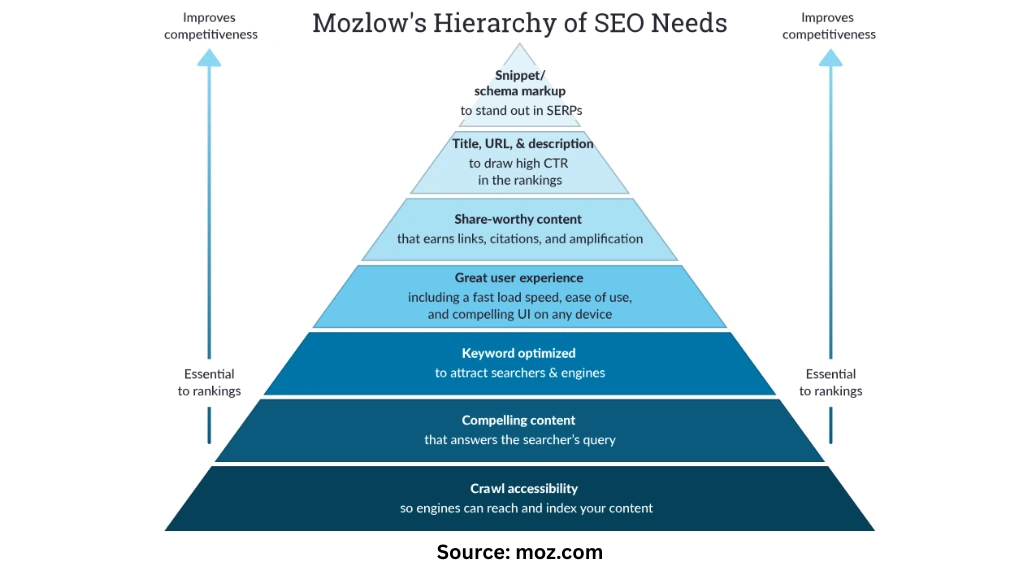
Core SEO Services We Deliver for SaaS Companies:
Our approach as a SaaS SEO agency is built around two things running in parallel: fixing the technical layer that search engines actually read, and building content that matches how SaaS buyers genuinely evaluate software. This is the same structured methodology behind our core SEO services for Ahmedabad-based and pan-India clients, just adapted for the longer, more research-heavy SaaS buying cycle.
In practice, that covers:
- Technical SEO audits and fixes: crawl budget optimization, Core Web Vitals improvement, structured data implementation, and indexation cleanup for large or fast-changing SaaS sites.
- Keyword and competitor mapping: identifying buyer-intent keywords your competitors are ranking for but you aren’t, mapped against your actual product positioning rather than generic industry terms.
- Content built for the SaaS funnel: problem-aware blog content, comparison and alternative pages, integration pages, and use-case pages that target long-tail, high-conversion searches.
- On-page and conversion architecture: restructuring product and pricing pages so they rank and convert, instead of treating SEO and CRO as separate workstreams.
- Link building through relevance, not volume: earning links from genuinely relevant publications and directories rather than chasing a number that means nothing to Google in 2026.
Some SaaS companies we work with also run a marketplace or self-serve storefront alongside their core product. Where that’s the case, our work as an ecommerce service provider extends into optimising those transactional flows too, since checkout friction and product-page SEO follow a different logic to a standard SaaS landing page.
Business Impact: What Changes When SEO Is Done Right?
The honest answer is that nothing changes in week one. SEO for SaaS is a compounding channel; the pages you publish in month two are still generating demo requests in month fourteen, which is exactly what makes it different from paid acquisition. What we typically see shift, in order, is: organic sessions to bottom-funnel pages rise first, branded search volume follows as awareness builds, and demo-to-signup conversion rate improves because the traffic arriving is already qualified by the content that brought them there.
The commercial upside is a lower blended customer acquisition cost over time, since organic traffic doesn’t carry a per-click price tag. It also builds a form of durability that paid channels can’t. A well-ranked comparison page doesn’t stop working the day a campaign budget gets cut mid-quarter. Backlinko’s research on SEO performance backs this up consistently: organic listings continue to outperform paid placements on trust and click-through rate across most B2B categories, software included.
How Our SaaS SEO Process Works?
Every engagement starts with an audit, not a proposal template. We need to see what’s actually broken before recommending fixes, which usually takes one to two weeks depending on site size and how much historical data is available.
- Discovery and technical audit: full crawl, Core Web Vitals check, and a competitive gap analysis against three to five direct competitors.
- Keyword and funnel mapping: matching search terms to where a buyer actually sits in their decision process, not just search volume.
- Technical fixes and content roadmap: prioritising issues by impact, starting with anything blocking indexation.
- Content production and on-page optimisation: written, reviewed, and published on a fixed monthly cadence.
- Reporting and iteration: monthly check-ins that show ranking movement, traffic quality, and what’s being adjusted next.
For SaaS companies whose product itself is a web application, this process often overlaps with our broader web app development services, particularly where page speed or rendering issues trace back to how the application itself was built rather than the marketing site alone.
One thing we’re upfront about: this process doesn’t run on a fixed six-month timeline that magically ends when a contract does. SaaS SEO is closer to product development than a marketing campaign; it needs ongoing iteration as your product evolves, as competitors reposition, and as search behaviour itself shifts. Companies that treat month six as a finish line usually see rankings plateau and slowly erode, because competitors who kept iterating simply overtake pages that stopped improving.
Investment and Pricing Approach:
We don’t run fixed SEO packages, and if an agency quotes you a flat number before seeing your site, that’s usually a sign they haven’t actually looked at it. Cost depends on how much technical debt exists, how competitive your keyword space is, and how fast you want to move on content production. What we can tell you upfront is that SEO is priced as a monthly retainer, not a one-off project, because the work audits, content, link building, iteration doesn’t stop after month one if you want the results to compound rather than plateau.
Common SEO Mistakes SaaS Companies in India Make:
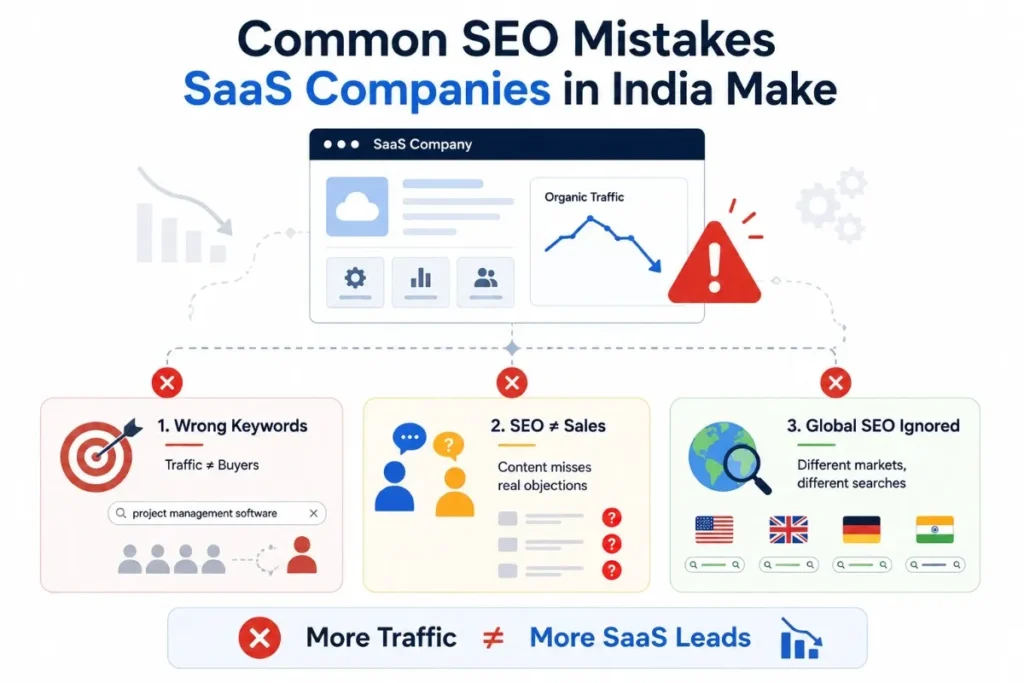
A handful of mistakes show up often enough to be worth naming directly. Chasing high-volume keywords that have nothing to do with your actual buyer “project management software” might get search volume, but if your product is built specifically for construction firms, that traffic won’t convert no matter how well the page ranks. Publishing content in isolation from the sales team, so the pages never answer the objections prospects actually raise on calls.
Treating international SEO as an afterthought matters more than founders expect too, given how many Indian SaaS companies sell into US and European markets from day one, where search behaviour and competitive density look completely different. NASSCOM’s ongoing coverage of India’s SaaS sector is worth following if you want a sense of just how fast that export-first pattern is accelerating across the industry.
Why SaaS Companies Choose Digifinity?
| What Matters | Typical Agencies | Digifinity |
| Content strategy | Generic blog calendar, same for every industry | Content mapped to SaaS buyer stages and search intent |
| Technical SEO | Surface-level checklist audit | Deep crawl, Core Web Vitals, and indexation fixes |
| Reporting | Vanity metrics: rankings, traffic volume | Pipeline-relevant metrics: qualified traffic, conversion rate |
| Team structure | Account manager relays work from a separate execution team | Direct access to the people doing the work |
| Flexibility | Locked into rigid monthly packages | Scope adjusts as your product and market shift |
A SaaS company’s positioning rarely stays static for long, and search strategy needs to move with it. That’s part of why founders working with a branding agency on repositioning often bring us in around the same time messaging and search intent are more connected than most teams assume, and our work as branding agency in Ahmedabad frequently runs in parallel with SEO for exactly that reason.